
Read the first chapter
The whole of chapter one, free. About 7 min. Turn the pages with the arrows, your keyboard, or a swipe.
Chapter 1
Daily Anxiety Check-In Routine
Build a Check-In You’ll Actually Use
A daily check-in gives you a small pause before anxiety starts running the show. You record what’s happening in your body, what set it off, and how strong it feels. That information helps you spot patterns while they’re still manageable.
You don’t need a perfect mood journal or a long morning ritual. You need a repeatable snapshot. Five minutes at roughly the same time each day is enough to notice changes, compare one day with another, and catch early warning signs - tight shoulders, racing thoughts, stomach tension, or the urge to avoid something.
Use the check-in at a consistent point, such as after breakfast, during a lunch break, or before bed. Choose one time you can usually protect. Keep a pen and this workbook in the same place, or use a notes app with the same headings. The goal isn’t to judge your answers. It’s to collect useful information.
Quick setup
Gather these materials before you begin:
• This workbook or a notes app - A pen or pencil - A timer set for five minutes - A 0-10 intensity scale, where 0 means no anxiety and 10 means the strongest anxiety you can imagine
For seven days, complete the check-in at the same general time. If you miss a day, don’t fill in a guessed answer later. Write “missed” and restart at the next planned time. Honest information is more useful than a perfect-looking page.
The Five-Minute Daily Anxiety Check-In
This routine has five parts: intensity, body signals, trigger, thoughts or urge, and one next step. Keep each answer short. A few words are enough.
Your Turn
1. Set the timer for five minutes. Write the date, time, and where you are. Record whether you’re starting the day, taking a midday pause, or winding down at night.
2. Rate your current anxiety. Circle one number from 0 to 10. Use the same scale each day. If your anxiety changed during the day, rate what you feel right now and note the highest level you remember.
3. Name the strongest body signal. Choose one or two specific sensations. Examples include jaw tension, fast heartbeat, shaky hands, chest pressure, nausea, sweating, or restless energy. Don’t write only “bad” or “stressed.” Use a body-based description.
4. Identify the trigger or setting. Ask, “What happened just before this feeling, or what situation am I anticipating?” Include ordinary details. A trigger might be an unanswered message, a crowded store, a deadline, poor sleep, caffeine, conflict, or an upcoming appointment.
5. Record the main thought or urge. Write the sentence your mind is producing, such as “I’ll mess this up,” “Something is wrong,” or “I need to leave.” If there’s no clear thought, record the urge: checking, avoiding, seeking reassurance, rushing, or staying busy.
6. Choose one small next step. Pick an action that takes five minutes or less and supports staying present. Examples: drink water, lower your shoulders, read the next email without replying, stand outside, or write the first task on a list. This is not a promise to make anxiety disappear. It’s a way to respond before the feeling escalates.
7. Record the result after five minutes. Rate your anxiety again from 0 to 10. Note whether it went down, stayed the same, or went up. The check-in is complete when all seven parts have an answer, including “not sure” where needed.
> Worked example > Date/time: Tuesday, 8:10 a.m.; starting the day > Current anxiety: 6/10 > Highest level today: 6/10 > Body signal: Tight chest and clenched jaw > Trigger or setting: I have a 10:00 a.m. meeting where I need to give an update > Main thought or urge: “I’ll freeze when people ask questions.” Urge to rehearse every sentence > Next step: Write three talking points, then stop rehearsing > After five minutes: 5/10; stayed seated and wrote the points
The example is specific without being dramatic. It separates the event from the body response, thought, and urge. That separation matters because patterns become easier to see when each part has its own line.
After seven days, review your entries for repeated signals. Look for the same time of day, type of situation, physical sensation, or action that appears before your number rises. You’re not trying to find one permanent cause. Anxiety can have several inputs, and the pattern may be as simple as “less sleep plus skipped lunch makes afternoon worry louder.”
What good looks like
• You complete the check-in in five minutes or less. - You use a 0-10 rating every time. - You name at least one concrete body signal. - You record a situation, event, or anticipated event - not a broad label like “life.” - You separate the anxious thought or urge from what actually happened. - You choose one next step that takes five minutes or less. - You record the second rating, even when anxiety didn’t improve. - After seven days, you can identify at least one repeated pattern.
Adjust the Routine Without Losing the Pattern
Consistency doesn’t mean using the exact same format in every situation. A full check-in works well when you have five minutes. A shorter version helps when anxiety spikes at work, in traffic, or in a public place. Keep the same core information so your entries remain comparable.
Full check-in - five minutes
Use this once daily at your planned time. Complete all seven steps. This version gives you the clearest record of triggers, intensity, body signals, thoughts, urges, and results.
Fast check-in - sixty seconds
Use this when you notice anxiety rising but can’t stop for five minutes. Write only:
• Anxiety now: _/10 - Body signal: ______ - Trigger or setting: ______ - Urge: ______ - Next five-minute action: ________
Complete the full version later only if you can remember the details accurately. If not, keep the one-minute entry. A brief honest record beats a detailed imaginary one.
Event-linked check-in - before and after a known trigger
Use this for situations such as calls, meetings, errands, medical appointments, or difficult conversations. Complete the first four lines before the event. Add the thought or urge, next step, and second rating afterward. Compare your prediction with what happened.
For example, before a presentation you might predict 8/10 anxiety and an urge to avoid eye contact. Afterward, you might record 5/10 and “answered two questions.” This comparison shows whether anxiety’s forecast matched the event. Sometimes it does. Sometimes it makes a very confident guess and gets it wrong.
Pattern review - once each week
Set a separate ten-minute timer after seven days. Count how often each pattern appeared. You might find:
• Morning anxiety: 3 days - Tight chest: 4 days - Work-related trigger: 5 days - Reassurance-seeking urge: 2 days - Anxiety reduced after a five-minute action: 4 days
Use counts rather than impressions. “It feels like every day” becomes clearer when you can check whether it happened two times or six. If your anxiety is repeatedly 8-10, interferes with sleep or daily tasks, or feels unsafe, consider contacting a qualified mental health professional. The check-in can help you explain what’s been happening, but it isn’t a substitute for personal care.
Review Your Progress and Set the Next Check-In
Use these questions after your first seven days. Answer with evidence from your entries, not what you think you “should” have noticed. Write at least one specific example for each question.
Reflect: Which trigger or setting appeared most often, and how many times did it appear?
__________________________________________________
__________________________________________________
Reflect: Which body signal showed up earliest before your anxiety rating rose?
__________________________________________________
__________________________________________________
Reflect: What was the average starting anxiety rating across the days you completed?
__________________________________________________
__________________________________________________
Reflect: Which five-minute action helped, stayed neutral, or made no difference? Include the before-and-after ratings.
__________________________________________________
__________________________________________________
Reflect: What time and place will you use for your next seven daily check-ins?
__________________________________________________
__________________________________________________
Criteria for success
• You completed at least five of the seven planned check-ins, or clearly marked missed days. - You can name one repeated trigger or setting with a count. - You can name one early body signal. - You compared at least one before-and-after rating. - You selected a regular time and location for the next week. - You can describe your pattern without blaming yourself for having anxiety.
A check-in is useful even when the number stays the same. The win is noticing sooner, naming more clearly, and choosing your next move with a little more information. Five quiet minutes can turn a vague sense of “something’s wrong” into a pattern you can work with.
End of chapter one. 9 more chapters in the full book.
Swipe or use the arrows to turn the page


What's inside: 10 chapters
- 1. Daily Anxiety Check-In Routine
- 2. Identifying Thoughts Behind Feelings
- 3. Challenging Thoughts with Evidence
- 4. Reframing with Balanced Self-Talk
- 5. Breathing for Calmer Body Signals
- 6. Worry Time and Scheduled Containment
- 7. Exposure Steps for Fear Reduction
- 8. Summarize the core insights in focused prose and reinforce what matters most.
- 9. Relapse-Proofing with Future Check-Ins
- 10. Core idea and practical overview
About this book
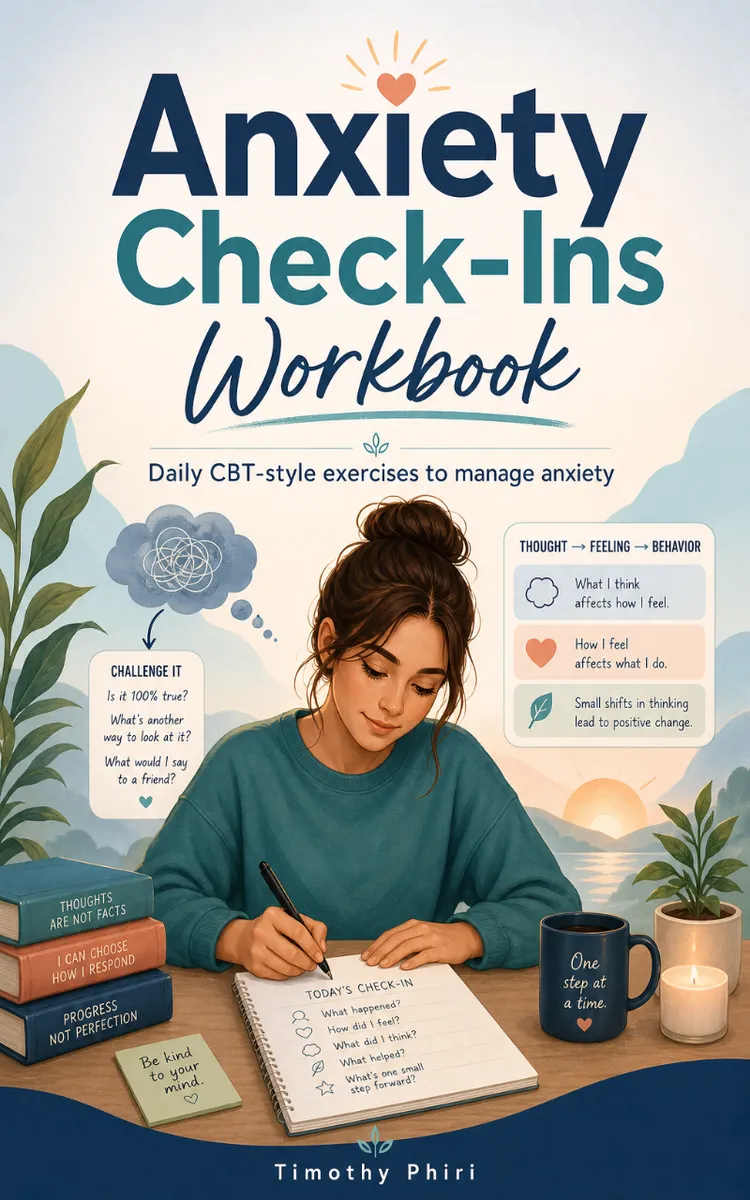
"Anxiety Check-Ins Workbook" is a workbook by Timothy Phiri with 10 chapters and approximately 13,342 words. Anxiety management workbook with daily check-ins and CBT exercises.
This book was created using Inkfluence AI, an AI-powered book generation platform that helps authors write, design, and publish complete books. It was made with the Workbook Generator.
Frequently Asked Questions
What is "Anxiety Check-Ins Workbook" about?
Anxiety management workbook with daily check-ins and CBT exercises
How many chapters are in "Anxiety Check-Ins Workbook"?
The book contains 10 chapters and approximately 13,342 words. Topics covered include Daily Anxiety Check-In Routine, Identifying Thoughts Behind Feelings, Challenging Thoughts with Evidence, Reframing with Balanced Self-Talk, and more.
Who wrote "Anxiety Check-Ins Workbook"?
This book was written by Timothy Phiri and created using Inkfluence AI, an AI book generation platform that helps authors write, design, and publish books.
How can I create a similar workbook?
You can create your own workbook using Inkfluence AI. Describe your idea, choose your style, and the AI writes the full book for you. It's free to start.
Write your own workbook with AI
Describe your idea and Inkfluence writes the whole thing. Free to start.
Start writingCreated with Inkfluence AI


