

Read the first chapter
The whole of chapter one, free. About 10 min. Turn the pages with the arrows, your keyboard, or a swipe.
Chapter 1
A Seat at the Atlanta Mixer
Nia Brooks had promised herself twenty minutes.
Long enough for Marcus to notice her. Long enough to drink something cold, smile at three people, and leave before anybody decided her quiet meant she was judging them. She had parked by the elevator so leaving wouldn’t mean crossing the whole rooftop again.
But the Atlanta air met her at the stairwell door with a warm, wet hand, and behind it came the noise - music pulsing through the concrete, laughter rising over the low wall, voices calling across tables crowded with paper plates and sweating cups.
Nia stopped with one hand on the door.
“Twenty minutes,” she whispered.
Her phone buzzed.
Marcus: You here? I’m by the bar. Don’t disappear on me.
She slipped the phone into her purse and stepped outside.
The student association mixer occupied the roof of a renovated building near campus, where strings of lights hung above folding tables and the skyline shone beyond the brick ledge. The city smelled like rain that had not yet fallen, hot pavement, and barbecue sauce. Someone had turned the speakers too high. The bass thrummed through her ribs.
She found Marcus near a metal drink tub, waving both arms as if she had arrived from another state.
“You made it!” he shouted.
“I said I would.”
“You said you might.”
“That is different.”
He laughed and pulled her into a hug that smelled like citrus cologne. Marcus had grown up in Atlanta and knew everybody - the people behind the mixer, the graduate students from three departments, the bartender’s cousin, and apparently every person who had ever owned a folding chair in the city.
“You look beautiful,” he said, stepping back.
Nia glanced down at her navy blouse and black trousers. “I look like I came from the lab.”
“You look like you came from the lab, but you’ve made it work.”
“That sounds like something you say to everyone.”
“Only the people I want to keep.”
Before she could answer, someone called Marcus’s name from the far side of the roof. Three hands lifted in greeting. He pointed at Nia.
“Stay right here.”
Nia looked at the crowd, then at him. “That is not a comforting instruction.”
“I’m introducing you to somebody.”
“I thought I was here to stand beside you.”
“You can stand beside him.”
Marcus was already moving. Nia took a sip of the lemonade in her cup and immediately regretted it. Too sweet. She set it on the nearest table and watched him weave through the crowd toward a tall man in a white button-down.
The man stood with one shoulder against the brick ledge, listening to two students argue about a football game. He carried a calm that cut through the noise. His sleeves were rolled to his forearms, and a silver watch caught the string lights when he moved. He smiled at the student’s joke, small and focused, and the student’s grin widened as if caught by a net of attention.
Marcus touched his arm.
The man turned.
Even from across the roof, Nia saw that his expression changed when Marcus spoke to him. His eyes sharpened with interest. Then they found her.
Nia looked away first.
She hated that she had done it. She hated more that Marcus noticed.
“Nia,” he said when they reached her, “this is Caleb Whitaker. Caleb, Nia Brooks. She’s the reason half the chemistry department still has functioning glassware.”
Caleb offered his hand. “That sounds like a dangerous amount of responsibility.”
His voice was warm, with a teasing edge that did not demand she perform.
Nia shook his hand. His palm was dry and firm. “It’s mostly the reason I don’t sleep.”
“Also dangerous.”
Marcus pointed toward Caleb. “Engineering. Third year. He thinks he can fix anything.”
“I think I can fix some things,” Caleb said.
“See? Arrogant.”
“Accurate.”
Nia’s mouth betrayed her before she could stop it. A smile touched it.
Caleb noticed. He did not make a show of noticing. That made the smile stay.
Marcus looked between them, satisfied. “I’m going to find my cousin before she leaves with somebody from public health.”
“You said you were staying with me,” Nia said.
“I said I wouldn’t let you leave without saying goodbye.”
“That is not the same thing.”
“It is in Atlanta.”
Then he disappeared into the crowd.
Nia watched him go. “He does this.”
“Leaves people together and calls it networking?”
“Creates situations and then acts surprised when they become situations.”
Caleb nodded as though she had given him useful data. “That explains why he introduced me to a woman named Patrice last month and told her I was emotionally available.”
“Were you?”
“I was eating chicken, not signing up for anything.”
“That wasn’t my question.”
“It was the answer I had.”
She laughed, quietly at first. Caleb’s smile deepened.
A server passed with a tray of jerk chicken skewers. Caleb took one and held the tray toward her. Nia shook her head.
“You haven’t eaten,” he said.
“I had a granola bar.”
“That is not food.”
“It had almonds.”
“Then you had a granola bar with ambition.”
She accepted a skewer to stop him from arguing. The chicken was smoky and sweet, the heat arriving a second later. Caleb watched her take another bite, then looked away before the attention became too intimate.
She noticed the way he looked away, and the small courtesy tightened a place behind her ribs she hadn’t meant to expose.
Around them, people kept moving. A woman in gold hoops leaned close to a professor and laughed. Two men in fraternity jackets crowded the bar. Someone shouted for the DJ to play an old Outkast song, and the roof answered with cheers.
Caleb tilted his head toward the stairwell. “You want somewhere quieter?”
The question landed softly.
Nia should have said yes. Instead, she said, “I’m fine.”
He glanced at the untouched lemonade on the table. “You’ve been holding that cup for ten minutes without drinking it.”
“You’ve been watching me?”
“I’ve been standing three feet away.”
“That is not an answer.”
“No,” he said. “It isn’t.”
The honesty caught her off guard. She looked at him fully then.
He was handsome in a way that seemed unplanned: close-cut hair, wide mouth, a small crease beside one eye when he smiled. His shirt was expensive enough to fit perfectly but plain enough not to announce itself. Nia knew that kind of plain. It was often the most expensive kind.
“You’re not from Atlanta,” he said.
“Why do you say that?”
“You look like you’re trying to determine the safest exit.”
“I’m from Macon.”
“That explains why you’re calculating.”
“Does Atlanta not calculate?”
“Atlanta calculates out loud.”
She took another bite of chicken. “And you?”
“Born at Grady. Raised near Cascade.”
“Local.”
“Very.”
“So you know how to survive this.”
Caleb looked over the rooftop. “This is not survival. This is people pretending they enjoy standing in loud places.”
That drew another laugh from her, fuller this time. He looked pleased but not triumphant.
Marcus appeared beside them with a woman in a green dress. “There you are. I knew I could trust the two of you not to wander off.”
“I was considering it,” Nia said.
Caleb lifted his cup. “She’s been studying the exits.”
Marcus ignored that. “Nia, this is my cousin Danielle. Danielle, Nia’s a doctoral student in organic chemistry.”
Danielle’s eyebrows rose. “A doctorate? Oh, so you’re serious.”
Nia felt the familiar shift in the air, the tiny distance people placed between themselves and a woman whose education had become visible. She had heard every version of it: You must be brilliant. You must be hard to date. You must think you’re better than everybody.
“I’m tired,” Nia said. “That’s different.”
Danielle laughed, but Caleb’s attention stayed on Nia.
“What kind of chemistry?” he asked.
“Organic.”
“Meaning?”
“Meaning I make molecules and then spend weeks proving I made the right ones.”
“Can you make one that keeps people from sending group texts after midnight?”
“If I could, I’d be rich.”
“That’s the first useful thing I’ve heard all evening.”
Danielle was pulled away by someone calling her name. Marcus followed, promising to return. Nia watched them go, then turned back to Caleb.
“You ask a lot of questions.”
“I like knowing what people care about.”
“That can be dangerous.”
“So can not knowing.”
The music shifted, the bass rolling through the soles of her shoes. Nia moved closer to the ledge, where the noise thinned beneath the open sky. Caleb followed but stopped a respectful distance away.
Below them, headlights streamed along the road. Atlanta glowed in layers - office towers, apartment windows, red taillights, a church sign flickering across the street.
“My family would say I ask too many questions," Caleb said.
Nia glanced at him. “Your family?”
“My mother, mostly. My sisters too, depending on the question.”
“You have sisters?”
“Older and younger. My older sister believes she has a degree in reading people.”
“Does she?”
“She has a degree in making confident guesses.”
“That sounds less useful.”
“It is if you’re the person she’s guessing about.”
There was a brief silence. Not awkward. Just unfilled.
Nia rubbed her thumb over the edge of her cup. “My family doesn’t ask enough questions.”
Caleb’s face changed. “About you?”
“About anything that might make life harder.”
He waited.
She had not meant to say more. The rooftop was too bright, too public. Yet Caleb did not rush to fill the pause, and that gave her room to hear herself.
“Only three people in my extended family have gone to college,” she said. “Since slavery, as far as anybody knows. My grandmother kept track because she kept everything. Report cards. Church programs. A receipt from a motel in Birmingham.”
Caleb’s gaze stayed on her, steady and unpitying.
“So when I got into the doctoral program,” Nia continued, “everybody celebrated. Then they started calling me bougie when I stopped answering the phone during exams.”
“Those things can happen at the same time,” he said.
She looked at him.
“People can be proud of you and resent what your life makes them feel,” he said. “That doesn’t mean you’re doing anything wrong.”
The words reached a place she kept guarded. Nia looked back at the city.
“You sound familiar with that.”
“My family has been in college for generations. My mother’s people were free before slavery. They saved land, built businesses, put children through school. There are portraits in my grandmother’s hallway of people who look like they’re waiting to correct you.”
Nia smiled despite herself. “And do they?”
“My mother does. The portraits just watch.”
She laughed again, and this time Caleb laughed with her. The sound softened the hard edges of the evening.
A breeze moved across the roof, lifting the ends of her hair. Caleb reached toward her, then stopped.
“Can I?” he asked.
Nia nodded.
He brushed a loose curl from her cheek with the pad of his finger, slow enough that she felt its warmth. His fingers barely touched her skin, but the contact traveled through her with startling clarity. The crowd seemed to recede. She could smell his soap beneath the smoke and sugar in the air.
His hand fell.
“You’re quieter than I expected,” he said.
“From what?”
“Marcus talks about you like you’re intimidating.”
“Marcus talks about everybody like they’re a story.”
“That too.”
“Am I intimidating?”
Caleb considered her. “You’re careful.”
The answer was too accurate to dismiss.
“And you’re not?” she asked.
“I’m careful in a louder way.”
She looked at his mouth before she could stop herself. He saw that, too, but did not move closer.
Marcus returned then, clapping his hands once. “There you are. We’re heading to Edgewood after this. A group of us. Food, music, maybe bowling if the place isn’t packed.”
Nia’s stomach tightened.
Caleb turned to her. “You should come with us, if you want to, ”
The invitation was simple. His expression was not. He seemed to understand that he was asking her to step back into the noise, to be seen beside him by people who had already begun to look.
“I have lab work in the morning,” she said.
“It’s Saturday.”
“Chemistry doesn’t respect weekends.”
“Then come for one hour.”
Marcus grinned. “See? Caleb knows how to negotiate.”
Nia looked past them at the rooftop: the crowded tables, the bright lights, the open stairwell waiting behind her. She had come to make an appearance and leave unnoticed. Instead, Caleb had learned where she came from, touched her hair only after asking, and invited her somewhere she would have to remain visible.
She should have said no.
“Yes,” she heard herself say. “One hour.”
Caleb’s smile arrived slowly, as if he knew the answer had cost her something.
Marcus cheered and reached for her cup. “That’s my girl.”
Nia let him pull her toward the stairs, Caleb walking on her other side. The music followed them to the doorway, loud enough to blur her thoughts.
One hour, she reminded herself.
But Caleb’s shoulder brushed hers as they descended, and for the first time that evening, leaving unnoticed no longer felt like the safest thing she could do.
End of chapter one. 19 more chapters and about 47,240 words in the full book.
Swipe or use the arrows to turn the page
What's inside: 20 chapters
- 1. A Seat at the Atlanta Mixer
- 2. The Walk After the Lecture
- 3. Coffee, Carefully Asked
- 4. The Whitaker Dinner Table
- 5. Three Degrees in Her Family
- 6. The Polite Second Invitation
- 7. The Sister’s Apology
- 8. A Welcome With Conditions
- 9. The Quiet She Calls Snobbery
- 10. The Family History Behind the House
- 11. A Promise at the Lab Door
- 12. The Message He Won’t Answer
- 13. The Whitaker House Without Caleb
- 14. The Sister’s Public Challenge
- 15. The Price of Being Chosen
- 16. Proof in the Family Calendar
- 17. One Last Conversation
- 18. The Breakup at the Whitaker Door
- 19. A Family That Stands With Her
- 20. The Door Left Unlocked
About this book
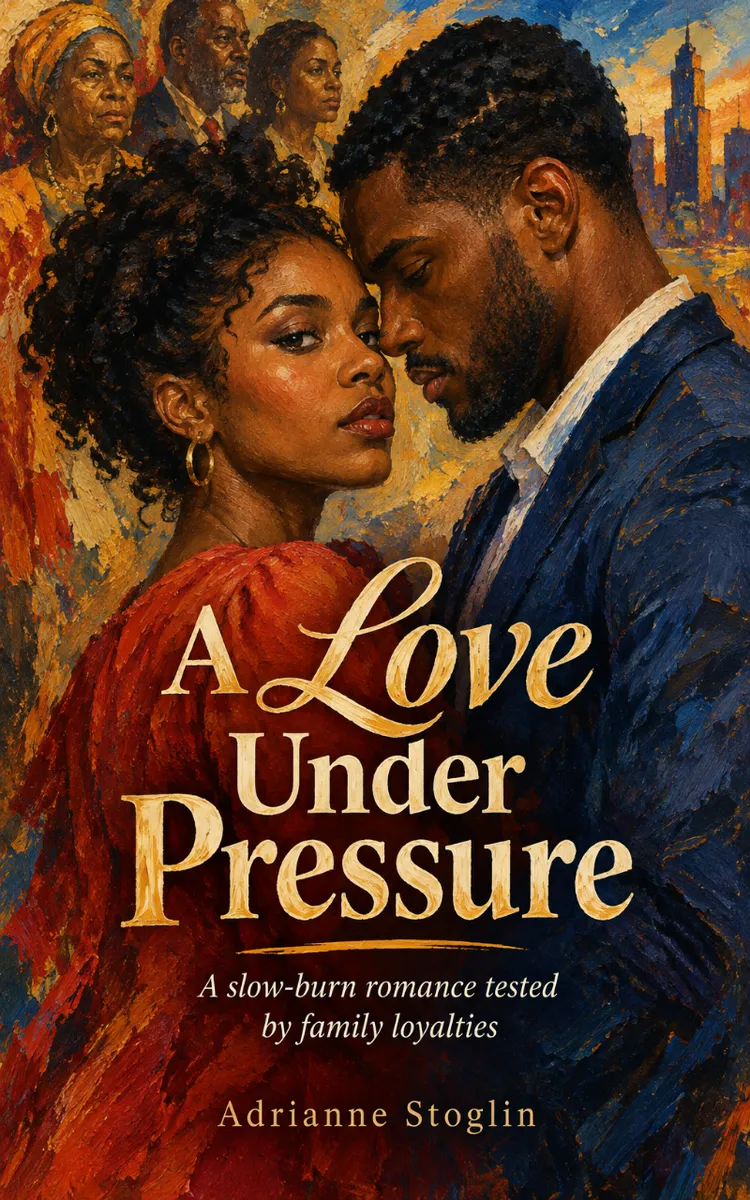
"A Love Under Pressure" is a romance book by Adrianne Stoglin with 20 chapters and approximately 47,240 words. An introverted doctoral student’s romance strained by class prejudice and an enmeshed family.
This book was created using Inkfluence AI, an AI-powered book generation platform that helps authors write, design, and publish complete books. It was made with the AI Romance Novel Writer.
Frequently Asked Questions
What is "A Love Under Pressure" about?
An introverted doctoral student’s romance strained by class prejudice and an enmeshed family
How many chapters are in "A Love Under Pressure"?
The book contains 20 chapters and approximately 47,240 words. Topics covered include A Seat at the Atlanta Mixer, The Walk After the Lecture, Coffee, Carefully Asked, The Whitaker Dinner Table, and more.
Who wrote "A Love Under Pressure"?
This book was written by Adrianne Stoglin and created using Inkfluence AI, an AI book generation platform that helps authors write, design, and publish books.
How can I create a similar romance book?
You can create your own romance book using Inkfluence AI. Describe your idea, choose your style, and the AI writes the full book for you. It's free to start.
Write your own romance book with AI
Describe your idea and Inkfluence writes the whole thing. Free to start.
Start writingCreated with Inkfluence AI


