
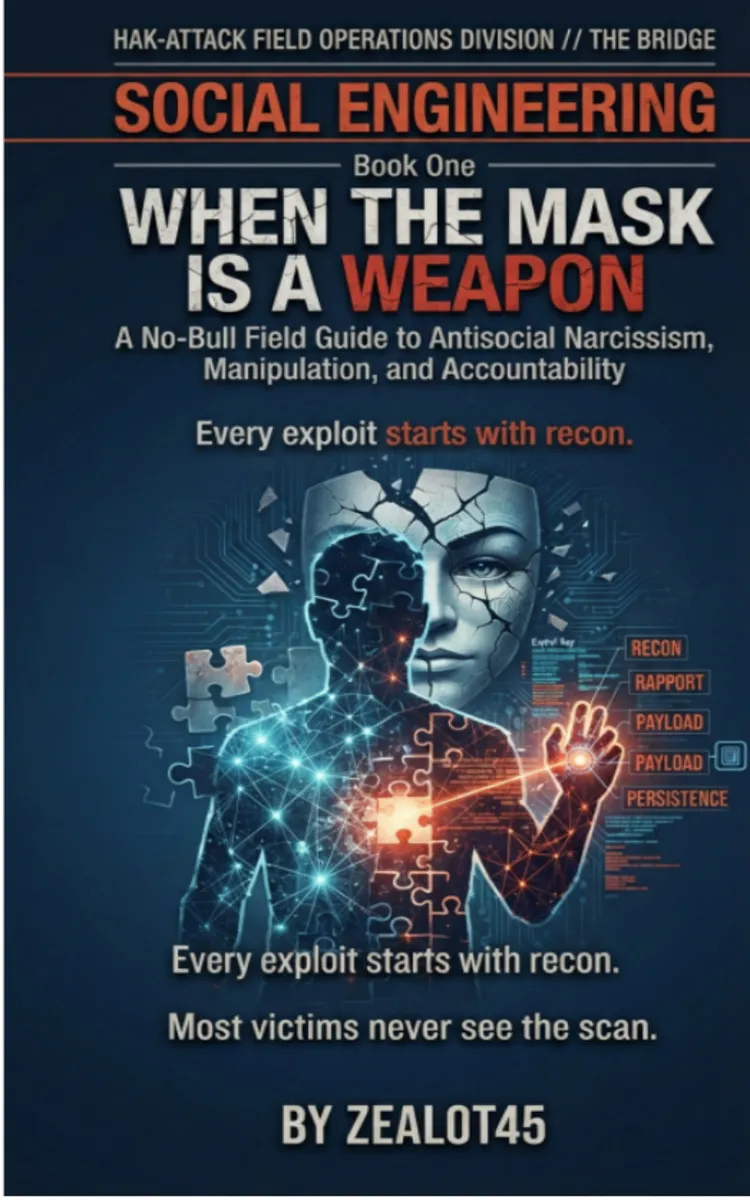
When the Mask Is a Weapon
Created with Inkfluence AI
Table of Contents
- 1. THE FACE OF THE BEAST — Know Your Threat Actor
- 2. Labels Versus Behavior — Why the Diagnosis Isn't Your Job
- 3. The Playbook of Manipulation — Observable Moves, Not Mysteries
- 4. Developmental Pathways — How Biology, Trauma, and Environment Build the Profile
- 5. The Brain and Behavior — Neuroscience Without the White Coat
- 6. Reinforcement and the Feedback Loop — How This Gets Learned, and Kept
- 7. For Families and Partners — What to Actually Do, Not Just How to Feel About It
- 8. At Work and in Public — The Suit Doesn't Change the Exploit
- 9. Boundaries That Actually Work — Scripts, Not Vibes
- 10. De-Escalation and Safety — Keeping Yourself Upright When It Goes Sideways
- 11. When to Bring in Professionals — Know Your Referral Chain
- 12. Consequences as Intervention — Accountability Isn't Cruelty, It's Data
- 13. Checklists and Red Flags — Pocket Tools for When You Don't Have Time to Think
- 14. Decision Tree: Help Versus Hold Accountable — One Page, Built to Work Under Stress
- 15. Case Files From the Unit — Fictionalized, Realistic Composites — Not Real People
- 16. Case 4 — The Juvenile With TBI
- 17. Case 5 — The Elder Financial Predator
- 18. Case 6 — The Institutionalized Repeat Offender
- 19. Resources and Research — Where to Go When This Book Isn't Enough
Preview: THE FACE OF THE BEAST — Know Your Threat Actor
A short excerpt from “THE FACE OF THE BEAST — Know Your Threat Actor”. The full book contains 19 chapters and 6,575 words.
1.1 - Plain-English Definitions (No DSM Required)
Strip the jargon and you've got two trait clusters that, on their own, are just uncomfortable to be around. Stacked together, they're a weapons platform. Antisocial traits, in plain terms: no functioning guilt response, a comfort with lying that most people reserve for emergencies, poor impulse control, and a willingness to use intimidation as a normal tool instead of a last resort. Think of it as a system running with the safety interlocks physically removed. Nothing stops the machine from doing what it wants to do except getting caught, and even that mostly just changes the story, not the behavior.
Narcissistic traits, in plain terms: a self-image that requires constant external validation to stay inflated, a baseline expectation of special treatment, a habit of treating other people as tools rather than as people, and a rage response - cold or hot - when the image gets challenged. Think of it as a system that needs a constant power feed of admiration or compliance, and treats any interruption to that feed as an attack that must be answered.
Put those two systems in one person and you get something specific: someone with the narcissist's hunger for control and admiration, running on the antisocial's total absence of brakes. The narcissist alone might just be exhausting. The antisocial alone might just be reckless. Combined, you get a person who wants to control you, feels entitled to control you, and has no internal system flagging the harm it costs you to be controlled. That's not a bad day. That's the operating system.
1.2 - How the Combo Looks in Real Life
It rarely looks like the movie version. No monologuing, no cartoon cruelty in week one. It looks like a guy who remembers your coffee order on the second date and somehow already knows your ex was "the problem." It looks like a manager who's charming in the all-hands and takes credit for your quarter in the room where it counts. It looks like a parent who tells the story of your childhood so consistently, and so differently from how you remember it, that you start doubting your own memory instead of theirs.
Composite field example - not any one person, built from patterns that repeat: Someone meets a partner and the relationship moves fast, flattering, almost aggressively generous. Within a couple months the partner's other relationships have quietly thinned out - not through any one dramatic event, just a hundred small frictions that make seeing friends more trouble than it's worth. Disagreements start getting reframed as the partner being "too sensitive" or "crazy," a phrase that gets repeated to other people too, so that by the time anything goes seriously wrong, the partner's own account is pre-discredited. When confronted, the response isn't defense - it's counter-attack, or tears, or both in quick succession, whichever lands. There is no version of any conflict, ever, where fault survives contact with this person.
That's the tell that separates this from a normal difficult person: normal difficult people occasionally lose an argument. This profile has never once, in the retelling, been wrong.
1.3 - What to Watch For: The One-Page Cheat Sheet
Pin this. You don't need to memorize a taxonomy to use it - you need to notice when three or more of these are true about the same person over a period of months, not days.
Charm arrives faster than trust should reasonably allow - intensity is being used as a substitute for time.
Every past relationship, job, or friendship in their telling ended because the other party was unstable, crazy, or evil. Nobody's ever just "had a falling out" with this person.
Rules apply to you and not to them, and the double standard is treated as obvious rather than debated.
Your account of an event reliably gets replaced by their account, even when you were both there.
Consequences produce performance - tears, rage, sudden vulnerability - timed suspiciously well to the moment accountability was about to land.
Isolation shows up as a side effect of loving them, never as a stated goal. You just notice, later, that your bench of support got smaller on their watch.
Apologies (if they come at all) are followed by a repeat of the exact same behavior, often within weeks.
You've started rehearsing conversations in your head before having them, because you're managing their reaction more than communicating.
None of this is a diagnosis, and it isn't a warrant. It's a scan result. A scan result tells you to look closer, not to convict. Chapter 2 covers exactly where that line sits - why the label matters clinically and matters a lot less for your safety planning than the behavior does. For now, the job is simpler: notice the pattern, trust what you're noticing, and stop explaining it away because the good moments were genuinely good. Social engineers are effective because the con includes real warmth in the mix. That's not a contradiction in the profile....
About this book
"When the Mask Is a Weapon" is a general book by Anonymous with 19 chapters and approximately 6,575 words. It covers key insights and practical takeaways on the topic.
This book was created using Inkfluence AI, an AI-powered book generation platform that helps authors write, design, and publish complete books.
Frequently Asked Questions
What is "When the Mask Is a Weapon" about?
"When the Mask Is a Weapon" is a general book by Anonymous covering key insights and practical takeaways on the topic.
How many chapters are in "When the Mask Is a Weapon"?
The book contains 19 chapters and approximately 6,575 words. Topics covered include THE FACE OF THE BEAST — Know Your Threat Actor, Labels Versus Behavior — Why the Diagnosis Isn't Your Job, The Playbook of Manipulation — Observable Moves, Not Mysteries, Developmental Pathways — How Biology, Trauma, and Environment Build the Profile, and more.
Who wrote "When the Mask Is a Weapon"?
This book was written by Anonymous and created using Inkfluence AI, an AI book generation platform that helps authors write, design, and publish books.
Write your own book with AI
Describe your idea and Inkfluence writes the whole thing. Free to start.
Start writingCreated with Inkfluence AI


