
Read the first chapter
The whole of chapter one, free. About 8 min. Turn the pages with the arrows, your keyboard, or a swipe.
Chapter 1
The Outfit Test for Politics
The Jacket That Arrived Before the Forecast
On the morning of the 2016 United States presidential election, many political professionals dressed for a familiar result: Hillary Clinton would become president. Their forecasts were not absurd. They were built from polling, demographic patterns, campaign history, and years of experience. Yet by the next morning, the political wardrobe had changed completely, and the same evidence was being described in a different emotional climate.
People do not merely predict events; they dress their predictions in the mood of the present. A tense moment makes warnings feel plausible. A period of calm makes continuity feel obvious. The habit is so ordinary that it often escapes notice, even when it shapes judgments about elections, China, Russia, Iran, Israel, and the possible return of Donald Trump.
The useful question is not simply why forecasts are wrong. It is why certain forecasts feel right before the evidence has earned that confidence. The answer begins with a quiet mental adjustment: we select an outfit for the moment, then mistake its fit for a description of the future.
When the political weather changes, are we changing our forecasts - or only changing what seems believable?
The Wardrobe Bias Loop
Clothing is a practical response to conditions. A person reaching for a raincoat has made a judgment about the sky, but the coat also changes how the day is experienced. It makes rain seem more central, more expected, and perhaps more threatening. Political interpretation works in a similar way. The surrounding mood becomes an outfit, and the outfit helps determine which predictions appear sensible.
The Wardrobe Bias Loop describes this movement. First comes the moment: a shocking speech, a war, a market crash, a scandal, a polling surge, or an apparent diplomatic breakthrough. People then choose a mental wardrobe suited to that moment. From inside it, they notice evidence that matches the clothing and discount evidence that feels out of season. Finally, their confidence in the forecast strengthens, which makes the original outfit seem even more appropriate.
The loop does not require deception or poor intelligence. A political activist worried about another Trump presidency may read every Republican victory as part of a gathering national tide. A data scientist fascinated by fantasy worlds and complex models may see an election as a system whose hidden structure can be inferred from enough signals. Both may be attentive and informed. Yet each can become dressed for a particular political atmosphere before the forecast is complete.
The same pattern appears in international affairs. After Russia’s full-scale invasion of Ukraine in 2022, predictions of further Russian expansion became easier to accept than they had been months earlier. During periods of Chinese economic growth, forecasts of steadily increasing Chinese influence often sounded inevitable. When relations between Israel and Iran worsened, predictions of direct regional war gained emotional force. The evidence mattered, but so did the clothing worn while looking at it.
A forecast rarely arrives naked. It comes wearing the assumptions of its season.
Why the Present Borrows Authority from the Future
The mind is designed to use recent information efficiently. If a person has just witnessed a dramatic event, that event becomes easier to recall than quieter developments. Psychologists call this the availability heuristic: judgments are influenced by how readily examples come to mind. A vivid event can therefore feel common, representative, and predictive even when it is unusual.
Political life supplies an endless stream of vivid examples. A candidate’s rally fills television screens. A leaked document dominates a news cycle. A military exercise is photographed from several angles. A single poll is repeated until it becomes part of the public landscape. The event is not merely remembered; it becomes the lens through which less visible facts are interpreted.
History offers repeated demonstrations of this effect. In the months before the 2008 financial crisis, many assumptions about American prosperity were dressed in the language of stability. After the collapse of Lehman Brothers in September 2008, instability became the more natural outfit, and predictions once considered extreme began to sound responsible. The underlying economy had not changed in a single morning as completely as public perception had. What changed first was the frame.
The recency effect adds another layer. Recent information often receives more weight than older information, even when older information remains relevant. A late campaign scandal may overshadow months of organizing. A fresh diplomatic insult may eclipse years of trade and security ties. A new battlefield development may make long-term constraints disappear from view.
This is why political predictions can seem to move faster than political reality. Institutions, alliances, voting habits, military logistics, and demographic patterns usually change slowly. Public attention can change within hours. The forecast follows attention because attention supplies the emotional temperature at which evidence is judged.
One surprising fact is that confidence can rise not when information becomes clearer, but when the story becomes simpler. A complicated election involving turnout, candidate quality, regional differences, and economic perceptions may suddenly be reduced to “a backlash” or “a realignment.” The simpler story fits the moment like a well-cut jacket. Its neatness is mistaken for accuracy.
The History of Dressing for the Political Weather
Political communities have always interpreted the future through the clothing of the present. In the early twentieth century, newspapers and party organizations helped create shared political atmospheres. A crisis could be presented as proof of national decline, while a recovery could be treated as evidence of inevitable progress. Readers did not receive events in isolation; they received them arranged into a season.
The arrival of radio and television intensified this process. Political events became synchronized experiences. Millions of people could watch the same convention, speech, debate, or election-night map. Shared images created shared moods, and shared moods made certain predictions feel socially obvious. The rise of cable news and digital platforms accelerated the cycle further. A development that once took days to circulate can now become the defining fact of an afternoon.
The United States presidential election of 2016 remains an especially clear case because it exposed the difference between probability and atmosphere. Many forecasts gave Clinton an advantage, but public conversation often converted an advantage into an expectation. Once expectation took hold, evidence pointing toward Trump’s path was treated as a warning about an unlikely upset rather than as part of a live contest. After the result, the wardrobe changed. Explanations emphasizing populism, hidden voters, economic resentment, and institutional distrust became more available and more persuasive.
None of those explanations had to be invented after the fact. The problem was that their visibility and weight changed with the outcome. Before the election, they were often background conditions. Afterward, they became the main plot.
The same reversal occurs in geopolitical prediction. Before an unexpected alliance forms, cooperation may look fragile or improbable. Once it forms, earlier signals are gathered into a story of inevitability. Before a government falls, warnings can seem exaggerated. Afterward, the same warnings are remembered as obvious. The mind is skilled at turning surprise into a sequence that appears to have been leading there all along.
The Forecast Is Part of the Costume
The counterintuitive point is simple: predictions do not merely reflect political moods; they help produce them. A forecast that gains attention can alter donor behavior, campaign strategy, media coverage, market expectations, and the language used by political actors. The outfit begins as a response to the weather, then becomes part of the weather.
That matters because people often treat forecasts as detached observations. A prediction of a coming Trump victory may encourage supporters, unsettle opponents, and change which voters believe participation matters. A prediction of Chinese dominance may influence how businesses and governments interpret every trade dispute. A forecast of imminent conflict between Iran and Israel may make restraint look temporary and escalation look natural.
The prediction therefore has two lives. It describes a possible future, but it also changes the present in which that future is being formed. This makes political forecasting different from checking tomorrow’s temperature. The forecast enters a social system crowded with actors who can react to it.
The Wardrobe Bias Loop becomes especially powerful here. A tense atmosphere produces a tense forecast; the forecast amplifies the tension; the amplified tension supplies fresh evidence that the tense forecast was correct. What looks like independent confirmation may partly be the result of the prediction itself moving through the world.
The Election-Night Suit
On election night in 2016, the concrete setting was a map of the United States turning red in places many viewers had expected to remain blue. Television analysts worked from familiar categories: the industrial Midwest, suburban voters, education levels, urban turnout, rural margins. As state after state moved toward Trump, the categories did not disappear, but their meaning shifted.
The people watching were not all making the same mistake. Some had examined polling uncertainty, turnout models, and the possibility of an Electoral College split. Others had absorbed a broader atmosphere in which Clinton’s victory seemed like the normal ending and Trump’s victory like a disruption requiring special explanation. The distinction mattered. A probability can acknowledge an uncertain outcome; a mood often quietly removes one.
For the 40-year-old political activist who wanted to know the outcome ahead of time, election night offered a painful lesson in the difference between preparation and prediction. Campaign experience can reveal how voters respond to messages, how volunteers behave, and where local enthusiasm is strong. It can also make a particular reading of the electorate feel physically familiar. The activist may recognize the signs of a winning campaign - or the signs of a backlash - because those signs match previous political seasons.
For the 29-year-old data scientist drawn to fantasy worlds, the temptation takes a different form. Models promise a map beneath the noise: hidden variables, branching paths, and measurable probabilities. Yet models are interpreted by people who live in the same political atmosphere as everyone else. The numbers may be technical; the choice of which numbers deserve attention is often human.
Both figures are subject to the same loop. The activist dresses in the campaign’s emotional weather. The data scientist dresses in the model’s apparent order. Neither outfit is useless. Neither is the body beneath it.
Political prediction becomes more believable when it resembles the world people already feel they inhabit. A forecast of stability sounds wise in a stable room. A forecast of rupture sounds perceptive after the glass has begun to crack. The evidence may be identical, but the surrounding atmosphere changes its apparent weight.
Human beings are not poor observers because they have moods; moods are among the instruments through which observation occurs. The difficulty is that an instrument can quietly become a costume, and a costume can be mistaken for the climate itself. The future remains hidden, while the present keeps offering new clothes in which to picture it.
End of chapter one. 7 more chapters and about 13,220 words in the full book.
Swipe or use the arrows to turn the page
What's inside: 8 chapters
- 1. The Outfit Test for Politics
- 2. The Next-Election Crystal Ball
- 3. Fantasy Data Meets Real Polls
- 4. China’s Signals, Not Its Slogans
- 5. Russia’s Influence as a Timing Game
- 6. Iran-Israel Forecasts Without Wishful Thinking
- 7. The Power Politics Feedback Loop
- 8. Your Last Prediction, Your Best Filter
About this book
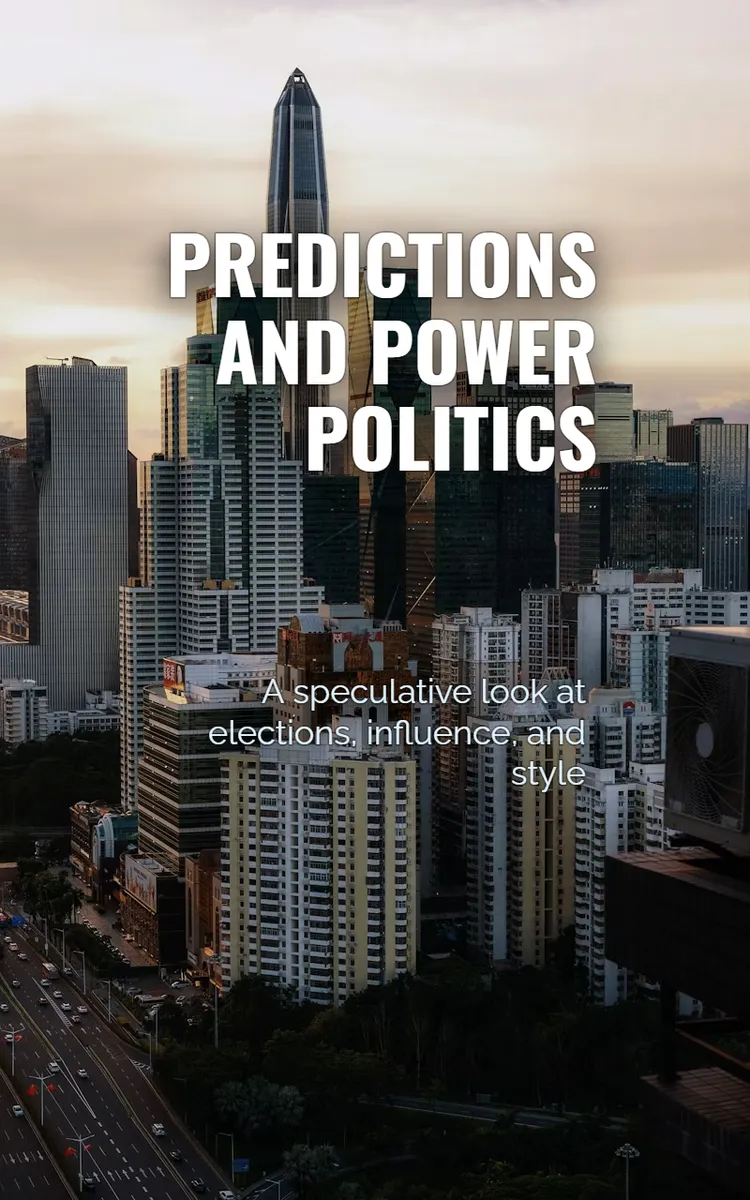
"Predictions And Power Politics" is a curiosity book by Anonymous with 8 chapters and approximately 13,220 words. Speculative predictions about US elections and geopolitical influence.
This book was created using Inkfluence AI, an AI-powered book generation platform that helps authors write, design, and publish complete books.
Frequently Asked Questions
What is "Predictions And Power Politics" about?
Speculative predictions about US elections and geopolitical influence
How many chapters are in "Predictions And Power Politics"?
The book contains 8 chapters and approximately 13,220 words. Topics covered include The Outfit Test for Politics, The Next-Election Crystal Ball, Fantasy Data Meets Real Polls, China’s Signals, Not Its Slogans, and more.
Who wrote "Predictions And Power Politics"?
This book was written by Anonymous and created using Inkfluence AI, an AI book generation platform that helps authors write, design, and publish books.
Write your own curiosity book with AI
Describe your idea and Inkfluence writes the whole thing. Free to start.
Start writingCreated with Inkfluence AI


