
Read the first chapter
The whole of chapter one, free. About 15 min. Turn the pages with the arrows, your keyboard, or a swipe.
Chapter 1
Fogline Poisoned at Harvest Night
Neon from the harbor stalls smeared across the fog like someone dragged a wet thumb over glass. The annual harvest festival had been loud an hour ago - clinking mugs, fiddles, the wet cheer of people pretending the rain couldn’t get in their bones. Now it was just Alderwick Lane, rain-dark and thinly lit, with the ocean pressing its cold face against the town’s throat. Evelyn Hart’s house sat at the end of the lane, windows filmed over, porch light buzzing the way a tired insect does before it gives up.
I stood under the eave with my coat half-open, listening to my own breathing and the steady hiss of water running off gutters. My phone screen kept going black and coming back, as if even it didn’t want to witness whatever came next. The air tasted like wet wool and salt. I told myself I was only waiting for a door to open.
Evelyn’s door didn’t open. It already had.
I remember the sound first - something soft and wrong, like a chair leg dragged across old wood. Then the smell, not the sweet candle-scent the neighbors would’ve used to dress up the evening, but a chemical bitterness that didn’t belong in a teacher’s home. My mouth went dry anyway, because my body had decided before my mind caught up. I pushed inside, calling her name once, and the house answered with silence and the faint, metallic tick of cooling pipes.
I wanted it to be an accident. I wanted my mentor to be sick the way people got sick in winter - too much wine, a headache that turned into something worse, a stumble, a clumsy fall. I wanted the story to land the way it always did in the classroom when a kid insisted their version was true: listen, then help. Fix it. Cover it with the right words.
But Evelyn Hart lay on her kitchen floor with her cheek turned toward the linoleum like she’d been listening for something. Her hand had fallen open, palm up, as if she’d reached for the smallest mercy. The lights in the room were dim, the curtains drawn, the whole place swallowing the festival noise as if it had never happened.
“Evelyn?” My voice came out thin, and I hated that it did. I hated that my eyes slid over her mouth first, hunting for the kind of mess a body made when it swallowed the wrong thing. I hated that I already knew, even before the paramedics arrived, that this wasn’t the kind of wrong I could talk my way out of.
Someone behind me said, “Ma’am - step back.”
I turned too fast. My shoulder knocked the doorframe. Rainwater dripped off my sleeve into a shallow puddle that had formed on the entryway tile. The man’s face was a blur under his hood. The only thing that stayed clear was his badge, catching light with an almost cheerful shine.
“Don’t - ” I started, and then stopped, because I didn’t have a plan beyond insisting there was no violence. No intrusion. No struggle. No forced entry. That was the sentence my mind kept building, like a bridge it could crawl across before the river arrived.
I pressed my tongue to the back of my teeth. “I came in. Her - her door was already unlocked.”
The man didn’t look convinced. He glanced at the door, then back at me, and I felt the shift the way you feel a floorboard tilt before it breaks. A second officer came in, boots squealing on wet tile, and their radios crackled with voices I couldn’t fully catch. Through it all, the house seemed to pull its breath in tighter around Evelyn’s body.
“No sign of a break-in?” I asked, too quickly. I heard my own desperation and tried to sand it down. “I mean, I didn’t see anything. I didn’t - ”
“Who are you?” the first officer said.
I told them. Mara Ellison. Substitute teacher, Evelyn’s former student, mentor, the woman who’d taken my scattered life and handed it structure like it was a gift. I watched their expressions register the name and then slide away from it, as if the facts of my relationship to her were less important than the fact that I was standing in her home with rain dripping off me.
The coroner arrived before the town’s curiosity could settle, because the night had a momentum to it. People came in clusters when tragedy gave them a reason. The neighbors’ voices were muffled by the fog outside, but I could hear them through the walls - an uneven chorus of condolences and questions, as if they could talk hard enough to change what had already happened.
I didn’t move much. I kept returning to the kitchen floor in my head, replaying it, trying to find the moment where I’d misread something. The smell hit me again, sharper now that I wasn’t alone in the room. Not just chemical - something floral beneath it, like a cheap perfume trying to cover a wound.
A paramedic leaned close to Evelyn’s wrist. “Time of death?” he muttered, and the question landed like a dropped tool.
“Don’t touch her,” I said automatically, and the room turned toward my voice. I hadn’t meant it as a command; it had been a reflex, the kind you get when you see something break and you want to glue it back together. The paramedic froze anyway, gloved hands hovering.
“Ma’am,” he said gently, which made my skin crawl. Gentle was for accidents. For broken promises. For bruises that didn’t come from a hand.
“I didn’t see anyone,” I insisted. “No one was here when I - ”
“You said the door was unlocked,” the officer replied, and it sounded like a statement he was already using against me.
I swallowed. “I said it was unlocked. I didn’t - there wasn’t any forced entry.”
The words came out, and with them my certainty fractured. I had been so sure about the door until I saw the officer’s eyes go to the knob and then to the frame. I’d been so sure until I remembered how my own hands had fumbled with the latch in the rain, how my fingers had slipped because my nails were still wet from the festival’s soggy games. I’d been so sure until I’d looked at Evelyn’s front hallway mirror and realized my reflection looked like someone who’d been running.
The officer stepped closer to the door. “You’re telling me you walked in without breaking anything.”
“Yes.”
He asked a question that felt harmless. “What time did you arrive?”
A number rose in my throat, one I’d been clinging to like a life raft. “Around… after the festival ended.”
“That’s not an answer,” he said, not unkindly. He just didn’t believe me. None of them did. They had already started assembling the pieces in their minds, and I was a loose piece that didn’t fit.
I tried again. “It was late. The lights were still - people were still out. I heard the cleanup. Then I - ”
“Why did you come to her house?” a woman’s voice asked from the hallway.
The bartender, I realized with a sick twist, even though I’d never seen her face close up before tonight. Rowan Pike’s place was all neon and noise, a warm rectangle in a cold town. She had those eyes that looked like she’d seen too much for too long and kept working anyway. She held a small notepad like it could anchor her.
“I - she texted me,” I said.
The words were a lie built from truth. Evelyn had texted me earlier in the evening, asking if I could stay late to help with lesson plans she’d promised she’d finalize. I’d been there, I’d helped. Then she’d said she’d take care of the rest and asked me to come by after the festival because she wanted to show me something. I’d assumed it was nothing. A new set of worksheets, a photocopied handout. The kind of thing mentors did when they worried you might fall behind.
But when the bartender stepped into the kitchen light, I saw her look flicker - not at me, but past me, to the doorway where the officers stood. She wasn’t just observing. She was listening for what would fit the story she’d already started telling herself.
The officer asked, “What did she want you to see?”
I could’ve said letters. I could’ve said the festival poster Evelyn had been working on. I could’ve said anything that made sense. Instead my mind grabbed the wrong detail because it was the one that felt most real.
“Her door wasn’t… it wasn’t messed up,” I said. “She wouldn’t - she wouldn’t leave it like that if she was expecting someone.”
“Expecting someone,” the coroner echoed, as if tasting the phrase. He was older, with hands that moved like they’d learned not to tremble around grief. He didn’t bother asking my name. People always asked names when they thought they were still in the talking stage.
He knelt beside Evelyn with a practiced quiet. “What do we have?” he asked the paramedic.
“Her mouth - ” the paramedic began, and then stopped. He looked at me, and I felt the attention like a spotlight.
The coroner’s fingers hovered near Evelyn’s lips, not touching yet. “Poison,” he said, and the word dropped into the room with a weight I couldn’t lift.
I heard it and denied it at the same time. Poison didn’t belong to Evelyn Hart. Evelyn was the kind of person who fought for kids who couldn’t afford lunch and wrote extra notes in the margins of their assignments because she couldn’t stand the idea of them feeling alone. Poison belonged to stories on late-night screens and crime podcasts - things people listened to when they wanted to imagine danger without having to live through it.
“That’s not - ” I started.
The coroner looked up. His eyes were tired, but not confused. “You want to tell me what you saw?” he asked.
My mouth opened. The truth I wanted was easy: I wanted to say I saw nothing. I wanted to say no one came through that door. I wanted to say the house was untouched, that the only thing disturbed was Evelyn’s body.
But my mind betrayed me with a flash of sound - something I hadn’t let myself notice before. A soft click, small as a fingernail tapping glass, when I’d entered. I’d assumed it was the latch catching. Now I wondered if it was something else. Something meant.
“I didn’t see anyone,” I said, and it sounded weaker than I intended.
The coroner’s gaze went past me again, toward the hallway. “Then we’ll start with what’s here,” he said. He gestured to the paramedic, and gloved hands moved back into motion.
The bartender - my future suspect, my future witness, the first person I didn’t know how to read - stepped closer to me. “Mara,” she said like she’d heard the name before. “You’re saying her door was unlocked.”
I nodded too fast, and the officer’s eyes narrowed as if that confirmation was a trap.
“I’m saying there was no forced entry,” I repeated. It felt like a rope. If I kept holding it, maybe the whole thing wouldn’t pull me under.
The coroner stood, finally, and the room seemed to exhale. He looked at the floor around Evelyn’s body, then at the counter. He moved one step toward the kitchen sink and paused.
“Someone cleaned,” he said.
He wasn’t accusing. He was stating, like weather. But my stomach turned anyway. I hadn’t noticed cleaning. I’d been too busy insisting the world was gentler than it was.
“What?” I asked.
He pointed, and now I could see it too: a smear that didn’t match the rest of the kitchen’s grime. Not a spill - more like someone had wiped too hard, too fast, leaving a faint sheen on the counter edge. On the floor, beside Evelyn’s hand, a thin ring of something dark had been scrubbed away until it looked like nothing at all.
The officer’s voice sharpened. “Did you touch anything?”
“No,” I said, and then my throat tightened, because I had. I’d moved a chair earlier to get a better look at her face. I’d shifted a throw blanket because Evelyn’s shoulders were too exposed to the cold. I’d done those things to comfort myself as much as her. Comfort was my worst habit.
“I - ” I started.
The bartender’s notepad made a quiet sound as she flipped a page. “Mara,” she said again, softer. “You said you came in through an unlocked door.”
“I did.”
“And you’re sure,” she pressed, “there was no one else.”
I wanted to tell her the truth, the one that made sense in my chest. I wanted to say I was there alone. That I didn’t hear footsteps. That I didn’t see shadows in the fog-lit hallway. That the house felt like it had been waiting for me like it always did when Evelyn had a sudden plan.
Instead my memory offered me Evelyn’s face from earlier in the evening, lit by harvest festival lights through the classroom windows. She’d been smiling, tired but bright, handing me a stack of worksheets and telling me to “hold onto your certainty.” She’d laughed at my nervous habit of reading too much into silence. She’d said, “Sometimes accidents come dressed like choices.” She’d said it like a joke.
I’d thought she meant life.
Now I couldn’t tell what she’d meant.
“I’m sure,” I said, because the alternative was admitting I’d been wrong. Wrong about the door. Wrong about the time. Wrong about what kind of wrong this was.
The coroner called for tape and evidence bags. The kitchen filled with the rasp of plastic and the dull thump of objects being handled carefully. I watched their movements and tried to keep my face neutral, as if neutrality could protect me.
Then the officer held up a small strip of something at shoulder height. “We found this on the entryway mat.”
A strip of tape, clear and thin, with a residue that caught the light when it shifted. It hadn’t been there in my memory. Or it had, and I’d filed it away as nothing because I was too busy believing in accidents.
“No forced entry,” the officer repeated, and his voice didn’t need to be loud to land. “But someone used adhesive. Someone wanted the door to behave a certain way.”
My hands went cold. I could feel the wet in my sleeves turn into a kind of numbness. “That isn’t - ” I started, but the sentence collapsed because I couldn’t finish it with anything that didn’t sound like denial.
The bartender looked between me and the strip of tape. “Adhesive,” she said, like she was trying to decide whether the word belonged in her life. “Like a - like a seal?”
I stared at the mat and tried to remember if I’d stepped on anything sticky. I tried to remember the latch. I tried to remember my own fingers slipping. The details refused to line up. My story was becoming a shape that didn’t match the evidence.
The coroner turned toward me again, and for a second I saw something in his face that wasn’t suspicion - something like fatigue with people who insisted on being the main character. “You said the door was unlocked,” he said. “Now we have a strip of adhesive. Walk me through it.”
I wanted to refuse. My mouth opened, and I heard myself say, “It was unlocked.”
“That’s not walking me through anything,” he replied.
I could feel the room tightening around my words. Every officer’s gaze, every paramedic’s glance, every neighbor’s muffled curiosity through the walls - it all pointed inward, to the same question I’d been trying to dodge since I saw Evelyn on the floor.
If it wasn’t forced, then what was it?
I turned my head slightly, just enough to look at Evelyn’s hallway. In the dim light, the entry mirror caught a slice of neon from the harbor - harvest festival lights still flickering against the fog, as if the town couldn’t let go of being cheerful. The reflection made the hallway look deeper than it was. It made the door look like it could open on a different night, a different version of events.
In my mind, Evelyn’s voice returned - earlier, warm and sharp, telling me to hold onto certainty. I’d believed her certainty was about teaching. About surviving adolescence. About getting through winter.
Now it sounded like warning.
I swallowed and forced my narration to behave, to stop changing its clothes. “I came in because she invited me,” I said, and my voice shook on the last word. “She knew I was coming. She wanted me to see something. The door was just… it was just open the way it sometimes is when she doesn’t want to deal with the rain.”
The bartender watched me like she was deciding whether to believe my fear or my story. The officer’s pen scratched. The coroner didn’t move, but his attention sharpened.
“Evelyn Hart,” he said, and it wasn’t a question. “Who else did she invite tonight?”
The room waited. I couldn’t give them a clean answer. I could only offer the truth that didn’t fit neatly into anything: Evelyn had been secretive lately. Not about her heart - about her private life. About letters she’d been keeping in a drawer I wasn’t supposed to open. About a sister I’d only met in passing and never trusted with my full name. About a mayor who used to be a boy in our classroom, sweet and charming and always looking for the next applause.
And then there was Rowan Pike’s podcast studio - Evelyn had mentioned it once, half-laughing, like she’d been annoyed by someone else’s obsession. I’d dismissed it as gossip.
Now, standing in her kitchen while the coroner confirmed the shape of poison, gossip felt like a map.
I opened my mouth to speak, and my memory betrayed me again, offering a different version - Evelyn’s face lit by hallway light, her hand hovering over a drawer, her voice low as she told me not to worry about “who gets access.” She’d meant it kindly. She’d meant it like a teacher protecting a student from embarrassment.
But the words now sounded like someone else’s plan.
The coroner’s gaze held mine. “We’re going to need your phone,” he said.
My phone was already in my hand, screen dim, my thumb hovering where it could unlock. I’d been thinking about texts, about times, about the version of the night I’d need to defend. I hadn’t been thinking about what the phone might show them - what it might contradict.
I didn’t want to hand it over. I wanted to keep my narrative intact long enough for someone to understand I’d walked into an accident, not a trap.
I looked at the adhesive strip again, at the counter smear, at the way Evelyn’s body had been left like a sentence with the ending missing.
I forced myself to do it. I unlocked the phone and held it out, and as my screen lit the coroner’s face, the glow made my reflection in the kitchen window look wrong - too pale, too certain, too practiced at lying even when I wasn’t trying.
Outside, the fog pressed against the glass, and the harbor neon kept blinking as if nothing had changed.
Inside, the accident I’d been begging for hardened into something else. The coroner didn’t say “murder,” not yet, but the room didn’t need the word to know it had become a case. The first suspect network started forming without anyone naming it out loud: who had access to Evelyn’s home, who might’ve slipped past an unlocked door, who could’ve known her habits well enough to leave adhesive instead of footprints.
And my story - my insistence on no forced entry - kept slipping, like wet fingers off a latch that wasn’t meant to hold.
End of chapter one. 7 more chapters in the full book.
Swipe or use the arrows to turn the page


What's inside: 8 chapters
- 1. Fogline Poisoned at Harvest Night
- 2. Mara’s Story Changes in the Bar Light
- 3. The Mayor’s Smile Covers a Locked Drawer
- 4. Podcaster Lyle Soren Hangs Up on Truth
- 5. Evelyn’s Sister Tamsin Hart Breaks the Pattern
- 6. Mara Loses Her Witness Note in the Rain
- 7. Fogline Poison Revealed in the Harvest Lanterns
- 8. Mara Chooses One Story, Not Many
About this book
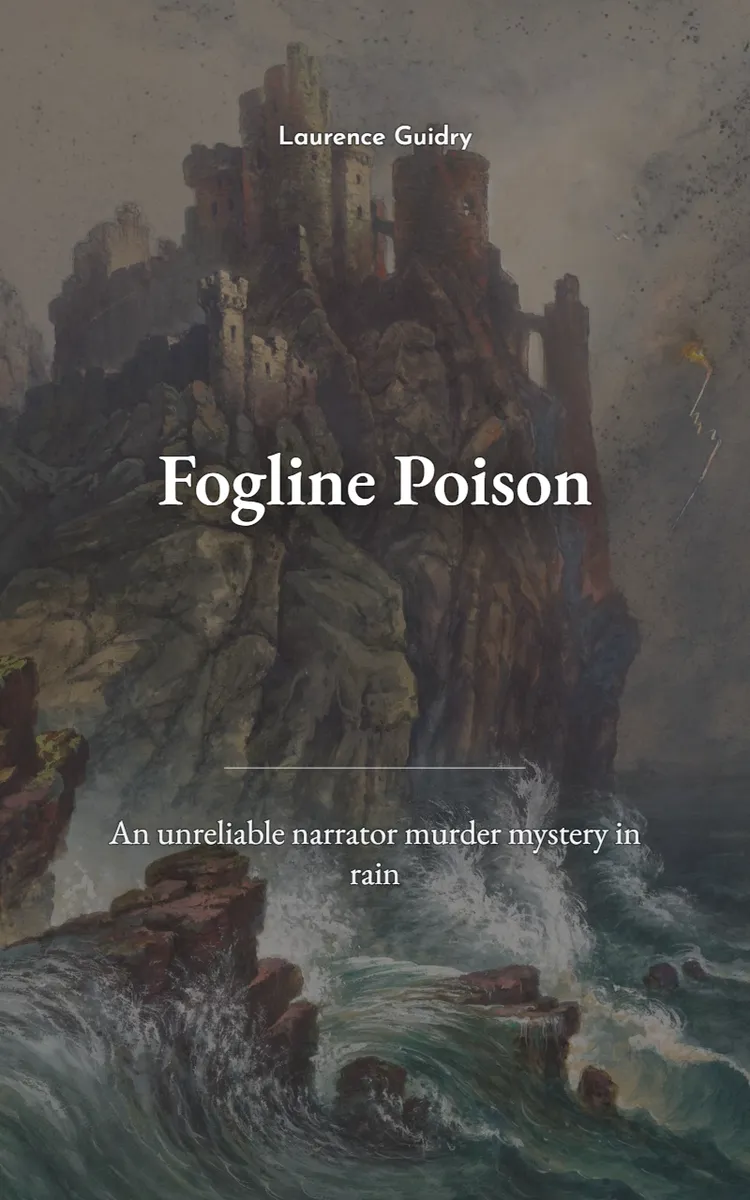
"Fogline Poison" is a fiction book by Laurence Guidry with 8 chapters and approximately 23,648 words. Unreliable-narrator murder mystery set in a foggy coastal town.
This book was created using Inkfluence AI, an AI-powered book generation platform that helps authors write, design, and publish complete books. It was made with the AI Novel Writer.
Frequently Asked Questions
What is "Fogline Poison" about?
Unreliable-narrator murder mystery set in a foggy coastal town
How many chapters are in "Fogline Poison"?
The book contains 8 chapters and approximately 23,648 words. Topics covered include Fogline Poisoned at Harvest Night, Mara’s Story Changes in the Bar Light, The Mayor’s Smile Covers a Locked Drawer, Podcaster Lyle Soren Hangs Up on Truth, and more.
Who wrote "Fogline Poison"?
This book was written by Laurence Guidry and created using Inkfluence AI, an AI book generation platform that helps authors write, design, and publish books.
How can I create a similar fiction book?
You can create your own fiction book using Inkfluence AI. Describe your idea, choose your style, and the AI writes the full book for you. It's free to start.
Write your own fiction book with AI
Describe your idea and Inkfluence writes the whole thing. Free to start.
Start writingCreated with Inkfluence AI


