
Read the first chapter
The whole of chapter one, free. About 9 min. Turn the pages with the arrows, your keyboard, or a swipe.
Chapter 1
Factories That Learn From Mistakes
When the Line Stops, the Factory Starts Talking
A production line can lose hours because of a fault that lasts less than a minute. A sensor flickers, a robot pauses, a machine rejects a part, and the immediate repair restores motion without explaining why the failure happened. The factory has not solved the problem; it has merely silenced its most visible symptom.
That distinction matters because modern production creates a trail of clues whenever something goes wrong. Motor temperatures rise, vibration changes, cameras capture a small shift in alignment, and quality systems record the exact moment a defect appears. For decades, much of this information remained scattered across maintenance logs, control panels, spreadsheets, and the memories of experienced workers. Artificial intelligence can connect those fragments quickly enough to influence the next decision rather than merely explain the last one.
The central idea is not a machine that never fails. It is a factory that learns from failure before the same mistake travels farther down the line.
What if the most valuable information in a factory is produced at the precise moment production goes wrong?
From Repairing Machines to Reading Their Warnings
Factories have always learned, but their learning was usually slow and local. A mechanic noticed that a bearing wore out after a certain sound appeared. An operator adjusted a press because the finished parts began showing a familiar mark. A supervisor kept a handwritten record of recurring stoppages. Knowledge accumulated through observation, repetition, and memory.
The first industrial control systems changed the speed of response. By the middle of the twentieth century, factories were using instruments to measure pressure, temperature, flow, and electrical load. Later, programmable logic controllers allowed machines to follow precise sequences and report specific faults. These systems were excellent at answering a narrow question: is a value above or below its permitted limit?
Production problems, however, rarely arrive as single dramatic signals. A motor may run slightly hotter while its vibration increases by a small amount. A cutting tool may produce acceptable parts even as its edge begins to wear. A packaging machine may experience tiny timing variations before a jam occurs. Each measurement alone can look harmless. Together, they may describe a machine drifting toward failure.
This is where artificial intelligence differs from a traditional alarm. An alarm waits for a rule to be broken. A learning system can compare the current pattern with thousands of earlier operating conditions and recognize that several ordinary-looking changes have become unusual in combination. It does not need a single red light. It can notice the shape of the warning.
The shift resembles the difference between listening for one loud crack in a building and noticing that several doors have begun sticking, a floor has developed a slope, and windows no longer close cleanly. None proves structural trouble. Taken together, they deserve attention.
In industrial settings, that attention is often called predictive maintenance, but the phrase can make the process sound more certain than it is. The system does not see the future. It estimates whether present evidence resembles conditions that previously preceded a fault. Its usefulness depends on the quality of the records, the consistency of the equipment, and the ability of people to judge whether the warning fits the physical situation.
The Closed-Loop Scrap-to-Signal Method
Defects are often treated as waste: a rejected part, a wasted batch, a cost to be recorded. AI introduces a different interpretation. A defect is also a labeled event, a physical result linked to the conditions that produced it. The rejected object can become a signal about temperature, pressure, tool wear, material variation, operator settings, or timing.
The Closed-Loop Scrap-to-Signal Method describes this change in viewpoint. A failed part is not simply removed from production. Its failure is connected back to the machine data gathered while it was being made. The system then searches for similar conditions in current production and sends the finding back into the decision process. The loop closes when the factory uses that information to adjust inspection, maintenance, machine settings, or scheduling.
Consider a vision system inspecting metal components. Traditional automation might compare each component with a fixed image and reject anything outside a defined boundary. A learning system can examine images of accepted and rejected parts together with process data. It may find that a faint surface mark appears more often when a tool reaches a particular stage of wear and coolant flow has begun to fluctuate. The mark is no longer an isolated cosmetic failure. It becomes evidence of a developing process condition.
The important work is not only recognizing the defect. It is tying the defect to a cause that can be acted upon. If the system merely announces that a part is bad, it adds another alarm. If it identifies a connection between surface variation, tool vibration, and production time, it can help maintenance occur before a larger run is affected.
A brief factory-floor anecdote captures the human side of this process. In many plants, operators have long separated questionable parts into bins marked with simple reasons: burr, scratch, short fill, wrong dimension. Those labels may look informal, but they contain a practical language developed through repeated work. When digitized and combined with machine records, that language can give AI something far more useful than a pile of anonymous rejects.
The surprising fact is that a scrap bin can function as a historical database.
That reframing changes the role of quality control. Inspection is no longer only a gate at the end of production. It becomes a source of information about what the line is beginning to do differently. The rejected part still represents loss, but it also provides a precise question: what changed before this object became unacceptable?
The Factory That Corrects Itself - Carefully
A self-correcting production system is not a machine making unlimited independent decisions. In well-designed plants, corrections occur within boundaries set by engineers, operators, safety rules, and product specifications. AI may recommend a change in feed rate, flag a tool for replacement, alter the order of jobs, or increase inspection frequency. Whether the change is applied automatically depends on the risk involved.
This matters because production is full of trade-offs. Increasing pressure might reduce one defect while shortening equipment life. Slowing a line may improve accuracy but create a delay elsewhere. Replacing a component early may prevent downtime, yet replacing it too often wastes parts and labor. AI can compare more interacting variables than a person can comfortably track, but it does not remove the need to decide what the factory is optimizing.
The science behind these systems is often less mysterious than the marketing suggests. A model learns relationships from historical examples. It might use time-series data from vibration sensors, thermal cameras, electrical readings, machine settings, and inspection results. It then estimates whether a new combination resembles a known healthy state or a condition associated with defects.
The difficult part is that factories change. A new supplier may provide material with slightly different properties. A machine may be rebuilt. A new product may run on an old line. A sensor may be moved or replaced. These changes can make yesterday’s patterns less reliable today. A model that once recognized normal operation may begin treating a legitimate change as a fault, or fail to recognize a new kind of failure at all.
For that reason, the most useful AI systems are often designed as partners to existing controls rather than replacements for them. A conventional interlock may stop a machine when a guard is open. A learning model may notice that the machine has begun drawing an unusual current before the guard ever becomes relevant. One protects against a known danger; the other searches for an emerging pattern.
The goal is not a factory without human judgment. It is a factory in which human judgment arrives with better evidence and more time.
The Unexpected Enemy: Too Much Success
Here is the counterintuitive finding: AI can struggle most when a factory is running exceptionally well. When failures are rare, there are fewer examples from which a system can learn what failure looks like. A spotless production record may therefore contain less training information than a messy one.
This matters because industrial data is not a balanced classroom exercise. Most hours are ordinary. A small number contain the events that engineers care about most: a bearing seizure, a cracked weld, a contamination incident, or a run of defective parts. The system must distinguish meaningful warning signs from the enormous background of normal variation. It also has to avoid mistaking harmless changes for danger.
The result is a reversal of the usual attitude toward mistakes. A defect is costly, but it can be informative. A stoppage is disruptive, but it may reveal a hidden relationship between machine conditions and product quality. The factory’s history of trouble becomes an uneven but valuable map.
There is another surprise. Preventing every failure is not always the best economic choice. Some components are inexpensive and quick to replace, while others are costly but capable of operating safely with minor wear. A useful system must estimate not only whether something may fail, but whether intervention is worthwhile now. That requires connecting machine predictions to production schedules, spare parts, labor availability, and the consequences of delay.
AI therefore changes the meaning of downtime. It is no longer simply empty time between two periods of production. It can become a decision window: a chance to inspect the right component, run the right test, or schedule a repair before a small irregularity becomes a line-wide interruption.
A Human Record Inside a Digital Loop
At Toyota’s Motomachi plant in Japan, the idea of stopping production to protect quality became closely associated with the andon system. Workers could signal a problem on the line, drawing attention before a defect moved farther through the process. The system represented a powerful industrial principle: stopping is sometimes a form of control, not a failure of control.
That principle provides useful context for AI-driven factories. A model may detect an unusual pattern, but the value of the detection depends on whether the organization treats the signal as legitimate information. If workers are pressured to clear every alert immediately, the system becomes background noise. If stopping the line is treated as an unacceptable embarrassment, early warnings are likely to be ignored. Technology can identify a problem; the surrounding culture determines whether the problem is allowed to teach anyone anything.
The modern version of the andon may include a camera that detects a changing weld shape, a vibration sensor that notices a developing imbalance, or software that links a rising defect rate to a particular tool. The signal travels through a digital network rather than a cord or illuminated board, but the underlying question remains human: should production continue, or should attention move to the cause?
The answer is rarely found in the data alone. An experienced operator may recognize that a warning reflects a temporary material change rather than a failing machine. A maintenance worker may know that a sensor has been unreliable since a recent repair. AI becomes more useful when it can absorb these corrections instead of treating them as interruptions to its authority.
The most advanced factory, then, may not be the one with the fewest people near the machines. It may be the one where machine evidence and human observation meet quickly enough to prevent a small mistake from becoming a large one.
When Mistakes Become Memory
Factories once stored their knowledge mainly in equipment, manuals, and experienced workers. Increasingly, they store it in connected records: the sound of a motor before failure, the image of a defective seal, the settings used during a successful run, and the sequence of events preceding a stoppage.
That memory is not automatically wisdom. It must be interpreted, tested, and kept tied to the physical world. Yet when a production line can connect a defect to its conditions, and its conditions to an earlier warning, failure begins to change character. It is still expensive and inconvenient, but it is no longer mute.
Human beings have always learned by noticing what went wrong. AI extends that old habit across machines, shifts, and years, turning scattered mistakes into a kind of industrial memory. The intriguing question is what new kinds of invention become possible when factories do not merely repeat instructions, but continually revise their understanding of how work gets done.
End of chapter one. 7 more chapters and about 14,306 words in the full book.
Swipe or use the arrows to turn the page
What's inside: 8 chapters
- 1. Factories That Learn From Mistakes
- 2. Digital Twins That Predict Failure
- 3. The Self-Optimizing Supply Chain Map
- 4. AI Robotic Quality That Sees More
- 5. Work Instructions Written by Machines
- 6. Energy Control That Negotiates With Reality
- 7. The AI Safety Case for New Machines
- 8. The Invention Pipeline: From Data to Product
About this book
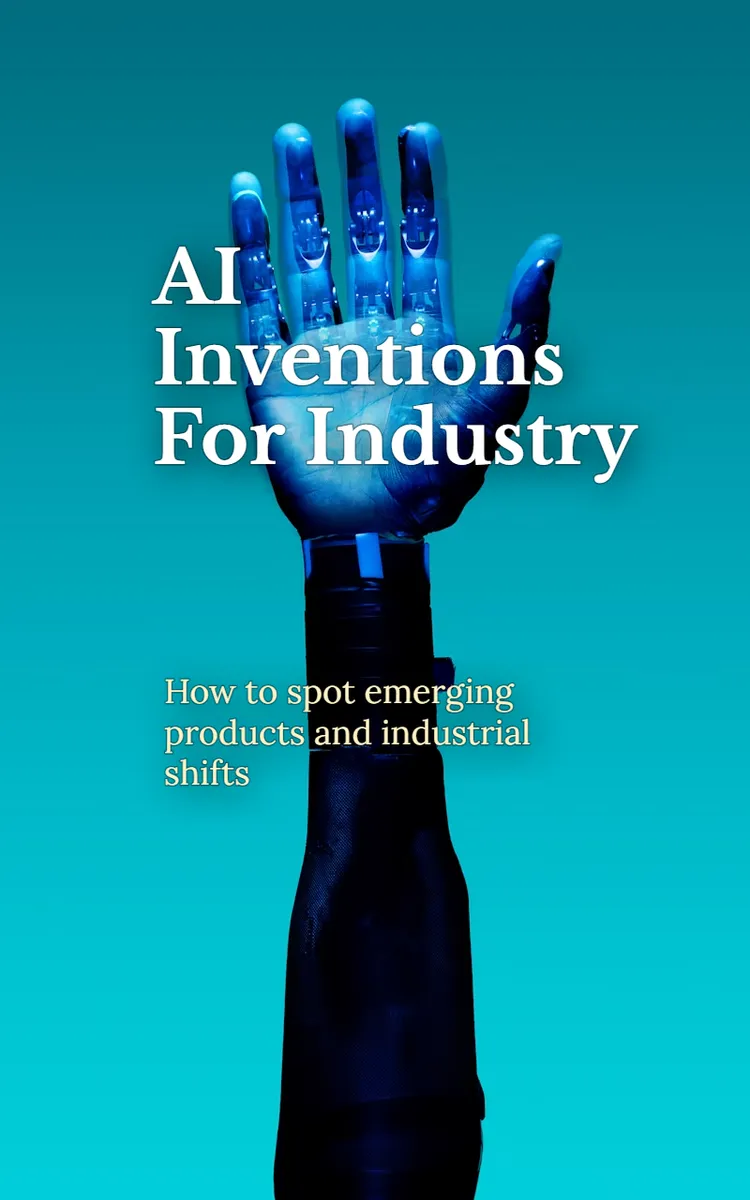
"AI Inventions For Industry" is a curiosity book by Anonymous with 8 chapters and approximately 14,306 words. Identifying likely AI-driven inventions in future products and industrialization.
This book was created using Inkfluence AI, an AI-powered book generation platform that helps authors write, design, and publish complete books.
Frequently Asked Questions
What is "AI Inventions For Industry" about?
Identifying likely AI-driven inventions in future products and industrialization
How many chapters are in "AI Inventions For Industry"?
The book contains 8 chapters and approximately 14,306 words. Topics covered include Factories That Learn From Mistakes, Digital Twins That Predict Failure, The Self-Optimizing Supply Chain Map, AI Robotic Quality That Sees More, and more.
Who wrote "AI Inventions For Industry"?
This book was written by Anonymous and created using Inkfluence AI, an AI book generation platform that helps authors write, design, and publish books.
Write your own curiosity book with AI
Describe your idea and Inkfluence writes the whole thing. Free to start.
Start writingCreated with Inkfluence AI


