
Read the first chapter
The whole of chapter one, free. About 9 min. Turn the pages with the arrows, your keyboard, or a swipe.
Chapter 1
The Fort Closes Behind Them
The rusted sign at Bhangarh’s entrance had lost every letter except a crooked black “H,” which trembled against the stone whenever the wind crossed the gateway.
“Keep moving,” Meera Rathore called. “We have less than three hours before the light goes.”
Her boots struck the worn flagstones as she passed beneath the arch. Behind her, Kabir Sen adjusted the camera case against his hip, while Anil dragged a tripod through the dust with a muttered curse. Dr. Leela Menon followed last, one hand pressed to the scarf covering her mouth. Beyond them, the fort spread across the dry valley in broken courtyards, roofless shops, temples, and dark doorways. The Aravalli hills stood beyond the walls like a row of watching backs.
Meera checked her field watch. Four twenty-seven.
Their permission allowed them to survey the old merchant quarter and the inner passage leading toward the palace ruins. If they reached the marked site before sunset, they could document the carved lintels and compare them with the plans in the Jaipur archive. If they did not, the forest guards would lock the outer gate and return at dawn.
“We should have started at the temples,” Kabir said.
“We started where the permit says we start.”
“The permit says west market. This is the southern gateway.”
“Then the map is wrong.”
Kabir gave her a look. “That is not comforting.”
Meera folded the map against her palm. The paper was new, but the fort had already made it look old. Dust had worked into its creases. A brown stain spread across the corner where she had dropped it near the road.
“Stay close,” she said. “The route is marked from the gateway to the market, then through the inner passage. We document as we go.”
A bell rang somewhere inside the ruins.
The sound was small and clear, a single note that seemed to hang beneath the arch.
Everyone stopped.
Anil’s fingers tightened around the tripod. “There are no bells on the survey plan.”
“Probably metal shifting in the wind,” Leela said.
“There is no wind,” Kabir replied.
Meera looked toward the dark lanes beyond the gateway. The fort’s walls caught the late sunlight in patches, but the spaces between them were already blue with shade. She heard a faint scraping from somewhere ahead, like a sandal being dragged over stone.
“Keep moving,” she repeated, though the words came out quieter.
They entered the first lane. On either side, ruined shops leaned into one another, their plaster facades flayed by weather. A stone idol sat beneath a collapsed awning, its face worn smooth. Meera raised her camera and took three photographs. The flash struck white against the walls.
“Coordinates,” she said.
Kabir lifted the handheld receiver. “Thirty degrees twenty-two minutes north. Seventy-six degrees twenty-four east.”
“That puts us inside the market.”
“It puts us near the market.”
“Near is not useful.”
He turned the receiver toward the lane ahead. The screen flickered, then settled on a blank field.
“Signal is gone.”
Meera took the device from him. The battery indicator showed full. She pressed the side button. A burst of static crackled through the speaker.
“Try the base unit,” Leela said.
“There is only one radio.”
“Exactly.”
Another scrape sounded behind them.
Meera turned sharply. The gateway stood at the end of the lane, framed by the bright road outside. Nothing moved beneath it. The crooked sign tapped once against the stone.
“Did someone come in after us?” Anil asked.
“No,” Meera said.
She did not know that. She knew only that the road beyond the gate was empty when she had looked back ten minutes earlier.
Kabir lowered his voice. “Meera, perhaps we should mark the entrance and return.”
“We have not reached the survey site.”
“The light - ”
“Is still with us.” She pointed to the west, where the sun burned through a gap between the hills. “We have time.”
The map showed a straight route through the market. The ruins offered three passages.
Meera chose the narrowest.
They moved between walls close enough for her shoulder to brush the stone. It was unexpectedly cold beneath her fingertips. The surface was rough with sand and tiny sharp grains that caught at her skin. Above them, a strip of sky faded from gold to a bruised violet.
The lane ended at a courtyard.
“No,” Kabir said. “This is not on the map.”
A dry fountain occupied the center. Four paths opened around it, each guarded by broken pillars. One led back toward the gateway. The other three disappeared into shadow.
Meera unfolded the map again. The inked lines shifted in the failing light, or perhaps her eyes had blurred. She traced the route with her finger.
“West,” she said. “Then north.”
“Which one is west?”
She checked her compass. The needle spun once, twice, and stopped pointing toward the fountain.
Anil gave a nervous laugh. “That cannot be right.”
Meera held the compass flat. The needle trembled beneath its glass.
“Back away from the stone,” she said.
They stepped away. The needle remained fixed on the fountain.
A low thud came from beneath the courtyard.
Dust slipped from the fountain’s rim.
Leela stared at it. “Was that underground?”
Meera crouched beside the basin. A narrow crack ran through the dry stone, black as ink. From below came a faint vibration, almost too soft to hear.
Kabir caught her arm. “Do not touch it.”
“I am not going to touch it.”
The vibration stopped.
For several seconds, no one spoke.
Then the fort darkened.
It did not happen like sunset. There was no gradual dimming, no soft retreat of color. One moment the courtyard held the last copper light; the next, darkness dropped across it as if a door had slammed shut over the sky.
Anil swore. His tripod clattered to the ground.
Meera looked up. The strip of sky above the walls had vanished behind a blackness without stars. The air turned cold enough to sting her teeth. Somewhere far off, a bird gave a single startled cry and fell silent.
Kabir switched on his torch. The beam reached only a few feet before thinning into gray.
“Everyone together,” Meera said. “No one moves without saying so.”
“I am beside you,” Leela whispered.
“Anil?”
“Here.”
“Kabir?”
“Here.”
A fourth voice answered from the passage behind them.
“Here.”
Meera spun around.
The beam swept over the courtyard. Empty fountain. Empty pillars. Empty lane.
Kabir’s face had gone pale. “That was not me.”
The radio in his hand crackled.
A voice emerged through the static, broken by long breaths.
“Meera Rathore.”
Her name seemed to strike the walls and return from every direction.
She snatched the radio from him. “Who is this?”
Only static answered.
“Repeat your transmission,” she said. “Identify yourself.”
A click sounded. Then the voice returned, lower now, as though speaking from the other side of a door.
“Do not take the palace road.”
Leela gripped Meera’s sleeve. “Turn it off.”
Meera pressed the power button. The display went dark.
The speaker continued.
“Do not take the palace road, Meera.”
Anil backed toward the nearest pillar. “How does it know her name?”
“It could be someone monitoring the frequency,” Kabir said, but his explanation lacked its usual certainty. “A prank. A local guide.”
“No one knows we are on this frequency,” Meera said.
The radio hissed again.
“Find the passage beneath the market.”
A hard metallic knock sounded from somewhere beneath their feet.
Meera looked at the fountain.
The voice whispered, “Before the fort closes.”
The transmission died.
For a moment, the only sound was Anil’s breathing.
Then the gateway slammed.
The impact rolled through the ruins like a cannon shot. Meera ran toward it, the others close behind. The lane seemed longer than before. Her torch beam slid over walls that leaned inward, over doorways that had not been there on their way in.
They reached the gateway.
The iron-barred entrance was shut. Beyond it, the road and the hills had disappeared. A wall of packed darkness filled the opening.
Anil seized the bars. “It was open.”
“Move aside.” Meera shoved her shoulder against the gate. The metal did not shift. It was cold and wet beneath her hands, though no rain had fallen.
Kabir looked over his shoulder. “Meera.”
At the far end of the lane, a pale shape stood beneath an arch.
It was too tall to be a person and too narrow to be a pillar. The torchlight did not touch it. When Meera blinked, it was gone.
“Back to the courtyard,” she said.
“You saw that,” Anil whispered.
“Back.”
They returned to the fountain. The compass still pointed toward the cracked basin. Meera knelt and ran her fingers along the stone rim. Beneath the dust, someone had carved a line of small triangles. The marks formed a border around a section of masonry at the fountain’s base.
Kabir crouched beside her. “That was not in the photographs.”
“It was covered.”
“With what?”
Meera scraped away the dirt. Her fingernails struck metal.
A ring was set into the stone.
Leela shook her head. “That is not possible.”
Meera wedged the end of her flashlight beneath it and pulled. The stone groaned. A square slab lifted half an inch, releasing a breath of air that smelled of wet earth and old ash.
Underneath lay a narrow stairway.
Anil stared into the opening. “That is the passage?”
“It leads somewhere,” Meera said.
“Or it leads under the fort.”
“We cannot stay here.”
Kabir caught her wrist. “The voice told us to find it.”
“I heard.”
“And you still want to go down?”
Meera looked at the sealed gateway, then at the black opening beneath the fountain. The darkness behind the bars seemed to press inward. From somewhere beyond the walls came the faint sound of footsteps, slow and measured, approaching along a lane they could not see.
She pulled free of Kabir’s grip.
“Light the stair,” she said.
One by one, they descended.
The steps were steep and uneven. Water slicked the edges, soaking through Meera’s boots. The ceiling lowered until she had to bend her head. Behind them, the slab remained open, a square of darkness above the stairwell.
Halfway down, Kabir stopped.
“What?” Meera asked.
He pointed upward.
The slab was moving.
No one stood above it. No hand touched the stone. Yet it was sliding back into place with a slow, grinding certainty.
“Keep going,” Meera said.
“We cannot leave it open.”
“Keep going!”
They hurried down. The slab sealed overhead just as Meera reached the bottom.
The sound of stone locking into stone traveled through the passage.
They stood in a chamber scarcely wider than a corridor. The walls were carved with faded figures: dancers, merchants, horses, and a line of faces with their mouths scratched away. At the far end, a doorway opened into deeper blackness.
Meera lifted her torch. On the floor lay a strip of paper, protected from the damp beneath a flat stone.
She picked it up.
The paper was torn from their own field notebook.
Across it, in Kabir’s handwriting, was a sentence none of them had written:
DO NOT ANSWER WHEN IT CALLS.
The radio crackled in Meera’s hand.
Kabir stared at it. “You turned it off.”
“I know.”
Static filled the passage. Then the voice came through, clearer than before, close enough to sound beside her ear.
“Meera Rathore.”
She could not move.
The voice took a breath.
“You found the way in.”
Behind them, the sealed stone gave a single heavy knock.
The voice continued.
“Now find the way out.”
End of chapter one. 4 more chapters and about 9,808 words in the full book.
Swipe or use the arrows to turn the page
What's inside: 5 chapters
- 1. The Fort Closes Behind Them
- 2. The Voice on the Recording
- 3. Footsteps in the Empty Market
- 4. The Map Beneath the Shrine
- 5. The Night the Bells Rang
About this book
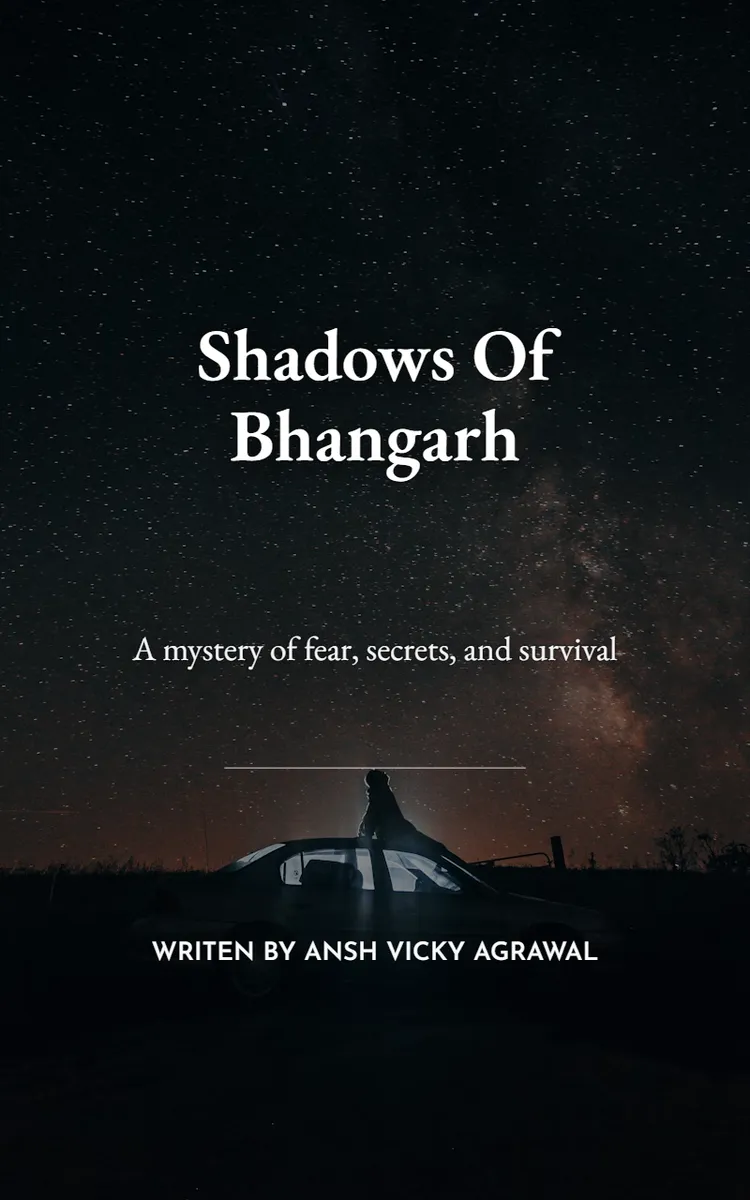
"Shadows Of Bhangarh" is a fiction book by WRITEN BY ANSH VICKY AGRAWAL with 5 chapters and approximately 9,808 words. Researchers encounter eerie and frightening events at Bhangarh Fort in Rajasthan.
This book was created using Inkfluence AI, an AI-powered book generation platform that helps authors write, design, and publish complete books. It was made with the AI Novel Writer.
Frequently Asked Questions
What is "Shadows Of Bhangarh" about?
Researchers encounter eerie and frightening events at Bhangarh Fort in Rajasthan
How many chapters are in "Shadows Of Bhangarh"?
The book contains 5 chapters and approximately 9,808 words. Topics covered include The Fort Closes Behind Them, The Voice on the Recording, Footsteps in the Empty Market, The Map Beneath the Shrine, and more.
Who wrote "Shadows Of Bhangarh"?
This book was written by WRITEN BY ANSH VICKY AGRAWAL and created using Inkfluence AI, an AI book generation platform that helps authors write, design, and publish books.
How can I create a similar fiction book?
You can create your own fiction book using Inkfluence AI. Describe your idea, choose your style, and the AI writes the full book for you. It's free to start.
Write your own fiction book with AI
Describe your idea and Inkfluence writes the whole thing. Free to start.
Start writingCreated with Inkfluence AI


