
Read the first chapter
The whole of chapter one, free. About 4 min. Turn the pages with the arrows, your keyboard, or a swipe.
Chapter 1
Nuclear Spins and Larmor Frequency
Chapter 1: Nuclear Spins and Larmor Frequency
Key Concepts
This chapter covers how hydrogen nuclei behave in a magnetic field and why they precess at a specific frequency. You need to know the Larmor relationship because it explains how MRI selects and excites hydrogen nuclei.
• Hydrogen nuclei contain one proton with spin and angular momentum.
• In the main magnetic field, called B0, proton magnetic moments partly align:
• Parallel: lower energy
• Antiparallel: higher energy
• The proton does not simply point straight along B0. It precesses, like a spinning top wobbling around an axis.
• Larmor frequency is the frequency of this precession.
• Formula: f = γB0
• For hydrogen:
• γ/2π ≈ 42.58 MHz/T
• At 1.5 T: about 63.9 MHz
• At 3 T: about 127.7 MHz
• Increasing B0 increases Larmor frequency in direct proportion.
Before you continue: Can you explain why the Larmor frequency is higher at 3 T than at 1.5 T?
Key Terms
Nuclear spin - Intrinsic angular momentum of a nucleus.
Magnetic moment - The magnetic property produced by a spinning charged nucleus.
Precession - Circular wobbling of a proton’s magnetic moment around B0.
B0 - The main static magnetic field of the MRI scanner.
Larmor frequency - The precession frequency of a nucleus in a magnetic field.
Gyromagnetic ratio (γ) - A constant linking a nucleus’s Larmor frequency to magnetic-field strength.
Active Recall
Nuclear spin
__________________________________________________
__________________________________________________
Magnetic moment
__________________________________________________
__________________________________________________
Precession
__________________________________________________
__________________________________________________
B0
__________________________________________________
__________________________________________________
Larmor frequency
__________________________________________________
__________________________________________________
Gyromagnetic ratio (γ)
__________________________________________________
__________________________________________________
Worked Examples
1. Calculate frequency at 1.5 T
• Use the hydrogen value: 42.58 MHz/T.
• Multiply by field strength: 42.58 × 1.5.
• Result: 63.87 MHz, approximately 63.9 MHz.
Now you try: Calculate the hydrogen Larmor frequency at 2 T.
__________________________________________________
__________________________________________________
__________________________________________________
2. Compare 1.5 T and 3 T
• The field strength doubles: 3 ÷ 1.5 = 2.
• The Larmor frequency also doubles.
• 63.9 MHz × 2 = 127.8 MHz.
• Therefore, hydrogen resonates at approximately 127.7-127.8 MHz at 3 T.
Now you try: If the frequency is 42.58 MHz at 1 T, what is it at 4 T?
__________________________________________________
__________________________________________________
__________________________________________________
Practice Questions
• (Easy) Define precession.
__________________________________________________
__________________________________________________
__________________________________________________
• (Easy) State the formula linking Larmor frequency and magnetic-field strength.
__________________________________________________
__________________________________________________
__________________________________________________
• (Medium) Calculate the hydrogen frequency at 1.5 T.
__________________________________________________
__________________________________________________
__________________________________________________
• (Medium) Explain what happens to Larmor frequency when B0 increases.
__________________________________________________
__________________________________________________
__________________________________________________
• (Hard) Explain why an MRI scanner must match its radiofrequency pulse to the Larmor frequency.
__________________________________________________
__________________________________________________
__________________________________________________
Answer Key
• Circular wobbling of a proton’s magnetic moment around B0.
• f = γB0.
• 42.58 × 1.5 = 63.87 MHz, approximately 63.9 MHz.
• It increases directly and proportionally.
• Matching the frequency allows efficient energy transfer and excites hydrogen nuclei into resonance.
Exam Tips & Common Mistakes
• Do not confuse spin with the proton physically rotating like a tiny ball. Spin is an intrinsic quantum property.
• Do not state that all nuclei point in exactly the same direction. Alignment is slightly biased toward the lower-energy parallel state.
• Do not confuse frequency with field strength. Frequency changes because B0 changes.
• Always include units: MHz/T, MHz, or tesla (T).
• Markers expect the phrase “directly proportional” when describing the Larmor relationship.
• Show the formula, substitution, calculation, and unit in numerical answers.
• In longer answers, link resonance to matching the RF pulse with the hydrogen Larmor frequency.
Quick Reference
Key rules
• f = γB0
• Hydrogen: 42.58 MHz/T
• 1.5 T → 63.9 MHz
• 3 T → 127.7 MHz
• Double B0 → double Larmor frequency.
Mnemonic
“Higher B, higher beat.”
A higher magnetic field produces a higher precession frequency.
Remember
• Hydrogen protons have spin and magnetic moments.
• In B0, protons precess around the field direction.
• Larmor frequency depends directly on B0.
• RF excitation must match the Larmor frequency.
Confidence Check
• I can define nuclear spin. [ ] 1 [ ] 2 [ ] 3 [ ] 4 [ ] 5
• I can explain precession. [ ] 1 [ ] 2 [ ] 3 [ ] 4 [ ] 5
• I can
explain Larmor frequency. [ ] 1 [ ] 2 [ ] 3 [ ] 4 [ ] 5
• I can use f = γB0 to calculate frequency. [ ] 1 [ ] 2 [ ] 3 [ ] 4 [ ] 5
• I can explain why RF must match the Larmor frequency. [ ] 1 [ ] 2 [ ] 3 [ ] 4 [ ] 5
• Exam Practice: Define precession, calculate hydrogen frequency at 1.5 T, and explain why RF must match the Larmor frequency.
• Exam Tips: Use “directly proportional,” show units, and show each calculation step.
• Remember: Higher B0 means higher Larmor frequency; hydrogen is approximately 42.58 MHz/T.
End of chapter one. 9 more chapters and about 9,261 words in the full book.
Swipe or use the arrows to turn the page


What's inside: 10 chapters
- 1. Nuclear Spins and Larmor Frequency
- 2. Relaxation Times T1 and T2
- 3. RF Pulses and Flip Angle
- 4. k-Space and Fourier Image Formation
- 5. Gradient Fields and Spatial Encoding
- 6. Pulse Sequences: Spin Echo vs GRE
- 7. Contrast Weighting: T1, T2, PD
- 8. Artifacts: Motion, Susceptibility, Aliasing
- 9. GE MRI System Basics and Signatures
- 10. Philips MRI System Basics and Differences
About this book
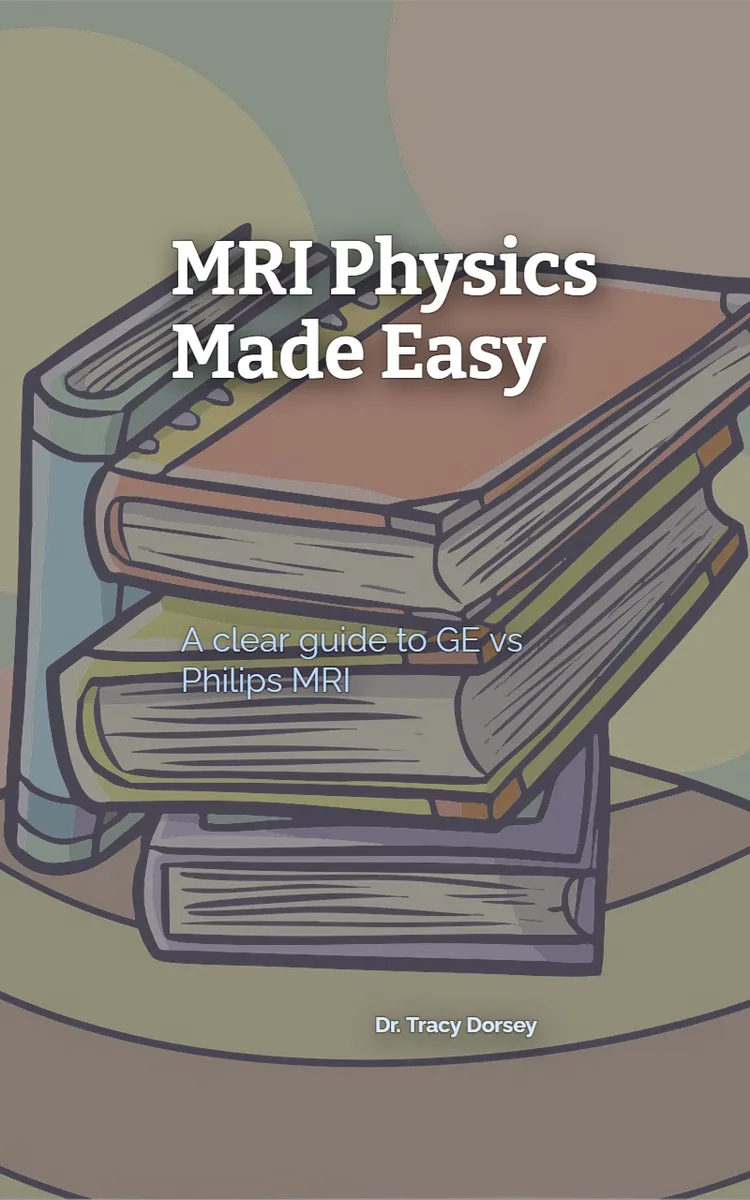
"MRI Physics Made Easy" is a study guide book by Dr. Tracy Dorsey with 10 chapters and approximately 9,261 words. MRI physics basics and differences between GE and Philips machines.
This book was created using Inkfluence AI, an AI-powered book generation platform that helps authors write, design, and publish complete books. It was made with the Study Guide Generator.
Frequently Asked Questions
What is "MRI Physics Made Easy" about?
MRI physics basics and differences between GE and Philips machines
How many chapters are in "MRI Physics Made Easy"?
The book contains 10 chapters and approximately 9,261 words. Topics covered include Nuclear Spins and Larmor Frequency, Relaxation Times T1 and T2, RF Pulses and Flip Angle, k-Space and Fourier Image Formation, and more.
Who wrote "MRI Physics Made Easy"?
This book was written by Dr. Tracy Dorsey and created using Inkfluence AI, an AI book generation platform that helps authors write, design, and publish books.
How can I create a similar study guide book?
You can create your own study guide book using Inkfluence AI. Describe your idea, choose your style, and the AI writes the full book for you. It's free to start.
Write your own study guide book with AI
Describe your idea and Inkfluence writes the whole thing. Free to start.
Start writingCreated with Inkfluence AI


