
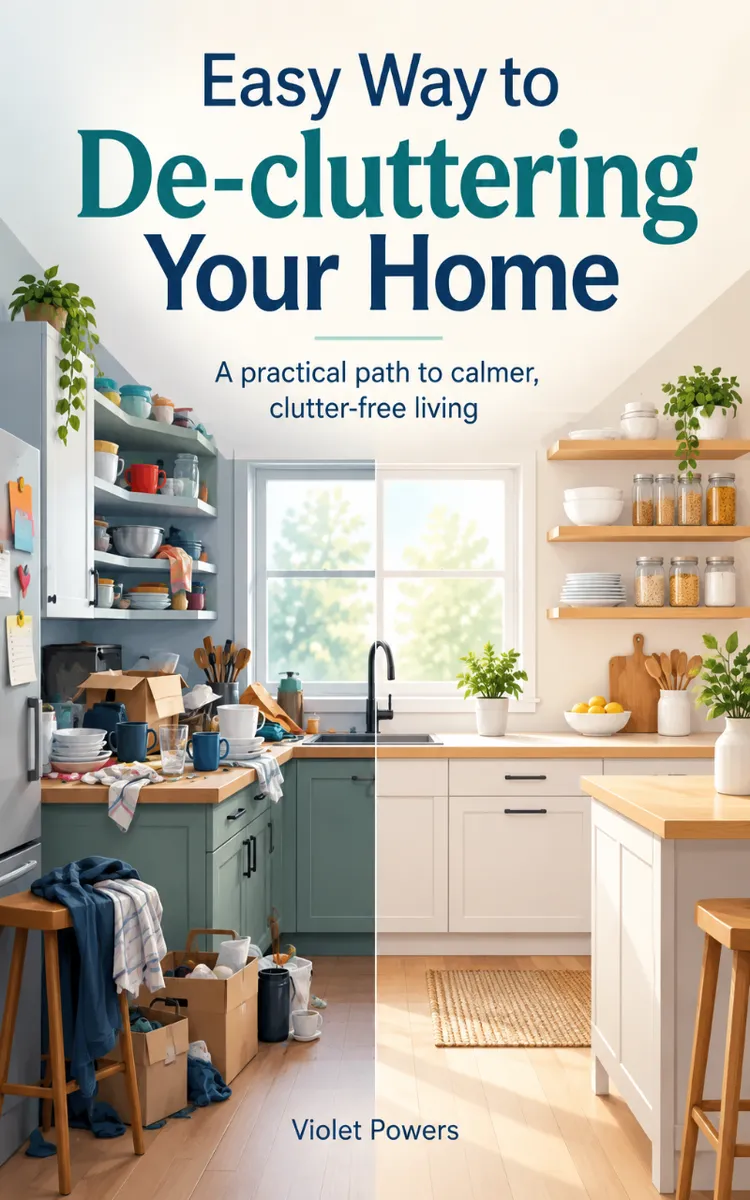

Read the first chapter
The whole of chapter one, free. About 9 min. Turn the pages with the arrows, your keyboard, or a swipe.
Chapter 1
Setting Decluttering Goals
Give Your Clearer Home a Direction
On Saturday morning, a kitchen table can disappear under unopened mail, school papers, shopping bags, and a small appliance that has not been used in months. The mess may look like one large problem, but it usually contains several smaller decisions: What needs to stay nearby? What can leave the house? Which area causes the most daily trouble? Without clear answers, decluttering turns into moving piles from one surface to another.
A clearer home does not mean an empty home. It means your rooms support the way you live, and the items you keep have a sensible place. Before you sort a drawer or fill a donation bag, you need to decide what “clearer” means for you, which change matters most, and how much time you can give without exhausting yourself.
The Clear Home Compass gives you that direction. You will define your target, choose a first priority, and set a pace that fits your real schedule. You will also know when a small area is finished, so you can stop sorting with a clear result instead of an unfinished house spread across every room. Before touching any belongings, write one sentence describing the home you want to use more easily.
Use the Clear Home Compass
The Clear Home Compass has three parts: purpose, priority, and pace. Purpose describes how you want the home to work. Priority identifies the area that will give you the most useful improvement. Pace sets the amount of work you can repeat without creating new piles or resentment.
Start with purpose by observing a normal day. Do not judge the room yet. Notice where the home slows you down. Perhaps you cannot prepare breakfast because the counter holds mail and rarely used equipment. Perhaps you avoid the hallway closet because coats fall out when you open the door. Perhaps bedtime takes longer because clean clothes sit in baskets instead of drawers. These details show what a clearer home needs to do.
Write a purpose statement using this pattern: “I want the _ to make _ easier.” For example, “I want the kitchen counter to make breakfast preparation easier,” or “I want the entryway to make leaving the house easier.” Keep the statement specific. “I want the whole house to feel better” may sound true, but it cannot tell you what to keep, remove, or rearrange.
Next, choose a priority. A priority is the area that deserves attention first because it creates frequent trouble or blocks an important activity. Use these three questions:
• Which area causes trouble most often? Choose the place you deal with every day, such as the kitchen counter or the front-door floor. Frequent contact makes a small improvement useful right away.
• Which area supports an important routine? Choose the space connected to cooking, sleeping, washing, working, or leaving home. A clearer routine gives you a practical reason to make decisions.
• Which area can you finish in one to three sessions? Choose a contained target, such as one shelf, one drawer, or one surface. A finishable target prevents the common mistake of emptying an entire room without enough time to complete it.
If two areas seem equally important, choose the smaller one. Finishing a single bathroom cabinet teaches you how to make decisions and gives you a working result. Starting with every cabinet in the house creates too many open choices at once. Your first goal is not to transform the home. Your first goal is to prove that your plan works.
Finally, set your pace. Count the time you can give during an ordinary week, not during an unusually free weekend. A realistic plan might include three sessions of 25 minutes. A 25-minute session gives you enough time to sort a small area while leaving time to put items away. Best to use an alarm to remind you of your time. If you have only 10 minutes, use that time for one drawer or one category. End each session with a five-minute reset so the area looks more orderly than when you began.
Ask yourself, “Can I repeat this plan next week?” If the answer is no, reduce the target or shorten the session. A manageable pace matters because decluttering decisions require attention. When you work past your limit, you may keep items simply to finish faster, create a donation pile you cannot transport, or leave the room in a worse state. The Clear Home Compass points toward useful change, not maximum effort.
Apply the Compass to One Problem Area
Consider a household where the entryway creates a daily bottleneck. Three people use the front door. Shoes collect on the floor, four coats hang from two hooks, and a narrow bench holds bags and unopened mail. The goal does not need to cover the entire hallway. The goal can be: “I want the entryway to make leaving home easier in the morning.”
Use the following steps before sorting:
• Record the current problem. Stand at the door during the busiest part of the day and note what blocks movement. In this example, shoes cover about 6 square feet of floor, and bags sit on the bench. This measurement matters because the target becomes clear: restore a walking path and a usable seat.
• Choose the first boundary. Work on the floor, bench, and two hooks only. Leave the nearby closet for another time. A boundary keeps the project small enough to finish and prevents items from spreading into other rooms.
• Set the work limit. Schedule two 25-minute sessions on Tuesday and Thursday. Reserve five minutes at the end of each session for returning keepers to their places and removing rubbish. The expected outcome is a finished entryway, not a half-sorted closet.
• Define the decisions. Label four temporary groups: keep here, keep elsewhere, give away, and discard. “Keep here” means the item supports leaving or arriving and deserves space in the entryway. “Keep elsewhere” means you want the item but that item(s) don't belong in that area.
• Set a capacity rule. Decide how much the space can hold before sorting. For example, the shoe rack holds eight pairs, the hooks hold three coats, and the bench must remain clear except for one small basket. Capacity gives you a fair reason to choose. If twelve pairs of shoes compete for eight spaces, four pairs need another solution.
• Stop at the planned time. At the end of each session, put the “keep here” items away, carry the “keep elsewhere” group to its proper rooms, and place rubbish in the bin. Put the giveaway group in a labeled bag near the exit. The expected outcome is a usable doorway even if later decisions remain elsewhere.
After two sessions, check the purpose statement. Can each person enter and leave without stepping around shoes? Can someone sit on the bench? Can you find the keys or bags without moving unrelated items? If yes, the priority area has met its purpose. You may then choose the next area, but do not expand the first project just because you still have energy. Stopping at a clear finish protects the pace you planned.
Quick checklist
• Write one sentence describing what you want the area to make easier.
• Choose one contained target, such as a surface, drawer, shelf, or small zone.
• Note the daily problem and, when useful, measure the space.
• Decide how much the space can hold before sorting.
• Schedule sessions that fit your normal week.
• Use four groups: keep here, keep elsewhere, give away, and discard.
• Finish each session by removing rubbish and relocating items.
• Check whether the area now supports its intended routine.
The practical test is simple: use the space during the routine you named. A clearer entryway should help you leave. A clearer counter should help you prepare food. If the space looks tidy but still slows you down, adjust the purpose or capacity rule rather than starting a larger project.
Avoid Plans That Collapse
Choosing the whole house as the first priority
A whole-house goal sounds efficient, but it gives you too many decisions and no clear stopping point. You may empty the living room, hallway, and bedroom at once, then run out of time before you can return anything.
Do this: Choose one visible, contained target that you can finish in one to three sessions.
Not this: Remove every item from a room because you hope a complete reset will feel faster.
If you want a broad result, connect it to a small first win. “Make the home easier to leave” can begin with the entryway floor and bench. Once those areas work, you can select the next part of the routine.
Setting a pace based on an ideal week
Planning a six-hour Saturday session may fail when errands, work, illness, or family needs take priority. An abandoned plan leaves sorting bags in the way and makes the home feel less settled.
Do this: Look at the next seven days and schedule the time you can honestly protect. Use two 20-minute sessions if that is what your week allows.
Not this: Promise a full-day project because you feel determined today.
Keep a small “next action” note with the project. Write a task such as “sort the top shelf for 20 minutes,” not “finish the closet.” A precise task makes it easier to restart without rereading your entire plan.
If you have 25 minutes free and the energy chose one area and work on that.
Confusing a tidy appearance with a useful purpose
You can hide mail in a drawer, stack shoes in a basket, or move kitchen equipment into a cabinet and still leave the daily problem untouched. The room may look better for an hour, but the same items will return because the space does not support the routine.
Do this: Test the area during its intended use. If the goal involves breakfast, prepare breakfast there. If the goal involves leaving home, gather keys, shoes, and bags at the door.
Not this: Judge success only by whether the surface looks empty.
When an item repeatedly lands in the wrong place, treat that pattern as information. The item may need a closer home, a smaller category, or a decision about whether it belongs at all. Your Compass should guide those choices.
Allowing a sentimental or uncertain item to control the schedule
Some belongings require more thought: letters, inherited dishes, children’s artwork, or clothing connected to a past event. If you stop every few minutes to make an emotional decision, a 25-minute session can disappear without improving the target area.
Do this: Place uncertain items in a clearly labeled review box and write a date for a separate decision session. Keep the review box limited to the items from that project.
Not this: Create an unlabeled pile that travels from room to room.
The review box protects both the pace and the decision. You do not force a rushed choice, but you also do not let uncertainty fill the space you are trying to clear.
A clearer home begins with a clear direction: one purpose, one priority, and one repeatable pace. Write your Compass before sorting begins, then let the finished area prove what works. Each useful decision makes the next part of the home easier to understand and easier to organize.
End of chapter one. 7 more chapters and about 14,615 words in the full book.
Swipe or use the arrows to turn the page


What's inside: 8 chapters
- 1. Setting Decluttering Goals
- 2. Sorting Items with Four Decisions
- 3. Decluttering One Room at a Time
- 4. Clearing Closets and Clothing
- 5. Organizing Kitchens and Pantries
- 6. Managing Paper and Household Documents
- 7. Choosing Storage That Prevents Clutter
- 8. Maintaining a Clutter-Free Home
About this book
"Easy Way to De-cluttering Your Home" is a how-to guide book by Violet Powers with 8 chapters and approximately 14,615 words. Practical methods for decluttering and organizing a home.
This book was created using Inkfluence AI, an AI-powered book generation platform that helps authors write, design, and publish complete books. It was made with the AI Ebook Generator.
Frequently Asked Questions
What is "Easy Way to De-cluttering Your Home" about?
Practical methods for decluttering and organizing a home
How many chapters are in "Easy Way to De-cluttering Your Home"?
The book contains 8 chapters and approximately 14,615 words. Topics covered include Setting Decluttering Goals, Sorting Items with Four Decisions, Decluttering One Room at a Time, Clearing Closets and Clothing, and more.
Who wrote "Easy Way to De-cluttering Your Home"?
This book was written by Violet Powers and created using Inkfluence AI, an AI book generation platform that helps authors write, design, and publish books.
How can I create a similar how-to guide book?
You can create your own how-to guide book using Inkfluence AI. Describe your idea, choose your style, and the AI writes the full book for you. It's free to start.
Write your own how-to guide book with AI
Describe your idea and Inkfluence writes the whole thing. Free to start.
Start writingCreated with Inkfluence AI


