
Read the first chapter
The whole of chapter one, free. About 7 min. Turn the pages with the arrows, your keyboard, or a swipe.
Chapter 1
UX Leadership Mindset for Owners
What if your biggest product problem still sits in the same place every week: “Users don’t get it,” “Sales can’t explain it,” and “Support keeps repeating the same questions” - but you keep treating UX like a design preference instead of a leadership job?
If you run a business, you already know the cost of that mindset. You patch screens, ship features, and hope the next release fixes the churn. You hear “UX” mentioned in meetings right after timelines and budgets, as if it only matters when you have spare time. The real problem isn’t that UX teams fail; it’s that owners set the wrong expectations about what UX is for. You need UX to reduce friction, clarify value, and protect revenue - not decorate the interface.
After this chapter, you’ll be able to shift from “nice-to-have UX” to UX leadership you can run: you’ll learn the specific mindset changes that make UX a business lever, you’ll use a simple owner-ready framework called the Compass-First Leadership Model, and you’ll leave with a first-week plan for setting the rules, questions, and decision habits that move outcomes.
How to turn UX into a leadership practice (not a design task)
UX becomes “nice-to-have” when owners treat it like output (“we need a new screen”) instead of decision support (“we need to choose the right direction”). That mindset breaks because it hides the link between user experience and business results. Your team can’t prove impact if you never ask for it. Your designers can’t prioritize if you never set what “good” means in your business language.
Consider Nadia, 34, founder of a B2B SaaS startup. Her team shipped fast, but every release created a new wave of tickets: “How do I do X?” “Where did Y go?” “Why can’t I see my report?” Her churn wasn’t spiking dramatically; it just refused to improve. In meetings, UX got defended as effort: “We did our best.” Nadia eventually realized the deeper issue: nobody owned the questions that connect UX decisions to revenue risk. She didn’t need a bigger design team. She needed clearer leadership.
The shift starts with how you frame UX in your company. You stop asking, “Did the design look good?” and you start asking, “Did we remove the reasons people get stuck?” That sounds like a small wording change, but it changes what your team measures, what they propose, and what you approve. You give UX a job: reduce avoidable friction in the moments that affect activation, retention, and expansion. Then you back that job with rules you actually enforce.
Use the Compass-First Leadership Model to make this real. It gives you an owner’s way to steer UX decisions using five “compass points” you can set in writing and revisit every week:
1. North Star Outcomes (pick one business outcome to protect) Define one outcome UX will influence right now, in plain business terms. For a B2B SaaS founder, that might be “reduce time-to-first-value” or “increase trial-to-paid conversion.” Explain why this outcome matters to cash flow, not just user satisfaction.
2. Friction Maps (name the exact moments users struggle) List the top three moments where users stall or ask for help. Use your real data: support ticket titles, calls logged by sales, and onboarding drop-off points from your analytics. You’re not collecting “insights”; you’re naming friction so your team can target it.
3. Decision Questions (force trade-offs to get answered) Before shipping, require answers to a small set of questions. For example: “Will this reduce steps to the action?” “Will this change user expectations?” “What will we measure in two weeks to know it worked?” Decision questions stop debates from turning into opinions.
4. Evidence Rhythm (run a repeatable check, not one-off reviews) Set a cadence that matches the speed of software. For Nadia, that could mean a weekly 30-minute UX outcome review and a biweekly “ship-or-stop” decision meeting. Evidence rhythm trains the team to connect UX work to measurable change.
5. Ownership Contracts (who decides, who contributes, who owns the outcome) Assign decision rights. The UX lead can propose; you decide trade-offs. Product owns scope. Support owns the recurring pain signals. This prevents “everyone cares” and “nobody decides,” which kills UX impact.
This model works because it forces UX to live inside your decision system. You don’t ask your designers to convince you with taste. You ask them to steer with evidence and clear trade-offs toward outcomes you care about.
Putting it into practice with Nadia’s first 14 days
Here’s a realistic way to apply the Compass-First Leadership Model when your company already has momentum and schedules. Nadia didn’t pause product development for “a UX initiative.” She ran a tight setup sprint that changed how decisions got made.
Step-by-step plan (14 days)
1. Write North Star Outcomes in one sentence Nadia picked one: “Improve trial users’ ability to complete setup and reach their first core report within the first week.” She tied it to revenue risk: delayed value meant fewer users tried the workflow that drives expansion.
2. Collect friction signals without building a new system She pulled the last 30 days of support tickets and grouped them by what users tried to do. She also skimmed the most common “stuck” messages from onboarding and sales calls. The goal: identify three friction moments, not twenty observations.
3. Create a simple Friction Map with three moments Nadia mapped: - Moment A: connecting the data source - Moment B: finding the right report configuration - Moment C: understanding why the report looked empty at first She wrote one sentence under each: “This is what users expect, and this is what they experience instead.”
4. Set Decision Questions for the next release For the next feature she required UX to answer: - “Does this remove a step or shorten a path to Moment A/B/C?” - “Does this reduce confusion risk (labels, empty states, navigation)?” - “What will we measure two weeks after release?” She used these questions to approve or reject proposals fast.
5. Start Evidence Rhythm immediately Nadia scheduled: - Weekly 30-minute UX outcome review (support + product + design lead) - Biweekly ship-or-stop check for the targeted friction moment She didn’t wait for “big results.” She looked for direction: fewer tickets tied to the moment, improved completion rates, and reduced “where do I click” questions.
6. Define Ownership Contracts for the friction moment She set: - UX lead owns the friction map updates and proposed fixes - Product owner owns scope trade-offs - Support lead owns the top ticket themes and ensures they get tagged to Moments A/B/C - Nadia owns go/no-go decisions based on evidence and trade-offs
Quick checklist (do this with your team)
• Pick one North Star Outcome for UX to protect in the next 30 days. - Identify exactly three friction moments using support and real user behavior. - Require the same Decision Questions before you approve UX changes. - Run a weekly evidence check and a biweekly ship-or-stop decision. - Assign ownership contracts so decisions don’t dissolve into group discussion.
Expected outcome after two weeks: your next release proposals sound different. UX work stops getting described as “redesigning screens” and starts getting described as “fixing Moment B confusion by changing labels and the empty-state flow,” plus “we will see fewer tickets about report configuration.”
What to watch for (and how to fix it fast)
Even strong teams hit predictable edge cases when owners introduce UX leadership. Here are the three most common mistakes Nadia saw, plus what to do instead.
Mist: You define UX as “making the product nicer.” If your North Star Outcomes stay vague, your UX team will optimize for what looks good, not what reduces friction. You’ll get polished screens and no change in support volume or conversion. Do this: force one outcome sentence and one measurable proxy tied to a friction moment (for example, “fewer tickets about report configuration” tied to Moment B). Not this: ask for “improvements to onboarding” without naming the exact place users get stuck.
Mist: You collect feedback, but you don’t change decisions. Owners often run user interviews or review analytics once, then keep approving work the same way. The team learns that evidence doesn’t matter; it just fills time. Do this: add Decision Questions to your approval step. If the proposal can’t answer “what will we measure in two weeks,” you delay approval and ask the team to refine the plan. Not this: run a research sprint and then revert to “we’ll see how it goes” when it’s time to ship.
Mist: You overload UX with too many priorities. When you ask UX to fix five moments at once, you dilute impact and confuse the evidence rhythm. The team can’t tell what caused movement. Nadia learned this when she tried to address setup, navigation, and reporting in the same release. Everything looked busy; results looked flat. Do this: choose one friction moment for the next biweekly ship-or-stop check. Treat the others as a backlog you revisit after you prove direction. Not this: spread effort across multiple moments because “everything feels important.”
Your UX leadership mindset becomes real when you stop treating UX as a department output and start treating it as a decision practice. When you run the Compass-First Leadership Model, you create a repeatable way to steer toward outcomes you can feel in the business: fewer repeat questions, faster onboarding, clearer value, and fewer revenue leaks caused by confusion.
Take one action today: write your one-sentence North Star Outcome and your three friction moments on a single page, then bring it to your next product meeting with one Decision Question you will enforce for the next release. That one page will become your compass - and it will carry you into the next steps of building a UX team that can lead with confidence, not just deliver design work.
End of chapter one. 4 more chapters in the full book.
Swipe or use the arrows to turn the page
What's inside: 5 chapters
- 1. UX Leadership Mindset for Owners
- 2. Building a UX Team Operating Rhythm
- 3. Translating Strategy into UX Priorities
- 4. Decision-Making with Evidence and Tradeoffs
- 5. Scaling UX Quality with Metrics
About this book
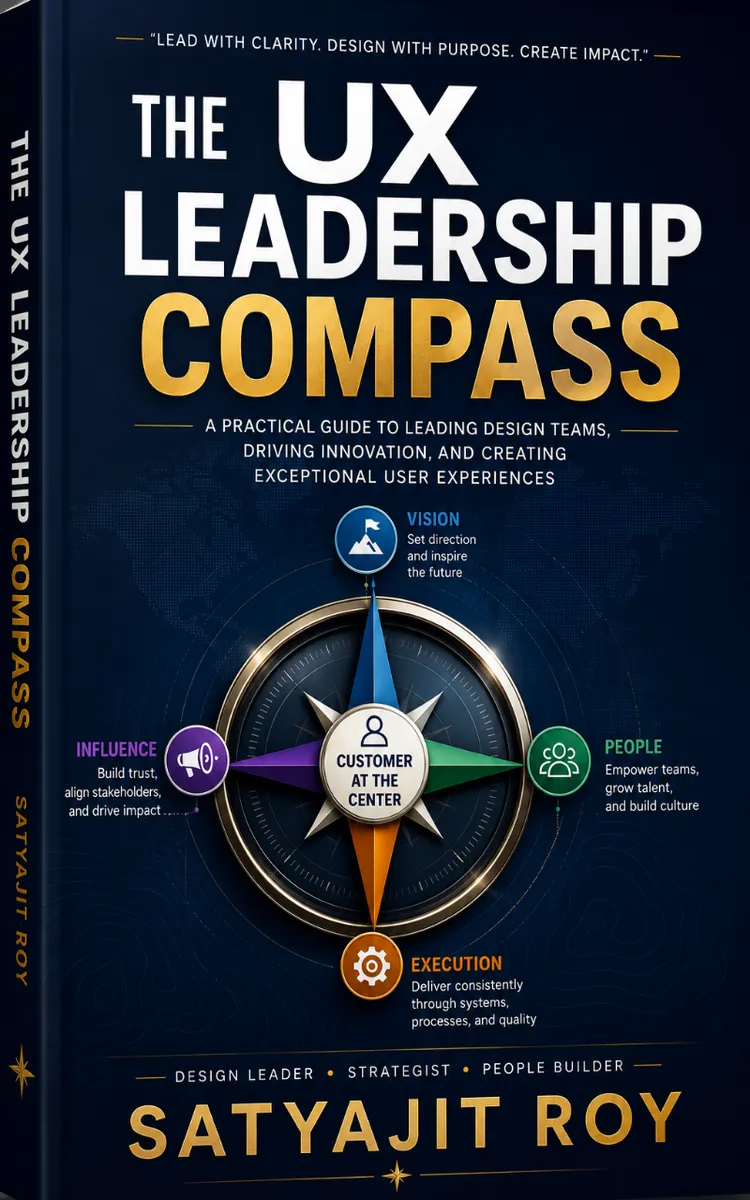
"UX Leadership Compass" is a business book by Satyajit Roy with 5 chapters and approximately 10,689 words. Guidance for leading UX teams, strategy, and decision-making.
This book was created using Inkfluence AI, an AI-powered book generation platform that helps authors write, design, and publish complete books. It was made with the AI Business Book Writer.
Frequently Asked Questions
What is "UX Leadership Compass" about?
Guidance for leading UX teams, strategy, and decision-making
How many chapters are in "UX Leadership Compass"?
The book contains 5 chapters and approximately 10,689 words. Topics covered include UX Leadership Mindset for Owners, Building a UX Team Operating Rhythm, Translating Strategy into UX Priorities, Decision-Making with Evidence and Tradeoffs, and more.
Who wrote "UX Leadership Compass"?
This book was written by Satyajit Roy and created using Inkfluence AI, an AI book generation platform that helps authors write, design, and publish books.
How can I create a similar business book?
You can create your own business book using Inkfluence AI. Describe your idea, choose your style, and the AI writes the full book for you. It's free to start.
Write your own business book with AI
Describe your idea and Inkfluence writes the whole thing. Free to start.
Start writingCreated with Inkfluence AI


