
Read the first chapter
The whole of chapter one, free. About 4 min. Turn the pages with the arrows, your keyboard, or a swipe.
Chapter 1
John 3:17: The Heart of God Behind the Message
When you read John 3:17, it’s like God pulls the curtain back and tells you what He’s really aiming at. Not your punishment. Your rescue. That one sentence has a way of cutting through the fog of “Maybe I’m not forgiven because I’m still struggling.”
John 3:17 > “For God did not send his Son into the world to condemn the world, but to save the world through him.”
Before you interpret your failures as condemnation, let’s slow down and listen to the purpose statement God gave us.
Scripture Focus
God’s heart behind the message is right there: Jesus wasn’t sent to sentence the world. He was sent to save it. That means forgiveness isn’t a reward for being “good enough.” Forgiveness is rooted in God’s character - His desire to rescue - rather than in your performance.
A helpful way to hold this verse is to notice the contrast: condemn versus save. Condemnation points to guilt that can’t be undone. Saving points to a rescue that gets you out. And in John’s Gospel, Jesus keeps returning to the same theme: God doesn’t throw people away; He draws them in.
So if you’ve ever wrestled with the thought, “God must be disappointed in me again,” pause and ask, “What does John 3:17 say God sent Jesus to do?” The answer is salvation - through Him.
Reflection
A lot of Christians live with two different voices in their head. One voice says, “You messed up, so you’re condemned.” Another voice - often quieter - says, “You messed up, so come to the Savior.” The difference isn’t small. It changes what you do next.
Condemnation usually sounds like finality: You are done. It piles up evidence and then turns it into a verdict. It may point to sin, but its direction is always toward distance - away from God, away from help, away from hope. Conviction, on the other hand, has a different shape. It points to what’s wrong and pulls you toward healing. Conviction makes room for repentance. Condemnation tries to steal your ability to repent.
John 3:17 helps you measure the voice. God’s purpose in sending Jesus wasn’t to crush the world under a guilty label. His purpose was to save the world through Him. That doesn’t mean sin is ignored. It means sin is handled by a Savior, not by you trying to earn your way back through sheer effort.
Here’s a real-life example many people recognize: you open your phone late at night, you see what you shouldn’t see, and the next morning you feel heavy. Not just “I did wrong,” but “God can’t be pleased with me.” That’s where condemnation loves to move in. It takes the moment and turns it into an identity. But John 3:17 refuses that twist. God’s message is not “You’re condemned.” God’s message is “You’re invited to be saved.”
The key insight is this: God’s goal is saving, not sentencing. If your heart is being pushed toward repentance with hope, that’s conviction. If your heart is being pushed toward shame with no way forward, that’s condemnation - and it doesn’t line up with the purpose of Jesus’ coming.
And forgiveness - real forgiveness - doesn’t spring up because you finally mastered the behavior. Forgiveness springs up because God is faithful to His own heart. He sent His Son to save, and He keeps saving. That means your growth journey can be honest without being hopeless. You can say, “I’m still learning,” without assuming, “So I must be rejected.”
So as you read John 3:17, don’t rush past it. Let it re-train your instincts. When your conscience twinges, you can ask a simple question: “Is this pulling me toward Jesus, or pushing me away from Him?” God’s purpose is always salvation through Christ.
Practice for Today
1) Read John 3:17 slowly and label the purpose. Write the verse in your own words on paper: “God sent Jesus to ________, not to ________.” Then underline the word that feels most relevant to your week. Was it “condemn” (because you feel judged), or “save” (because you need rescue)? This isn’t a test - it’s a mirror.
2) Timed prayer exercise (5 minutes): “Rescue, not verdict.” Set a timer for 5 minutes. During that time, pray only in two short lines, repeating them as needed: - “Jesus, rescue me through You.” - “I receive Your saving purpose, not a condemning verdict.” If you get distracted, that’s okay. Come back. The goal isn’t poetic praying. The goal is returning to the Savior.
3) Journal prompt: Where am I calling my conviction ‘condemnation’? Answer this with one specific example from the last 24-72 hours (something small counts): - What did I do or avoid? - What story did my heart tell me afterward (“God is finished with me,” or “God is still working on me”)? - Which direction does that story point me - toward Jesus for help, or away from Him?
If it helps, end the page with gratitude. Even a single sentence like, “Thank You that You came to save,” can steady your mind when shame tries to sprint ahead.
Closing Prayer
Jesus, thank You for the purpose behind Your message - You weren’t sent to condemn me, You were sent to save me through Your mercy. Help me recognize the difference between conviction and condemnation, and give me the courage to come to You with honesty. Teach my heart to run toward rescue, not toward verdict. Amen.
End of chapter one. 6 more chapters in the full book.
Swipe or use the arrows to turn the page

Successful Christian Business Leadership

When the devil whispers to you

Worrying Is Like Worshipping
What's inside: 7 chapters
- 1. John 3:17: The Heart of God Behind the Message
- 2. Condemnation vs. Conviction: How to Tell the Difference
- 3. Trust Over Self-Defense: Coming to the Savior
- 4. Prayer for the Guilty Heart: Asking, Listening, Receiving
- 5. Hope That Doesn’t Pretend: Forgiveness and Real Change
- 6. Surrender the Verdict: Let God Be True
- 7. Walk in the Light of John 3:17: Forgiven, Not Condemned
About this book
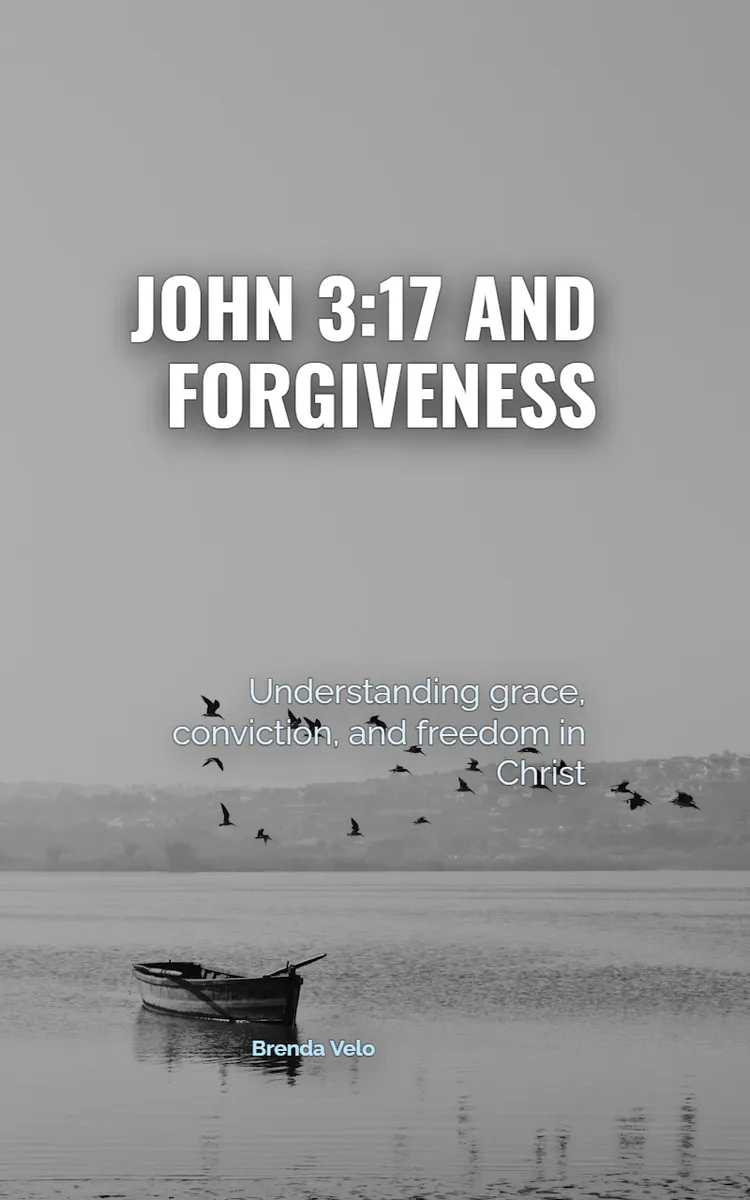
"John 3:17 And Forgiveness" is a religious devotional book by Brenda Velo with 7 chapters and approximately 7,374 words. Bible study on John 3:17, forgiveness, conviction vs condemnation.
This book was created using Inkfluence AI, an AI-powered book generation platform that helps authors write, design, and publish complete books.
Frequently Asked Questions
What is "John 3:17 And Forgiveness" about?
Bible study on John 3:17, forgiveness, conviction vs condemnation
How many chapters are in "John 3:17 And Forgiveness"?
The book contains 7 chapters and approximately 7,374 words. Topics covered include John 3:17: The Heart of God Behind the Message, Condemnation vs. Conviction: How to Tell the Difference, Trust Over Self-Defense: Coming to the Savior, Prayer for the Guilty Heart: Asking, Listening, Receiving, and more.
Who wrote "John 3:17 And Forgiveness"?
This book was written by Brenda Velo and created using Inkfluence AI, an AI book generation platform that helps authors write, design, and publish books.
Write your own religious devotional book with AI
Describe your idea and Inkfluence writes the whole thing. Free to start.
Start writingCreated with Inkfluence AI


