
Read the first chapter
The whole of chapter one, free. About 5 min. Turn the pages with the arrows, your keyboard, or a swipe.
Chapter 1
Introducing Yourself with Basic Forms
Saying and Writing Your Personal Details
When you meet a teacher, receptionist, doctor, or new classmate, you may need to give basic information about yourself. You can say your name, spell it, give your address, and answer simple questions. You may also need to write these details on a form.
A question often has a matching answer. For example:
• “What’s your first name?” - “My first name is Ahmed.” - “What’s your surname?” - “My surname is Khan.” - “What’s your address?” - “My address is 24 Green Road.” - “What’s your postcode?” - “My postcode is B12 3AB.”
Your personal details have different parts:
1. First name: the name people usually call you. 2. Surname: your family name. 3. Address: your house or flat number, street, town or city. 4. Postcode: the letters and numbers for your area. 5. Telephone number: your phone number. 6. Date of birth: the day, month, and year you were born.
Key takeaway: You can use a simple question-and-answer pattern to say and write your personal details clearly.
Read each question slowly. Check the spelling and numbers before you finish. Be careful with private information. Only give your personal details to a trusted person or organisation.
Completing a Personal Details Form
Materials needed: a pen or pencil, this page, and a copy of a real or practice form. Time required: 20 minutes.
Use the practice details below first. Do not use another person’s real information. After the example, complete the form with your own details if you feel safe to do so.
Completed example
> First name: Samira > Surname: Ali > Address: 24 Green Road, Birmingham > Postcode: B12 3AB > Telephone number: 07123 456789 > Date of birth: 16 March 1994
1. Read the completed example aloud. Point to each line as you read it. 2. Cover the example with a piece of paper. 3. Answer these questions aloud: - “What’s her first name?” - “What’s her surname?” - “What’s her address?” - “What’s her postcode?” 4. Uncover the example and check your answers. 5. Copy the example into the practice form below. 6. Check every letter, number, space, and capital letter. 7. Now complete the second form with your own details, or use these safe practice details: David Brown, 8 King Street, Leeds, LS1 4AA, 07000 111222, 9 July 1988. 8. Read your completed form to a partner, teacher, or trusted person. Ask them to check only spelling and clear writing.
Your Turn: Practice Form
First name: ________________________________________________
Surname: __________________________________________________
Address: ___________________________________________________
Postcode: __________________________________________________
Telephone number: __________________________________________
Date of birth: ______________________________________________
Now practise the questions and answers. Write the answers in full sentences.
What’s your first name? My first name is _______________________________________________
What’s your surname? My surname is __________________________________________________
What’s your address? My address is ___________________________________________________
What’s your postcode? My postcode is __________________________________________________
What’s your telephone number? My telephone number is __________________________________________
What’s your date of birth? My date of birth is ______________________________________________
Use this checklist when you finish. You are finished when all six boxes are checked.
• [ ] I wrote a first name. - [ ] I wrote a surname. - [ ] I wrote an address. - [ ] I wrote a postcode with letters and numbers. - [ ] I wrote a telephone number. - [ ] I wrote a date of birth. - [ ] I answered at least five questions in full sentences. - [ ] I checked my spelling and numbers.
Using Personal Details in Everyday Situations
You may need these question-and-answer patterns at college, at a GP surgery, in a library, or when you start a new job. A receptionist might ask, “What’s your full name?” You can answer, “My full name is Maria Santos.” They might then ask, “Can you spell your surname?” You can say, “S-A-N-T-O-S.”
At a college office, you may need to write your address on an enrolment form. Write one part on each line. For example, write 24 Green Road on the address line and B12 3AB in the postcode box. Do not put the postcode in the telephone number box (that would be a funny phone number!).
When you give information aloud, speak clearly and pause between numbers. For a telephone number, you can say: “Zero seven one two three, four five six seven eight nine.” If you do not understand, use a helpful sentence: “Could you repeat the question, please?” If the other person does not understand you, try again slowly.
Apply It: Role-play
Work with a partner, teacher, or trusted person.
1. Person A asks the six questions from the form. 2. Person B answers using the practice details or safe personal details. 3. Person A writes the answers on the form. 4. Person B checks the spelling, address, postcode, and numbers. 5. Change roles. 6. Complete two rounds. In the second round, add: “Can you spell your surname?”
You meet the goal when you can answer at least five of six questions clearly and your partner writes at least five answers correctly.
Checking Your Progress and Planning Your Next Step
Reflect
1. Which personal detail can you say most easily: your name, address, postcode, telephone number, or date of birth? Why?
__________________________________________________
__________________________________________________
__________________________________________________
2. Which question do you need to practise again? Write the question and one full answer.
__________________________________________________
__________________________________________________
__________________________________________________
3. Where will you use these English questions this week? Name one real place and write the sentence you will use.
__________________________________________________
__________________________________________________
__________________________________________________
Use this self-check. Circle one answer for each line.
| Skill | Not yet | With help | By myself | |---|---:|---:|---:| | I can say my first name. | 1 | 2 | 3 | | I can spell my surname. | 1 | 2 | 3 | | I can say my address. | 1 | 2 | 3 | | I can say my postcode. | 1 | 2 | 3 | | I can write my telephone number. | 1 | 2 | 3 | | I can write my date of birth. | 1 | 2 | 3 | | I can answer five personal-detail questions. | 1 | 2 | 3 |
Add your scores. A score of 15 or more shows that you can use many of these details independently. A lower score shows exactly what to practise next. Choose one question, write it three times, and say the answer three times aloud.
Your name, address, and other details help you complete forms and speak to people clearly. Practise the same short patterns until they feel natural. Then you’ll be ready when someone asks, “Could you give me your details, please?”
End of chapter one. 4 more chapters in the full book.
Swipe or use the arrows to turn the page
What's inside: 5 chapters
- 1. Introducing Yourself with Basic Forms
- 2. Asking and Answering Simple Times
- 3. Building a Daily Routine Sentence
- 4. Ordering Food with Simple Requests
- 5. Finding Directions Using Prepositions
About this book
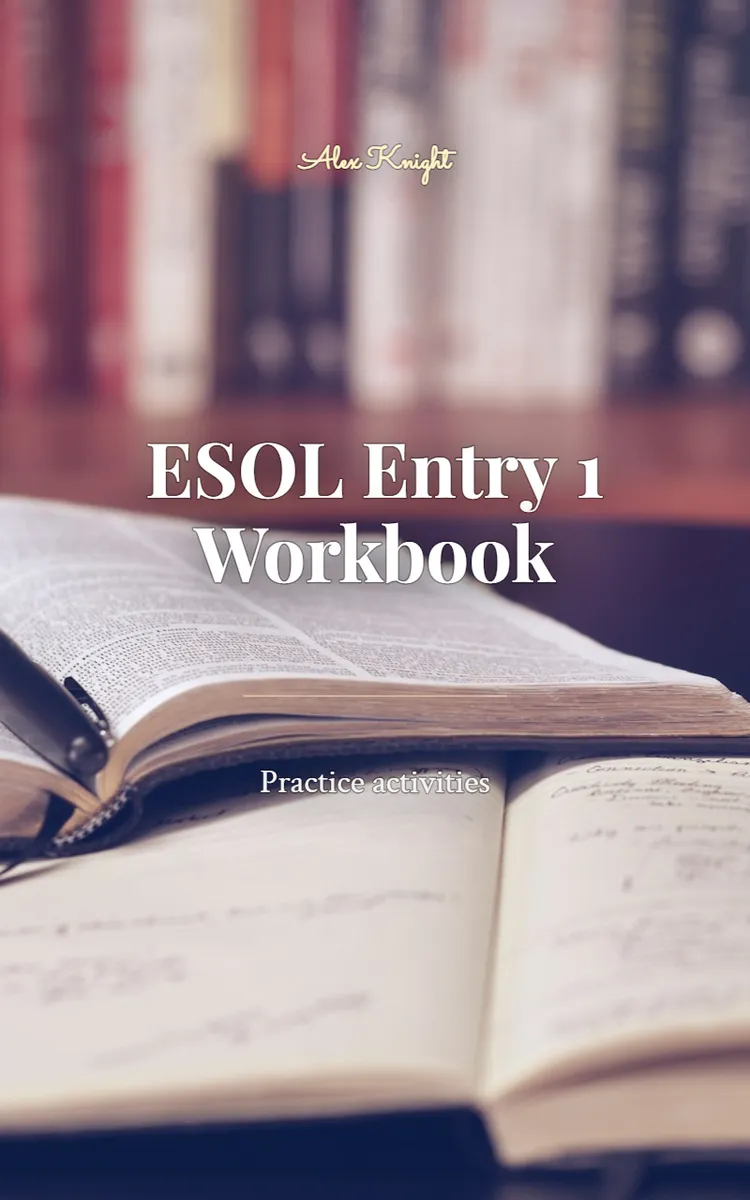
"ESOL Entry 1 Workbook" is a workbook by Alex Knight with 5 chapters and approximately 6,717 words. Beginner ESOL Entry 1 English as an additional language practice.
This book was created using Inkfluence AI, an AI-powered book generation platform that helps authors write, design, and publish complete books. It was made with the Workbook Generator.
Frequently Asked Questions
What is "ESOL Entry 1 Workbook" about?
Beginner ESOL Entry 1 English as an additional language practice
How many chapters are in "ESOL Entry 1 Workbook"?
The book contains 5 chapters and approximately 6,717 words. Topics covered include Introducing Yourself with Basic Forms, Asking and Answering Simple Times, Building a Daily Routine Sentence, Ordering Food with Simple Requests, and more.
Who wrote "ESOL Entry 1 Workbook"?
This book was written by Alex Knight and created using Inkfluence AI, an AI book generation platform that helps authors write, design, and publish books.
How can I create a similar workbook?
You can create your own workbook using Inkfluence AI. Describe your idea, choose your style, and the AI writes the full book for you. It's free to start.
Write your own workbook with AI
Describe your idea and Inkfluence writes the whole thing. Free to start.
Start writingCreated with Inkfluence AI


