
Read the first chapter
The whole of chapter one, free. About 8 min. Turn the pages with the arrows, your keyboard, or a swipe.
Chapter 1
The Rarity Mindset for Writers
Stop Writing for the Shelf
What would change if you judged each page by the value it could keep - not by how quickly you could finish the manuscript?
Many writers treat rarity as something that arrives later. They expect time, sales, praise, or a second edition to make a book important. That approach creates a common problem: the manuscript reaches the reader carrying familiar ideas, loose examples, and sentences that sound acceptable but leave no lasting mark. Time cannot repair choices the writer never made.
A rare manuscript becomes rare during its creation. It earns that quality when the writer chooses a clear promise, observes details others overlook, explains an idea in a usable way, and removes words that weaken the point. This mindset solves a practical problem: it gives you a way to make decisions before publication instead of hoping readers will discover value afterward.
By the end of these pages, you will have a working method for testing your manuscript as you write it. You will know how to run the Rarity Loop, how to turn ordinary advice into specific guidance, and how to check whether a passage deserves a permanent place in the book. Start by asking one question at the end of every writing session: “What does this page contain that a reader could not easily find elsewhere?”
That question changes your next action. If the answer sounds vague, you gather a sharper example. If the answer sounds familiar, you add your own observation. If the answer sounds useful but difficult to apply, you add a step, a boundary, or a visible result. The page becomes rarer because you improve its substance while you still control it.
The Rarity Loop
The Rarity Loop is a repeated four-part method for making a manuscript distinctive as you write:
1. Name the useful promise. State what the passage helps the reader do. This prevents attractive but unfocused writing. 2. Find the overlooked detail. Add a precise observation, decision, warning, or example that gives the idea a clear shape. Details make general advice recognizable and memorable. 3. Make the idea usable. Show the reader what to do, in what order, and what result to look for. A rare insight loses value if the reader cannot act on it. 4. Remove the replaceable. Delete sentences that merely repeat common knowledge or decorate the point. Space should go to the material only you can provide.
Run the loop on a small unit, such as one section or 500 words. First, write the promise in one sentence. For example: “This section helps a shop owner write a service page that answers a customer’s real concern before the customer calls.” That promise gives the passage a job. If a paragraph does not support that job, move it or cut it.
Next, look for the overlooked detail. “Explain your service clearly” sounds reasonable but common. A sharper version might say, “Describe what happens during the first 15 minutes after the customer arrives, including what you inspect and what you do not inspect.” That detail gives the reader something to copy. It also reveals the writer’s standard for clarity.
Then make the idea usable. Give the reader a short sequence: list the customer’s first concern, answer it in the opening paragraph, name the first action, and state what the customer should prepare. Explain why each step matters. The opening answer earns attention; the first action removes uncertainty; the preparation note prevents a delay. The reader can now test the advice on a real page.
Finally, remove the replaceable. Cut phrases such as “provide excellent service” when the passage already shows what excellent service looks like. Delete a second explanation if it adds no new decision. Read the remaining text aloud. If two sentences make the same point, keep the one with the stronger verb and clearer detail.
Ask yourself three quick questions after each loop:
• Can I state the passage’s promise without using words such as “better,” “effective,” or “successful”? - Does the passage include at least one detail drawn from direct work, close observation, or a hard-earned decision? - Can a reader complete the recommended action without guessing the next step?
If you answer “no,” do not polish the sentences yet. Return to the missing part of the loop. A smooth paragraph with no distinct value remains ordinary. A plain paragraph with a precise observation and a usable action can become one of the book’s strongest pages.
The Rarity Loop does not ask you to make every sentence dramatic. It asks you to make every section earn its space. Your practical takeaway: before you draft more pages, run one existing section through all four parts and mark the exact sentence that carries its rarest value.
A Working Pass on 500 Words
Consider a 500-word section titled “Writing Instructions Customers Can Follow.” Its first draft says that instructions should be clear, concise, and friendly. It advises the writer to use short sentences and avoid confusing language. Nothing is wrong with the draft, but another book could contain the same advice almost word for word.
Apply the Rarity Loop in numbered steps:
1. Write the promise in the margin. Use: “The reader will turn a vague instruction into a three-action checklist.” Expected outcome: every paragraph must help create or explain that checklist. 2. Underline familiar claims. Mark “be clear,” “keep it simple,” and “think about the reader.” Expected outcome: you identify sentences that need evidence or replacement. 3. Add one working example. Change “Tell customers what to bring” to “Write ‘Bring the appliance model number and two photos of the damaged area’ instead of ‘Bring any relevant information.’” Expected outcome: the reader sees the difference between a broad request and a useful one. 4. Add the reason. Explain that specific items reduce back-and-forth messages and help the worker prepare before the appointment. Expected outcome: the instruction gains a practical purpose. 5. Build the action sequence. Tell the reader to name the item, explain where to find it, and state what happens if the item is missing. Expected outcome: the reader can produce a complete instruction without inventing steps. 6. Cut repeated advice. Remove the paragraph that repeats “short sentences” after the example already demonstrates that principle. Expected outcome: the section becomes shorter while carrying more usable information. 7. Run a reader test. Give the revised instructions to someone who has not seen the draft and ask them to list the required items. Expected outcome: confusion reveals the missing detail before publication.
The revised passage might say: “Ask for the appliance model number and two photos of the damaged area. Tell customers where to find the model number: usually on a label inside the door or on the back panel. If they cannot find it, ask for the brand and a photo of the full appliance. This backup keeps the appointment moving while giving you enough information to prepare.”
That paragraph contains a promise, a detail, a sequence, and a fallback. It does not claim to offer rare wisdom. It demonstrates care that readers can use. That is the point: rarity often appears as precision, not decoration.
Use this short checklist when you finish a section:
• [ ] I wrote the section’s promise in one sentence. - [ ] I replaced at least one familiar claim with a specific example. - [ ] I explained why the recommended action matters. - [ ] I included a fallback for the most likely obstacle. - [ ] I removed repeated or merely decorative sentences. - [ ] I tested the instruction by asking someone to repeat the action. - [ ] I marked the sentence that gives the section its own character.
A useful result does not require a grand theory. In the example above, the expected outcome is simple: a customer knows what to bring, where to find it, and what to do when the item is unavailable. That level of care makes the passage more durable because it solves a real point of friction. Your practical takeaway: measure rarity by the reader’s changed behavior, not by the writer’s feeling that the prose sounds impressive.
Mistakes That Make a Manuscript Ordinary
Mistaking polish for rarity
A writer may spend an hour replacing plain words with elegant ones while leaving the passage’s idea unchanged. Polished language can hide a thin point, but it cannot give the reader a new decision or useful observation.
Do this: Add one concrete example, one reason, and one action before revising style. Then read the passage aloud and simplify any sentence that sounds more impressive than useful.
Not this: Treat smoother wording as proof that the manuscript now offers something distinctive.
Waiting for time to create value
Time can reveal which ideas readers remember, but it cannot add missing substance to a finished draft. If a section contains broad advice today, it will still contain broad advice after years on a shelf.
Do this: Mark weak sections with a question: “What could the reader do differently after reading this?” Add the smallest useful answer before moving on. For a 2,000-word chapter, choose three weak sections and repair one during each writing session.
Not this: Assume later praise, age, or scarcity will make an underdeveloped passage valuable.
Adding personal detail without a reader’s use for it
Writers sometimes add private experiences to make a manuscript feel original. A detail becomes useful only when it helps the reader understand a choice, avoid a mistake, or repeat a result.
Do this: After adding a personal observation, write “This matters because…” and complete the sentence with a reader benefit. If you cannot complete it, remove the detail or connect it to a clear instruction.
Not this: Include background merely because it happened to you.
Forcing every page to sound unique
Rarity does not mean constant novelty. Definitions, transitions, and basic explanations still serve a purpose. The danger appears when a writer twists simple ideas into complicated language to avoid sounding ordinary.
Do this: Keep necessary explanations plain, then place your distinctive value in the example, boundary, sequence, or judgment. A clear definition followed by a sharp application often works better than an unusual phrase.
Not this: Make familiar material confusing just to make it look original.
Before you finish a writing session, choose one passage and ask what makes it difficult to replace. The answer may be a precise observation, a tested sequence, a useful warning, or a clear way of seeing a common problem. If you cannot find that element, run the Rarity Loop again. A manuscript becomes enduring through these small decisions, repeated page by page, until its value is present from the moment it reaches the reader.
End of chapter one. 36 more chapters and about 67,858 words in the full book.
Swipe or use the arrows to turn the page
What's inside: 37 chapters
- 1. The Rarity Mindset for Writers
- 2. Why Today’s Manuscripts Vanish
- 3. What “Rare” Really Means
- 4. Pick a Reader Promise
- 5. Choose a Distinct Point of View
- 6. Build a Magnetic Opening Scene
- 7. Write Character Wants, Not Traits
- 8. Create Conflict with Escalation Steps
- 9. Design Plot Beats for Re-Reads
- 10. Use Specificity That Feels Lived-In
- 11. Craft Voice Through Sentence Rhythm
- 12. Write Dialogue with Subtext Pressure
- 13. Turn Themes into Character Decisions
- 14. Make Every Chapter Earn Its Space
- 15. Create Scenes with Clear Endings
- 16. Use Time Management in Drafting
- 17. Outline for Discovery, Not Control
- 18. Draft Fast with the Zero-Second Rule
- 19. Revise with the Three-Pass Method
- 20. Cut Clutter Using the Meaning Audit
- 21. Strengthen Openings with Micro-Hooks
- 22. Write Endings That Echo
- 23. Polish Prose with the Clarity Ladder
- 24. Improve Pacing with Scene Timing
- 25. Avoid Clichés with Fresh Constraints
- 26. Make Research Disappear into Story
- 27. Create Worldbuilding with Reader Use
- 28. Use Sensory Details with Purpose
- 29. Strengthen Stakes with Consequence Chains
- 30. Balance Novelty and Familiarity
- 31. Develop a Signature Motif System
- 32. Write with Emotional Accuracy
- 33. Beta Readers with Specific Prompts
- 34. Revise from Feedback Without Losing You
- 35. Proofread for Final Rarity
- 36. Title and Blurb That Match the Promise
- 37. Release Plans for Long-Term Discovery
About this book
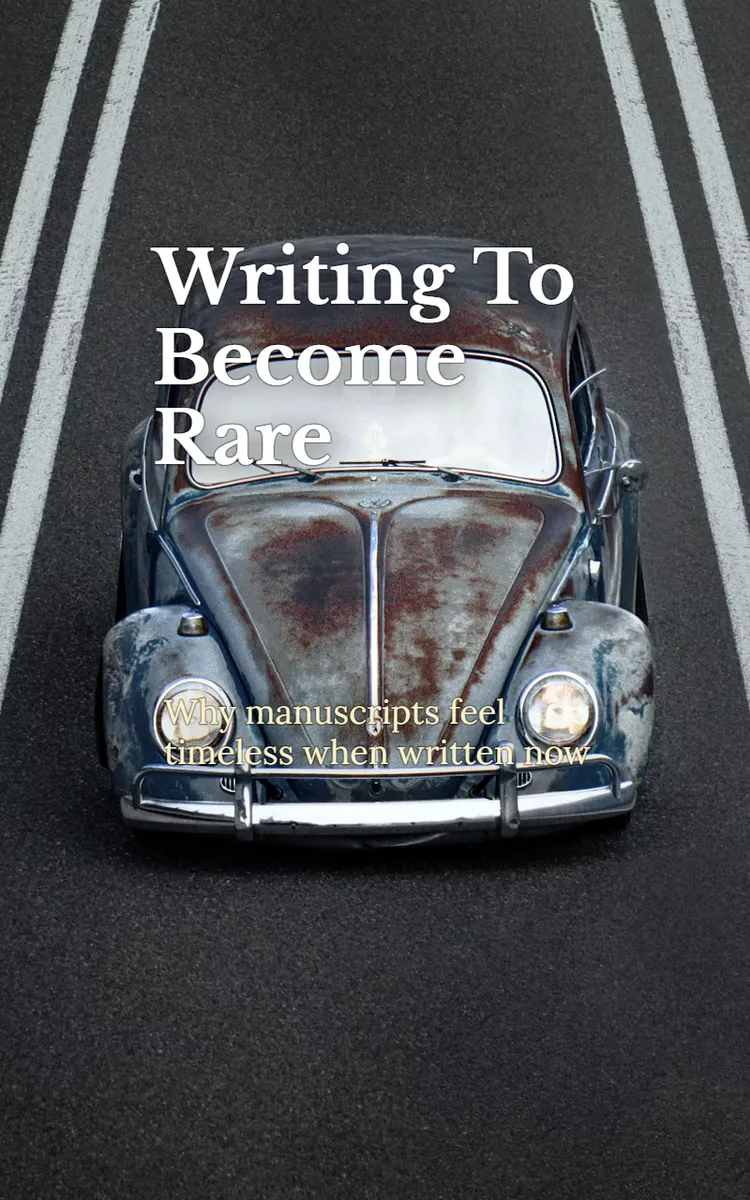
"Writing To Become Rare" is a how-to guide book by Anonymous with 37 chapters and approximately 67,858 words. How modern writing can become enduring and rare.
This book was created using Inkfluence AI, an AI-powered book generation platform that helps authors write, design, and publish complete books. It was made with the AI Ebook Generator.
Frequently Asked Questions
What is "Writing To Become Rare" about?
How modern writing can become enduring and rare
How many chapters are in "Writing To Become Rare"?
The book contains 37 chapters and approximately 67,858 words. Topics covered include The Rarity Mindset for Writers, Why Today’s Manuscripts Vanish, What “Rare” Really Means, Pick a Reader Promise, and more.
Who wrote "Writing To Become Rare"?
This book was written by Anonymous and created using Inkfluence AI, an AI book generation platform that helps authors write, design, and publish books.
How can I create a similar how-to guide book?
You can create your own how-to guide book using Inkfluence AI. Describe your idea, choose your style, and the AI writes the full book for you. It's free to start.
Write your own how-to guide book with AI
Describe your idea and Inkfluence writes the whole thing. Free to start.
Start writingCreated with Inkfluence AI


