
Read the first chapter
The whole of chapter one, free. About 8 min. Turn the pages with the arrows, your keyboard, or a swipe.
Chapter 1
Piranhas: The River’s Real Reputation
A River Predator Smaller Than Its Reputation
In 1914, former United States president Theodore Roosevelt traveled through the Brazilian Amazon and recorded a familiar river story: piranhas could strip an animal to bone in minutes. The tale was vivid, memorable, and useful to anyone trying to describe an unfamiliar wilderness. It was also missing the conditions that make such feeding possible.
Piranhas do have sharp, triangular teeth. Some species can take flesh with startling efficiency, and injured or trapped fish may draw a rapid feeding response. Yet the famous image of a living cow vanishing beneath a boiling surface is not a normal afternoon in an Amazon tributary. It is a compressed version of several truths, stripped of their context.
The gap between those truths and the legend is where the real animal appears. Its teeth, diet, schooling behavior, seasonal movements, and relationship with river communities reveal a predator less like a cinematic monster than a highly adapted scavenger, hunter, and opportunist.
When does a dangerous animal become more frightening than the danger it actually poses?
Teeth Built for Opportunity
The word piranha covers several related fish, most famously species in the genera Pygocentrus and Serrasalmus. They are not all alike. Some rely heavily on fish, others take scales, fins, insects, fruit, or scraps of dead animals. Their bodies and teeth reflect this variety. A red-bellied piranha has a deep, powerful body and interlocking teeth suited to cutting flesh, while other species are slimmer and better adapted to nipping scales from larger fish.
That mouth is the source of much of the legend. Piranha teeth meet like the blades of pruning shears. A single bite can remove a neat piece of tissue, especially from a soft-bodied fish. The lower jaw provides force; the upper and lower teeth fit together with an efficiency that makes the fish look over-equipped for its size. But a tool built for cutting is not proof that it is used constantly.
Most piranhas are cautious around large animals. They are themselves vulnerable to river dolphins, caimans, large catfish, birds, and bigger predatory fish. A school offers some protection, but it also creates competition. Feeding frenzies are not the default condition of a school; they usually arise when food is concentrated, escape routes are limited, or many fish have been drawn to the same source.
The popular picture of a school as a single-minded killing machine misses an important detail: piranhas are individual fish responding to opportunity. A dead fish, a wounded animal, or a piece of meat entering the water can create that opportunity. So can low water, when pools shrink and fish are crowded together. The result may look coordinated because many bodies react at once, but the behavior begins with ordinary hunger and unusually favorable conditions.
One surprising fact is that some piranhas eat fruit and seeds that fall from forest trees. During the flooded season, rising water carries them into forests, where branches hang over the water and ripe fruit drops into the current. The fish are not locked into the role of aquatic wolf. In the Amazon, where the boundary between river and forest shifts for months at a time, a fish’s menu can change with the landscape.
The Legend Travels Faster Than the Fish
European accounts of South American rivers helped establish the piranha as a symbol of tropical danger. Travelers, soldiers, naturalists, and later filmmakers encountered a creature that looked designed for horror: silver scales, red bellies, exposed teeth, and a name that sounded foreign and sharp. Reports of feeding on carcasses were easy to repeat. The details that mattered most to the fish - water level, temperature, injury, confinement, and food scarcity - were less memorable.
The Roosevelt expedition made the story especially durable. Roosevelt’s 1914 journey through the Amazon included observations of wildlife collected and described for audiences far from the river. Accounts of piranhas entered a wider culture already prepared to admire and fear the rainforest. Later films and television programs simplified the animal further. A school became a red flash. A bite became an attack. A rare event became the rule.
The simplification was not entirely invented. Local people have long treated piranhas with practical respect. Fishers know where they occur, what bait attracts them, and how quickly they can damage a catch held in a net. A person swimming near a fishing area may be warned away, particularly during the dry season or after fish have been cleaned in the water. Such warnings are not evidence of a supernatural predator. They are the accumulated knowledge of people who understand a river’s changing conditions.
In many Amazonian communities, piranhas are also food. They appear in markets and cooking pots, their flesh prepared in soups, stews, or fried dishes. The same fish that appears in a foreign horror story can be an ordinary catch at home. That contrast matters. It shows how reputation depends on distance: the farther the observer is from the river’s daily habits, the easier it is to see a monster instead of a resource.
A brief comparison helps explain the distortion. A crocodile seen from a boat is a predator; a crocodile understood through its territory, breeding season, and basking habits is an animal. Piranhas suffer the same transformation in reverse. Their teeth are visible, while most of their ecology remains hidden beneath the surface.
What Provokes a Rare Attack
Piranha attacks on humans are uncommon, but uncommon does not mean impossible. The risk rises when several pressures overlap. Low water can concentrate fish in shrinking channels and pools. Dry conditions can reduce the supply of natural food. Fish caught in nets or hooked on lines may injure themselves and release blood, movement, and scales into the water. Wading near a cleaning site can place a person directly beside a food signal.
The dry season is especially important because the Amazon is not one stable river. It is a vast network of channels, lakes, flooded forests, and temporary connections. As water falls, habitats that were once open become isolated. Fish are crowded into smaller spaces, and animals that normally avoid one another have fewer choices. A piranha does not need to become more vicious for the situation to become more hazardous. The river simply removes distance.
Young children may face greater danger because they are smaller, less visible in murky water, and more likely to splash in shallow areas where fish are concentrated. A person with an open wound is also more likely to attract attention from fish already feeding. Yet even under such conditions, the most common outcome is not a dramatic attack. Piranhas may nip toes, heels, or fingers, especially when startled or when a person disturbs vegetation and muddy shelter.
The injuries themselves help explain the legend. A piranha bite can be clean and deep, and several fish may bite in succession. A group of small wounds can appear far more extraordinary than one bite viewed alone. If the victim is already frightened, the splashing that follows may provoke further contact. Fear becomes part of the physical event, not merely a reaction to it.
The film version reverses this sequence. It begins with a hungry school and treats the victim as the trigger. In real rivers, the surrounding conditions usually come first: food, confinement, falling water, disturbance, or injury. The fish respond to a changed environment.
The Bite-Behind-the-Myth Method
The Bite-Behind-the-Myth Method asks a simple question: what had to be true for the famous story to happen? Applied to piranhas, it separates the visible detail - the teeth - from the hidden setting that gives those teeth their significance.
The first layer is anatomy. Piranhas can cut flesh because their jaws and teeth are suited to it. The second is behavior. They feed opportunistically, and some species gather rapidly when food is available. The third is ecology. Water levels, seasonal food supplies, and habitat shape where fish meet. The fourth is human interpretation. A rare encounter becomes a warning, a travel story, a newspaper account, or a film scene.
This method produces a less dramatic but more interesting conclusion: the piranha is not frightening because it attacks everything. It is frightening because a normal feeding adaptation can become dangerous when the river’s usual boundaries collapse.
That is the counterintuitive finding. The conditions behind a piranha attack are often more important than the piranha’s temperament. The fish does not need to be unusually aggressive; it needs only to encounter food, crowding, and opportunity in the same place.
This changes the way the animal is understood. Instead of asking whether piranhas are “man-eaters,” a better question is how a river arranges bodies, food, and escape routes. The answer belongs as much to hydrology and human behavior as to the fish itself. A piranha’s reputation is therefore a story about ecology disguised as a story about evil.
A Fish Seen from the Riverbank
For river communities, the piranha is encountered through ordinary work: nets lifted at dawn, bait lowered from a canoe, fish cleaned beside a bank, and children warned about particular pools at particular times of year. The animal’s danger is local and changing. A fisherman does not need a universal rule saying that piranhas are always dangerous. He needs to know which backwater is crowded during the dry season and where discarded fish remains have entered the water.
That knowledge is precise because it is practical. A piranha caught in a net may continue biting, not because it has entered a special state of rage, but because confinement and injury have intensified the feeding response. Handling the fish carelessly can produce a serious cut. The same creature becomes far less alarming when viewed from a cooking pot, where its teeth are an inconvenience rather than a threat.
The riverbank also reveals the difference between fear and respect. People who live beside piranhas may avoid swimming in certain places, yet they may also catch and eat them. There is no contradiction. Familiarity does not erase danger; it places danger among other facts. The fish has a season, a habitat, a price, a taste, and a mouth capable of cutting flesh.
Human observers far away tend to keep only the mouth.
Piranhas expose a recurring weakness in the way people tell stories about wildlife. We prefer creatures with fixed identities: harmless, useful, beautiful, or monstrous. The river offers no such simplicity. A piranha can be predator, scavenger, prey, food, warning sign, and ecological participant, sometimes within the same day.
Its legend survives because the teeth are easy to see and the circumstances are not. Beneath the red belly and the silver flash is a more unsettling truth: nature does not need to be malicious to be dangerous, and the boundary between ordinary behavior and nightmare may be no wider than a shrinking pool.
End of chapter one. 7 more chapters and about 13,286 words in the full book.
Swipe or use the arrows to turn the page
What's inside: 8 chapters
- 1. Piranhas: The River’s Real Reputation
- 2. Anaconda Encounters Without the Legend
- 3. The Jaguar’s Hidden Night Hunt
- 4. Electric Eels in Murky Water
- 5. Mapinguari: The Forest’s One-Eyed Giant
- 6. The Boto Who Becomes a Stranger
- 7. Curupira’s Backward-Facing Footprints
- 8. Why the Amazon Keeps Its Monsters
About this book
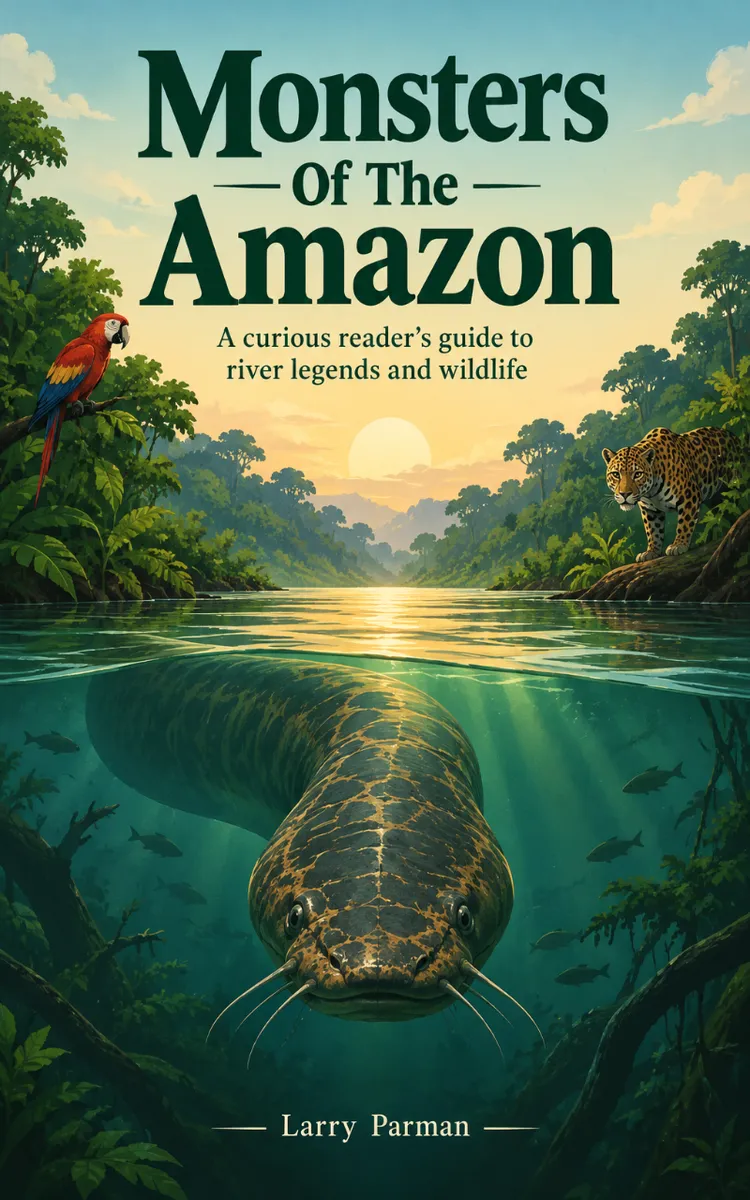
"Monsters Of The Amazon" is a curiosity book by Anonymous with 8 chapters and approximately 13,286 words. Real animals and mythical monsters of the Amazon rainforest and river.
This book was created using Inkfluence AI, an AI-powered book generation platform that helps authors write, design, and publish complete books.
Frequently Asked Questions
What is "Monsters Of The Amazon" about?
Real animals and mythical monsters of the Amazon rainforest and river
How many chapters are in "Monsters Of The Amazon"?
The book contains 8 chapters and approximately 13,286 words. Topics covered include Piranhas: The River’s Real Reputation, Anaconda Encounters Without the Legend, The Jaguar’s Hidden Night Hunt, Electric Eels in Murky Water, and more.
Who wrote "Monsters Of The Amazon"?
This book was written by Anonymous and created using Inkfluence AI, an AI book generation platform that helps authors write, design, and publish books.
Write your own curiosity book with AI
Describe your idea and Inkfluence writes the whole thing. Free to start.
Start writingCreated with Inkfluence AI


