
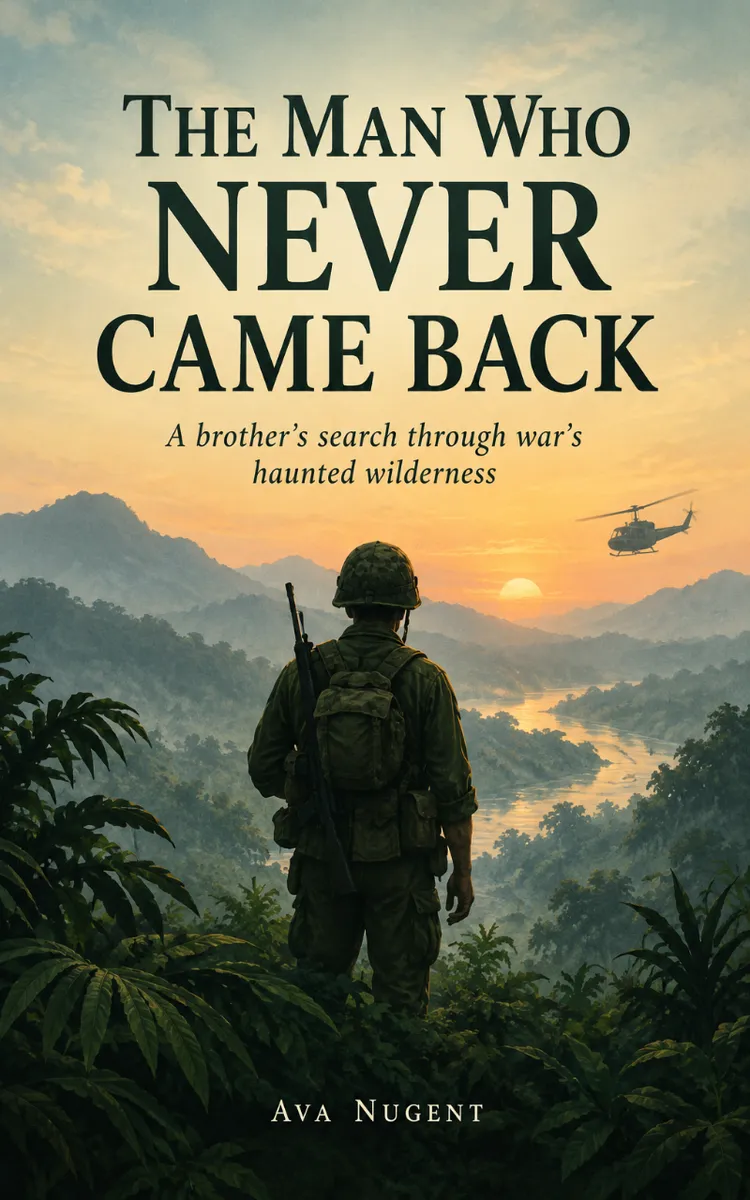

Read the first chapter
The whole of chapter one, free. About 8 min. Turn the pages with the arrows, your keyboard, or a swipe.
Chapter 1
Thomas in the Bamboo
The letter slid beneath Mae’s front door just after midnight, making a soft scrape across the worn linoleum.
She was awake in the back room, listening to the ceiling fan click once every turn. Outside, a streetcar groaned along St. Charles Avenue, its bell fading between the shotgun houses. Mae rose from the edge of her bed and crossed the dark hallway.
The envelope lay against the door.
No stamp. No name. No return address.
She did not touch it at first.
For fifty-five years, Thomas had been a question with no answer. He had disappeared in Vietnam in 1969, and every explanation offered by the Army had worn thin with time. Missing in action. Presumed dead. No remains recovered. Mae had lived long enough to stop expecting a knock, a telegram, or a miracle.
But the envelope had come to her house.
She picked it up. The paper felt damp and cold, though the night outside was warm. A faint brown smear marked one corner, like river mud dried into the fibers.
Mae carried it to the kitchen and turned on the light. Moths tapped against the window screen. Her hands stayed steady as she slit the envelope with a butter knife.
Inside was a photograph.
It had been folded once. The crease ran through the center of the image, splitting a line of bamboo and the shoulder of a man standing beneath it. The paper was gray with age, the picture grainy and blurred at the edges.
Mae leaned closer.
The man wore a dark shirt and loose trousers. His hair was longer than Thomas had ever allowed it to grow. He stood in front of a village she did not recognize, with narrow wooden houses pressed close together and red lanterns hanging from their eaves.
His face was turned partly away.
“No,” Mae whispered.
She set the photograph on the kitchen table, then stepped back. The room seemed suddenly too small. The refrigerator rattled. Somewhere under the floor, a pipe knocked twice.
She reached for the lamp above the table and pulled the chain. Yellow light spilled over the photograph.
The man’s left hand rested against a bamboo post. His thumb was bent inward. A pale scar crossed the knuckle.
Thomas had gotten that scar at twelve, when he tried to break a bottle behind their mother’s shed. He had hidden the cut beneath a dish towel until blood reached his elbow.
Mae touched the image with one finger.
The paper was rough beneath her skin.
She lifted the photograph and carried it to the window. Moonlight silvered the glass. Behind her, the house creaked in its familiar places, but the picture seemed to hold a different sound. Leaves rubbing together. Water moving slowly over stones. A soft wooden clatter from the red lanterns.
The village appeared empty, yet Mae could not shake the feeling that someone was watching from one of the dark doorways.
She turned the photograph over.
Nothing. No writing. No date. No stamp from a camera shop. Only a faint thumbprint near the lower edge.
Mae placed it beside the telephone and called the number she had kept for the Army records office, though she knew the office had closed years ago. The line gave one dead click and went silent.
She tried Thomas’s old number next.
It had belonged to three different families since 1971. The last one had disconnected it.
Her hand remained on the receiver.
“Come on, Tommy,” she said. “Give me something.”
The house answered with the ceiling fan’s steady click.
Mae pulled open the drawer beneath the telephone. Inside lay the small collection of Thomas’s things she had never been able to throw away: his high school ring, a brass button from his uniform, two letters he had written before leaving, and a creased photograph of the two of them beside the Mississippi.
She spread the old photograph beside the new one.
In the picture from home, Thomas was twenty-two. He stood with one arm around Mae’s shoulders, squinting into the sun. His hair was cropped short. His grin tilted higher on the right side because one front tooth sat slightly crooked.
Mae brought the new photograph close.
The blur hid most of the man’s face. His cheek was lost in gray grain. His mouth was only a dark line.
She moved the lamp. The man’s features shifted with the light.
Not Thomas.
She lowered the photograph.
Thomas.
The answer changed each time she looked.
Mae took a magnifying glass from the junk drawer. The handle was cracked, and the lens held a film of dust. She wiped it on her nightgown and bent over the image.
The village sharpened into broken squares. Bamboo walls. A narrow path. A child-shaped shadow near one doorway.
Then the man’s face came clear enough for one detail: the crooked front tooth.
Mae dropped the glass.
It struck the table and rolled into the sink.
She grabbed the photograph before it could fall. Her breath came in short, shallow pulls. The room tilted, but she held on to the counter until the floor steadied.
Thomas had that tooth.
No one else had it in the exact same place. No one else had the scar on his knuckle. No one else had stood in a Vietnamese village decades after the Army declared him missing.
Mae pressed the picture against her chest.
For the first time since 1969, hope entered the house.
It did not come gently. It came like floodwater through a broken door, carrying mud, branches, and everything she had worked to keep buried.
She saw Thomas at seventeen, climbing the live oak behind their house. She saw him at twenty-two, packing his duffel while their mother cried in the kitchen. She saw the last letter he had sent, its paper thin from being opened too many times.
I’ll be home before the pecans fall, he had written.
The pecans had fallen that year. Then the next. Then every year after.
Mae sat at the table and read the new photograph again.
The man looked older, but not old. His shoulders were broad. His stance was familiar: weight balanced on the right leg, left foot turned outward. Thomas had stood that way whenever he expected trouble.
She reached for the envelope.
The flap had been sealed with something dark and glossy. Mae ran her thumb along the edge. The paper gave a faint crackle.
A sound came from the front porch.
One step.
Mae froze.
Another step followed, slow and careful, just outside the door.
She slid the photograph beneath the old Army letters and picked up the butter knife. The blade was dull, but it was all she had.
The porch boards groaned.
“Who is it?” she called.
No answer.
Mae moved down the hall. The floorboards complained beneath her bare feet. Through the narrow glass beside the door, she saw only the porch light and the black shape of the yard.
A moth struck the bulb.
She unlocked the dead bolt.
Before she could open the door, something brushed against the other side. A sleeve, perhaps. Or a hand.
Mae stepped back.
“Thomas?”
The word left her before she could stop it.
The porch went silent.
She opened the door.
No one stood there. The street lay empty beneath the orange lamps. A stray dog watched from across the road, then turned away. The warm night pressed in, carrying the distant clang of a streetcar.
On the threshold, beside the place where the envelope had rested, lay a single green leaf.
Mae stared at it.
It was long and narrow, with a sharp central vein. Not oak. Not magnolia. Not anything that grew in her yard.
She shut the door and locked it twice.
In the kitchen, she took the photograph from beneath the letters. The man in the village seemed closer now. His blurred eyes faced the camera, but Mae had the uneasy sense that they faced her.
She turned the picture over again.
The blank back held a faint impression, as if someone had written on another sheet above it. Mae angled it beneath the lamp. Lines appeared in the paper: a crooked mark, then another, and beneath them the ghost of a word.
She could not read it.
A sudden knock struck the front door.
Mae flinched so hard the photograph slipped from her hand.
“Mae?”
The voice belonged to her neighbor, an old woman from two houses down. Mae hurried to the door but did not open it.
“What is it?”
“I saw someone at your porch,” the neighbor said. “A man.”
“Did you see his face?”
“No. He was gone when I came outside.”
Mae looked toward the kitchen.
The photograph lay faceup on the floor.
“Was he carrying anything?”
There was a pause.
“Something dark,” the neighbor said. “A bag, maybe.”
Mae kept one hand on the lock. “Did he say anything?”
“No. But he stood there a long time.”
“Go home,” Mae said. “Lock your door.”
The neighbor hesitated. “Are you all right?”
Mae looked at the picture again. Thomas stood beneath the bamboo, surrounded by a village that seemed to lean toward him.
“I don’t know,” she said.
After the neighbor’s footsteps faded, Mae returned to the table. She placed the old photograph beside the new one and studied them together.
The faces did not match at first. One belonged to a laughing young man beside the river. The other belonged to someone worn by distance, silence, and a place that had kept him hidden.
But the tooth matched.
The scar matched.
The left shoulder dipped in the same way.
Mae touched the blurred face.
“It’s you,” she said.
The house gave no answer.
She searched the envelope again, running her fingers along every seam. Nothing fell out. No hidden note. No thread. No clue except the picture itself and the dried brown smear.
Then she saw the back flap.
There should have been a postmark. Even an old one. A town, a date, a machine’s black stamp proving the envelope had traveled through ordinary hands.
There was nothing.
Mae held it beneath the lamp.
No postmark.
No return address.
She checked the front again, though she already knew what she would find. The envelope bore only her name, written in narrow black letters.
MAE.
Not her street. Not the city. Just Mae.
A cold prickling moved across her wrist, the same warning she had felt as a child whenever Thomas was about to tell her a truth that would hurt.
She looked toward the dark window.
Beyond the glass, the New Orleans night waited with its wet streets and locked houses. Somewhere far beyond it, across an ocean and a war that had never ended inside her, Thomas stood in a village of red lanterns.
Alive.
Mae folded the photograph once, carefully along the old crease, and slid it into her coat pocket.
Then she picked up the envelope and held it close to the light.
It had come from nowhere.
And someone, somewhere, knew exactly where she lived.
End of chapter one. 27 more chapters in the full book.
Swipe or use the arrows to turn the page


What's inside: 28 chapters
- 1. Thomas in the Bamboo
- 2. Static on the Last Patrol
- 3. The Fiancée’s Warning
- 4. The Scout’s Lost Trail
- 5. Lines That Refuse to Stay
- 6. Mud on the Tail
- 7. A Ticket Across the Pacific
- 8. Lan’s Moving Village
- 9. The River Keeps Its Own
- 10. The Boatman’s Empty Sandals
- 11. Lanterns Without Wind
- 12. Dog Tags at the Shrine
- 13. The Protector’s Contradiction
- 14. The Journal’s Final Entry
- 15. Trees That Cry Out
- 16. Thomas Beneath the Canopy
- 17. The Brother Who Stayed
- 18. The Photograph’s Real Sender
- 19. The CIA Extraction Order
- 20. Lan’s Price of Passage
- 21. The Village Goes Up
- 22. Thomas Refuses Rescue
- 23. The Forest Closes Behind
- 24. The Forest’s Unanswerable Test
- 25. Roots Under the Hunter
- 26. Why Thomas Stayed
- 27. The Guardian’s Final Breath
- 28. Louisiana Hears the Trees
About this book
"The Man Who Never Came Back" is a fiction book by Ava Nugent with 28 chapters and approximately 56,878 words. A sibling searches Vietnam’s haunted jungle for his long-missing brother.
This book was created using Inkfluence AI, an AI-powered book generation platform that helps authors write, design, and publish complete books. It was made with the AI Novel Writer.
Frequently Asked Questions
What is "The Man Who Never Came Back" about?
A sibling searches Vietnam’s haunted jungle for his long-missing brother
How many chapters are in "The Man Who Never Came Back"?
The book contains 28 chapters and approximately 56,878 words. Topics covered include Thomas in the Bamboo, Static on the Last Patrol, The Fiancée’s Warning, The Scout’s Lost Trail, and more.
Who wrote "The Man Who Never Came Back"?
This book was written by Ava Nugent and created using Inkfluence AI, an AI book generation platform that helps authors write, design, and publish books.
How can I create a similar fiction book?
You can create your own fiction book using Inkfluence AI. Describe your idea, choose your style, and the AI writes the full book for you. It's free to start.
Write your own fiction book with AI
Describe your idea and Inkfluence writes the whole thing. Free to start.
Start writingCreated with Inkfluence AI


