

Read the first chapter
The whole of chapter one, free. About 7 min. Turn the pages with the arrows, your keyboard, or a swipe.
Chapter 1
From Hiding to Safe Connection
When Hiding Feels Safer Than Being Seen
Your phone lights up with a message: “Are you coming to dinner?” You read it, lock the screen, and place the phone face down. You tell yourself you’ll answer later, when you feel less awkward. Then evening arrives, and you’re still in the same clothes, scrolling through other people’s lives while avoiding your own.
Maybe you’ve learned to disappear in smaller ways. You sit at the edge of the room. You leave before anyone can ask questions. You keep your replies short so nobody gets close enough to disappoint you. Hiding can feel like control. If nobody sees you, nobody can judge you, reject you, or misunderstand you.
But hiding also takes something from you. It turns ordinary moments into threats and makes connection feel like a huge leap instead of a small step. Nia, a 19-year-old first-year college student, noticed this after spending three days eating alone in her dorm room. She wanted friends, but the thought of walking into the dining hall made her stomach tighten.
You don’t have to force closeness today - but you do have to give connection one safe place to begin.
The Mindset Shift: From Total Withdrawal to Safe-First Connection
Old Belief: If I can’t be fully comfortable, open, and social, I should stay away.
New Reality: Connection can begin with a small, controlled moment that doesn’t require me to reveal everything.
The old belief sounds protective, but it creates an unfair test. It tells you that you must feel confident before you speak, trust someone completely before you share anything, and know exactly what to say before you join in. Most people would struggle under those rules. No wonder withdrawing starts to feel like the only option.
The Safe-First Connection Ladder gives you another way. You start with the lowest-risk action that still moves you toward people. That might mean making eye contact and saying “morning” to someone in your hallway. It might mean sitting at a shared table for ten minutes without expecting a friendship to appear. The goal isn’t instant closeness. The goal is teaching your mind, through experience, that being near people doesn’t always lead to danger.
Nia used this approach in the dining hall. She didn’t force herself to introduce herself to a whole group. On Monday, she carried her food to a table near other students and stayed for five minutes. On Tuesday, she asked the student beside her, “Is this seat taken?” On Wednesday, she made one simple comment about the homework. None of these moments looked dramatic from the outside. For Nia, they were meaningful because she stayed present instead of escaping.
This matters because your nervous system learns from what you repeatedly do. If you withdraw every time discomfort appears, your brain treats withdrawal as proof that people are unsafe. If you stay for one manageable moment, you create a different message: “I felt nervous, and I handled it.” That message is the beginning of healthy self-worth.
Why Small Contact Changes the Pattern
Withdrawal often grows through a quick loop. You expect rejection, so you avoid people. Because you avoid them, you don’t get ordinary positive experiences. Then the lack of connection seems to confirm that you don’t belong. The loop can feel like truth, even when it began as fear.
The Safe-First Connection Ladder interrupts that loop without throwing you into the deep end. It has three questions: What is the safest available connection? How long can I stay? What small action can I take before I leave? These questions give you structure when your mind is busy predicting embarrassment.
You’re not trying to become the loudest person in the room. You’re practicing being present without abandoning yourself. That distinction matters. Reconnecting doesn’t mean accepting rude treatment, sharing private information with strangers, or pretending to enjoy every social situation. Safe connection includes choice. You can approach, pause, and leave respectfully.
Signs this pattern is running your life:
1. You regularly cancel plans, then feel lonely once you’re alone. 2. You rehearse simple messages for so long that you never send them. 3. You assume silence means people dislike you, even when you have no clear evidence. 4. You wait to feel completely confident before taking any social step.
Small, safe contact teaches your mind that discomfort is something you can move through - not a command to disappear.
For today, choose a connection that is real but limited. Send one honest text. Sit in a public place for ten minutes. Ask one low-pressure question. Then stop. Ending while you still feel in control helps your brain remember the experience as manageable.
Questions for Finding Your Safe Starting Point
1. Where do I withdraw most often: messages, shared spaces, classes, work, family gatherings, or something else? Name one setting, not your entire life. Nia chose the dining hall because it was a daily place where she wanted to feel less alone.
2. What am I afraid will happen if I make one small attempt to connect? Be specific. “They might think I’m awkward” gives you something to examine. “Everything will go badly” keeps the fear too large to work with.
3. What is the smallest action that would count as showing up without forcing closeness? You might reply to a message with one sentence, sit near others, or ask someone how their day is going. The action should feel slightly uncomfortable, not overwhelming.
4. What boundary would help me feel safe during this attempt? You could decide to stay for ten minutes, share no personal details, or leave if someone becomes disrespectful. A boundary isn’t a failure. It’s part of making connection safe enough to try.
5. What would I say to myself if the interaction feels awkward? Try: “That was uncomfortable, but it wasn’t dangerous,” or “One quiet conversation doesn’t decide my worth.” Use words you can actually believe. You don’t need to praise the moment as perfect.
Write your answers on paper or in your phone. Keep them nearby when you take your first step. When fear gets loud, a written plan can keep one uncomfortable moment from turning into another full day of hiding.
Today’s Safe-First Connection Ladder
Challenge: One Rung, One Day
For the next seven days, take one small connection step each day. Use the ladder below, but repeat an easier rung whenever you need to. Progress means choosing a safe action, not performing confidence.
• Day 1: Spend ten minutes in a shared space, such as a dining hall, library, break room, or common area. You don’t need to speak. Notice three ordinary details around you. - Day 2: Offer one simple greeting to someone you regularly see. - Day 3: Send a short message to a safe person: “I’ve been keeping to myself, but I wanted to say hi.” - Day 4: Ask one low-pressure question, such as “How did that assignment go?” or “Have you tried the food here?” - Day 5: Stay in a shared space for fifteen minutes. If a conversation begins, remain for at least two exchanges before deciding whether to leave. - Day 6: Share one small, non-private detail, such as a show you’re watching, a class you’re taking, or a meal you enjoyed. - Day 7: Review the week and choose the connection step you’re willing to repeat.
Before each attempt, rate your discomfort from 0 to 10. Afterward, rate it again. You’re not trying to reach zero. You’re collecting evidence that discomfort can rise, settle, and pass.
Expected difficulty: Medium
You’ll know it’s working when...
• You pause before automatically canceling or disappearing. - You can stay in a shared space a little longer than planned. - You stop treating one awkward moment as a final verdict. - You notice that safe connection feels different from forced closeness. - You begin choosing people and settings instead of avoiding all people and settings.
If one day feels too hard, step down the ladder. Send a message instead of having a conversation. Sit near people instead of joining them. The point is not to prove that you can tolerate anything. The point is to build trust with yourself through a steady, repeatable choice.
The First Step Out of Hiding
You don’t heal from isolation by forcing yourself into closeness; you heal by taking safe, honest steps toward connection and staying with yourself as you do.
• You learned that withdrawal can protect you briefly while deepening loneliness over time. - You learned to replace the demand for instant comfort with the Safe-First Connection Ladder. - You identified small actions, clear boundaries, and time limits that make reconnection manageable. - You created a seven-day plan to practice being present without giving away your safety.
Nia didn’t become outgoing in one week. She became more willing to remain visible for a few minutes at a time. That willingness mattered. Every small step challenged the old story that she had to hide until she felt worthy of belonging.
Your next steps will build on this same foundation. As you practice safe connection, you’ll begin noticing the inner voice that turns mistakes into proof against you. That voice may have learned to keep you small, but it doesn’t have to lead anymore.
End of chapter one. 7 more chapters in the full book.
Swipe or use the arrows to turn the page


What's inside: 8 chapters
- 1. From Hiding to Safe Connection
- 2. Defusing the Inner Critic Voice
- 3. Rewriting Beliefs About Being Unworthy
- 4. Building Boundaries Without Guilt
- 5. Choosing Habits That Heal, Not Hurt
- 6. Communicating Needs With Calm Confidence
- 7. Becoming Resilient When Life Hits Back
- 8. From Outcast to Outstanding Identity
About this book
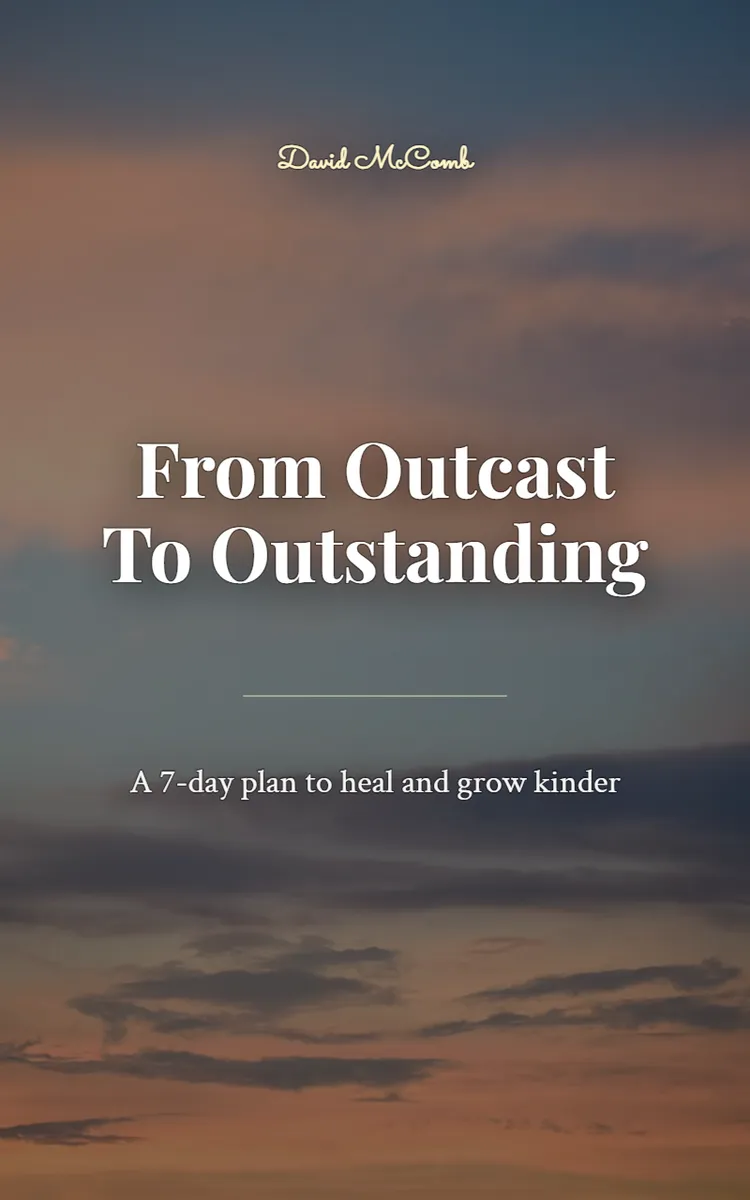
"From Outcast To Outstanding" is a self-help book by David McComb with 8 chapters and approximately 12,608 words. Overcoming self-sabotage and building healthy self-worth.
This book was created using Inkfluence AI, an AI-powered book generation platform that helps authors write, design, and publish complete books. It was made with the AI Self-Help Book Writer.
Frequently Asked Questions
What is "From Outcast To Outstanding" about?
Overcoming self-sabotage and building healthy self-worth
How many chapters are in "From Outcast To Outstanding"?
The book contains 8 chapters and approximately 12,608 words. Topics covered include From Hiding to Safe Connection, Defusing the Inner Critic Voice, Rewriting Beliefs About Being Unworthy, Building Boundaries Without Guilt, and more.
Who wrote "From Outcast To Outstanding"?
This book was written by David McComb and created using Inkfluence AI, an AI book generation platform that helps authors write, design, and publish books.
How can I create a similar self-help book?
You can create your own self-help book using Inkfluence AI. Describe your idea, choose your style, and the AI writes the full book for you. It's free to start.
Write your own self-help book with AI
Describe your idea and Inkfluence writes the whole thing. Free to start.
Start writingCreated with Inkfluence AI


