
Read the first chapter
The whole of chapter one, free. About 7 min. Turn the pages with the arrows, your keyboard, or a swipe.
Chapter 1
Assessing Local Risks
Read the Ground Beneath Your Feet
What would fail first where you live if the power stopped tonight: the water pumps, the fuel station, the mobile network, or the roads into town? The answer depends less on national headlines than on local systems. A household near a river faces different problems from one on a hillside. An apartment above a city water pump has different limits from a rural home with a well.
A useful preparation plan starts with facts, not a shopping list. The Local Risk Map helps you identify likely disruptions, find weak points inside your household, and locate trustworthy information before communications become confused. It solves a common problem: buying supplies that do not match the way your area actually works.
By the end, you should have a short written map showing what may fail, how long the failure could last, what your household depends on, and whom you can contact for verified updates. That map gives every later preparation a clear reason.
Build the Local Risk Map
The Local Risk Map combines three views: the disruption, the household vulnerability, and the information path. A disruption is a service or condition that stops working, such as electricity, treated water, internet access, fuel delivery, banking, or a road connection. A vulnerability is the harm that follows because your household depends on that service. An information path is a reliable way to learn what happened and what authorities expect people to do.
Start by examining your location rather than guessing about distant events. Mark your home, nearest hospital, fire station, police station, fuel stations, grocery stores, pharmacies, bridges, low-lying roads, rail lines, water-treatment sites, and large industrial facilities. You do not need exact technical details. You need to know which places affect your access to water, food, medical care, transport, and information.
Then list the services your household uses during an ordinary day. Ask yourself:
• Does the tap depend on an electric pump? - Does the heating system need electricity even when it burns gas or oil? - Does the garage door need power to open? - Can you cook without the electric stove? - Can you reach work or school if fuel sales stop? - Does anyone depend on refrigerated medicine, powered medical equipment, or a lift? - Can you receive warnings if mobile data and home internet both fail?
Record each answer in a simple table. Add the likely result of failure and the first sign that the problem has begun.
| Service | Household dependence | Likely effect if it stops | First warning sign | |---|---|---|---| | Electricity | Lights, refrigerator, heating controls | Food warms; rooms become cold or dark | Flickering lights or a utility alert | | Water supply | Drinking, toilets, washing | Taps lose pressure or run dry | Low pressure or a boil-water notice | | Internet | News, payments, work, messages | Online services stop | Router loses connection | | Fuel supply | Car, generator, deliveries | Travel and resupply become difficult | Queues or station closures | | Local roads | Work, hospital, food access | Detours or isolation | Police barriers or transport alerts |
Next, rank each disruption by likelihood, speed, and impact. Likelihood means how often your area experiences the problem. Speed means how quickly it can affect you. Impact means how seriously it threatens health, shelter, water, food, or contact with others. Use “low,” “medium,” or “high” rather than pretending to know an exact probability.
For example, a short power cut may have medium likelihood, high speed, and medium impact. A water outage may have lower likelihood but high impact because it affects drinking, toilets, and hygiene at once. A blocked bridge may have medium likelihood and high impact if it forms your only route to a hospital or fuel station. This comparison shows where to work first.
Finally, trace information from the source outward. Put official emergency alerts, local government notices, the electricity or water provider, local radio, and emergency services near the top. Treat forwarded messages, anonymous social-media posts, and dramatic voice recordings as unconfirmed until a trusted source supports them. Save phone numbers and web addresses on paper because a dead phone or overloaded network can make stored online contacts useless.
Your first practical result should be a one-page map and a one-page contact sheet. If you cannot explain your top three local risks and your first reliable source for each, continue checking before buying equipment.
Apply the Map to a Household
Consider a three-person household in a town of 40,000 people. The home sits on the third floor of an apartment building, 2 kilometers from a river and 6 kilometers from the nearest hospital. The building uses electric pumps to move water to upper floors. The household has one car, an electric cooker, a gas heating system with electric controls, one refrigerated prescription, and a family member who cannot climb stairs easily.
Use the Local Risk Map in the following order:
1. Mark the first 72 hours. Write what the household needs for three days without normal services. The expected result is a clear short-term target: drinking water, medication cooling, lighting, food, communication, and safe toilet use.
2. Identify the single points of failure. A single point of failure is one item whose loss affects several needs. Here, electricity controls heating, refrigeration, lifts, lighting, and the building’s water pumps. The expected result is a priority list instead of five separate guesses.
3. Measure the access problem. Walk the stairs once while carrying a 10-kilogram load. Check whether the person with limited mobility can leave safely. Measure the distance to the nearest working tap, pharmacy, and public building. The expected result is a realistic plan that does not depend on the lift or a long walk.
4. Check local information channels. Tune a battery radio to the local public-service station. Visit the local authority website and write down its emergency page and phone number. Ask the building manager how residents receive water and evacuation notices. The expected result is at least three independent ways to confirm an alert.
5. Test the plan during a normal week. Turn off the main breaker for 30 minutes with an adult present. Do not test this if medical equipment or another hazard makes it unsafe. Check the refrigerator, lights, cooker, heating controls, door entry, mobile charging, and stair lighting. The expected result is a list of failures discovered before an emergency.
6. Record decision points. Write specific triggers: “If the water authority reports an outage lasting more than six hours, fill every clean container”; “If the building manager reports lift failure, move the mobility plan into effect”; “If officials advise leaving, use the marked stair route.” The expected result is faster action under stress.
After this test, the household may discover that bottled water alone does not solve the problem. The building also needs a plan for toilets, stair movement, medicine cooling, and verified messages. That finding is valuable because it connects each preparation to a known weakness.
Quick checklist
• Draw your home, main roads, bridges, hospitals, pharmacies, fuel stations, and public buildings. - List every household service that needs electricity, water, internet, or fuel. - Mark each dependence as low, medium, or high impact. - Identify the first warning sign for each major disruption. - Write down official contacts, local radio frequencies, and utility fault numbers. - Keep the contact sheet on paper and in at least two accessible places. - Test the plan for 30 minutes without electricity. - Confirm who checks on children, older adults, disabled people, and neighbors. - Set clear triggers for filling containers, calling for help, staying home, or leaving.
The goal is not to predict every event. The goal is to notice failure early, understand its effect, and act before a minor outage becomes a household crisis.
Avoid Bad Assumptions
Mistaking a nearby source for an available source
A river, public fountain, shop, or fuel station may appear close on a map but become unreachable because of flooding, roadblocks, queues, contamination, or a power failure. A supermarket may have goods but no working payment system or refrigeration.
Do this: Visit the location, measure the route, and identify one alternative. Check whether the alternative works without a car, internet, or electricity.
Not this: Count a resource as available simply because it appears on a map.
Trusting one communication channel
Mobile networks can fail when towers lose power or too many people call at once. Internet pages can become unreachable, and rumors can spread faster than corrections.
Do this: Keep four forms of contact: a battery or hand-crank radio, official text alerts if available, a paper list of phone numbers, and a known local person who can pass information. Compare important instructions across two trusted sources before acting, unless immediate danger requires evacuation.
Not this: Treat a forwarded message or screenshot as an official order.
Planning for the average household
A plan that works for a healthy adult may fail for a baby, an older person, a person with limited mobility, or someone who needs refrigerated medicine. Apartment residents also face different problems from people in detached homes.
Do this: Test the actual route, carrying limits, medication needs, toilet arrangements, and sleeping conditions for every household member. Ask the person affected to explain what would make the plan impossible.
Not this: Assume someone will “manage somehow” when lifts, heating, water pressure, or transport stop.
Review the Local Risk Map every six months and after any major road change, building renovation, new prescription, household move, or utility warning. A map stays useful only when it reflects present conditions. Once you know which local systems can fail and how those failures reach your front door, later preparations become targeted decisions rather than piles of gear.
End of chapter one. 19 more chapters and about 37,367 words in the full book.
Swipe or use the arrows to turn the page
What's inside: 20 chapters
- 1. Assessing Local Risks
- 2. Building a Household Emergency Plan
- 3. Stocking a Practical Emergency Kit
- 4. Storing Food Without Refrigeration
- 5. Finding and Treating Water
- 6. Managing Water Use at Home
- 7. Sanitation Without Running Water
- 8. Staying Warm or Cool Safely
- 9. Lighting and Cooking Without Power
- 10. First Aid and Medication Continuity
- 11. Communicating Without Internet
- 12. Navigating When Phones Fail
- 13. Traveling Without Fuel
- 14. Sheltering in Place
- 15. Evacuating With Essential Supplies
- 16. Protecting Children and Vulnerable Adults
- 17. Coordinating With Neighbors
- 18. Handling Stress and Uncertainty
- 19. Recognizing Hazardous Conditions
- 20. Recovering After Services Return
About this book
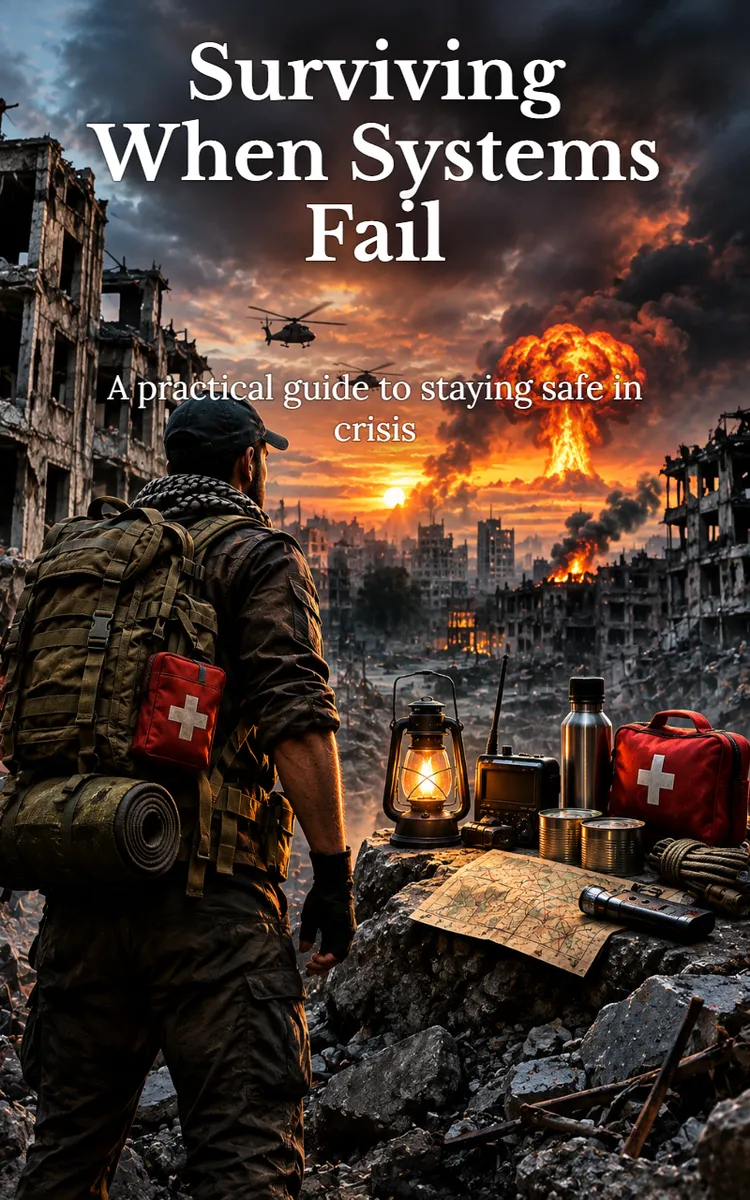
"Surviving When Systems Fail" is a how-to guide book by Anonymous with 20 chapters and approximately 37,367 words. Practical survival skills for war and prolonged infrastructure failures.
This book was created using Inkfluence AI, an AI-powered book generation platform that helps authors write, design, and publish complete books. It was made with the AI Ebook Generator.
Frequently Asked Questions
What is "Surviving When Systems Fail" about?
Practical survival skills for war and prolonged infrastructure failures
How many chapters are in "Surviving When Systems Fail"?
The book contains 20 chapters and approximately 37,367 words. Topics covered include Assessing Local Risks, Building a Household Emergency Plan, Stocking a Practical Emergency Kit, Storing Food Without Refrigeration, and more.
Who wrote "Surviving When Systems Fail"?
This book was written by Anonymous and created using Inkfluence AI, an AI book generation platform that helps authors write, design, and publish books.
How can I create a similar how-to guide book?
You can create your own how-to guide book using Inkfluence AI. Describe your idea, choose your style, and the AI writes the full book for you. It's free to start.
Write your own how-to guide book with AI
Describe your idea and Inkfluence writes the whole thing. Free to start.
Start writingCreated with Inkfluence AI


