
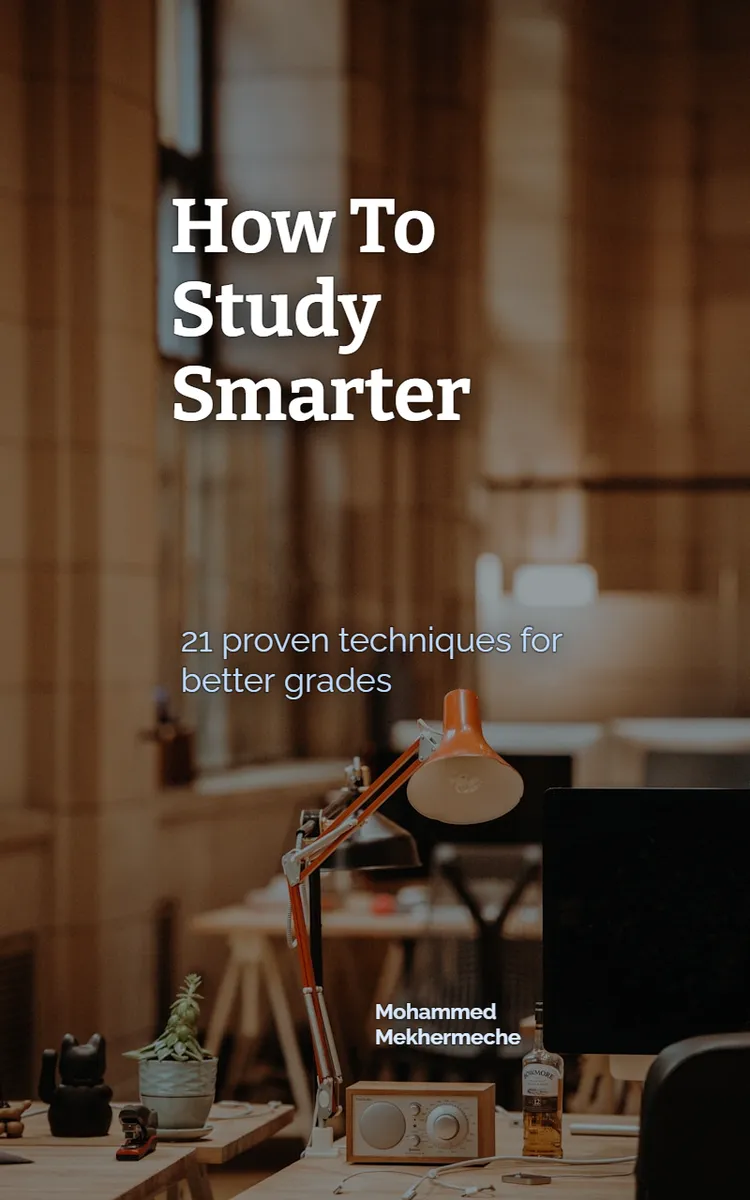
How To Study Smarter
Created with Inkfluence AI
Study methods and techniques to improve student learning
Table of Contents
- 1. Active Recall with Practice Prompts
- 2. Spaced Repetition Scheduling for Exams
- 3. Interleaving Study for Better Discrimination
- 4. Dual Coding with Diagrams and Notes
- 5. Elaborative Interrogation for Deeper Understanding
Preview: Active Recall with Practice Prompts
A short excerpt from “Active Recall with Practice Prompts”. The full book contains 5 chapters and 4,444 words.
Key ConceptsActive recall means retrieving information from memory instead of rereading it. In exams, targeted practice prompts help you identify what you know, expose gaps, and practise producing precise answers.
Retrieval beats recognition: Cover notes and answer from memory before checking.
Targeted prompts: Ask for one specific fact, definition, process, or comparison.
Difficulty matters: Start with basic prompts, then use application and exam-style questions.
Feedback completes recall: Check your answer, correct errors, and repeat the prompt later.
Spacing improves retention: Revisit difficult prompts over several study sessions.
Before you continue: How does answering a prompt from memory differ from rereading the same notes?
Key TermsActive recall - Retrieving information from memory without looking at the answer.
Practice prompt - A focused question designed to make you retrieve a particular piece of knowledge.
Recognition - Identifying information when it is shown to you, such as choosing a familiar answer.
Retrieval cue - A word, phrase, image, or question that helps you access stored information.
Feedback - Information showing whether your recalled answer is accurate or incomplete.
Elaborative prompt - A question asking you to explain why, how, or with what consequence.
Spacing - Reviewing information across separate sessions rather than in one block.
Active RecallActive recall__________
__________
Practice prompt__________
__________
Recognition__________
__________
Retrieval cue__________
__________
Feedback__________
__________
Elaborative prompt__________
__________
Spacing__________
__________
Worked Examples1. Definition promptPrompt: What is active recall?
Cover the definition.
State that it is retrieving information without looking.
Add its exam benefit: it strengthens the ability to produce an answer.
Now you try: Define recognition and explain why it is weaker exam practice.
__________
__________
__________
2. Process promptPrompt: How should you use a missed practice prompt?
Attempt the answer before checking notes.
Compare your response with a reliable answer.
Mark the exact missing or incorrect point.
Rewrite the answer from memory, then schedule the prompt again.
Now you try: Describe a four-step method for correcting a missed prompt.
__________
__________
__________
3. Elaborative promptPrompt: Why are targeted prompts more useful than rereading?
Rereading mainly tests recognition.
Targeted prompts require retrieval, like an exam.
Feedback reveals precise knowledge gaps.
Repeating difficult prompts strengthens later recall.
Now you try: Explain why “Why did this happen?” is a stronger prompt than “Read this page again.”
__________
__________
__________
__________
Practice Questions(Easy) Define active recall.
__________
__________
__________
(Easy) What is the difference between recognition and retrieval?
__________
__________
__________
(Medium) Give two features of an effective practice prompt.
__________
__________
__________
(Medium) Explain why checking the answer immediately after guessing can improve revision.
__________
__________
__________
(Hard) Design three prompts for one topic: one factual, one comparative, and one elaborative.
__________
__________
__________
...
About this book
"How To Study Smarter" is a study guide book by Mohammed Mekhermeche with 5 chapters and approximately 4,444 words. Study methods and techniques to improve student learning.
This book was created using Inkfluence AI, an AI-powered book generation platform that helps authors write, design, and publish complete books. It was made with the Study Guide Generator.
Frequently Asked Questions
What is "How To Study Smarter" about?
Study methods and techniques to improve student learning
How many chapters are in "How To Study Smarter"?
The book contains 5 chapters and approximately 4,444 words. Topics covered include Active Recall with Practice Prompts, Spaced Repetition Scheduling for Exams, Interleaving Study for Better Discrimination, Dual Coding with Diagrams and Notes, and more.
Who wrote "How To Study Smarter"?
This book was written by Mohammed Mekhermeche and created using Inkfluence AI, an AI book generation platform that helps authors write, design, and publish books.
How can I create a similar study guide book?
You can create your own study guide book using Inkfluence AI. Describe your idea, choose your style, and the AI writes the full book for you. It's free to start.
Write your own study guide book with AI
Describe your idea and Inkfluence writes the whole thing. Free to start.
Start writingCreated with Inkfluence AI


