
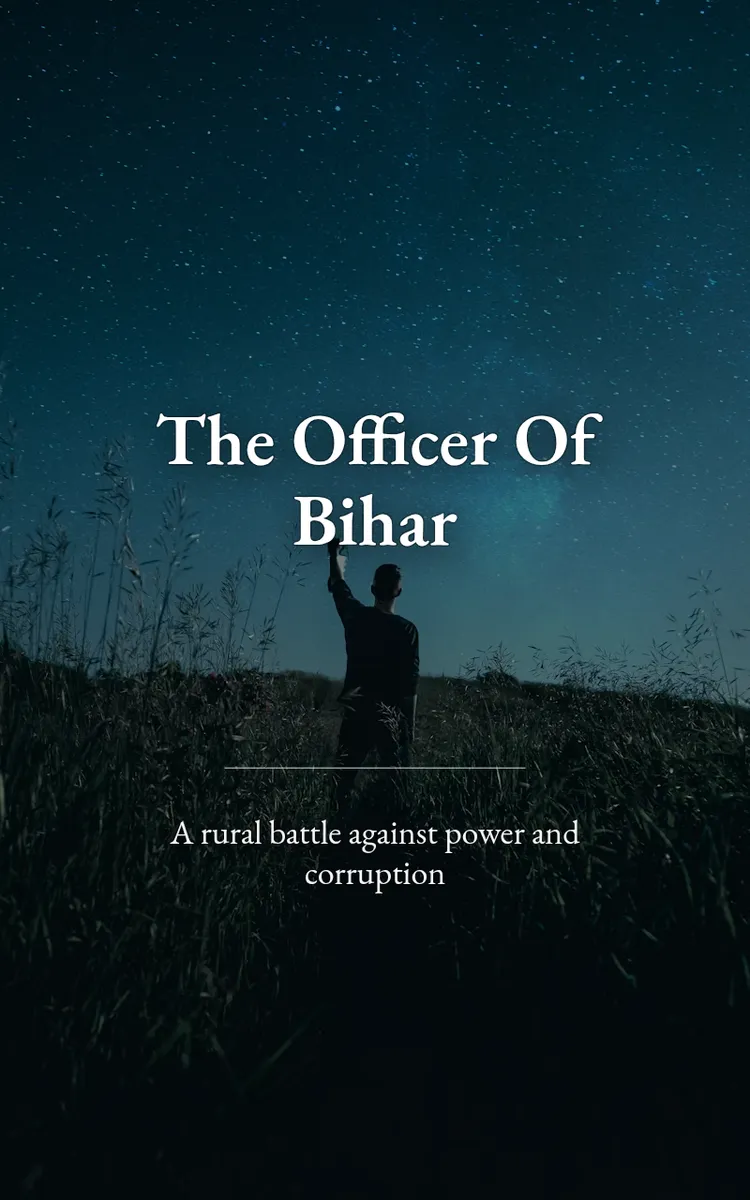
Read the first chapter
The whole of chapter one, free. About 9 min. Turn the pages with the arrows, your keyboard, or a swipe.
Chapter 1
The Flooded Checkpost
The brass plate above the Bansghat Checkpost knocked against its rusted chain each time the floodwater struck the outer wall. Ananya Sinha heard the hollow clang from inside the jeep before she saw the building itself - a low, yellowing structure marooned on a strip of raised earth, with brown water spread on every side as far as the eye could follow.
“Stop there!” someone shouted.
The jeep’s front wheels sank into the mud. Men and women crowded around it, their clothes dark with rain and river water. A woman struck the bonnet with the flat of her hand.
“Where is the grain?” she cried. “Our children have eaten boiled water for two days!”
Ananya opened the door and stepped down. Cold mud swallowed her boots to the ankles. Behind her, Constable Raghav Singh climbed out with one hand on his rifle, while Constable Meena Kumari moved to the other side of the vehicle.
“Move away from the jeep,” Ananya said.
Her voice did not rise, but the crowd heard the order. The woman at the bonnet stared at her with fury.
“You are the new officer?” an old man demanded. “Then tell us why three trucks came here and only half a truck reached the village.”
Ananya looked past them toward the checkpost. A blue tarpaulin sagged across the veranda. Water dripped through holes in its fabric. The station’s single radio antenna leaned at an angle above the roof, its wire trailing loose like a broken vein.
She had been posted to Bansghat that morning. The district office had called it a temporary assignment, a place requiring “firm supervision until conditions stabilized.” The officer who gave her the file had avoided her eyes when he said the words.
Now the villagers were waiting for an answer she did not yet possess.
“I will count what is here,” Ananya said. “Then I will see the records. No one will take another sack until I know where the rest went.”
A murmur passed through the crowd.
“You cannot count what the party men have locked away,” said a thin man in a white shirt. He stood beneath the broken veranda, dry despite the rain. “The relief room is under my supervision.”
“Your name?”
“Brijesh Yadav. Block coordination committee.”
“Show me your order.”
His smile tightened. “Madam, this is not the time for paperwork. The river is rising.”
“It is exactly the time for paperwork.”
Brijesh glanced at the villagers, measuring them. “You have just arrived. Do not create trouble before you understand the arrangement.”
Ananya walked toward him. The veranda boards flexed under her boots. “I understand that people are standing in floodwater without food. Open the relief room.”
Brijesh stepped aside only after Raghav came up behind her. He pulled a ring of keys from his pocket and selected one with deliberate slowness.
The room held twenty-four sacks of rice, six cartons of medicine, and a heap of plastic sheets stacked against the wall. Water had reached the threshold, leaving a brown line across the plaster. Ananya counted the sacks twice.
“This is all?” she asked.
Brijesh shrugged. “The trucks were never full.”
The villagers pressed closer behind her.
“Three trucks,” the old man said. “We watched them come from the embankment.”
“Two,” Brijesh corrected.
“Three,” another voice shouted. “One after dark.”
Ananya turned to Raghav. “Secure the room. No movement without my permission.”
Brijesh gave a short laugh. “You cannot hold government relief in a police station.”
“I can hold evidence.”
That silenced him for a moment.
The station consisted of two rooms, a narrow lockup, and a covered passage where rainwater ran in a constant sheet. The previous officer’s desk stood beside a window sealed with cardboard. Files had been lifted onto bricks, but several had already swollen and split at the edges.
Ananya placed her wet cap on the desk. “Where is the dispatch ledger?”
Raghav pointed toward a metal cabinet. “The key is missing.”
Brijesh leaned against the doorframe. “The ledger is with the block office.”
“Why?”
“Because relief is a block matter.”
“Then why were you supervising the room?”
He did not answer.
Ananya opened the cabinet with the butt of her service pistol. The lock snapped, and the door swung inward. Empty folders sagged on their strings. At the bottom lay a torn carbon sheet, its ink blurred into blue clouds.
Meena picked it up. “Madam.”
Ananya took the sheet between two fingers. A few numbers remained visible. Truck registration marks. Quantities. At the bottom, a signature had been rubbed until the paper was thin.
“Who removed the ledger?” she asked.
Brijesh’s voice sharpened. “You are making an accusation without knowing the facts.”
“I am asking a question.”
“You should ask the block development officer.”
“I will. After I see the ledger.”
He pushed away from the doorway. “It is not here.”
“Then you will tell me where it is.”
A gust of wind drove rain across the passage. Somewhere outside, a child began crying. The crowd shifted, restless and tired. Ananya felt the weight of every face turned toward her. If she let Brijesh leave, the ledger might disappear before sunset. If she detained him without grounds, the district office would call it misconduct and the villagers would lose the only official standing between them and the men controlling the relief.
She stepped closer.
“Raghav, shut the gate.”
Brijesh’s expression changed. “On what authority?”
“On mine.”
Raghav hesitated only a second before moving. The iron gate scraped across the flooded ground. The villagers watched as it closed between them and the station yard.
Brijesh reached for his phone. Ananya caught his wrist.
“Leave the phone on the desk.”
His eyes hardened. “Do you know whose man I am?”
“No,” she said. “But I know whose food is missing.”
He pulled free. For an instant, the veranda seemed too narrow for both of them. Then a shout rose from the yard.
“Madam! The boat!”
A wooden boat had broken loose from its rope and was drifting toward the rear of the checkpost. Raghav ran through the rain, seized the line, and hauled it back against the wall. Inside the boat lay a black metal trunk, half-covered by a torn blanket.
Brijesh moved first.
Ananya caught his shoulder and turned him against the wall. “Do not move.”
“I was securing government property.”
“You were running toward it.”
His cheek struck the plaster. He swore under his breath.
The trunk was locked. Raghav brought it inside while Meena stood guard at the gate. Ananya recognized the district relief seal stamped into the metal, though the wax had been broken and pressed back into place.
“Where did this come from?” she asked.
No one answered.
She forced the latch with a screwdriver from the station toolbox. The lid opened with a wet metallic groan.
Beneath a folded raincoat lay the ledger.
Its cover was swollen from water, but the pages inside had been wrapped in plastic. Ananya lifted it carefully and placed it on the desk. The first pages contained typed entries in neat black ink. Three truck numbers appeared under the date of the flood delivery. Each carried rice, lentils, tarpaulins, and medicine.
The total matched the villagers’ claim.
Then Ananya turned the page.
The entries had been crossed out in red ink. Two truck numbers were missing. The remaining truck had been marked as “partially received due to road damage.” Beneath it, a new total had been written in blue ink.
She compared the ink with the carbon sheet from the cabinet.
The blue figures matched.
But the original writing remained visible beneath the scraping. Ananya tilted the page toward the weak window light. The erased line showed a destination that was not Bansghat.
Suryapur Party Storage.
Her eyes moved to the signature at the bottom. The name was faint but legible.
Brijesh Yadav.
“You altered this,” she said.
The room went still except for the rain hammering the roof.
Brijesh looked at the ledger, then at the villagers beyond the gate. “That is a serious allegation.”
“You signed the original receipt.”
“I signed what I was given.”
“You changed the quantity.”
“The supplies were moved for security.”
“To a party warehouse?”
His silence answered before he did.
Ananya opened the next page. Several deliveries had been recorded in the same hand, each with a different destination scratched away. Beside one entry, a thumbprint had been pressed into the damp paper. The name beneath it belonged to a village that had received nothing.
Meena came to the desk. “Madam, the people outside are asking whether the grain will be released.”
“Not yet.”
A man near the gate shouted, “They will take it again!”
Ananya closed the ledger. The decision settled inside her with the hard certainty of a bolt sliding into place.
“Raghav, seal the relief room.”
Brijesh stepped forward. “You cannot seize the stock.”
“I am not seizing it. I am preserving it.”
“You will regret this.”
“I already regret arriving late.”
She took a blank sheet from the desk and began writing. Her hand remained steady as she recorded the condition of the room, the number of sacks, the damaged lock, the ledger’s altered entries, and Brijesh’s presence at the station. She asked Meena to witness the inventory. Raghav signed beneath her.
When Ananya reached for the station radio, the speaker answered with a burst of static. She twisted the dial.
“District control, this is Bansghat Checkpost. Come in.”
Only crackling returned.
She tried again. “District control, respond.”
Brijesh’s gaze shifted toward the radio.
Ananya noticed.
“Raghav,” she said, “stay with him.”
The constable moved between Brijesh and the desk. Ananya lifted the radio handset. Before she could speak, a stone struck the window.
The cardboard covering burst inward. The radio flew from her hand and crashed against the wall. Its casing split. A thin spark flashed, then vanished.
For a second no one moved.
Then the crowd outside erupted. Men shouted over one another. The gate shook under several hands. Rain poured through the broken window onto the desk, spreading across the written statement.
Ananya grabbed the ledger and pulled it beneath her coat.
“Meena, bar the gate.”
“Madam, the radio - ”
“I know.”
Brijesh smiled faintly, as if the ruined machine had restored the balance between them.
Ananya looked at him, then at the ledger pressed against her ribs. The evidence was in her hands. The district office was less than an hour away by road in dry weather, but the flood had erased the road, and now the only radio that could carry her voice beyond the water lay broken on the floor.
Outside, another stone struck the iron gate.
Ananya drew her pistol and stepped toward the entrance.
“Open it,” she said.
Raghav stared at her. “Madam?”
“Open the gate. Let them see who is standing here.”
The bar lifted. The gate swung inward beneath the rain, and the villagers surged toward the veranda. Ananya held the ledger under one arm and the pistol low in her other hand.
For the first time since she had arrived, the crowd fell silent.
Behind her, Brijesh whispered, “You have no one to call.”
Ananya did not turn.
“Then they will have to hear me directly.”
End of chapter one. 4 more chapters and about 10,619 words in the full book.
Swipe or use the arrows to turn the page
What's inside: 5 chapters
- 1. The Flooded Checkpost
- 2. The Oath at the Station
- 3. Across the Sandbar
- 4. The Warehouse Ledger
- 5. The Convoy at Dusk
About this book
"The Officer Of Bihar" is a fiction book by Anonymous with 5 chapters and approximately 10,619 words. A courageous woman police officer confronting political corruption in rural Bihar.
This book was created using Inkfluence AI, an AI-powered book generation platform that helps authors write, design, and publish complete books. It was made with the AI Novel Writer.
Frequently Asked Questions
What is "The Officer Of Bihar" about?
A courageous woman police officer confronting political corruption in rural Bihar
How many chapters are in "The Officer Of Bihar"?
The book contains 5 chapters and approximately 10,619 words. Topics covered include The Flooded Checkpost, The Oath at the Station, Across the Sandbar, The Warehouse Ledger, and more.
Who wrote "The Officer Of Bihar"?
This book was written by Anonymous and created using Inkfluence AI, an AI book generation platform that helps authors write, design, and publish books.
How can I create a similar fiction book?
You can create your own fiction book using Inkfluence AI. Describe your idea, choose your style, and the AI writes the full book for you. It's free to start.
Write your own fiction book with AI
Describe your idea and Inkfluence writes the whole thing. Free to start.
Start writingCreated with Inkfluence AI


