
Read the first chapter
The whole of chapter one, free. About 4 min. Turn the pages with the arrows, your keyboard, or a swipe.
Chapter 1
Chapter 1: The Truth About Testosterone
Master Regulator of Systemic Homeostasis
Testosterone is widely misunderstood in popular culture. It is routinely reduced to a caricature of aggression, superficial vanity, or hyper-masculine posture. The biological reality, however, is far more elegant: testosterone is the principal androgenic-anabolic steroid hormone in males, acting as a foundational master regulator of systemic homeostasis. It is an essential chemical messenger that coordinates cellular function across virtually every major organ system in the male body, directly influencing musculoskeletal development, metabolic efficiency, cognitive performance, and long-term cardiovascular health.
Synthesized from a raw cholesterol precursor, its production is heavily concentrated in the interstitial Leydig cells of the testes, which account for approximately 95% of total circulating systemic output. The remaining 5% is synthesized within the adrenal glands. Because its secretion is entirely governed by the highly sensitive, multi-tiered neuroendocrine feedback loop known as the hypothalamic-pituitary-gonadal (HPG) axis, its baseline levels are profoundly reflective of your overall physiological environment.
At the cellular level, testosterone acts as the primary anabolic driver of lean tissue accretion. When free testosterone molecules penetrate target cells, they bind directly to intracellular androgen receptors (AR). This binding induces a critical conformational shift, causing the hormone-receptor complex to translocate into the cell nucleus, where it interacts with specific DNA sequences to upregulate transcription.
In skeletal muscle tissue, this genomic action directly accelerates muscle protein synthesis (MPS) and stimulates cellular hypertrophy. Without optimal levels of this hormone, the body's rate of protein degradation systematically outpaces its rate of synthesis, leading over time to muscle loss, joint vulnerability, and reduced physical capacity.
The Metabolic Linchpin
Beyond its structural role in skeletal muscle and bone mineral density, testosterone serves as a crucial metabolic linchpin. It plays a direct, non-negotiable role in regulating glucose disposal, systemic insulin sensitivity, and mitochondrial lipid oxidation.
Testosterone facilitates glucose uptake into peripheral tissues by promoting GLUT4 translocation across cell membranes. When systemic androgens drop, this pathway degrades, accelerating the onset of peripheral insulin resistance and impaired glucose tolerance.
Furthermore, testosterone acts as a powerful gatekeeper of body composition. It directly modulates adipose tissue metabolism by inhibiting lipoprotein lipase (LPL) activity—the primary enzyme responsible for fatty acid uptake and fat storage within abdominal fat stores. Concurrently, it upregulates $\beta$-adrenergic receptors, driving continuous lipolysis and lipid clearance.
When testosterone is optimally elevated within a healthy physiological range, the accumulation of central visceral fat is actively suppressed. Conversely, when baseline hormones fall, LPL activity increases unchecked, leading to rapid, stubborn fat accumulation around the midsection. This creates a vicious metabolic cycle: visceral fat behaves as an active secretory organ that further degrades endocrine output.
Clinical vs. Functional Hypogonadism
In contemporary media, terms like "Low T" or "androgen deficiency" are frequently thrown around as subjective catch-alls for normal age-related slowing, mild weight gain, or work-induced fatigue. To optimize your health effectively, you must discard this loose terminology and look exclusively at objective, clinical metrics. Medical consensus guidelines establish a clear, dual-criteria definition for male hypogonadism.
According to the American Urological Association (AUA) and the Endocrine Society, a formal diagnosis of testosterone deficiency requires a total testosterone level persistently below 300 ng/dL (10.4 nmol/L). Crucially, this biochemical threshold must be confirmed on at least two separate, early morning blood samples drawn between 8:00 AM and 10:00 AM, and it must be accompanied by documented clinical signs and symptoms. A single lab result captured during a stressful week is clinically meaningless.
When a true biochemical deficiency is established, medicine categorizes hypogonadism into two primary structural etiologies:
1. Primary Hypogonadism (Hypergonadotropic): This represents direct testicular failure. The interstitial Leydig cells are physically unable to synthesize testosterone despite receiving strong stimulation from the brain. Biochemically, this state is characterized by total testosterone levels below 300 ng/dL paired with above-normal levels of luteinizing hormone (LH) and follicle-stimulating hormone (FSH). It is commonly caused by direct trauma, genetic anomalies, mumps orchitis, or severe cellular aging.
2. Secondary Hypogonadism (Hypogonadotropic): This represents a central signaling failure located within the hypothalamus or the anterior pituitary gland. The testes are completely healthy and fully capable of producing testosterone, but the brain is failing to secrete adequate amounts of Gonadotropin-Releasing Hormone (GnRH) or LH/FSH to trigger production. Biochemically, this presents as low total testosterone accompanied by inappropriately low or low-normal gonadotropins (LH/FSH).
For the modern high performer, the most critical concept to understand is Functional Hypogonadism. This is a distinct, highly prevalent form of secondary hypogonadism that is entirely non-structural. It is a state where your brain has intentionally turned down your hormonal thermostat in response to reversible, lifestyle-induced inputs.
Chronic psychological stress, accumulation of visceral abdominal fat, metabolic syndrome, and persistent sleep fragmentation act as direct environmental off-switches for the HPG axis. Your body hasn't broken down; it has simply executed a survival program that shifts resources away from reproduction and toward immediate defense. Because functional hypogonadism is driven by behavioral mismatches, it can be reliably reversed through systematic, evidence-based lifestyle modification.
Key Takeaways
● Testosterone is a systemic master regulator governing muscle protein synthesis, glucose disposal, and central fat distribution.
● Clinical hypogonadism requires a total testosterone level below 300 ng/dL across
multiple early morning draws paired with definitive symptoms.
● Functional hypogonadism is a non-structural, fully reversible suppression of the HPG axis driven entirely by lifestyle mismatches.
End of chapter one. 7 more chapters in the full book.
Swipe or use the arrows to turn the page


What's inside: 8 chapters
- 1. Chapter 1: The Truth About Testosterone
- 2. Chapter 2: The High-Performer’s Testosterone Traps
- 3. Chapter 3: The Endocrine Map
- 4. Chapter 4: Symptoms: What’s Real vs. What’s Nonspecific
- 5. Chapter 5: Testing & Labs: The Executive Dashboard
- 6. Chapter 6: Sleep: The #1 Multiplier
- 7. Chapter 7: Body Composition: Visceral Fat and Insulin
- 8. Chapter 8: Training: Strength Without Burnout
About this book
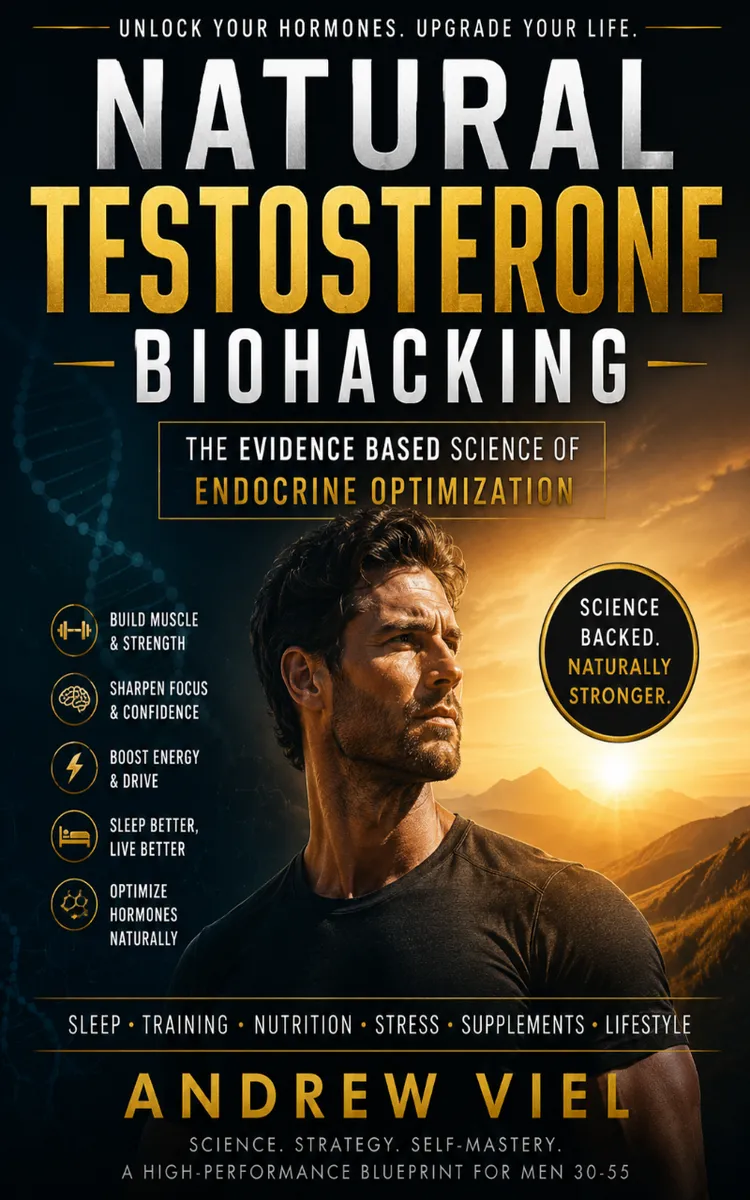
"Natural Testosterone Biohacking" is a health & wellness book by Camilo Murillo with 8 chapters and approximately 8,610 words. It covers key insights and practical takeaways on the topic.
This book was created using Inkfluence AI, an AI-powered book generation platform that helps authors write, design, and publish complete books. It was made with the AI Health Book Generator.
Frequently Asked Questions
What is "Natural Testosterone Biohacking" about?
"Natural Testosterone Biohacking" is a health & wellness book by Camilo Murillo covering key insights and practical takeaways on the topic.
How many chapters are in "Natural Testosterone Biohacking"?
The book contains 8 chapters and approximately 8,610 words. Topics covered include Chapter 1: The Truth About Testosterone, Chapter 2: The High-Performer’s Testosterone Traps, Chapter 3: The Endocrine Map, Chapter 4: Symptoms: What’s Real vs. What’s Nonspecific, and more.
Who wrote "Natural Testosterone Biohacking"?
This book was written by Camilo Murillo and created using Inkfluence AI, an AI book generation platform that helps authors write, design, and publish books.
How can I create a similar health & wellness book?
You can create your own health & wellness book using Inkfluence AI. Describe your idea, choose your style, and the AI writes the full book for you. It's free to start.
Write your own health & wellness book with AI
Describe your idea and Inkfluence writes the whole thing. Free to start.
Start writingCreated with Inkfluence AI


