

Read the first chapter
The whole of chapter one, free. About 11 min. Turn the pages with the arrows, your keyboard, or a swipe.
Chapter 1
Cat Communication Basics
My first “decoder” moment came from a rescue kitten that seemed to hate everything - doorways, new people, even the vacuum. Then I watched her the way you’d watch a flickering warning light: tail speed, ear angle, and what she did with her mouth. One week she hissed at the hallway. The next week she walked through it calmly because I stopped reading her like “bad behavior” and started reading her like “messages.” That shift turns cat life from guessing into doing.
Cats don’t speak English, but they do communicate constantly. They broadcast with body language, vocalizations, and scent. When you understand the core signals, you stop getting surprised by scratches, you reduce stress for both of you, and you help your cat feel safe enough to choose you. After this chapter, you’ll be able to look at a moment - right then - and decide what your cat is asking for: space, reassurance, play, food, or a boundary.
You’ll also learn how to avoid the trap that catches most cat owners: treating one sign as a whole story. Cats stack signals. A single meow might mean “food,” but a meow paired with slow blinks and relaxed ears usually means something else. Your goal isn’t to memorize everything. It’s to start reading the basics accurately enough to act.
The Cat Signal Decoder: Body, Voice, and Scent in Plain Terms
The Cat Signal Decoder works by grouping what your cat shows into three channels: body (posture and movement), voice (meows, chirps, growls), and scent (where she rubs, scratches, and marks). You don’t need fancy tools. You need a quick habit: scan the whole cat, then match the signals to the likely meaning.
Start with body language because it changes fastest. If your cat’s body looks tense, assume she feels threatened or overwhelmed until you see proof otherwise. If her body looks loose - weight spread, tail steady, ears forward - you can usually relax your approach. A rescue kitten like Nina’s often “looks dramatic,” but her body still tells you the truth: a low crouch plus flattened ears beats any guess you make from a single hiss.
Next, use vocalizations as confirmation. Cats use sound to get your attention, to express comfort, or to warn you. But vocal noise alone can mislead you. A loud yowl during a bedtime routine might sound like “anger,” yet the body might show she wants you to follow her to the bedroom. Pair the voice with what the body does right at the same time.
Finally, read scent as a slow, steady layer of communication. Cats mark because they want stable, familiar space. They rub, scratch, and sometimes spray to adjust their environment. You won’t “hear” scent the way you hear a meow, so you learn the patterns: where your cat targets, how often, and what happens right after.
Here are the core signals to learn first - because they show up in real homes, not just in training videos:
• Ears and whiskers: aim and tension
• What you watch for: ears rotate forward, sideways, or back; whiskers fan forward or pull tight.
• What it usually means: forward/neutral ears often signal interest or readiness; flattened ears signal fear or warning. Tight whiskers often show stress.
• Try it at home: when Nina’s kitten approached the rug edge, she flattened her ears. Nina stepped back and offered a clear path. The kitten followed a few minutes later.
• Tail position and tail movement
• What you watch for: tail up, tail level, tail tucked; fast twitching at the tip; slow wagging.
• What it usually means: tail up often means friendly confidence; tail tucked often means fear or withdrawal; rapid tip twitching often appears when a cat feels irritated and wants you to stop.
• Try it at home: if your cat swats at a toy while the tip twitches, pause the game. She’s not “playing rough” - she’s hitting a limit.
• Mouth and “lip behavior”
• What you watch: open mouth, teeth showing, slow blinking with relaxed mouth, or hissing/growling.
• What it usually means: teeth bared and hissing usually mean “back off.” Slow blinking with a soft mouth often means “I feel safe with you.”
• Try it at home: Nina learned to stop reaching when her kitten’s mouth tightened. Once Nina lowered her hand and sat still, the kitten approached within a minute.
• Vocalizations: match the sound to the body
• What you watch for: meow tone, yowl length, chirp bursts, growl/hiss.
• What it usually means: short meows often ask for something; long yowls often signal frustration or strong need; chirps often show excitement or focus (like watching birds); growls/hisses warn.
• Try it at home: if you hear a short meow while your cat rubs the couch, she’s likely asking for access to a preferred spot, not demanding punishment.
• Scent behavior: rubs, scratches, and the “target”
• What you watch for: cheek rubbing on you or furniture, scratching posts (or your couch), and spraying (urine marking).
• What it usually means: rubbing and scratching often help your cat feel secure and “claim” a familiar route. Spraying usually means stress, territory changes, or conflict - often triggered by a new scent or routine.
• Try it at home: when Nina moved a chair, her kitten started scratching the new edge of the floor. Nina returned the chair to its old spot for a few days, then gradually adjusted it. Scratching dropped because the kitten felt the space again.
Practical takeaway: When you decode, you don’t chase single signs. You confirm meaning by matching body + voice + scent in the same moment.
Putting It Into Practice: Decode in 10 Seconds, Then Choose a Response
You’ll get better fast if you use a simple routine you can repeat under real stress. Here’s a way to decode without overthinking.
• Do a 10-second scan
• Action: Look from head to tail: ears, eyes (wide vs. half-lidded), whiskers, tail, body posture.
• Expected outcome: you identify “fear,” “irritation,” “attention-seeking,” or “comfort” more reliably than guessing from one sound.
• Example: Nina watched her kitten freeze near the bathroom door - ears back, body low. Nina treated it as fear, not defiance.
• Listen for the “message,” then check the timing
• Action: Note the vocal sound and when it happens: before your approach, during contact, or after you back away.
• Expected outcome: you learn whether the sound warns you to stop or asks you to continue.
• Example: If your cat meows right as you walk past her food bowl, you can test a cause: pause, then refill once and see if the behavior repeats.
• Check scent cues when behavior repeats over days
• Action: Track where your cat rubs and scratches, and whether the targets change after you change something in the home.
• Expected outcome: you spot “environment updates” that stress your cat - like a new bag, a different door path, or a moved piece of furniture.
• Example: Nina kept a tote bag on the floor by the entry. Her kitten started scratching the tote and then the nearby wall. Nina stored the bag higher and provided a scratching post in that zone.
• Respond based on the channel that looks strongest
• Action: If body shows fear, you create space. If body shows irritation, you pause movement. If scent shows insecurity, you add familiarity and reduce changes.
• Expected outcome: you stop accidentally rewarding the behavior that you actually want to reduce.
Use this “response rule” right after decoding:
• If you see fear: back up slowly, lower your body, give a clear escape route, and avoid direct eye contact.
• If you see irritation: stop the interaction, redirect with distance (a toy tossed away from your cat), and let her reset.
• If you see comfort: use gentle, predictable contact - sit nearby, offer a calm voice, and let her choose closeness.
• If you see scent stress: stabilize the environment, clean carefully where spraying happened, and keep familiar routes consistent.
Ask yourself a quick check: What would I do if I believed my cat felt unsafe right now? Then do the safer version first. You can always add interaction later; you can’t always undo a scare.
Quick checklist
• Scan ears, whiskers, tail, and body posture (10 seconds).
• Match the vocal sound to the body (not to your interpretation).
• Notice scent targets over days, not just minutes.
• Choose a response: space for fear, pause for irritation, familiarity for scent stress.
• Repeat the same “decode → respond” pattern for a few days so your cat can learn what to expect.
Practical takeaway: Decode quickly, then act in a way that matches the strongest channel you see.
A Real-World Decode: Nina’s Rescue Kitten and the Hallway Problem
Nina’s kitten started acting “mean” in the hallway. She didn’t just run away - she crouched low, pinned her ears back, and let out short warning meows. Nina kept trying to coax her forward with hands and treats, and the kitten got worse over the day. The turning point came when Nina stopped treating the hallway as a place that needed conquering and treated it as a communication hotspot.
Here’s how Nina decoded it using the Cat Signal Decoder and what she changed.
• Observe the body-first pattern
• Nina watched the kitten the moment the hallway door opened.
• She saw: ears back, whiskers tight, body low, tail tucked.
• Expected outcome: she recognized fear/warning, not “defiance.”
• Confirm with vocal timing
• Nina noticed the short warning meows happened before Nina reached toward her.
• Expected outcome: the meows functioned like “slow down” rather than “come here.”
• Check scent triggers
• Nina compared “good days” and “bad days.”
• She found the hallway smelled different after she used laundry detergent on towels or after family members brought in shoes.
• Expected outcome: scent stress likely made the hallway feel unfamiliar.
• Change one variable at a time
• Nina did three concrete steps:
• She kept hallway scent stable for a week (same towel routine, same shoe storage spot).
• She added a familiar blanket carried from the kitten’s safe room to the hallway landing.
• She stopped reaching toward the kitten when she crouched; Nina moved her own body instead.
• Expected outcome: the kitten’s fear signals decreased because the hallway felt predictable again.
• Use a “distance reward”
• Nina placed a small amount of her kitten’s food or treats near the hallway entrance, then walked back to give space.
• She waited for the kitten to relax - ears forward or neutral, body no longer crouched.
• Expected outcome: the kitten learned that staying calm near the hallway leads to good things.
• Track progress in small, visible signs
• Nina wrote down what she saw each day:
• Ears: back vs. neutral
• Tail: tucked vs. level
• Distance: how far the kitten approached
• Expected outcome: she saw improvement even if the kitten still didn’t love the hallway yet.
After several days, the kitten stopped crouching every time Nina opened the hallway door. She still preferred to linger close to the safe-room side, but she moved through the doorway without the warning meows. Nina didn’t force closeness; she reduced fear triggers and let the kitten choose the next step.
Quick checklist
• When fear shows up (low body, ears back), stop reaching and create space.
• Treat warning meows as “slow down,” especially when they start before contact.
• Stabilize scent changes for a week to test the trigger.
• Add familiarity (a carried blanket) in the “scary zone.”
• Reward calm at a distance; reward does not require picking up or cornering.
Practical takeaway: If a place triggers fear signals repeatedly, change the environment first and then teach the cat that the place stays safe.
Common Mistakes and Edge Cases When Decoding Signals
Reading cat communication gets messy fast when owners mix up “similar-looking” signals. Here are the most common traps and how to fix them.
Mistaking irritation for play
A cat can look energetic and still feel overstimulated. You might see wrestling, but the body gives it away: tail tip twitching, ears shifting back, and sudden swats that come with tension. If you keep the game going, you can push her past her limit.
Do this: Watch for the tail tip twitch and tense mouth. End the play quickly, then give the cat a quiet break in her safe spot for 10-20 minutes.
Not this: Start “one more round” after the swat. You train the cat that warning signals don’t work.
Practical takeaway: If the body tightens, you stop. You don’t bargain with the body.
Over-relying on one vocal sound
A single meow can mean “food,” “hello,” “annoyed,” or “help me get to a spot.” If you don’t check the ears and tail at the same time, you’ll respond to the wrong need. Nina almost made this mistake when she treated every meow as “she’s mad at me.”
Do this: Ask yourself, What changed right before the sound? Then check the body right after the sound. If the ears flatten, treat it like a warning. If the ears relax and eyes soften, treat it like a request.
Not this: Assume “meow = food” or “hiss = anger” every time, no matter what the body looks like.
Practical takeaway: Pair voice with body posture. One channel can’t carry the whole meaning.
Ignoring scent because it feels “slow”
Owners often chase the visible behavior - scratching, hiding, avoiding - while the real driver sits in the background: a new detergent smell, a changed route, a new cat scent on a jacket. Your cat may communicate through scent for days before you connect the dots.
Do this: When a behavior repeats in the same location, inspect what changed there: cleaned surfaces, moved furniture, new bags, new litter, or a different towel routine. Then stabilize for a few days and observe.
Not this: Deep-clean everything with a strong scent and expect the cat to instantly “accept” the space. You can erase familiar markers without replacing them.
Practical takeaway: Treat repeated location-based behavior as a scent and routine problem until proven otherwise.
Practical end-of-chapter reflection
Pick one core signal to practice this week: ears/whiskers, tail position, or scent target patterns. The goal isn’t perfection. The goal is fewer guesses and more “I know what to do next.” Once you can read the basics consistently, you’ll be ready to understand what your cat does when she’s stressed, excited, or trying to settle - because communication doesn’t stop when your cat gets comfortable.
End of chapter one. 7 more chapters and about 16,117 words in the full book.
Swipe or use the arrows to turn the page


What's inside: 8 chapters
- 1. Cat Communication Basics
- 2. Reading Stress and Fear Cues
- 3. Territory, Resources, and Boundaries
- 4. Litter Box Success and Hygiene
- 5. Hunting Play That Builds Trust
- 6. Training With Clicker-Free Rewards
- 7. Handling Scratches, Bites, and Swats
- 8. Becoming Your Cat’s Friend
About this book
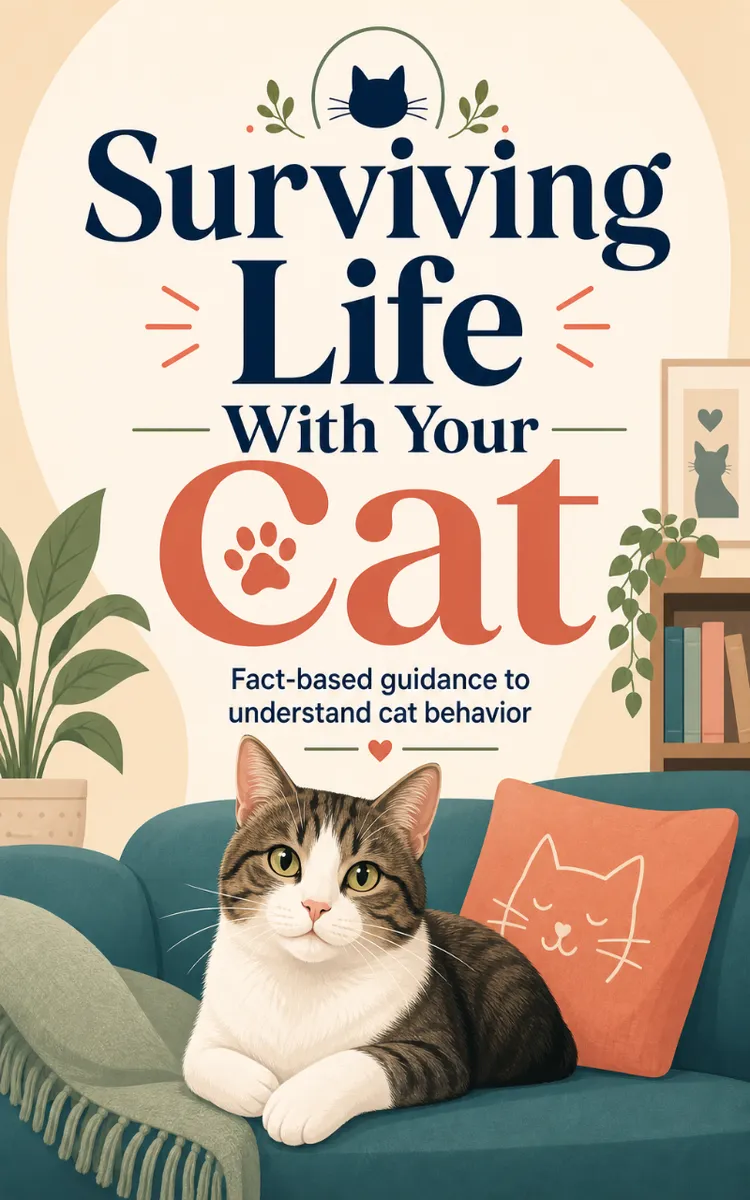
"Surviving Life With Your Cat" is a how-to guide book by Violet Powers with 8 chapters and approximately 16,117 words. Understanding cat behavior and building a friendly bond.
This book was created using Inkfluence AI, an AI-powered book generation platform that helps authors write, design, and publish complete books. It was made with the AI Ebook Generator.
Frequently Asked Questions
What is "Surviving Life With Your Cat" about?
Understanding cat behavior and building a friendly bond
How many chapters are in "Surviving Life With Your Cat"?
The book contains 8 chapters and approximately 16,117 words. Topics covered include Cat Communication Basics, Reading Stress and Fear Cues, Territory, Resources, and Boundaries, Litter Box Success and Hygiene, and more.
Who wrote "Surviving Life With Your Cat"?
This book was written by Violet Powers and created using Inkfluence AI, an AI book generation platform that helps authors write, design, and publish books.
How can I create a similar how-to guide book?
You can create your own how-to guide book using Inkfluence AI. Describe your idea, choose your style, and the AI writes the full book for you. It's free to start.
Write your own how-to guide book with AI
Describe your idea and Inkfluence writes the whole thing. Free to start.
Start writingCreated with Inkfluence AI


