
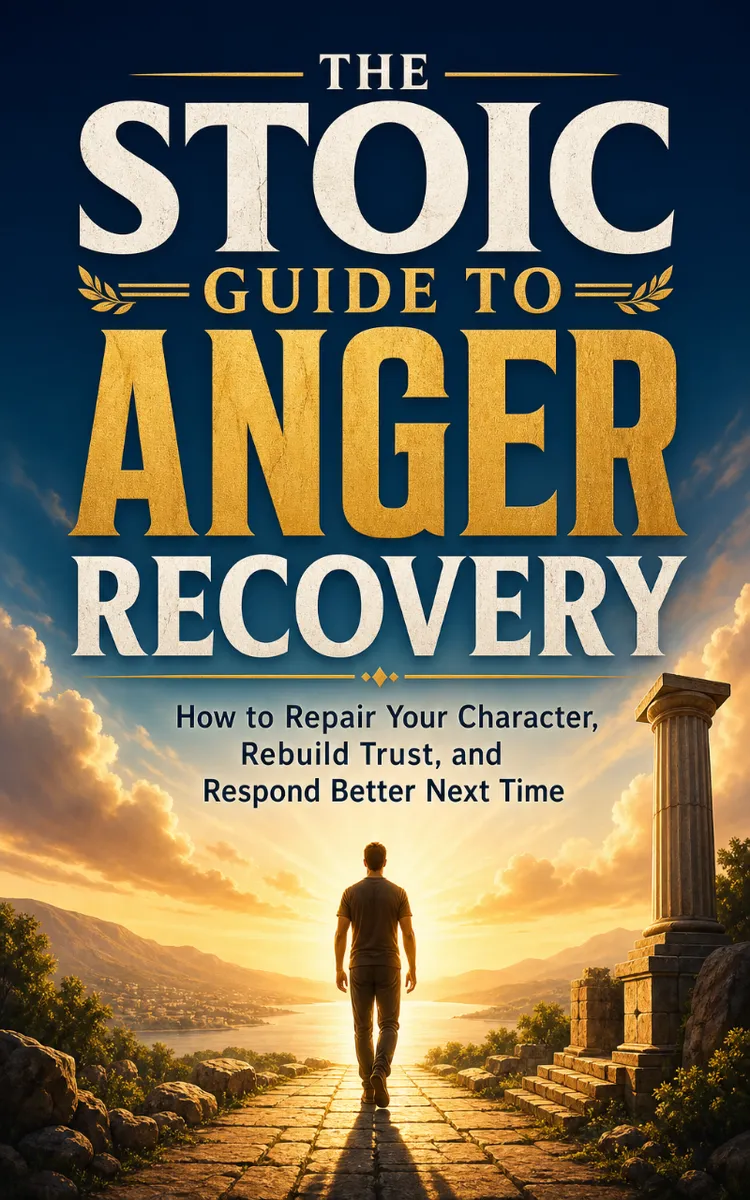
The Stoic Guide To Anger Recovery
Created with Inkfluence AI
Stoic-based strategies for recovering from anger mistakes
Table of Contents
- 1. Admitting Anger Without Excuses
- 2. Separating Judgment From Event
- 3. Choosing Virtue Over Winning
- 4. The Control Ladder for Anger
- 5. Rewriting Your Anger Trigger Story
- 6. Building a Pause That Works
- 7. Breathing for Temperance Under Stress
- 8. Using Pre-Commitments for Hard Moments
- 9. Repairing in the First 24 Hours
- 10. Apology That Rebuilds Trust
- 11. Making Amends With Specific Actions
- 12. Setting Boundaries Without Threats
- 13. Communicating With the Stoic Tone
- 14. Listening That De-Escalates
- 15. Turning Shame Into Character Work
- 16. Practicing Virtue in Small Reps
- 17. Handling Relapse Without Losing Progress
- 18. Rebuilding Trust Through Consistency
- 19. Creating a Relationship Repair Plan
- 20. Living a Stoic Life After Anger
Preview: Admitting Anger Without Excuses
A short excerpt from “Admitting Anger Without Excuses”. The full book contains 20 chapters and 28,894 words.
Picture This
Darius is halfway through the workday when the first thing goes wrong: a pallet count is off, a delivery shows up late, and one of his guys asks the same question twice like it’s no big deal. Darius feels his chest tighten. He tells himself he’s staying calm-until he hears his own voice get sharp. It’s not a scream, not even a full-on explosion. It’s worse than that: the kind of anger that sounds “reasonable” while it cuts.
After everyone walks away, he replays it like a highlight reel he doesn’t want to watch. He thinks, They had it coming. Then his stomach drops, because he knows what he’s doing-protecting his pride by making the story about other people. Later, when he tries to apologize, he ends up negotiating: “I shouldn’t have snapped, but you really need to-” and the apology turns into a debate. The trust he’s trying to rebuild stays just out of reach, like it’s on the other side of a locked door.
How can you face your anger honestly-without excusing it or hating yourself for it?
The Mindset Shift
Old Belief: Anger is proof you’re right, so the goal is to justify it or minimize the damage.
New Reality: Anger is information about what you’re protecting, so the goal is to tell the truth about what it costs.
That shift matters because anger recovery isn’t about becoming a different person overnight. It’s about stopping the inner courtroom where you’re both the judge and the lawyer. When you treat anger like “evidence,” you’ll keep trying to win. When you treat it like “information,” you can finally repair what you broke.
Here’s how it lands for Darius. The warehouse has a way of turning small frustrations into a full-body alarm. When the pallet count is off, part of him feels responsible. When the delivery is late, part of him feels disrespected. When someone asks a question twice, part of him feels like he’s being ignored. That’s what anger is doing: it’s trying to protect his sense of control, his responsibility, his dignity. But the anger doesn’t just protect-it also charges a fee. That fee shows up as tone, wording, body language, and the way people start to brace before you even speak.
If he can tell the truth-“I got angry because I felt out of control and I wanted to regain it fast”-he doesn’t have to pretend the snapping didn’t happen. He also doesn’t have to pretend he was “just reacting.” He can own the choice he made in the moment, without turning it into self-hatred. That’s the difference between repair and repeating.
Going Deeper
Anger usually doesn’t arrive as a villain. It arrives as a guard dog with bad manners. It reacts to something you care about, something you think needs attention right now. The Stoic angle here isn’t “never feel anger.” It’s that you don’t get to steer your life by the first emotion that stands up. You have to ask what the emotion is pointing at.
The Full-Account Ledger is the tool for telling the truth without denial or self-punishment. Think of it like a simple list of what’s happening inside you and what it costs outside you. You’re not doing it to punish yourself-you’re doing it to stop lying to yourself. Because the lie usually sounds like one of these:
- “I only snapped because they…” (blame)
- “It wasn’t that bad…” (minimize)
- “I’m just stressed…” (excuse without ownership)
- “I don’t even know why I did it…” (fog that protects you from change)
With the Ledger, you track both sides: what anger was trying to protect, and what it damaged. In practice, that means you don’t just say “I got mad.” You write down what you were protecting and how you spent it.
Signs this pattern is running your life
1. You argue about the facts instead of the impact. If someone says, “Your tone scared me,” you feel pulled to prove you weren’t that bad.
2. You apologize like a contract. “I’m sorry, but…” shows up every time you try to repair trust.
3. You only feel relief after you feel “understood,” not after you’ve actually changed.
4. You keep repeating the same scene, just with different people and different triggers, like your anger is using the same script.
En résumé: Anger recovery starts when you stop treating your anger like a verdict and start treating it like a report you can read.
If you want a concrete place to start, use a quick Ledger after a real moment-Darius’s “snapped at the guy who asked the question twice” moment is perfect for this. Don’t start with “I’m a bad person.” Start with two headings in your notes app:
- What I was protecting: (control, respect, responsibility, speed, safety, fairness-pick the closest one)
- What it cost: (tone, words, silence, rushed instructions, tension, trust, team confidence)
Now the truth is specific. And when it’s specific, repair becomes possible.
Reflection & Self-Assessment
1. What did my anger protect in that moment-specifically?
Try to name one thing, not a whole cloud....
About this book
"The Stoic Guide To Anger Recovery" is a self-help book by Socratic Mastery with 20 chapters and approximately 28,894 words. Stoic-based strategies for recovering from anger mistakes.
This book was created using Inkfluence AI, an AI-powered book generation platform that helps authors write, design, and publish complete books. It was made with the AI Self-Help Book Writer.
Frequently Asked Questions
What is "The Stoic Guide To Anger Recovery" about?
Stoic-based strategies for recovering from anger mistakes
How many chapters are in "The Stoic Guide To Anger Recovery"?
The book contains 20 chapters and approximately 28,894 words. Topics covered include Admitting Anger Without Excuses, Separating Judgment From Event, Choosing Virtue Over Winning, The Control Ladder for Anger, and more.
Who wrote "The Stoic Guide To Anger Recovery"?
This book was written by Socratic Mastery and created using Inkfluence AI, an AI book generation platform that helps authors write, design, and publish books.
How can I create a similar self-help book?
You can create your own self-help book using Inkfluence AI. Describe your idea, choose your style, and the AI writes the full book for you. It's free to start.
Write your own self-help book with AI
Describe your idea and Inkfluence writes the whole thing. Free to start.
Start writingCreated with Inkfluence AI


