
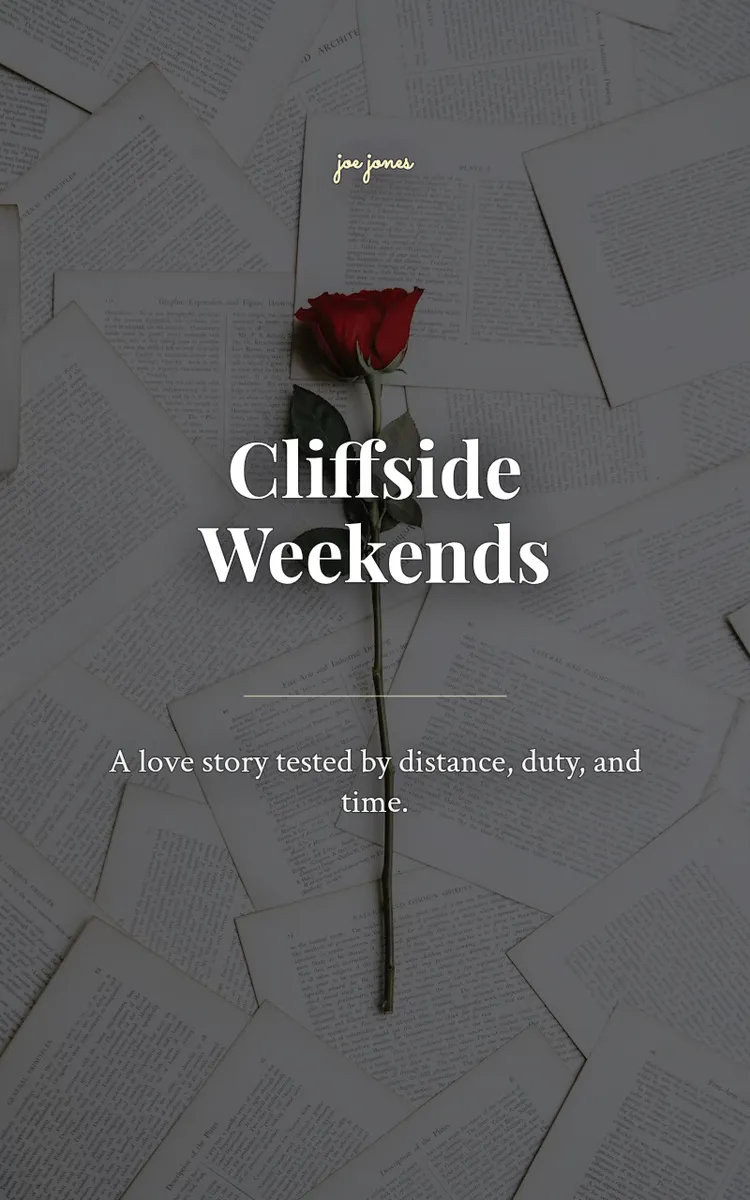
Read the first chapter
The whole of chapter one, free. About 9 min. Turn the pages with the arrows, your keyboard, or a swipe.
Chapter 1
A Table Above the Waterfall
The waterfall announced itself before Thomas Marini saw it.
Its roar rolled through the trees and over the narrow road, drowning the engine of the rented Fiat as he climbed toward the cliffside. He had been driving for hours with his uniform folded in the back seat and dust whitening his boots. Italy had given him vineyards, stone villages, and the sharp green smell of cypress. Now, at dusk, it gave him water falling into darkness.
He parked beside a crooked wall and stepped out.
Below the overlook, the waterfall broke over black rock in three white ribbons. Mist drifted upward, cool against his face. A few locals lingered along the railing with glasses in their hands, speaking softly as the sky turned the color of bruised peaches.
Thomas wanted one evening without orders.
He wanted a table, a meal, and someone who would not ask him where he had been sent next.
There was only one table left, set apart from the others near the cliff’s edge. Its iron legs stood unevenly on the stone, and a small candle trembled inside a glass jar. Thomas reached for the empty chair just as a woman crossed the terrace carrying a bottle of wine.
“That seat is taken,” she said.
Her English was careful, but not hesitant. She wore a pale blue dress with a cardigan looped around her shoulders. Dark hair fell loose to her waist, catching the last copper light. She looked young - perhaps twenty-five, perhaps a little older - and entirely certain that he had no right to touch the chair.
Thomas released it. “I’m sorry.”
“You are American.”
It was not a question.
“Is it that obvious?”
“You looked at the waterfall before you looked at the wine.” She set the bottle on the table. “Americans usually look at the wine first.”
He glanced at the bottle. “I’ve had a long day.”
“Then you should look at the wine.”
The corner of her mouth lifted. Thomas felt the first loosening in his chest since the telegram had arrived that morning.
“Thomas,” he said.
She studied him for a breath. “Lucia.”
He repeated it, quietly. “Lucia.”
“Now you sound Italian.”
“I’ve been practicing.”
“Since when?”
“Since I got lost.”
She laughed, and the sound moved through him with surprising force. The waterfall thundered below them, but he heard the laugh more clearly than anything else.
Lucia pulled out the chair. “Sit, Thomas. If you are going to steal my table, you should at least help me finish the wine.”
He sat across from her. The stone beneath the table held the day’s warmth. A waiter brought bread, tomatoes shining with oil, and a plate of grilled fish scented with lemon. Thomas poured the wine. His hand was steady because years of training had taught it to be steady, though Lucia watched him as if she could see the effort.
“You are a soldier,” she said.
He looked at the insignia on the sleeve of his travel jacket. “Was it the uniform?”
“No. The way you sit.”
“How do I sit?”
“Like the chair may need to be defended.”
He leaned back deliberately. “Better?”
“Now you look uncomfortable.”
“I’m out of practice.”
“With chairs?”
“With being somewhere I don’t have to defend.”
The teasing left her face. She lowered her eyes to the wineglass, turning it by the stem.
Thomas wished he could take the words back, not because they were untrue, but because they had fallen between them too quickly. He had met her less than ten minutes ago. He did not want to place the weight of his life on her table.
Lucia broke the silence first. “You came here for rest?”
“For a little while.”
“Only a little?”
“That is all I have.”
The answer sat there, plain and unadorned. She lifted her glass but did not drink.
“Then we must make it worth remembering,” she said.
The waiter returned with a dish of roasted peppers. Lucia moved her plate toward Thomas, insisting he try them. He told her he disliked peppers. She placed one on his bread anyway.
“You are a soldier,” she said. “You cannot be frightened of a pepper.”
“I’m frightened of many things.”
“Such as?”
“Bad coffee. Unreliable maps. Women who make demands before dessert.”
“Those are sensible fears.”
He ate the pepper. It was sweet, smoky, and hot at the back of his throat. Lucia watched him swallow.
“Well?”
“I may survive.”
“I am relieved.”
Their conversation found its rhythm after that. She told him the overlook belonged to no one and everyone: fishermen came in the morning, families came on Sundays, and young people came after dark when they wanted to believe the world had been made only for them. Thomas told her almost nothing about the places he had served. He described the smell of rain on a training field in Georgia, the terrible coffee in an airport outside Frankfurt, and his mother’s habit of leaving every light on when she was worried.
Lucia listened without interrupting. When he spoke of his mother, her fingers tightened around the glass.
“You have family here?” he asked.
“Yes.”
“Parents?”
Her gaze shifted toward the falls. The last brightness had left the sky, and the water below looked like torn cloth.
“My parents are gone.”
Thomas set down his fork. “I’m sorry.”
“They died in a car wreck.” Her voice remained level, but one shoulder drew inward. “Three years ago. I was their only child.”
He waited.
“I stayed in the house,” she continued. “There was no one else to stay for.”
The waterfall filled the pause. Thomas understood then that her beauty had not made her untouched. It had only made it easier for strangers to assume she was.
“You take care of everything?” he asked.
“Not everything. Only what refuses to disappear.”
He wanted to reach across the table. He did not. Instead, he pushed the bread basket toward her.
Lucia looked at the gesture and then at him. “You do not know me.”
“No.”
“And already you are trying to help.”
“I’m offering bread.”
“Bread is how it begins.”
“With most good things.”
Her smile returned, but sadness remained behind it. Thomas felt the dangerous pull of wanting to be the person who could make that sadness rest.
A sharp vibration came from his jacket.
The sound was small. It changed the air completely.
Thomas froze. The phone vibrated again. Lucia’s eyes moved to his pocket, then to his face.
“You should answer,” she said.
“I don’t want to.”
“That is not the same as not needing to.”
He took out the phone. The number was from the base. For a moment he watched it light his hand. Then he stood and walked several paces toward the railing.
The call lasted less than a minute.
When he returned, Lucia had poured herself more wine. She had not touched his plate.
“Orders?” she asked.
“Yes.”
“When do you leave?”
“Tomorrow morning.”
Her eyes did not widen. She simply looked down at the candle between them.
“You said you had a little while.”
“I thought I did.”
“That is a dangerous thing to think.”
“I know.”
“What happens now?”
“I report to the airfield. They’re moving the unit sooner than expected.”
“Where?”
“I can’t tell you.”
She nodded once. “Of course.”
The words were polite. The distance in them was not.
Thomas sat. “Lucia - ”
“You came here wanting one evening.”
“I still do.”
“But now the evening has an ending.”
“Every evening has an ending.”
“Not everyone arrives already knowing the hour.”
He had no answer for that. The wind lifted her hair and carried the scent of wet stone from the falls. Somewhere behind them, a glass broke, followed by a burst of laughter that sounded indecently ordinary.
Lucia rose from the table.
Thomas stood too. “Please don’t go.”
She looked at him then, fully. “Why should I stay?”
Because he had spent the entire day searching for a place where he could set down the war, and she had become part of that place. Because her hand had brushed his when she passed him the salt, and he had felt the touch long after. Because he had already begun imagining her across from him in another season.
He said the only honest thing. “Because I don’t want this to be the only night I know you.”
Her expression changed - not softened, exactly, but opened enough for him to see the fear beneath her composure.
“You are leaving,” she said.
“Yes.”
“And you will go back to your country.”
“Yes.”
“Soldiers always say they will return.”
“I am not saying I will return soon.”
“That is not what I asked.”
Thomas stepped closer, leaving the table between them. “I will return.”
Lucia’s breath caught, almost imperceptibly. “You cannot promise that.”
“I can promise what I intend.”
“That is how people make promises they cannot keep.”
He reached for her hand, stopping before he touched it. “May I?”
She looked at his raised hand, then placed hers in it.
Her fingers were cool. His closed around them carefully.
“I don’t know what happens to me tomorrow,” he said. “But I know I want to see you again. Not by accident. Not if the army happens to send me near here.”
“Then how?”
“Same place. Same week. Every year.”
Lucia gave a small, disbelieving laugh. “You are making a calendar out of one dinner.”
“I’m making a way back.”
“And if you cannot come?”
“Then I’ll write.”
“And if you cannot write?”
“Then I’ll find another way.”
She searched his face. “You say that because you are leaving.”
“I say it because I’m afraid that if I leave without saying it, I’ll spend the rest of my life wishing I had.”
For the first time, Lucia looked as unsteady as he felt.
She came around the table. Thomas did not move until she stood before him, close enough that he could feel the warmth of her through the thin fabric of her dress.
“Your life is not here,” she whispered.
“No.”
“Mine is.”
“I know.”
“I cannot leave it for you.”
“I’m not asking you to.”
The answer seemed to reach somewhere guarded inside her. Her free hand rose to his face, fingertips brushing the roughness along his jaw.
“Then what are you asking?”
Thomas turned his head and kissed her palm.
“For one night,” he said. “And for the next one we can have.”
Lucia’s eyes shone in the candlelight. She pulled him down by the collar of his shirt.
The kiss began cautiously, as if both of them were listening for a reason to stop. Then her mouth opened beneath his, warm and trembling, and the waterfall disappeared into the rush of her breath. Thomas placed his hands at her waist. He waited until she leaned into him before drawing her closer.
She tasted of wine and orange peel. Her hair slid over his wrist. When he kissed her again, more deeply, she made a quiet sound against his mouth and gripped his shoulders as though he were the one thing on the cliff that could not move.
They broke apart only when the waiter called from the terrace.
Lucia rested her forehead against his. “You really leave at dawn?”
“Yes.”
“Then come with me.”
The invitation held no promise beyond the night. That made it more dangerous.
Thomas looked toward the road, toward the car waiting beside the wall, toward the orders folded in his pocket. Then he looked back at her.
“I have to go,” he said.
“I know.”
“But not yet.”
Her eyes closed. “Not yet.”
They left the table with the candle still burning between the empty plates. At the edge of the overlook, Lucia took his hand and faced the waterfall.
“Same place,” she said.
“Same week.”
“Every year.”
“Every year.”
“And if you break the promise?”
Thomas watched the white water vanish into the dark below.
“Then you have every right to hate me.”
Lucia turned to him. “I would rather have the chance.”
He kissed her once more, knowing the morning had already begun its approach, knowing the army would take him before either of them was ready, and knowing that rest had not been what he found in Italy.
He had found a reason to return.
Now he had to leave it.
End of chapter one. 4 more chapters in the full book.
Swipe or use the arrows to turn the page
What's inside: 5 chapters
- 1. A Table Above the Waterfall
- 2. Letters That Cross the Atlantic
- 3. The Year Lucia Doesn’t Arrive
- 4. A Hospital Bed by the Sea
- 5. Choosing One More Week Together
About this book
"Cliffside Weekends" is a romance book by joe jones with 5 chapters and approximately 12,439 words. A soldier and an Italian woman meet yearly, then face loss..
This book was created using Inkfluence AI, an AI-powered book generation platform that helps authors write, design, and publish complete books. It was made with the AI Romance Novel Writer.
Frequently Asked Questions
What is "Cliffside Weekends" about?
A soldier and an Italian woman meet yearly, then face loss.
How many chapters are in "Cliffside Weekends"?
The book contains 5 chapters and approximately 12,439 words. Topics covered include A Table Above the Waterfall, Letters That Cross the Atlantic, The Year Lucia Doesn’t Arrive, A Hospital Bed by the Sea, and more.
Who wrote "Cliffside Weekends"?
This book was written by joe jones and created using Inkfluence AI, an AI book generation platform that helps authors write, design, and publish books.
How can I create a similar romance book?
You can create your own romance book using Inkfluence AI. Describe your idea, choose your style, and the AI writes the full book for you. It's free to start.
Write your own romance book with AI
Describe your idea and Inkfluence writes the whole thing. Free to start.
Start writingCreated with Inkfluence AI


