
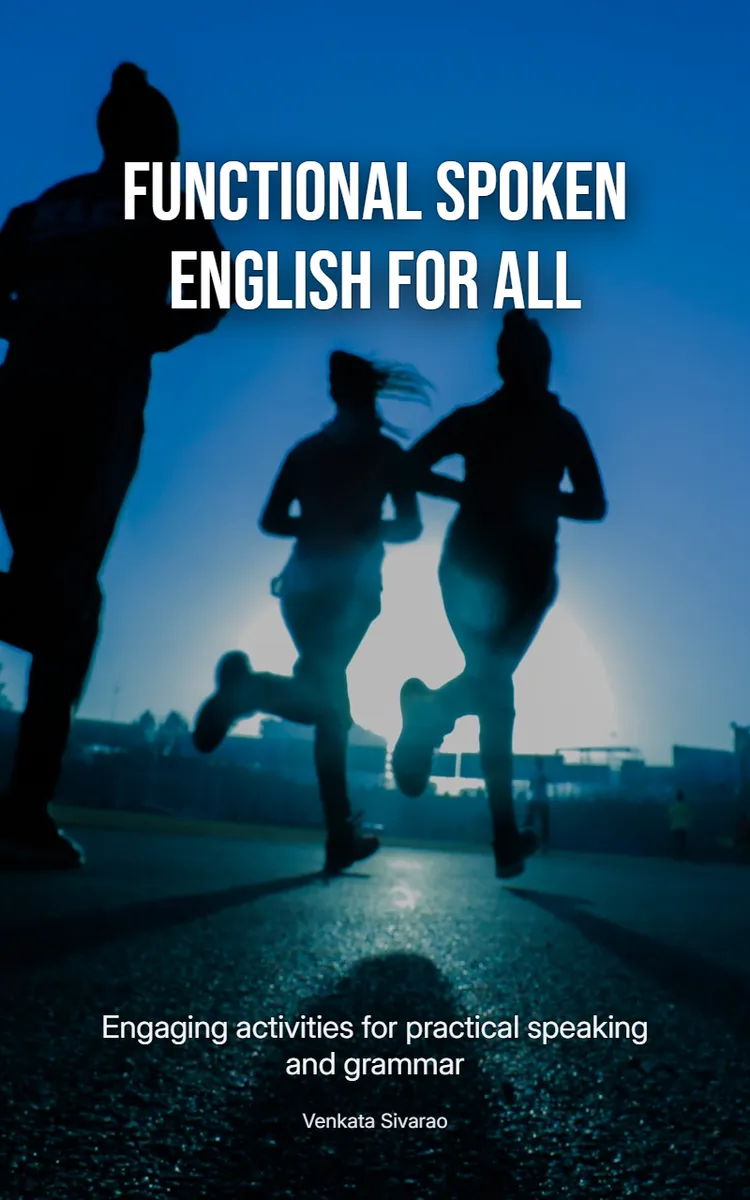
Functional Spoken English For All
Created with Inkfluence AI
Spoken English lessons with functional phrases and basic grammar activities
Table of Contents
- 1. Greetings, Introductions, and Polite Requests
- 2. Present Simple for Daily Routines
- 3. There Is/There Are for Places
- 4. How Much/How Many for Shopping
- 5. Past Simple for Yesterday’s Events
Preview: Greetings, Introductions, and Polite Requests
A short excerpt from “Greetings, Introductions, and Polite Requests”. The full book contains 5 chapters and 9,877 words.
Greetings, Introductions, and Polite Requests in Everyday Conversation
A learner enters a classroom, meets a new partner, and needs to say more than “Hello.” They must choose the right greeting, give their name, ask for information politely, and respond when someone makes a request. These small exchanges help learners take part in real conversations at school, at work, in shops, and in public places.
The focus here is everyday spoken English. Learners practise short functional phrases, basic sentence structures, and natural responses through dialogues and role-play. The work connects with earlier practice of simple sentences and the verb “be”: “I am Ravi,” “She is my teacher,” and “They are students.” Now those structures become useful in real communication.
Learning Objectives
Use formal and informal greetings in suitable situations.Introduce yourself and another person using the verb “be.”Make and answer polite requests with “Can,” “Could,” and “Would you mind.”
A useful classroom routine is to place three phrase cards on the board: Greeting, Introduction, and Request. Learners first identify the purpose of each phrase, then practise it with a partner.
The practical takeaway is simple: good spoken English begins with choosing a phrase that fits the person, place, and purpose.
Key Phrases and Basic Structures for Social Talk
Greeting - a phrase used when meeting or welcoming someone. Common greetings include “Hello,” “Hi,” “Good morning,” “Good afternoon,” and “Good evening.” “Hi” is friendly and informal. “Good morning” is polite and suitable for a teacher, customer, colleague, or someone meeting you for the first time.
The time of day affects the greeting. Use “Good morning” before midday, “Good afternoon” from midday until early evening, and “Good evening” later in the day. “Good night” is usually used when leaving or going to bed, not when first meeting someone.
A greeting often needs a response:
Speaker ASpeaker BGood morning.Good morning.Hi, how are you?I’m fine, thank you. How are you?Hello. Nice to meet you.Nice to meet you too.
Introduction - words used to tell someone your name or to present another person. The basic structure is:
“I’m Anil.”“My name is Anil.”“This is my friend, Meena.”“I’d like you to meet Mr Khan.”
“I’m” is the short spoken form of “I am.” Both forms are correct, but “I’m” is more common in everyday conversation. When introducing another person, use “This is,” not “He is” or “She is” as the opening phrase. For example, “This is my colleague, Sara.”
After an introduction, a listener may ask, “What do you do?” or “Where are you from?” Suitable answers are short:
“I’m a teacher.”“I work at Vijethat IIT Foundation School.”“I’m from Hyderabad.”
Polite request - a question used to ask for help, information, permission, or an object in a respectful way. The choice of phrase depends on the situation.
“Can you...?” is common and friendly: “Can you open the window, please?” “Could you...?” sounds more polite: “Could you repeat that, please?” “Would you mind...?” is very polite, but the grammar after it is different: “Would you mind opening the window?”
Notice the structure:
“Could you + base verb...?”
“Could you pass the book, please?”
“Would you mind + verb-ing...?”
“Would you mind waiting for two minutes?”
“Can I + base verb...?”
“Can I borrow your pen?”
A base verb is the simple form of a verb, such as “open,” “pass,” “wait,” or “borrow.” After “could you,” use the base verb: “Could you help me?” not “Could you helping me?”
A polite request often includes “please,” although a respectful voice is also important. The listener can respond in several ways:
Accepting: “Certainly.” “Of course.” “Sure.”Accepting with action: “Yes, I’ll do that.”Refusing politely: “I’m sorry, I can’t right now.”Asking for time: “Just a moment, please.”
Learners should also practise the difference between a request and an instruction. “Close the door” is an instruction. “Could you close the door, please?” is a polite request. In a classroom, teachers can say both forms and ask learners to identify which sounds more respectful.
Short dialogues help learners connect grammar with purpose:
At the school office
A: Good morning. I’m Priya Das.
B: Good morning, Priya. I’m Mr Thomas. Nice to meet you.
A: Nice to meet you too. Could you tell me where Room 4 is, please?
B: Certainly. It’s on the first floor.
A: Thank you very much.
B: You’re welcome.
The dialogue contains a greeting, two introductions, a request, an answer, and thanks. Ask yourself: Which phrase shows respect? “Could you tell me...” Which phrase closes the exchange? “You’re welcome.”
A practical teaching sequence is to let learners underline the greeting once, circle the introduction, and box the request. Then pairs replace one detail, such as the room number or the person’s name. This keeps the structure stable while giving learners fresh speaking practice.
...
About this book
"Functional Spoken English For All" is a education book by Venkata Sivarao with 5 chapters and approximately 9,877 words. Spoken English lessons with functional phrases and basic grammar activities.
This book was created using Inkfluence AI, an AI-powered book generation platform that helps authors write, design, and publish complete books. It was made with the AI Lesson Plan Generator.
Frequently Asked Questions
What is "Functional Spoken English For All" about?
Spoken English lessons with functional phrases and basic grammar activities
How many chapters are in "Functional Spoken English For All"?
The book contains 5 chapters and approximately 9,877 words. Topics covered include Greetings, Introductions, and Polite Requests, Present Simple for Daily Routines, There Is/There Are for Places, How Much/How Many for Shopping, and more.
Who wrote "Functional Spoken English For All"?
This book was written by Venkata Sivarao and created using Inkfluence AI, an AI book generation platform that helps authors write, design, and publish books.
How can I create a similar education book?
You can create your own education book using Inkfluence AI. Describe your idea, choose your style, and the AI writes the full book for you. It's free to start.
Write your own education book with AI
Describe your idea and Inkfluence writes the whole thing. Free to start.
Start writingCreated with Inkfluence AI


