

Read the first chapter
The whole of chapter one, free. About 8 min. Turn the pages with the arrows, your keyboard, or a swipe.
Chapter 1
Dog Body Language Basics
The CALM Signal Ladder: How to Read Comfort, Stress, and Attention Before It Escalates
The fastest way to prevent dog problems starts with one simple skill: reading your dog’s body language early. Most “bad behavior” starts long before your dog finally snaps, lunges, or freezes. You miss the early signs, then you try to fix the situation once your dog is already overloaded. That’s like trying to stop a spill after the bucket tips - sometimes you can, but it gets harder.
In this chapter, you’ll learn the most reliable signals of comfort, stress, and attention so you can act before things tip over. After you finish, you’ll be able to watch your dog’s face, posture, and movement and decide what to do next - whether that means slowing down, adding space, or asking for an easy job your dog can succeed at.
We’ll use one practical tool you can remember in the moment: the CALM Signal Ladder. It groups the signals you’ll see into Comfort, Attention, and Stress so you can respond quickly and consistently. Talia, a 31-year-old first-time dog owner, will be our main example as we walk through what she notices and what she does next.
The CALM Signal Ladder for Dog Body Language Signals (Comfort → Attention → Stress)
Dogs don’t “talk” with words, so they communicate with their bodies. The trick is to read the signals that show what your dog feels right now. The CALM Signal Ladder helps you do that by sorting signals into three states:
• Comfort: your dog feels safe and able to relax
• Attention: your dog notices something and is deciding what to do
• Stress: your dog feels unsafe, pressured, or unsure
Start by asking yourself one question every time you watch your dog: “What is my dog trying to communicate with this body position?” Then compare what you see to the ladder below. You don’t need every signal. You need the pattern.
Here are the most reliable signals for each state, with real-world examples so you can recognize them fast.
• Comfort signals: loose body + smooth movement
Comfort usually looks like a dog who can move without looking “stiff.” Watch for a loose, wiggly posture, a soft mouth (not tightly closed), and normal blinking. Many comfortable dogs also shake off after a moment of excitement, then keep doing their task.
Example: In your kitchen, your dog sniffs the floor and then lies down with a relaxed belly. That’s comfort. You can keep your routine steady.
•
Attention signals: focused eyes + “ready” posture
Attention means your dog’s brain locked onto something. You’ll often see forward head/ears, steady gaze, and stillness that’s not tense yet. The body may look upright and “parked,” like your dog is gathering information.
Example: A neighbor walks past the fence and your dog stands tall, staring. That’s attention. Your job is to decide whether you can let your dog look from a comfortable distance or you need to break the focus before stress builds.
• Stress signals: avoidance, tension, and “help me” body
Stress signals often show up as tight body, lip licking (when nothing is being eaten), whale eye (you see more white around the eyes), turning the head away, freezing, backing up, or tail tucked. Some dogs also pant in a non-hot moment, or move with a “bouncy but not happy” quality.
Example: At the front door, your dog starts lip licking and avoids making eye contact with the person coming in. That’s stress. If you greet anyway, you’ll likely push your dog up the ladder.
• The “ladder rule”: act when you see the first stress signal
You don’t wait for growling. You act when you see the earliest signs of stress or a fast slide from attention into stress. The earlier you intervene, the more control you have.
Example: Your dog starts with attention at the door (staring). Then you notice whale eye and a step back. That’s your cue to create space and lower pressure right then.
Ask yourself during each moment: “Am I seeing comfort signals, or is my dog moving toward stress?” When you can answer that quickly, you can prevent problems instead of reacting to them.
Takeaway: Use the CALM Signal Ladder to read patterns, not single behaviors. Comfort relaxes, attention locks in, stress asks for space.
Putting the CALM Signal Ladder to Work: Spot It, Name It, Then Change the Situation
Talia’s first week with her dog felt like a mystery. She thought barking meant “bad,” pulling meant “excited,” and freezing meant “being stubborn.” Then one afternoon she noticed a small thing: her dog would lip lick right before barking at the mail carrier. That small signal helped her catch the moment earlier and stop the barking from building.
Here’s a practical way to use the ladder with real steps you can do right away.
• Pick one short time window to practice: 2 minutes, same spot
Choose a place you already use daily, like your living room or a spot on your walk route. Watch your dog for two minutes without trying to train.
Expected outcome: You start seeing patterns faster because you remove extra variables.
• Watch in this order: face → ears → body → feet
• Face: eyes (soft vs whale eye), mouth (soft vs tight)
• Ears/head: forward focus vs turning away
• Body: loose vs stiff, leaning in vs pulling back
• Feet: stepping forward vs backing up, slow shuffle vs freeze
This order prevents you from getting stuck on one detail like tail wagging.
Expected outcome: You catch early changes before your dog “blows up.”
• Label the state out loud once per minute
Say one word: Comfort, Attention, or Stress. You’re training your brain to notice the ladder, not to judge your dog.
Expected outcome: You stop arguing with your dog’s “mood” and start tracking signals.
• Respond based on the ladder, using one clear action
Pick the simplest action that matches what you see:
• If you see Comfort: keep the plan and continue your routine.
• If you see Attention: create a safe way to look (more distance, a calmer path, or a brief pause).
• If you see Stress: reduce pressure immediately (increase distance, turn away, lower your voice, or end the interaction).
Expected outcome: Your dog gets less pressure and more choice, so stress stops climbing.
• Measure success by one thing: how fast the signals improve
Success doesn’t mean “your dog never shows attention.” It means the stress signals stop and comfort returns.
Expected outcome: You learn which responses help your dog settle.
Quick checklist (use this on the spot)
• Look at your dog’s eyes and mouth first.
• Notice ear and head direction (forward focus vs turning away).
• Check if the body looks loose or stiff.
• Watch the feet: forward steps vs backing up vs freezing.
• If you see the first stress signal, increase distance or end the pressure.
• Ask: “Did my dog’s signals improve within about 30-60 seconds?”
Now try it once on a normal day. Pick a moment when your dog usually reacts - door sounds, guests, leash on, the first moment you step outside - and practice reading the earliest signals.
Takeaway: Don’t “wait for the problem.” Label the state and change the situation immediately.
What to Watch For: Common Misreads and Edge Cases That Raise Stress
Even with a good ladder, people get tripped up by signals that look similar on the outside. Here are the most common mistakes and how to fix them fast.
Tail wagging doesn’t always mean comfort
A waggy tail can show excitement, attention, or stress. What matters is the rest of the body. A comfortable wag often comes with a loose body and smooth movement. A stress wag usually comes with stiffness, a higher tail posture, or a tense body.
Do this: Watch tail position plus face and body. If you see whale eye, stiff legs, lip licking, or a hard stare while the tail wags, treat it as attention or stress and add space.
Not this: Don’t assume “happy” because the tail moves. Don’t push a greeting just because your dog looks active.
Practical example: Your dog wags at the door while keeping a stiff stance and turning the head away from the person. That combination usually means your dog feels pressured, not friendly.
Lip licking can mean stress, not manners
People often think lip licking means “polite” or “calm.” In dog body language, lip licking commonly shows stress when nothing food-related happens. If your dog licks lips right before barking, freezing, or backing up, treat it as a stress signal.
Do this: If lip licking shows up out of nowhere, slow down your movement and increase distance from the trigger.
Not this: Don’t keep approaching or keep asking for attention. Don’t say “it’s okay” while you ignore the signal.
Practical example: On leash, your dog lip licks when another dog appears. If you keep walking closer, your dog often climbs the ladder and the barking starts.
Freeze can look like “good behavior” and still be stress
Freezing can be a sign of stress or overwhelm. Some dogs freeze because they’re trying to avoid conflict, or because they can’t decide what to do. People sometimes reward freezing by continuing the situation, thinking the dog is “being quiet.”
Do this: If your dog freezes and shows stiff posture, whale eye, or head turning away, treat it as stress. Change the setup - turn your body, walk away, or create distance.
Not this: Don’t push past the freeze. Don’t force “meet and greet” while your dog looks locked up.
Practical example: A new person stands too close and your dog goes stiff, stares at the ground, and stops moving. That freeze is a clear cue to stop the interaction and give space.
Takeaway: Read the full picture. Don’t trust one signal alone - use the ladder pattern.
The takeaway you can use today
Your goal isn’t to memorize every dog signal forever. Your goal is to catch stress early, when your dog still gives you a warning. When you can spot Comfort, Attention, and Stress with the CALM Signal Ladder, you stop guessing and start steering your day.
Before your next outing, pick one spot and practice for two minutes. Then, when your dog shows the first hint of stress, change one thing - distance, direction, or pressure - and watch what happens to the signals. That feedback teaches you faster than any theory ever will, and it builds the kind of safety your dog needs to become truly your friend.
End of chapter one. 7 more chapters and about 13,950 words in the full book.
Swipe or use the arrows to turn the page


What's inside: 8 chapters
- 1. Dog Body Language Basics
- 2. Read Stress Signals Early
- 3. Reward Timing and Marker Words
- 4. House Training With Predictable Routines
- 5. Leash Manners Without Pulling
- 6. Crate Training for Safety
- 7. Prevent Resource Guarding
- 8. Build Friendship With Consent Games
About this book
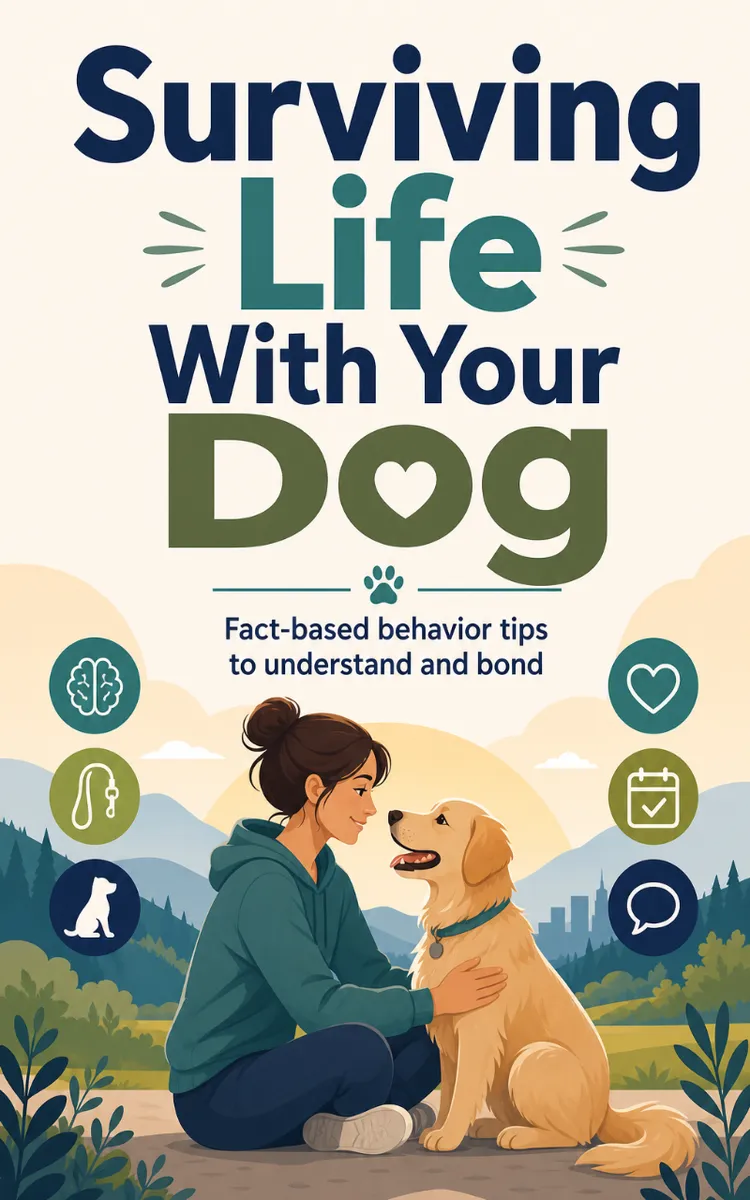
"Surviving Life With Your Dog" is a how-to guide book by Violet Powers with 8 chapters and approximately 13,950 words. Dog behavior basics, reading signals, and building friendship.
This book was created using Inkfluence AI, an AI-powered book generation platform that helps authors write, design, and publish complete books. It was made with the AI Ebook Generator.
Frequently Asked Questions
What is "Surviving Life With Your Dog" about?
Dog behavior basics, reading signals, and building friendship
How many chapters are in "Surviving Life With Your Dog"?
The book contains 8 chapters and approximately 13,950 words. Topics covered include Dog Body Language Basics, Read Stress Signals Early, Reward Timing and Marker Words, House Training With Predictable Routines, and more.
Who wrote "Surviving Life With Your Dog"?
This book was written by Violet Powers and created using Inkfluence AI, an AI book generation platform that helps authors write, design, and publish books.
How can I create a similar how-to guide book?
You can create your own how-to guide book using Inkfluence AI. Describe your idea, choose your style, and the AI writes the full book for you. It's free to start.
Write your own how-to guide book with AI
Describe your idea and Inkfluence writes the whole thing. Free to start.
Start writingCreated with Inkfluence AI


