
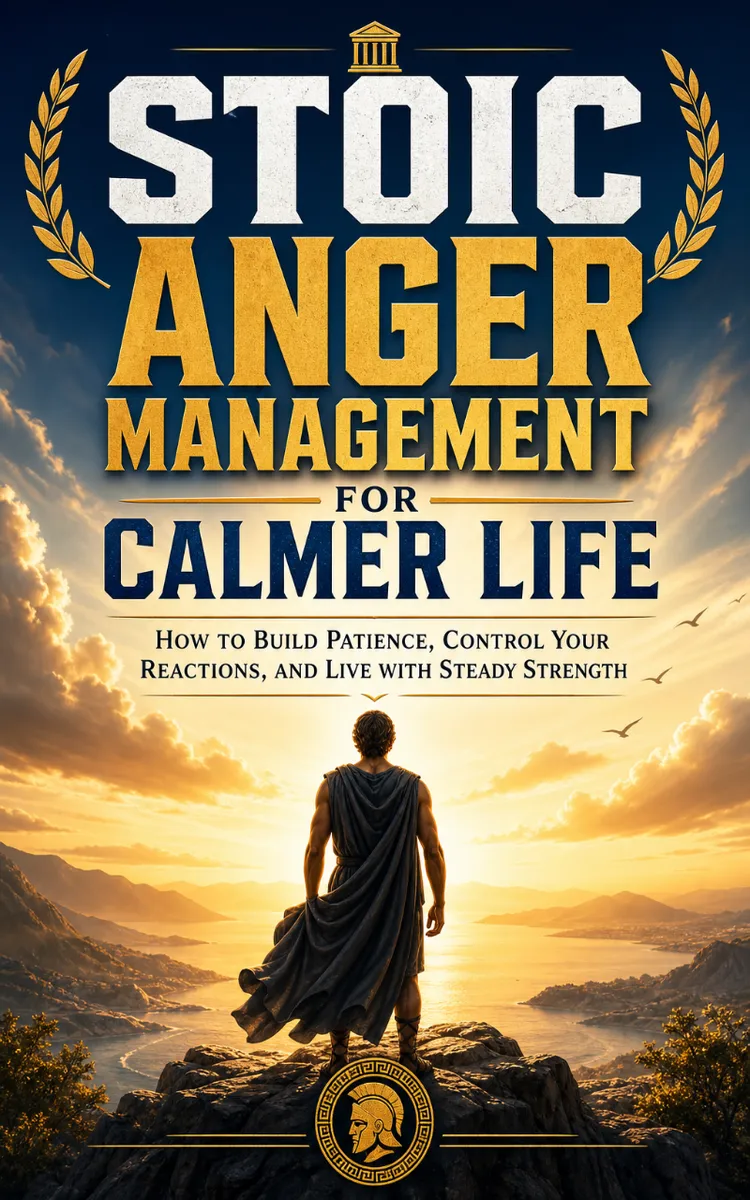
Stoic Anger Management For Calmer Life
Created with Inkfluence AI
Stoic-based strategies for managing anger and reactions
Table of Contents
- 1. Anger Isn’t the Enemy
- 2. Control What You Can
- 3. Name the Trigger Precisely
- 4. Separate Fact From Judgment
- 5. Build Your Inner Pause
- 6. Practice Voluntary Discomfort
- 7. Turn Complaints Into Requests
- 8. Set Boundaries Without Rage
- 9. Use Pre-Meditation for Hard Days
- 10. Stop Mind-Reading Instantly
- 11. Defuse Catastrophic Thoughts
- 12. Practice Justice in Everyday Conflict
- 13. Choose Virtue Over Winning
- 14. Repair After You Snap
- 15. Turn Rumination Into Review
- 16. Create a Calm Response Habit
- 17. Manage Anger in Relationships
- 18. Handle Workplace Provocations
- 19. Practice Evening Stoic Audits
- 20. Live with Steady Strength
Preview: Anger Isn’t the Enemy
A short excerpt from “Anger Isn’t the Enemy”. The full book contains 20 chapters and 27,976 words.
Picture This
“Anger is a fire alarm, not a verdict.”
It sounds nice-until you’re the one standing in the break room, staring at the message you just got. The one that makes your chest tighten. The one that feels disrespectful, unfair, personal. You read it once… then again, slower, as if extra time will turn it into something kinder. It doesn’t. Your mind starts handing you evidence like it’s building a case: “They meant to…” “They always…” “They don’t care about…”
Marcus, 34, a warehouse supervisor, knows that exact punch-in-the-gut feeling. A dock worker clocked out early, and the next day someone blamed him in front of the team. Not quietly. Not with questions. With that tone that says, You’re the problem. Marcus felt the heat rise fast-so fast it almost felt automatic. He could already see himself snapping back, defending his name, turning the whole room into a courtroom. And the worst part? Part of him believed he had to respond immediately, because silence would “prove” the accusation.
When you feel anger flare, are you treating it like a helpful signal-or like a verdict you must defend?
The Mindset Shift
Old Belief: Anger means you’re right, and you should act on it right now.
New Reality: Anger means something got triggered-and you still have a choice about what you judge and what you do next.
Here’s the shift that changes everything: anger isn’t automatically proof. It’s a reaction. A signal from your mind that something mattered to you-respect, fairness, safety, competence, belonging. The signal is real. The conclusion is optional.
Marcus felt anger and assumed it was telling him, “They’re wrong.” But the Stoic distinction is sharper than that. Something happens-someone blames you. Then your mind adds a verdict: They’re attacking me. They don’t respect me. I must correct this now. Anger rides in on that verdict like a passenger who insists they’re driving.
So the question becomes: can you separate what happened from what you judged? Not by pretending the situation is harmless, but by refusing to let your first interpretation become law. For example, Marcus could acknowledge, “That comment stung,” without immediately concluding, “They’re disrespectful and I need to win this.” That one pause turns the moment from escalation into choice.
A concrete version: imagine Marcus walks to the supervisor’s office and feels the urge to fire back. Instead of defending in the heat, he tries one sentence that buys him time: “I want to understand what happened with the dock schedule.” It’s not a surrender. It’s a steering wheel. He’s still addressing the issue, but he’s not letting anger write the dialogue.
Going Deeper
Stoics didn’t treat anger like a villain you have to crush. They treated it like a messenger with questionable credibility. The messenger can be accurate about your internal state-“Something matters to you”-while your interpretation can still be off. That’s the key.
Your anger often arrives with a bundle of assumptions. It feels like clarity because it comes with intensity. But intensity doesn’t equal truth. It equals energy. Energy wants expression; it doesn’t automatically deserve obedience. When you treat the heat as a verdict, you act as if your first story about the situation must be defended. That’s how disagreements turn into fights, and misunderstandings turn into grudges.
The Stoic move is to slow the moment where your mind jumps from “what happened” to “what it means.” The Mindset Shift isn’t about suppressing anger or forcing a fake calm face. It’s about refusing to let the verdict harden before you’ve checked the facts and examined the meaning you’re assigning.
Here’s how you can spot when the “anger = verdict” pattern is running the show:
1. You feel righteous urgency. The anger doesn’t just want to be felt-it wants immediate action, often in the form of a defense or a counterattack.
2. Your mind starts collecting “proof” that supports your first story. You replay the moment and highlight only the parts that confirm your judgment.
3. You treat silence as failure. You believe not responding means you’ll “lose” respect, status, or safety.
4. You get stuck in outcome obsession. Instead of addressing the problem, you focus on making the other person see it your way.
En résumé: Anger can signal “something matters,” but it can’t be trusted as the final judge of what’s true.
Marcus noticed his pattern the moment he felt his throat tighten. The heat wanted to protect his name. That makes sense. But the verdict-“They’re trying to embarrass me”-was a leap. Once he recognized the leap, he could choose a different response. Not weaker. Just steadier.
The practical value of the Signal vs. Verdict Map is that it gives you a name for what’s happening inside you....
About this book
"Stoic Anger Management For Calmer Life" is a self-help book by Socratic Mastery with 20 chapters and approximately 27,976 words. Stoic-based strategies for managing anger and reactions.
This book was created using Inkfluence AI, an AI-powered book generation platform that helps authors write, design, and publish complete books. It was made with the AI Self-Help Book Writer.
Frequently Asked Questions
What is "Stoic Anger Management For Calmer Life" about?
Stoic-based strategies for managing anger and reactions
How many chapters are in "Stoic Anger Management For Calmer Life"?
The book contains 20 chapters and approximately 27,976 words. Topics covered include Anger Isn’t the Enemy, Control What You Can, Name the Trigger Precisely, Separate Fact From Judgment, and more.
Who wrote "Stoic Anger Management For Calmer Life"?
This book was written by Socratic Mastery and created using Inkfluence AI, an AI book generation platform that helps authors write, design, and publish books.
How can I create a similar self-help book?
You can create your own self-help book using Inkfluence AI. Describe your idea, choose your style, and the AI writes the full book for you. It's free to start.
Write your own self-help book with AI
Describe your idea and Inkfluence writes the whole thing. Free to start.
Start writingCreated with Inkfluence AI


