
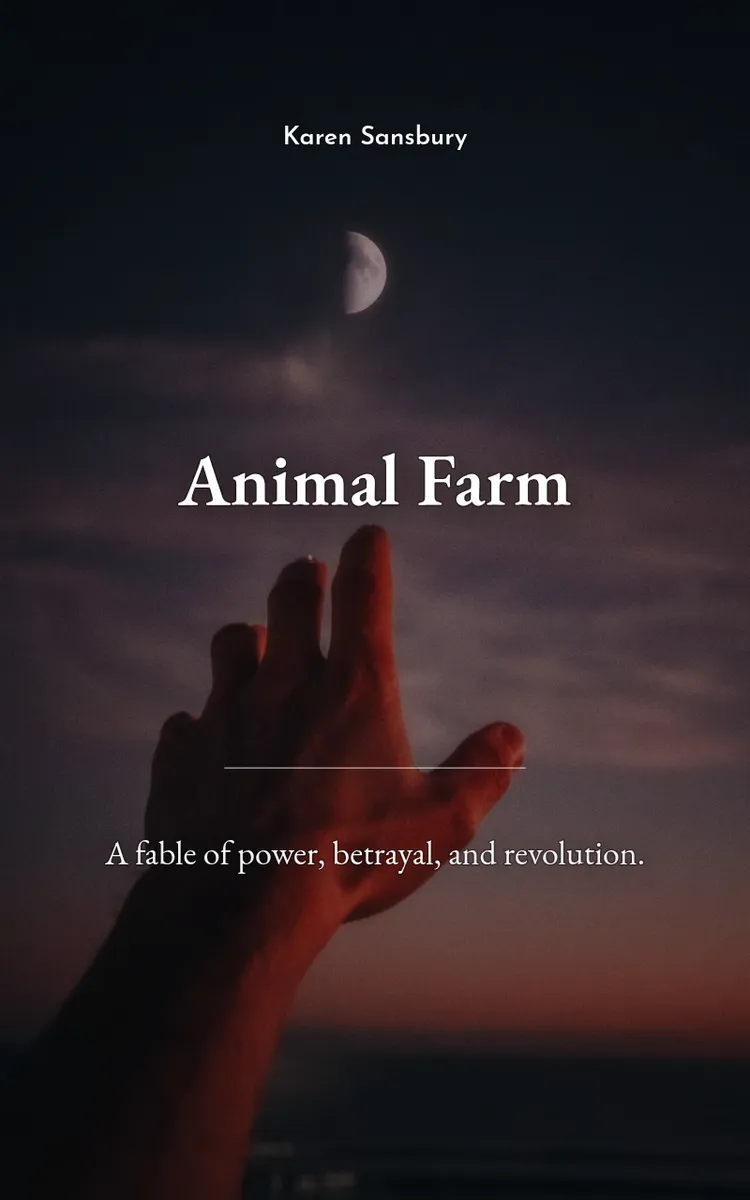
Read the first chapter
The whole of chapter one, free. About 9 min. Turn the pages with the arrows, your keyboard, or a swipe.
Chapter 1
The Manor’s First Night Crack
Benjamin Finch found the farmyard by the broken weather vane.
It had fallen from the roof of the farmhouse and lay across the cobbles, its iron rooster bent beneath a wheel rut. Around it, the yard heaved with bodies. Hens scattered beneath stamping hooves. Geese shrieked from the pond path. Somewhere beyond the kitchen garden, a gun cracked, and every animal flinched at once.
“Not that way,” Benjamin said.
The three animals behind him stopped so sharply that a sack of oats slid from Clover’s back and burst against the stones. The grain rolled into the mud.
“We cannot stay here,” said Muriel. Her voice trembled, though she tried to hide it. “The men will come back.”
“They may already be here.”
Benjamin looked toward the farmhouse. Its windows glowed yellow behind drifting smoke. A shutter banged against the wall. From inside came the dull crash of furniture, then a human cry cut short.
He wanted the barns. That was all. A roof, a barred door, and enough food to carry them through the night. The fighting had spread from the farmhouse to the yard, and no animal standing in the open could expect to remain unhurt. The barns were close, but between them and shelter lay the churned yard, the tool shed, and the narrow passage beside the pigsties where the larger animals were pushing toward the grain store.
Benjamin nudged the spilled oats with one hoof.
“Leave them,” he said.
Clover stared at the food. “They may be all we have.”
“They are what we cannot carry.”
A black-and-white cow lurched past them, bleeding from one ear. Behind her came two sheep, then a knot of younger pigs, all driven forward by a roar from the farmhouse steps.
“Back!” cried a voice. “Back to the barns! No one crosses the yard without permission!”
Benjamin turned.
Two pigs stood atop the water trough. One was a broad-shouldered animal with a torn ear; the other was smaller, pale, and clean despite the mud around him. Each held a length of timber between his teeth. Behind them, several sheep had formed a ragged line across the yard.
“Permission from whom?” Muriel called.
The pale pig lifted his head. “From the committee.”
“What committee?” asked Clover.
The pig gave a quick, contemptuous snort. “The one keeping order.”
A fresh shot sounded near the stables. The sheep broke formation. One fled toward the orchard, and the others followed. The broad-shouldered pig leapt from the trough and struck a young ram across the muzzle with his timber.
“Stay where you are!”
The ram stumbled back, stunned.
Benjamin felt the old, familiar weight of contempt settle in him. It was not new. Nothing was new. The farm had changed hands, but the creatures in charge had already discovered that a frightened crowd was easier to rule than a free one.
“Move,” he said.
He seized the torn sack of oats in his teeth and dragged it toward the tool shed. Clover followed, lowering her head against the press of bodies. Muriel stayed close to Benjamin’s flank. A goose flapped directly into his face, feathers striking his eyes, and he nearly lost his grip.
“Finch!” Clover shouted. “The shed!”
The door stood ajar. Benjamin reached it first and shoved his shoulder against the warped wood. Inside, the darkness was thick with the smell of oil, damp rope, and old iron. He pulled the sack through. Clover squeezed after him, then Muriel. The door slammed behind them as something heavy struck it from outside.
For a few seconds they heard only their own breathing.
Then a hoof scraped against the boards.
“Open up,” said a voice.
Benjamin set down the sack. “Who is it?”
“Friends.”
“There are no friends in the yard tonight.”
The hoof scraped again, harder. “Open it, or we open it for you.”
Clover pressed beside him. Her coat was streaked with mud, and one of her eyes had begun to swell.
“Benjamin,” she whispered, “we cannot fight them.”
“No.”
The door shuddered. A crack appeared between two boards.
Benjamin glanced at the back of the shed. A narrow window, half-blocked by a rake, looked toward the pigsties. Beyond it, the barn doors stood open. Lantern light moved inside.
“Through there,” he said.
Muriel stared at the opening. “I cannot fit.”
“You can if you stop thinking about it.”
Another blow struck the door. The latch bent.
Benjamin climbed onto a crate and pulled the rake aside. The window frame splintered beneath his hoof. He pushed through, scraping his shoulder on the jagged wood, and dropped into the mud beyond. Clover came next, then Muriel, who cried out when her hind leg caught on a nail.
The tool shed door burst inward.
“After them!”
Benjamin did not look back. He crossed the narrow strip behind the pigsties, where the mud was warm from the animals penned there. Pigs squealed and pressed against the rails. A lantern swung above the barn entrance, throwing the ground in and out of darkness.
The main doors were crowded with animals. Some were trying to enter; others were being driven away by a line of sheep armed with sticks. The sheep wore strips of red cloth tied around their necks. Benjamin had seen the cloth before, tied to the horns of animals who had shouted loudest in the yard.
“Let us through!” Clover called.
A sheep thrust his stick across the entrance. “The north barn is reserved.”
“For whom?”
“For those on the list.”
“What list?” Muriel asked.
The sheep’s eyes moved over them. “The list of loyal animals.”
Behind him, the barn was already filling. Crates had been dragged into a rough barricade. Bags of grain stood stacked against the far wall. A lantern burned beside them, and near the lantern sat a pig with a strip of red cloth around his foreleg. Benjamin recognized him: the pale pig from the trough.
He was speaking to three others, all pigs, while a pair of cart horses guarded the grain.
“You cannot keep us outside,” Clover said.
The sheep raised his stick. “Stand back.”
Benjamin stepped between them. “We have food.”
He nudged the sack forward.
The pale pig looked over. “How much?”
“Enough for four.”
“Then you have enough to pay.”
Clover’s head snapped around. “Pay?”
“Security,” said the pig. “Shelter. Protection from the men.”
“The men are not in the barn.”
“They are in the yard.”
“And you are making their work easier.”
A murmur moved through the animals behind Benjamin. It was not agreement. It was fear searching for a safe shape.
The broad-shouldered pig pushed through the entrance. Blood had dried along his torn ear.
“Who is this?” he asked.
“Benjamin Finch,” said the pale pig. “He has brought stores.”
“I know him.” The broad-shouldered pig looked at Benjamin with open dislike. “He never joined the meetings.”
“I attended enough.”
“You listened.”
“I still do.”
The pig stepped close. His breath was hot against Benjamin’s face. “Then listen now. Napoleon’s animals hold the farmhouse and the east yard. Snowball’s lot have taken the mill path and the south field. We hold the barns. No faction enters here without giving up weapons, food, and names.”
“Napoleon and Snowball are fighting already?” Muriel asked.
The pig gave a short laugh. “Fighting? They are counting followers. The shooting is merely how they count.”
A crash came from the farmyard. The animals in the barn flinched. Dust drifted from the rafters.
Benjamin looked past the pigs toward the stacked grain. It was not much, but it was dry. The barn walls were thick. The doors could be shut. Outside, the yard had become a trap with no safe corner.
“What do you want?” he asked.
The pale pig smiled. “The sack.”
“And then?”
“Then you may enter.”
“For how long?”
“As long as you remain useful.”
Clover moved beside Benjamin. “We will not surrender food to thieves.”
The broad-shouldered pig swung his timber downward. It struck the ground between her forelegs, splitting the packed earth.
“Not thieves,” he said. “Custodians.”
Benjamin watched the crack widen beneath the stick. He thought of the spilled oats by the weather vane, already trampled into mud. He thought of the broken shutter, the gunshots, the animals running without knowing where safety lay. He had spent his life expecting little from those who ruled the farm. It seemed the new rulers had learned the old method before the old ones had finished falling.
Behind him, Muriel whispered, “Benjamin.”
He knew what she wanted him to do. Turn away. Find another route. Risk the orchard, the open field, perhaps the farmhouse itself. But the sack was heavy, and Clover could barely stand. Muriel’s leg was bleeding. The barn was within reach.
Benjamin pushed the oats toward the pig.
The pale pig seized the sack and dragged it inside.
“Let them enter,” he said.
The sheep lifted their sticks. The line opened just wide enough.
Clover went first, limping. Muriel followed. Benjamin remained at the threshold until the last moment, looking back across the yard.
The farmhouse door had been torn from its hinges. A group of pigs moved along the veranda, carrying papers and boxes. Near the well, a white horse stood beside a cluster of animals wearing red cloth. At the far end of the yard, another group had raised a green flag over the tool shed.
There were no longer two sides.
There were at least three.
The broad-shouldered pig shoved Benjamin from behind. “Inside.”
Benjamin crossed the threshold.
The barn door swung shut, and darkness folded over them. Animals pressed against the walls, their bodies hot and trembling. Somewhere in the loft, a hen cried out. The floor shook beneath the weight of hooves as more creatures entered.
“Sit down,” ordered the pale pig. “No one takes grain without permission.”
Clover lowered herself onto the straw. Muriel leaned against a post, clutching her injured leg.
Benjamin looked toward the grain stacks. His share of the food had vanished among the other sacks.
“So this is shelter,” he said.
“It is order,” replied the pale pig.
“Order has a curious way of eating.”
The broad-shouldered pig turned. “Careful.”
The lantern flame jumped. Its light showed the faces around them: tired, frightened, watchful. Some animals looked at Benjamin with resentment because he had brought food. Others looked at him with resentment because he had not brought enough.
The pale pig climbed onto a crate.
“Before the doors are barred,” he said, “every animal will declare where he stands. No silence. No neutrality. The farm cannot be protected by creatures who refuse to choose.”
A murmur rose.
Benjamin felt Clover’s shoulder against his. Muriel’s breathing had become shallow.
The pig pointed at a goat near the wall. “You.”
“I stand with the animals,” said the goat.
“That is not an answer.”
“It is the only answer.”
The broad-shouldered pig struck the goat across the ribs. The goat collapsed into the straw.
“No,” said the pale pig. “The answer is the barns. Those who shelter here obey the barn committee.”
He turned to Benjamin.
“Finch.”
Benjamin did not move.
“Where do you stand?”
Outside, another gunshot cracked. The animals in the barn jolted. Dust sifted down from the beams and settled on Benjamin’s back like ash.
He looked at Clover, at Muriel, at the sacks stacked behind the pigs. He had won the shelter he wanted. The cost lay before him, plain as the broken weather vane in the yard.
“Here,” he said.
The pale pig waited.
Benjamin’s jaw tightened.
“With the barns,” he said.
“Say it properly.”
The broad-shouldered pig lifted his timber.
Benjamin heard the frightened breathing around him. He heard the barn door being barred. He heard, beyond the walls, the farm dividing itself into commands.
“I swear loyalty to the barn committee,” he said.
The pig lowered his stick.
“Good,” said the pale one. “Now we can begin.”
And in the darkness, while the grain was counted and the names were written, Benjamin understood that the revolution had not ended with the Manor changing hands. It had only found new doors to lock.
End of chapter one. 4 more chapters and about 11,362 words in the full book.
Swipe or use the arrows to turn the page

What's inside: 5 chapters
- 1. The Manor’s First Night Crack
- 2. Benjamin Finch Chooses the New Oath
- 3. The Missing Milk and Hidden Orders
- 4. The Windmill Plan Turns Into Betrayal
- 5. Commandments Rewritten, Benjamin Finch Breaks
About this book
"Animal Farm" is a fiction book by Karen Sansbury with 5 chapters and approximately 11,362 words. Allegorical farm rebellion and political corruption..
This book was created using Inkfluence AI, an AI-powered book generation platform that helps authors write, design, and publish complete books. It was made with the AI Novel Writer.
Frequently Asked Questions
What is "Animal Farm" about?
Allegorical farm rebellion and political corruption.
How many chapters are in "Animal Farm"?
The book contains 5 chapters and approximately 11,362 words. Topics covered include The Manor’s First Night Crack, Benjamin Finch Chooses the New Oath, The Missing Milk and Hidden Orders, The Windmill Plan Turns Into Betrayal, and more.
Who wrote "Animal Farm"?
This book was written by Karen Sansbury and created using Inkfluence AI, an AI book generation platform that helps authors write, design, and publish books.
How can I create a similar fiction book?
You can create your own fiction book using Inkfluence AI. Describe your idea, choose your style, and the AI writes the full book for you. It's free to start.
Write your own fiction book with AI
Describe your idea and Inkfluence writes the whole thing. Free to start.
Start writingCreated with Inkfluence AI


