

Read chapter 2
The whole of chapter two, free. About 10 min. Turn the pages with the arrows, your keyboard, or a swipe.
Chapter 2
The Teahouse Beneath the Bridge
The old bridge leaked river water through its stones in steady, deliberate taps, each drop striking the passage with the patience of a clock that had forgotten whom it was timing. Melissa Venn counted them as she descended, one hand on the rusted rail and the other closed around Bianca’s blue hair ribbon.
Seven taps. Pause.
Seven taps. Pause.
The rumor had said to follow the river until the bridge forgot which side it belonged to. Then find the door with no handle.
Melissa had spent six nights looking for it.
Tonight, the water rose over her boots.
She kept walking.
The passage had once been a service tunnel, if the flaking notices and dead lamps along the ceiling could still be trusted as evidence. Whatever municipal logic had built it was gone now: brick yielded to black stone, black stone to slick plaster, and somewhere behind the walls the river muttered with the intimate resentment of something imprisoned beside her.
Melissa lifted her lantern. Its flame leaned toward the dark.
“Very encouraging,” she said.
Her voice came back from ahead of her, thin and delayed.
Encouraging.
She stopped.
The echo stopped a moment later.
Melissa tightened her fingers around the ribbon. Bianca had worn it on the day she died, looped around her wrist after illness had taken the hair it was meant to hold. The silk still retained the faint crease of Bianca’s hand. Melissa had washed the blood from everything else herself: the dress, the floorboards, the little silver cup Bianca dropped when the fever became something no physician, priest, neighbor, or frightened sister could name with confidence.
Not the ribbon.
At the next turn, the passage divided into three corridors. All three contained the same sign, nailed crookedly to the wall.
TEA SERVICE.
An arrow pointed left.
A second arrow, beneath it, pointed right.
A third pointed straight down.
Melissa stared at the signs.
“Which one goes to the teahouse?”
The lowest arrow trembled.
The floor opened beneath it.
She jumped back as a black stream poured from the crack, carrying drowned leaves, a child’s shoe, and something pale that turned once in the water before vanishing around the bend.
The left corridor filled with the clatter of cups.
The right corridor filled with Bianca’s laugh.
Melissa went right.
The corridor narrowed at once. Brick pressed against her shoulders. Water crawled over her boots and climbed her calves, cold enough to numb the bones. Behind her, the signs began to rattle on their nails.
“Melissa?”
She nearly fell.
Bianca’s voice came from ahead.
Not the voice from the hospital, pinched and breathless. Not the voice from Melissa’s dreams, where it was always too far away to touch. This was Bianca at twenty-three, amused by a bad joke, impatient with the world’s inability to keep up.
“Melissa, you’re going to miss the train.”
Melissa shoved through the darkness.
The corridor ended at a wall.
The laugh ceased.
For one foolish second she pressed both palms against the wet bricks.
“Bianca?”
Something knocked from the other side.
Once.
Twice.
Then three times, like a knuckle against a table.
Melissa stepped away. The water had reached her knees. Her lantern went out.
In the dark, a door appeared.
It had no handle.
A brass slot opened at eye level.
“Name?” asked a voice.
Melissa’s mouth had gone dry. “Melissa Venn.”
“Purpose of visit?”
“To see my sister.”
“Relationship to deceased?”
“Sister.”
“Proof?”
Melissa held up the ribbon.
The slot snapped shut. A pause followed, filled with the faint scratching of a pen.
“Insufficient.”
“She’s dead,” Melissa said. “That should be proof enough.”
“Not according to Form Nine.”
“What is Form Nine?”
“Proof of grief.”
The door remained shut.
Melissa felt the water tugging at her coat. Somewhere behind her, the passage shifted with a long groan, like a ship turning in deep water.
“What does it require?”
“Three tears, freely shed, witnessed by a licensed mourner.”
“I don’t have a licensed mourner.”
“Then acquire one.”
“Where?”
The voice brightened with bureaucratic sympathy. “There is a waiting list.”
Melissa struck the door with her fist. “I have walked through a flooded tunnel for an hour.”
“Time spent in transit does not constitute grief.”
“She died six weeks ago.”
“Recent grief is often considered administratively unreliable.”
Something moved in the water behind her.
Melissa turned. Her lantern, though extinguished, now floated on the surface several yards away. Its glass chamber glowed with a small green light. Around it, the water dimpled as if many fingers were testing it.
She faced the door again.
“I don’t care what form you need.”
“No one ever does.”
“I want to see Bianca.”
The slot opened.
“Do you accept hospitality?”
“What?”
“Do you accept hospitality?”
“I accept tea.”
“That is not what I asked.”
The water rose to her waist. It was no longer cold. It had the clammy warmth of bathwater left too long in a locked room.
Melissa put her hand flat against the door.
“I accept.”
The door opened inward.
Warmth struck her first, then lamplight, then the smell of black tea, burnt sugar, and wet wool. Melissa stumbled across the threshold. The door slammed behind her, cutting off the river.
She stood in a narrow teahouse tucked beneath the bridge like a confidence regretted immediately after disclosure. Pipes and bundles of drying herbs crowded the low ceiling; copper lamps burned without visible flame, and every table had been laid for absent company with a cup, a saucer, and a folded white napkin of almost insulting precision.
At the far end, behind a counter made from dark polished wood, stood the keeper.
They were tall and narrow, dressed in a green coat buttoned to the throat. Their hair was the color of old ash. A silver chain ran from one breast pocket to the other, carrying a dozen tiny keys. None of them appeared to fit anything in the room.
The keeper looked at Melissa’s soaked coat, then at the water spreading across the floor.
“You tracked in the river.”
“I noticed.”
“Most visitors do.”
“Are you the keeper?”
“That depends who is asking.”
“Melissa Venn.”
“Yes,” the keeper said. “You are.”
Melissa looked past them. “Where is Bianca?”
“Not here yet.”
“You said the tea -”
“I have said nothing.”
“The rumor said -”
“Rumors are the cheapest form of advertising. They are also the least regulated.”
Melissa stepped toward the counter. Her boots left black prints on the floorboards. “Can your tea bring back the dead?”
The keeper’s expression did not change, but one of the keys at their chest began to turn slowly on its chain.
“No.”
“Can it let me speak to them?”
“Yes.”
“For how long?”
“One night.”
Melissa swallowed. “One night?”
“The invitation may be renewed.”
“How?”
The keeper lifted a porcelain cup from beneath the counter. It was white, except for a thin red line circling the rim.
“By drinking again.”
“How many times?”
The keeper placed the cup on the counter between them.
“Three cups make an account.”
“What account?”
“Yours.”
Melissa stared into the tea. Steam rose in narrow threads, touching her face with the intimacy of breath, while the dark surface resolved into a room she knew too well: Bianca’s bedroom, yellow curtains lifting in a nonexistent draft, the cracked mirror, the blue sweater still hanging from the chair as though its owner had merely stepped away.
Then the image rippled away.
“What happens after three?”
The keeper wiped a dry spot from the already spotless counter.
“You have not accepted the first.”
“I’m asking what happens after three.”
“People often ask that after the third.”
“Answer me.”
The keeper’s eyes were pale and reflective, like coins at the bottom of a fountain.
“Hospitality always collects its due.”
“That isn’t an answer.”
“It is the only one the house is authorized to provide.”
Melissa laughed once. It came out ugly. “Authorized?”
“There is a records office.”
“Of course there is.”
“They are very strict about language.”
“Then use plain language.”
The keeper leaned closer. Their voice softened.
“The first cup opens the door. The second keeps it open. The third decides which side of it you belong to.”
The teahouse seemed to contract around Melissa, not dramatically but by degrees, as though the room were revising its dimensions after learning her answer. Somewhere overhead the bridge gave a deep stone groan, and dust sifted from the beams with the solemnity of ash.
Melissa looked again at the tea.
“Can I see her tonight?”
“If you drink.”
“And if I don’t?”
“You may leave.”
She glanced at the door. It stood behind her without a handle, its wood darkened by river water. A thin line of black seeped beneath it.
“Can I come back?”
“If the house remembers you.”
“How do I make it remember?”
The keeper’s mouth curved, not quite into a smile.
“Accept hospitality.”
Melissa thought of Bianca’s room. The empty bed. The ribbon in her fist. The sound of her sister laughing from a corridor that ended in a wall.
She reached for the cup.
The keeper caught her wrist.
Their fingers were cold and dry. The touch stopped Melissa more effectively than any warning.
“One condition,” they said.
“You said there were no terms.”
“I said there were no terms beyond the cup.”
“That sounds like a term.”
“It is a courtesy.”
“What courtesy?”
“Do not ask the dead to stay.”
Melissa pulled against their grip. “I’m not asking her to stay.”
“Not aloud, perhaps.”
“Let go.”
The keeper did.
A red mark remained around Melissa’s wrist, shaped like a ring.
She lifted the cup. The porcelain was warm against her palms. The tea smelled of smoke, cloves, and the wool blanket Bianca used to drag from room to room as a child.
Melissa took a sip.
The teahouse vanished.
For one breath she was standing in Bianca’s bedroom, though the floor beneath her feet felt soft and wet. The yellow curtains stirred without wind. The cracked mirror showed Melissa from behind, her face turned toward someone who stood just outside its frame.
Then the room returned.
The cup was empty.
Across the table, a chair scraped backward.
Bianca sat down.
Melissa could not move.
Bianca looked exactly as she had on the last morning: hair unbrushed, one sleeve rolled higher than the other, blue ribbon tied around her wrist. Her skin was pale, but not sickly. It had the faint translucence of paper held over a lamp. Beneath it, something dark moved along her veins like ink searching for a pen.
“Melissa,” Bianca said.
Melissa’s knees struck the chair behind her.
Bianca reached across the table. Her hand stopped an inch above Melissa’s.
“Can I touch you?”
Melissa made a sound that might have been yes.
Bianca’s fingers settled over hers.
They were cold.
Not winter-cold. Grave-cold. The temperature of a coin buried in earth.
Melissa folded over their joined hands. The tears came without permission, hot and humiliating. Bianca’s thumb moved over her knuckles as it had when they were children hiding beneath the kitchen table during thunderstorms.
“I knew you’d find it,” Bianca said.
Melissa looked up sharply. “You knew?”
“I hoped.”
“You’re dead.”
Bianca smiled with unbearable tenderness, the same crooked softness she had worn after every childhood disaster too large to repair and too small to confess. “Yes.”
The word broke something open in Melissa.
She gripped Bianca’s hand. “I tried everything.”
“I know.”
“I called every hospital. I found the woman who reads bones. I slept in your room.”
“I know.”
“You don’t get to say you know.”
“I’m sorry.”
“Don’t apologize.”
“I’m sorry.”
Melissa laughed through her tears. The sound frightened her. It was almost their old laugh, the one that used to get them thrown out of libraries.
At the counter, the keeper lifted a large black ledger.
Melissa turned. “What are you doing?”
“Recording the visit.”
“You said one night.”
“Yes.”
“You said I could leave.”
“Yes.”
“Then why are you recording it?”
The keeper dipped a pen into an inkwell. The ink crawled up the nib like a living thing.
“Because the invitation has begun.”
Bianca’s fingers tightened around Melissa’s.
“What invitation?” Melissa asked.
The keeper wrote across the page. The scratch of the pen sounded much too loud.
“Your account is open,” they said. “One cup has been received. Two remain available.”
Melissa looked down at the empty cup.
“I didn’t agree to two.”
“No,” said the keeper. “You agreed to hospitality.”
The lamps flickered. Beyond the walls, the river struck the bridge supports with a heavy, patient force.
Bianca leaned closer. Her lips brushed Melissa’s ear, cold as the underside of a stone.
“Don’t drink the third,” she whispered.
At the counter, the keeper turned a page in the ledger.
“Do not worry,” they said. “The house will remind you.”
Then every occupied chair in the teahouse turned toward Melissa at once.
End of chapter two. 12 more chapters in the full book.
Swipe or use the arrows to turn the page


What's inside: 14 chapters
- 1. Introduction
- 2. The Teahouse Beneath the Bridge
- 3. A Sister at the Window
- 4. The Receipt's Fine Print
- 5. The Keeper's Locked Pantry
- 6. The Cup She Wants
- 7. The Stolen Third Cup
- 8. The Ledger Names Her
- 9. The Bridge That Eats Names
- 10. Elian's Last Message
- 11. The Room Without Morning
- 12. The Ledger's Open Case
- 13. A Door Back to Rain
- 14. The Unclaimed Cup
About this book
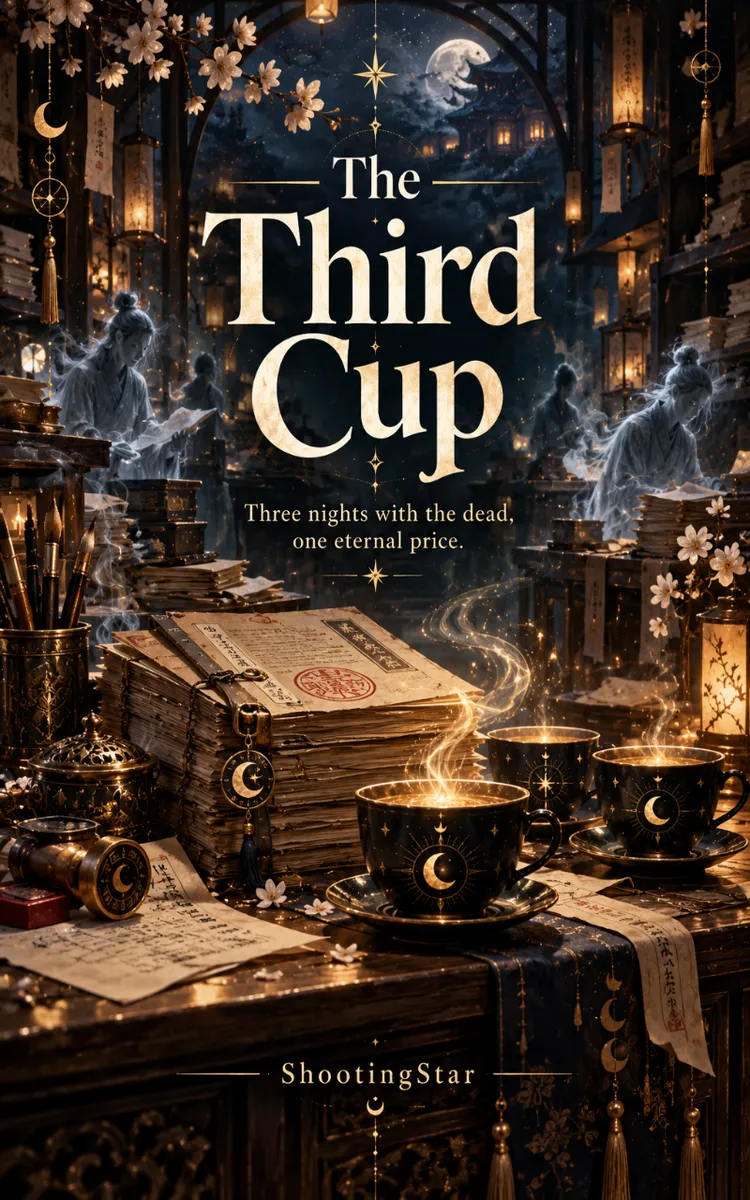
"The Third Cup" is a fiction book by ShootingStar with 14 chapters and approximately 28,254 words. It covers key insights and practical takeaways on the topic.
This book was created using Inkfluence AI, an AI-powered book generation platform that helps authors write, design, and publish complete books. It was made with the AI Novel Writer.
Frequently Asked Questions
What is "The Third Cup" about?
"The Third Cup" is a fiction book by ShootingStar covering key insights and practical takeaways on the topic.
How many chapters are in "The Third Cup"?
The book contains 14 chapters and approximately 28,254 words. Topics covered include Introduction, The Teahouse Beneath the Bridge, A Sister at the Window, The Receipt's Fine Print, and more.
Who wrote "The Third Cup"?
This book was written by ShootingStar and created using Inkfluence AI, an AI book generation platform that helps authors write, design, and publish books.
How can I create a similar fiction book?
You can create your own fiction book using Inkfluence AI. Describe your idea, choose your style, and the AI writes the full book for you. It's free to start.
Write your own fiction book with AI
Describe your idea and Inkfluence writes the whole thing. Free to start.
Start writingCreated with Inkfluence AI


