
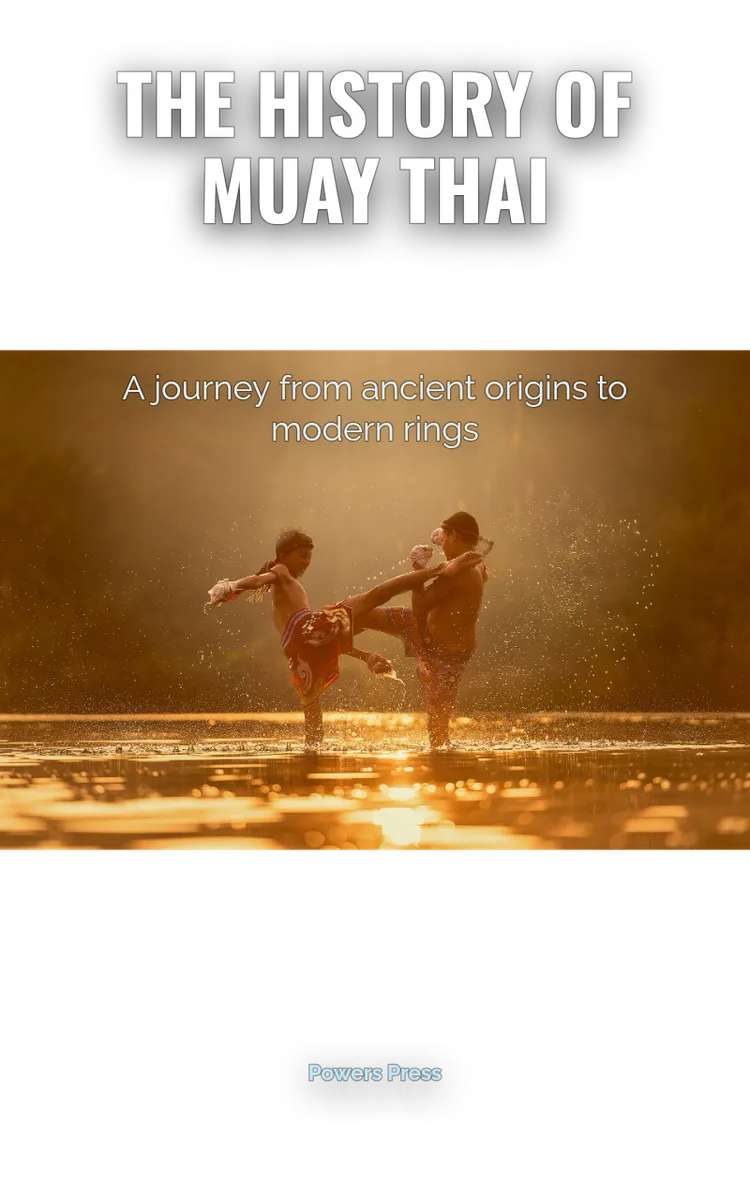
Read the first chapter
The whole of chapter one, free. About 8 min. Turn the pages with the arrows, your keyboard, or a swipe.
Chapter 1
The Wai Kru Before Any Fight
The Gesture Before the Bell
At Bangkok’s Rajadamnern Stadium, a fighter may spend several minutes moving in a circle before the first punch is thrown. The music rises, the crowd watches, and the opponent remains still. To an unfamiliar eye, the delay can look ceremonial. Historically, it is closer to a public record: the fighter is showing where he comes from.
The ritual is the Wai Kru Ram Muay. Wai kru means paying respect to the teacher; ram muay refers to the stylized movement performed by the fighter. The two are often spoken of together, but they carry different layers. One acknowledges the teacher, the gym, and the knowledge passed down through bodies. The other gives that knowledge a visible form - part dance, part prayer, part declaration of identity.
Its meaning changed as Muay Thai moved from village contests and royal ceremonies into organized gyms, radio broadcasts, and modern stadiums. Yet the ritual remained because it answered a question that rules and scorecards could not: how can a fighting art preserve its lineage when every match ends with only one winner?
What does a fighter reveal before the fight has begun?
A Ritual Older Than the Modern Ring
The roots of the wai kru lie in a Thailand where fighting was not yet separated into the neat categories familiar today. Combat training belonged to soldiers, palace guards, local champions, and young men learning under a teacher whose authority was practical as well as moral. Early forms of Thai boxing were known by regional names and practiced with fewer standardized rules. The formal ring, timed rounds, gloves, and national stadiums came later.
In that older setting, a teacher was not simply a person who corrected technique. A kru transmitted a body of knowledge: how to stand, strike, evade, read an opponent, and conduct oneself around danger. Training took place through close observation and repetition. The student learned not only a knee or elbow but the habits surrounding it - when to show restraint, when to accept instruction, and how to carry the reputation of the training camp.
The wai, made by bringing the palms together, already belonged to Thai social and religious life. Its meaning changes with height and context. A gesture directed toward a senior person differs from one offered to a monk or an image of the Buddha. In the wai kru, respect is not abstract. The fighter lowers the head, raises the hands, and acknowledges relationships that existed before the match.
The ram muay adds movement and local character. Fighters circle the ring, kneel, bow, and perform gestures that may refer to a teacher, a place, a protective figure, or a particular school. Some movements resemble archery, hunting, rowing, or the handling of weapons. Not every gesture has a single agreed translation. That uncertainty is part of the ritual’s history: it developed through transmission, adaptation, and memory rather than through one central manual.
A ring therefore became more than a marked space for violence. Before the contest, it became a temporary map of belonging. The fighter moved through it carrying the name of a camp, a province, a teacher, and sometimes a family tradition.
The Wai Kru Lineage Map
The Wai Kru Lineage Map is a useful way to understand why the ritual survived modernization. It does not chart bloodlines alone. It follows the routes by which technique, authority, and identity travel from teacher to student and from one generation of fighters to another.
At its center is the kru. Around that center are the camp, the local community, the music, the ritual gestures, and the rules of conduct expected from a fighter. When a student performs the wai kru, these elements become visible at once. The ritual says, in effect, that skill did not appear from nowhere.
This is especially important in a combat sport, where individual reputation can easily overshadow collective inheritance. A fighter may become famous under his own name, but the pre-fight ritual places that name inside a larger chain. The camp may be recognized by a distinctive sequence of movements. A teacher may be honored through the direction of the bow. A fighter from a particular region may carry habits of rhythm and posture associated with that place.
The map also explains why the ritual cannot be reduced to choreography. Two fighters may perform similar steps while meaning different things by them. One may be honoring a deceased teacher. Another may be following a camp tradition learned from a senior fighter. A third may have learned a shortened version designed for a television audience or an international event. The visible form is shared, but the lineage beneath it can differ.
One surprising fact follows from this: the wai kru is not merely a pre-fight ceremony; it is one of Muay Thai’s oldest systems for identifying ownership of knowledge.
That matters because Muay Thai has repeatedly crossed boundaries. It moved from military and local settings into commercial stadiums, from Thailand into gyms around the world, and from oral teaching into videos and online instruction. The ritual remained a way to distinguish inherited practice from a collection of techniques assembled without context. It does not prove that a fighter has learned well, but it announces that learning is understood as a relationship.
The music reinforces this lineage. Traditional fight music, commonly played by a small ensemble including drums, a reed instrument, and cymbals, changes pace as the bout develops. During the wai kru, its measured rhythm gives the fighter a shared timing before the contest becomes a test of reaction. The music belongs to the event as much as the ropes and canvas do. It places the individual performance inside a public tradition.
From Training Yard to Stadium
As Muay Thai became more organized during the twentieth century, the ritual changed in scale without losing its basic purpose. The establishment of major Bangkok stadiums, especially Lumpinee Stadium in 1956 and the earlier Rajadamnern Stadium, created national stages for fighters who had often been known mainly within their provinces or camps.
The stadium altered the audience. A village crowd might know a fighter’s teacher, family, and local reputation. A Bangkok audience could be encountering him for the first time. The wai kru helped supply missing context. Before the bell, the fighter’s behavior offered clues about his camp and his discipline. The ritual became a kind of introduction, one that required no announcer to explain every relationship.
Commercial promotion also placed pressure on the ceremony. Stadium bouts had schedules, betting activity, and audiences attentive to time. Fighters often performed shorter versions than those seen in local or ceremonial settings. The movements became more recognizable as a standard part of the Muay Thai event, even as their personal meanings remained varied.
This is where respect became practical rather than decorative. In a sport shaped by gambling and public judgment, the wai kru distinguished the contest from an uncontrolled brawl. It established that the fighters were entering a rule-bound encounter, under the authority of trainers, officials, and tradition. The ritual did not make the violence harmless. It gave the violence a social frame.
The comparison with a military parade is imperfect but useful. A parade displays order before conflict; the wai kru displays belonging before competition. Yet the fighter is not simply representing a nation or unit. He is representing a chain of instruction that may reach through several camps and generations.
Modern international competition introduced another layer. Foreign fighters training in Thailand began learning the wai kru, while Thai fighters encountered promoters, audiences, and rules outside the country. Some international viewers treated the ritual as an exotic opening, detached from the fight that followed. Within Muay Thai culture, however, the ceremony continued to carry questions of legitimacy. Who taught the fighter? Which camp does he represent? Does he understand the form, or is he copying its surface?
Those questions became sharper as Muay Thai spread globally. A ritual can travel more easily than the social world that created it. The wai kru therefore became both a bridge and a test: a bridge connecting new practitioners to Thai tradition, and a test of whether tradition was being treated as living practice rather than costume.
A Fighter, a Camp, and the Public Meaning of Respect
The history of Apidej Sit-Hirun, one of Thailand’s celebrated fighters of the twentieth century, shows how individual fame could remain tied to gym identity. Apidej became renowned for his powerful kicking and was associated with the Sor Thanikul camp. His reputation grew through stadium competition, but the public did not encounter him as an isolated athlete in the modern sense. His name carried the camp’s authority, the trainer’s work, and the expectations attached to a respected Muay Thai lineage.
At a Bangkok stadium, that relationship was visible before the fight began. The fighter entered under the eyes of his corner, performed the ritual, and then returned to them between rounds. The wai kru and the corner formed a continuous line: instruction before the bout, guidance during it, and acknowledgment afterward. The fighter’s body was the point where the camp’s knowledge became public.
This connection also helps explain why the ritual matters to spectators who may not know every technical detail. A viewer can recognize that the fighter is not presenting himself as self-created. The movements establish seniority and dependence in a culture where the teacher’s role has historically been central. Even a champion remains, for a few minutes, a student addressing the person who taught him.
At the same time, the ritual leaves room for personality. Fighters do not all move identically. Differences in speed, posture, gestures, and length reflect the camp, the teacher, the occasion, and the individual. The ceremony preserves identity by allowing variation within a recognizable frame.
That balance is rare. Too much standardization would turn the wai kru into a uniform procedure. Too much individual invention would sever it from lineage. Its survival rests on the tension between the two: the form must be recognizable, but it must still belong to someone.
What the Ring Remembers
The wai kru reveals that martial arts are preserved not only through techniques but through relationships made visible. A punch can be taught in seconds; the meaning of performing it under a teacher’s name may take years to understand. The ritual gives that invisible history a place in the ring.
Across village contests, early gyms, Bangkok stadiums, and international promotions, Muay Thai has changed its equipment, rules, audiences, and economic structure. The fighter still begins by acknowledging that no one enters the ring alone. Somewhere in those measured steps is a teacher’s correction, a camp’s reputation, and a tradition that has survived by allowing each generation to move differently inside an old pattern.
The bell eventually interrupts the music. It does not end the lineage. It only changes the way the lineage speaks.
End of chapter one. 7 more chapters in the full book.
Swipe or use the arrows to turn the page

What's inside: 8 chapters
- 1. The Wai Kru Before Any Fight
- 2. Why Muay Boran Looked Different
- 3. The Art of the Mongkol
- 4. Sak Yant: Marks, Myths, and Morale
- 5. The Fight Card That Changed Everything
- 6. The Science of Wai, Wreath, and Work
- 7. When Stadiums Met Television
- 8. Muay Thai’s Global Identity Crisis
About this book
"Muay Thai Through History" is a curiosity book by Powers Press with 8 chapters and approximately 13,452 words. The historical development of Muay Thai across eras.
This book was created using Inkfluence AI, an AI-powered book generation platform that helps authors write, design, and publish complete books.
Frequently Asked Questions
What is "Muay Thai Through History" about?
The historical development of Muay Thai across eras
How many chapters are in "Muay Thai Through History"?
The book contains 8 chapters and approximately 13,452 words. Topics covered include The Wai Kru Before Any Fight, Why Muay Boran Looked Different, The Art of the Mongkol, Sak Yant: Marks, Myths, and Morale, and more.
Who wrote "Muay Thai Through History"?
This book was written by Powers Press and created using Inkfluence AI, an AI book generation platform that helps authors write, design, and publish books.
Write your own curiosity book with AI
Describe your idea and Inkfluence writes the whole thing. Free to start.
Start writingCreated with Inkfluence AI


