
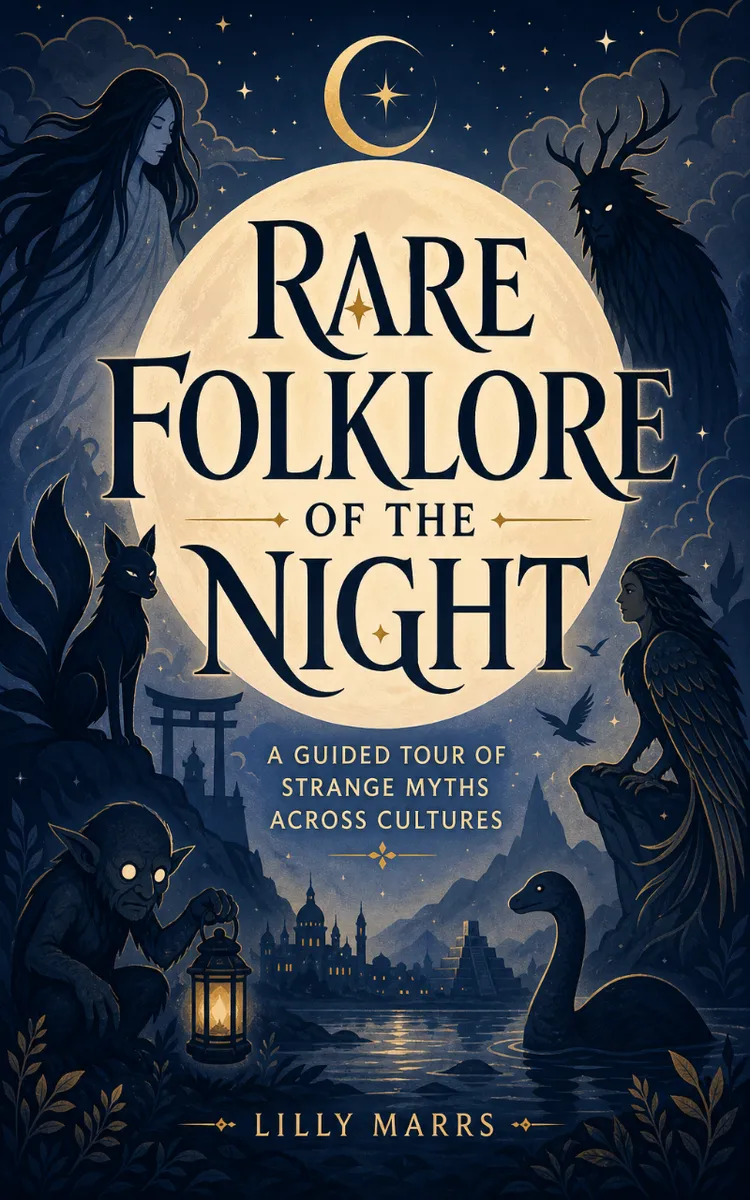

Read the first chapter
The whole of chapter one, free. About 11 min. Turn the pages with the arrows, your keyboard, or a swipe.
Chapter 1
Bread, Salt, and the Winged Hunger
Bread and salt sound like the opening of a blessing, not a weapon - but in medieval Jewish folklore, those humble things are also the lock and key for a winged night predator called the estri. The paradox is that the creature who drinks blood is also, in her own rules, forced to pause for something as ordinary as a meal. And if you can’t get her to stop, the stories say you can at least get her to stay put.
To understand why that matters, you have to look past the word “vampire,” which makes everything feel modern and tidy. The estri is older, stranger, and - most importantly - behavioral. Her power isn’t just in what she wants; it’s in what she is required to do before she can go where she wants to go. This chapter follows those feeding rules and travel limits like tracks in dust: what she can reach, what she must eat, and what happens when people meet her with rituals meant to turn movement into a trap.
At the center of it all is a question that sounds almost too simple to be myth: what kind of horror needs a schedule - bread first, salt second - and why would a culture build a creature around constraints?
The Opening: A Vampire With a Rulebook
The first time I heard the estri described as “winged” and “blood-hunting,” it was in the context of a larger conversation about medieval Jewish demonology - how communities explained sudden illness, nocturnal fear, and the feeling that night could bring visitors. But the detail that stuck wasn’t the wings. It was the choreography.
In the folklore, an estri is not merely a monster that attacks; she’s a creature with conditions. Before she can travel, before she can cross certain boundaries, she must eat bread and salt. That’s the sort of specificity that makes you pause, because it treats the night creature like a commuter with a ritual timetable rather than a free-roaming nightmare. The story then adds another hard edge: to permanently stop her, people believed you needed to stuff her mouth with dirt - a final interference so physical it sounds more like folk technology than metaphysics.
If that feels counterintuitive, that’s because most vampire stories in the popular imagination treat hunger as pure appetite: thirst drives everything. The estri flips the emphasis. Hunger is still there, but it’s bounded. She’s terrifying not because she is unstoppable, but because she is legible. Her rules let humans imagine that the night is not random; it’s governed.
So the question becomes less “what does she feed on?” and more “what does she need in order to keep feeding?” The feeding rules and travel limits turn the estri into a rule-bound night predator - a predator whose danger has seams, and whose seams can be found.
The Deep Dive: How Feeding Rules Become Travel Limits
Folklore creatures often work like mirrors. They reflect a community’s anxieties, but they also reflect its sense of how the world behaves. The estri’s particular logic - bread and salt before travel - belongs to a tradition where ritual acts can alter outcomes, where boundaries matter, and where the night is full of beings that are not fully independent of human attention.
To see why those rules matter, it helps to remember what “travel limits” means in a premodern world. Movement wasn’t just convenience; it was safety, especially when nighttime brought poor visibility, locked doors, and the fear of what might slip through. In many European traditions, boundaries between inside and outside, living and dead, known and unknown are kept by practice: lamps lit in certain ways, prayers spoken, objects placed. The estri folklore leans into that same impulse. Her need to eat before traveling effectively turns her from a roaming threat into a staged one.
There’s also a practical psychology to the way these stories are built. When people describe a dangerous animal or a dangerous person, they often describe it in terms of habits: when it comes, what it responds to, what it ignores. The estri stories do the same, except the “animal” is supernatural. A blood-hunting creature that must stop to eat bread and salt is, in narrative terms, a creature that can be delayed. And a delayed creature is a creature whose reach can be measured.
Here’s one counterintuitive reframing that lands sharply: the estri’s hunger doesn’t make her more free - it makes her more manageable. Two things that sound like simple tastes - bread and salt - become structural limits on her motion. That matters because it shifts the folklore from “unpredictable evil” to “predictable evil,” and that predictability is exactly what a frightened community would crave.
Why does that change our understanding? Because it suggests the mythology isn’t only trying to terrify; it’s trying to impose order on terror. When a culture imagines a predator with rules, it’s also imagining that the night can be negotiated - at least in story, at least in belief. The estri becomes a rule-bound predator, and the rules become a bridge between human fear and human control.
The folklore’s final step - stuffing her mouth with dirt - fits this pattern. Dirt is not just a substance; in many traditions it marks the earth, the boundary between living flesh and the ground. Blocking her mouth is blocking her ability to enact her hunger. If bread and salt are the keys to movement, dirt is the lock that ends the motion entirely.
One might be tempted to dismiss this as purely symbolic, but the symbolic is doing real narrative work. It explains why a community would remember particular materials, particular actions, and particular moments. The myth turns everyday items into travel permissions and travel refusals. That’s not how “random horror” behaves. That’s how a creature with constraints behaves.
The Threshold Checklist: Leah’s Museum Lesson in Constraints
Leah is a museum educator, 34, the kind of person who can talk for ten minutes about a single object label without making it feel like a lecture. She works with visitors who arrive expecting monsters and leave talking about context - about why a community would preserve certain stories and not others. When I asked her what she looks for in rare folklore materials, she didn’t start with dragons or demons. She started with rules.
Her go-to habit - informal, but reliable - is something she calls her Threshold Checklist. It’s not a modern self-help tool; it’s the practical question she brings to any display: what is the creature allowed to do, and what stops it at the threshold? In other words, where does the story draw the line between “crossing” and “not crossing”?
Leah points to how museums handle the problem of temptation. People want a creature to be limitless because limitless creatures are easy to imagine and hard to understand. But folklore often does the opposite. It builds a supernatural threat with choke points: a door that must be knocked on, a name that must be spoken or not spoken, a boundary that requires payment in the form of a ritual act.
When she brings up the estri, she uses the bread-and-salt detail as a teaching anchor because it’s so physical. Visitors can picture bread. They can picture salt. They can picture the uncomfortable practicality of something that must be eaten before moving. That concreteness makes the “threshold” visible. The estri is not simply hungry; she is hungry in a way that creates a pause - an in-between state where the threat is present but not yet unleashed.
Leah connects this to how people in the past lived with boundaries that were real even without monsters. Doors closed at night. Travel routes were known and watched. Illness could come suddenly, and communities sought explanations that felt consistent. If a myth says a predator must eat before traveling, it gives people an imaginative reason to believe the night has timing. It gives them a way to think about delay.
And in that sense, Leah’s checklist doesn’t just help her teach; it helps her interpret. She tells visitors that when folklore creatures have feeding rules, those rules often function like permissions. In modern life, permission systems are bureaucratic. In folklore, they’re magical. Either way, the creature’s power is conditional, and the conditionality is the point.
There’s a small, real-world museum detail that reinforces the estri’s logic: Leah says the most memorable folklore artifacts aren’t the most dramatic ones. They’re the ones that describe objects - bread, salt, earth - because visitors can map them onto the ordinary world they already know. The estri’s rulebook does that same mapping. It takes the night predator and pins her to kitchen-table items, which is a kind of domestication: not because the monster becomes friendly, but because her menace becomes interpretable.
Leah’s audience often assumes “vampire” means the predator always gets what she wants. The estri folklore corrects that assumption by making hunger a gate you can’t skip. You can’t get straight to the attack. You have to go through the meal.
What You Did Not Expect: A Predator’s Constraints Make Her Scarier
The surprise in the estri story is that the constraints don’t reduce fear; they intensify it. A roaming monster can be terrifying, but a rule-bound monster is the kind that teaches you to notice patterns - and once you notice patterns, you realize how close the predator’s routine sits to your own. Bread and salt aren’t just props; they imply that the estri moves in relation to human time, human food, human spaces.
That’s why the dirt-in-the-mouth ending hits so hard. It’s not a mystical flourish; it’s an interference with the mechanics of the creature’s hunger. If the estri is dangerous because she can travel, then you stop her by removing the very channel through which travel and feeding connect. In effect, the myth treats the mouth as a control point: the place where appetite becomes motion.
This reframing matters beyond the estri herself because it changes how we read the vampire idea in general. “Vampire” in popular culture tends to be a single image - fangs, blood, transformation - rather than a system. The estri folklore presents a system: prerequisites, thresholds, and consequences. That means the fear isn’t only about what the estri does in the night; it’s about what the night does to you when it follows rules.
It also points to a deeper connection between folklore and everyday observation. People in any era notice that certain things happen in sequences. There’s a reason humans develop calendars, meal times, and routines. Folklore can be seen as an extension of that instinct: if the night brings harm, then perhaps it brings harm with a pattern. The estri’s bread-and-salt requirement offers a pattern that listeners can hold in their heads, like a keyring.
And once you accept the pattern, the story’s logic becomes almost administrative. The predator doesn’t break into your life randomly; she arrives by conditions that reflect the human world. That’s an unsettling thought, because it means the monster’s power is partly braided with ordinary things - food, thresholds, the earth.
Even the winged detail fits the same logic. Wings suggest flight, freedom, distance. Yet the folklore insists on a pause and a preparation. The wings may imply reach, but the feeding rule implies restraint. The estri is built to look like pure movement while behaving like a creature that must stop to enact her own threat.
In that sense, her constraints are the scariest feature. They make the predator feel less like a distant legend and more like a presence that could be accounted for - tracked by its own needs.
The Human Story: Museum Notes, Community Memory, and the Night’s Schedule
Leah’s museum work often involves visitors encountering folklore as entertainment - until one detail refuses to stay “just a story.” She describes how, during a small community program, an older attendee recognized the bread-and-salt motif with a kind of quiet certainty. Not everyone recites full narratives from medieval sources, but people carry fragments: a substance, a gesture, a phrase that signals “this is how it works.”
That moment, Leah says, is what makes the estri’s rule-bound nature feel real. The folklore isn’t only about an imaginary predator; it’s about how memory trains people to expect a certain kind of order from the unknown. In community settings, these details travel because they solve something emotional: they make dread less formless.
In the museum, Leah can show visitors a map of how Jewish manuscript culture preserved and transmitted stories over centuries, but she doesn’t need to. The bread-and-salt rule already does the teaching. Visitors can see the logic of threshold: the estri can hunt, but not without a specific sequence. That sequence turns the monster into a kind of schedule-based presence - danger that isn’t random, danger that comes with prerequisites.
Leah also emphasizes that people in the past lived with nocturnal vulnerability that we often forget. Even without thinking about monsters, night was when the senses failed, when travel was risky, when illness could be blamed on what couldn’t be seen. Folklore filled that gap with beings whose behavior could be narrated. The estri’s feeding rules and travel limits make that narrative more than a scary tale; they make it a framework for interpreting the night.
What ties the human story back to the chapter’s mystery is this: the estri doesn’t just frighten people; she organizes their attention. She demands that listeners remember particular things - bread, salt, dirt - because those are the myth’s tools for negotiating the edge between safety and threat. In Leah’s classroom-like conversations, that’s where the rule-bound predator becomes more than a medieval curiosity. It becomes a window into how communities cope with uncertainty by turning it into pattern.
And pattern, once it’s lodged in memory, has staying power. That’s what museums preserve: not only what a story said, but what kind of thinking it rewarded.
What This Tells Us: When the Night Learns Your Language
Folklore often treats the unseen as if it has manners, and the estri is one of the clearest examples. Her need for bread and salt turns a vampire into a creature that speaks in the language of the everyday - kitchen items, thresholds, earth. The night predator becomes rule-bound because humans crave a world where even terror has terms and conditions.
There’s a lesson here about society’s relationship to fear. We don’t just want explanations; we want explanations that feel structured enough to hold. When a myth builds a schedule into a monster, it’s offering more than comfort - it’s offering a way to make the world legible, even when it’s dark.
And maybe the biggest unanswered question - the one that keeps the estri lingering at the edge of curiosity - is what it says about us that we imagine our worst threats as creatures of prerequisites, as if the night itself can be made to follow rules we can remember.
End of chapter one. 15 more chapters in the full book.
Swipe or use the arrows to turn the page

The World In Chaos 6x9 Interior

When Everyone Else Has Moved On 8 5x11 196p REVISED v3

The Blind Spot of Reality EDITED Garamond 6x9
What's inside: 16 chapters
- 1. Bread, Salt, and the Winged Hunger
- 2. Why Dirt in Her Mouth Works
- 3. The Shape-Shifter Who Needed Rules
- 4. Blood Hunger vs. Social Boundaries
- 5. Red-Woman’s First Target: Expectant Mothers
- 6. The Surviving Twins Who Refuse Fate
- 7. How Monsters Get Outplayed
- 8. Resurrection as a Moral Technology
- 9. Red-Woman’s Color as a Warning
- 10. The Night Whistle That Calls Trouble
- 11. When Whistling Becomes a Doorway
- 12. Devil-Calling and the European Echo
- 13. Shape-Shifters in the Night Air
- 14. The Fear We Pay to Feel
- 15. How Communities Teach Without Explaining
- 16. Your Night Is a Negotiation
About this book
"Rare Folklore Of The Night" is a curiosity book by Lilly Marrs with 16 chapters and approximately 31,346 words. Explores lesser-known folklore creatures and regional superstitions.
This book was created using Inkfluence AI, an AI-powered book generation platform that helps authors write, design, and publish complete books.
Frequently Asked Questions
What is "Rare Folklore Of The Night" about?
Explores lesser-known folklore creatures and regional superstitions
How many chapters are in "Rare Folklore Of The Night"?
The book contains 16 chapters and approximately 31,346 words. Topics covered include Bread, Salt, and the Winged Hunger, Why Dirt in Her Mouth Works, The Shape-Shifter Who Needed Rules, Blood Hunger vs. Social Boundaries, and more.
Who wrote "Rare Folklore Of The Night"?
This book was written by Lilly Marrs and created using Inkfluence AI, an AI book generation platform that helps authors write, design, and publish books.
Write your own curiosity book with AI
Describe your idea and Inkfluence writes the whole thing. Free to start.
Start writingCreated with Inkfluence AI


