
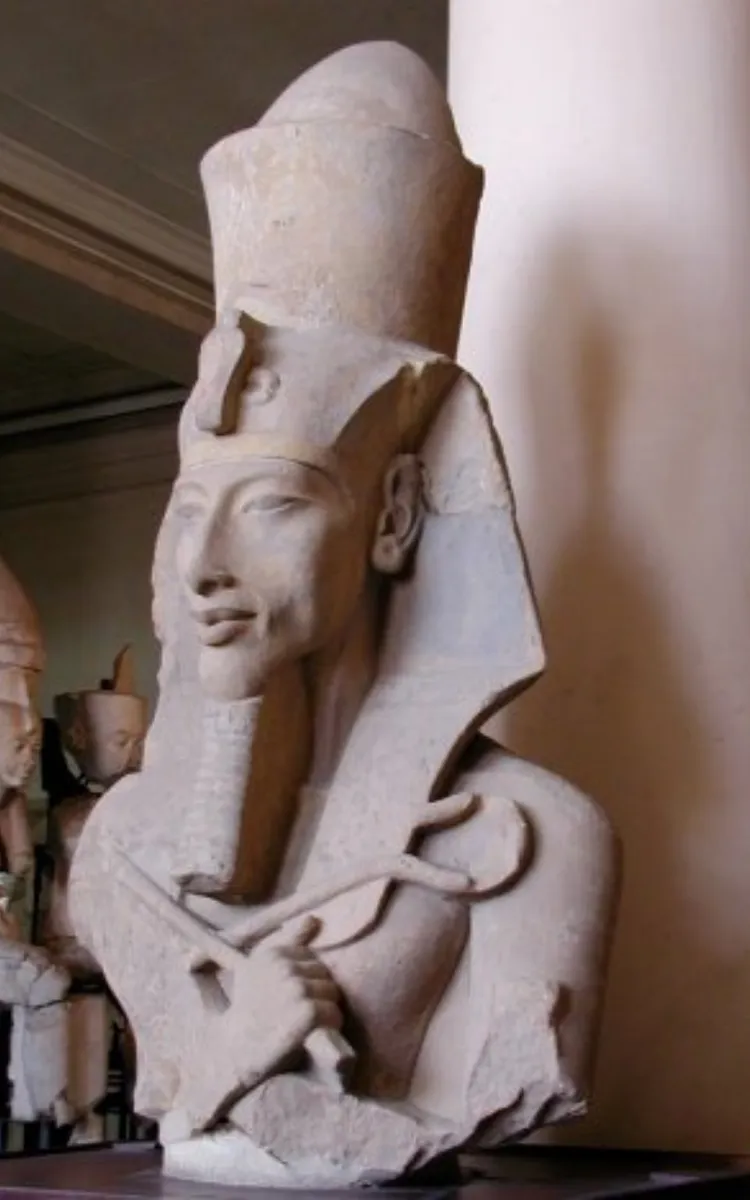
Akhenaten: Pharaoh Of Change
Created with Inkfluence AI
The life, reign, and reforms of Pharaoh Akhenaten
Table of Contents
- 1. The Sun-Disc That Rewired Egypt
- 2. Why Akhenaten Moved the Capital
- 3. The Aten Art Rulebook
- 4. The Heresy Trial Nobody Called That
- 5. What “Change” Costs a Kingdom
Preview: The Sun-Disc That Rewired Egypt
A short excerpt from “The Sun-Disc That Rewired Egypt”. The full book contains 5 chapters and 9,347 words.
The King Who Moved the Sun
When Akhenaten ordered the royal court away from Thebes, he did more than change addresses. He shifted Egypt’s political center toward a new city built for a god whose visible form was the sun’s disk, the Aten. A religious reform became a rearrangement of power, land, labor, art, and ordinary public life.
The change began during the reign of a king first known as Amenhotep IV, probably around the middle of the fourteenth century BCE. Egypt already possessed a crowded and sophisticated religious world, with temples, priests, festivals, sacred animals, household rituals, and gods whose identities overlapped across centuries. The Aten did not enter an empty landscape. It entered a system with deep roots and powerful institutions.
At first, the king’s devotion may have looked like an addition to that system. Gradually, it became a challenge to the system itself. The Aten received unusual prominence; the old god Amun lost ground; the king changed his name to Akhenaten, “Effective for the Aten”; and a new royal city rose at a place now called Amarna.
The remarkable question is not simply why Akhenaten worshiped the sun. It is how a religious preference became a program for reorganizing an entire kingdom.
When a ruler changes the god at the center of public life, what else must move with it?
Before the Aten Took the Center
Egyptian religion was not organized like a modern list of competing denominations. A god could have several forms, local identities, family relationships, and areas of influence. Amun, especially at Thebes, had become one of the kingdom’s most important divine powers. His temple estates controlled land, workshops, livestock, and labor. Priests served him, but the institution also functioned as a major economic and political force.
The king stood between the human and divine worlds. Egyptian temples were not simply places where people gathered for weekly worship. Their inner sanctuaries housed cult images, and priests performed daily rites: washing, dressing, feeding, and presenting offerings to the god. Much of this activity was restricted. The temple was a managed world of storerooms, fields, scribes, and specialized workers.
Akhenaten’s early reign did not immediately erase this arrangement. Inscriptions from the first years still refer to traditional gods, although the Aten receives growing attention. The sun disk appears in a new visual form: its rays end in small hands, sometimes offering the ankh, the Egyptian sign of life, to the king and queen. This was not merely a decorative change. It made divine power appear to flow visibly from the disk to the royal family.
The distinction mattered. Older Egyptian gods were often represented through human bodies, animal forms, or combinations of the two. The Aten was represented as a disk and its rays. The image was strikingly direct: sunlight touched the royal couple, and the royal couple stood at the center of the religious picture.
That arrangement placed Akhenaten in a position unlike that of a priestly intermediary. He was not simply one worshiper among many. He and Nefertiti became the principal human receivers of the Aten’s life-giving force. The public could honor the god, but the royal family occupied the unique position through which the god’s blessing became legible.
This was the first turn in what can be called the Aten Pivot Map. The pivot had three connected points: the god’s new public image, the king’s unique access to that god, and the movement of institutions toward the king’s chosen center. Change in one point pressed on the others.
Closing Amun’s Door
The most consequential early change was not a theological sentence but a struggle over visibility. Akhenaten began removing the name and images of Amun from monuments. The process was uneven, and it did not always target every traditional god at once, but the direction was unmistakable. Amun’s name could be chiseled from inscriptions; his image could be damaged; royal names containing Amun could be altered.
The king’s own name made the issue personal. Amenhotep IV became Akhenaten, publicly binding his identity to the Aten. Names in ancient Egypt were not casual labels. They carried religious meaning and appeared in official records, monuments, seals, and family memory. Changing the king’s name announced that the old relationship between kingship and Amun no longer defined the reign.
At the same time, Akhenaten founded a new capital on the eastern bank of the Nile, at a site marked by boundary stelae. He called it Akhetaten, “Horizon of the Aten.” The city was planned on land that had not previously served as a major royal capital. Its location was presented as a place belonging especially to the Aten, outside the established claims of Thebes and its temple establishment.
The move required more than royal orders....
About this book
"Akhenaten: Pharaoh Of Change" is a curiosity book by Mohamed elshamy with 5 chapters and approximately 9,347 words. The life, reign, and reforms of Pharaoh Akhenaten.
This book was created using Inkfluence AI, an AI-powered book generation platform that helps authors write, design, and publish complete books.
Frequently Asked Questions
What is "Akhenaten: Pharaoh Of Change" about?
The life, reign, and reforms of Pharaoh Akhenaten
How many chapters are in "Akhenaten: Pharaoh Of Change"?
The book contains 5 chapters and approximately 9,347 words. Topics covered include The Sun-Disc That Rewired Egypt, Why Akhenaten Moved the Capital, The Aten Art Rulebook, The Heresy Trial Nobody Called That, and more.
Who wrote "Akhenaten: Pharaoh Of Change"?
This book was written by Mohamed elshamy and created using Inkfluence AI, an AI book generation platform that helps authors write, design, and publish books.
Write your own curiosity book with AI
Describe your idea and Inkfluence writes the whole thing. Free to start.
Start writingCreated with Inkfluence AI


