
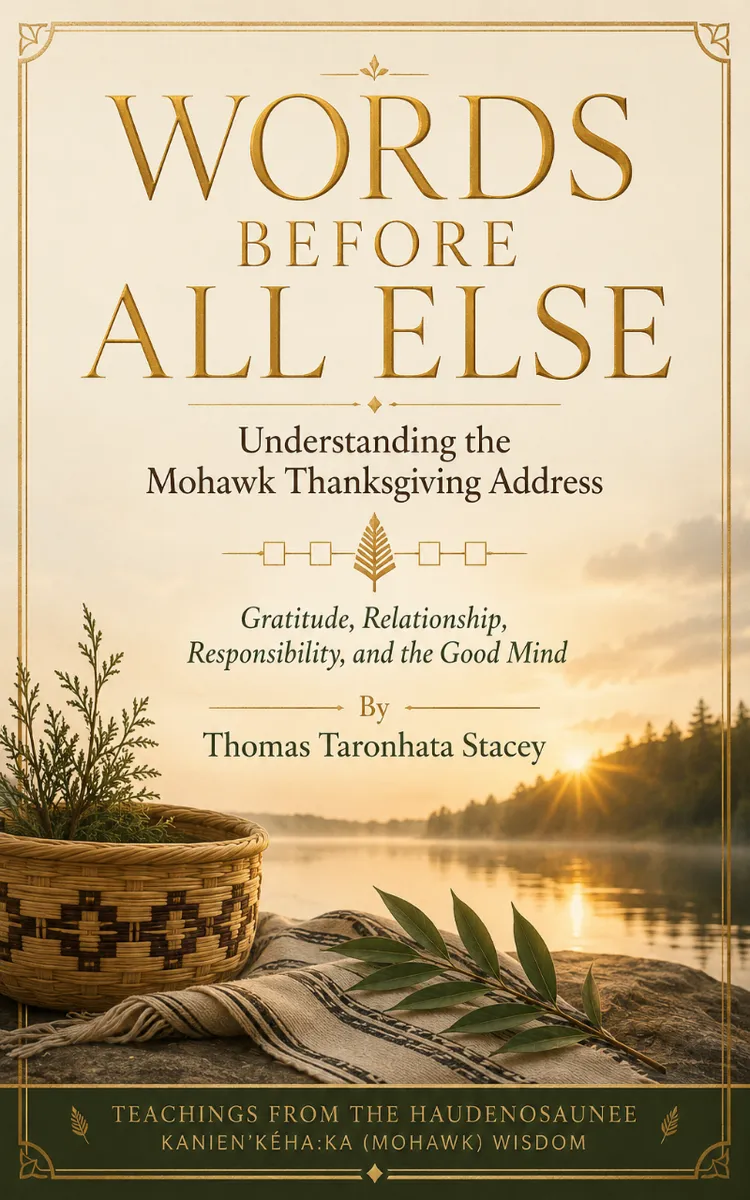
For Words Before All Else
Created with Inkfluence AI
What if the Mohawk Thanksgiving Address is not a text to get right, but a relationship that changes every time it is spoken? In Six Nations and beyond, the words may sound familiar, yet their meaning shifts with the people, the place, the time, and the purpose of the gathering. That difference is not a flaw. It is the point. This exploratory nonfiction book follows the Address as living speech, using a Guided-Reader Compass to keep meaning, relationship, responsibility, and context in view. You will learn how gratitude becomes work, how recognition carries obligations, and why “the words before all else” asks readers to pay attention to more than a printed sequence. Read now if you want to understand the worldview behind the Address without freezing it on the page.
Table of Contents
- 1. A Thanksgiving Address, Not a Script
- 2. How to Use This Book
- 3. The First Surprise: Gratitude Is Work
- 4. Who Speaks, Who Listens, Why
- 5. Words as Bridges, Not Decorations
- 6. The World You’re Placed In
- 7. Thanksgiving’s Calendar of Care
- 8. Why Protocols Vary by Community
- 9. The Responsibility Triangle
- 10. Listening That Changes the Listener
- 11. The Gratitude Grammar: Who Gets Mentioned
- 12. When Translation Feels Like a Trap
- 13. The Thanksgiving Address and Time
- 14. Land Isn’t a Backdrop
- 15. The Community Memory You Can’t Ignore
- 16. Thanksgiving as a Relationship Contract
- 17. The Unsaid Boundaries of Respect
- 18. A Map of Kinship Terms
- 19. The Address’s Moral Weather
- 20. Why Thanks Includes Repair
- 21. The Speaker’s Responsibility to Accuracy
- 22. How to Read for Meaning, Not Just Words
- 23. What to Do With Your New Understanding
- 24. Common Misreadings and How to Unlearn
- 25. For Words Before All Else
Preview: A Thanksgiving Address, Not a Script
A short excerpt from “A Thanksgiving Address, Not a Script”. The full book contains 25 chapters and 42,374 words.
When the Words Change
At a community gathering in Six Nations of the Grand River, a speaker may offer the Thanksgiving Address in words that differ from those used by another speaker elsewhere. The difference does not make one version less authentic. It reveals something essential: the Address is not a script waiting to be recited correctly; it is a living act of relationship, shaped by the people, place, time, and purpose of the gathering.
That distinction can be difficult for readers accustomed to written ceremonies. A printed page appears stable. It has an opening, a sequence, and an ending. Yet the Mohawk Thanksgiving Address, known in Kanien’kéha as Ohén:ton Karihwatéhkwen, is better understood through what it does than through how it looks on paper. It gathers attention, names relationships, recognizes responsibilities, and brings a community into a shared frame of mind before other words or decisions begin.
The Living-Text Lens used here follows the Address as something carried by people rather than contained by pages. Its wording matters, but so do the circumstances that call the words forward.
What changes when a ceremonial text is understood not as a recital, but as a relationship renewed in speech?
The Address Is Spoken Into a Place
The Thanksgiving Address is associated with Haudenosaunee communities, including the Mohawk, Oneida, Onondaga, Cayuga, Seneca, and Tuscarora nations. It is often offered at the beginning of gatherings, meetings, ceremonies, educational events, and other occasions when people come together. Its familiar English versions commonly move through a sequence of acknowledgments: the people, the earth, the waters, the plants, the animals, the winds, the sun, the moon, the stars, the spiritual world, and the Creator.
That sequence can look like a list. It is not merely a list.
Each portion places human life within a wider field of relations. The waters are not introduced as scenery. The plants are not mentioned as a category of useful objects. The animals are not treated as symbols selected to decorate a human message. The Address recognizes them as participants in a world that sustains human beings and to which human beings owe attention and care.
This is why the opening words are sometimes translated as “The Words Before All Else.” The phrase points to an order of attention. Before a meeting turns to policy, teaching, conflict, business, or ceremony, the people are reminded of the conditions that make their gathering possible.
The order also carries a practical meaning. Human beings are not self-sufficient. Breath, food, water, warmth, shelter, and knowledge arrive through relationships that precede any individual decision. The Address gives those relationships a public place in the gathering.
A written version may preserve the broad movement, but it cannot determine every detail of delivery. A speaker may shorten a section, expand it, use a local translation, name particular concerns, or adjust the wording for children, visitors, a funeral, a school assembly, or a council meeting. The central act remains recognizable while its expression responds to the setting.
The Living-Text Lens
The Living-Text Lens begins with a simple observation: a text can have a stable purpose without having a single fixed wording. This is common in ordinary speech. A person thanking a host does not repeat the same sentences at every meal. The gratitude is real because it responds to the actual occasion.
The Address works in a related way, though its significance is far deeper than everyday politeness. Its words are guided by inherited teachings, community practice, and responsibilities that extend across generations. At the same time, the speaker must meet the present moment. The people gathered today are not identical to those gathered yesterday. The weather, the place, the age of the listeners, and the reason for meeting all affect how the Address is spoken.
This flexibility is not carelessness. It is a form of precision.
A speaker addressing schoolchildren may explain the role of the waters in language they can understand. At a council gathering, the same recognition may be connected more directly to decisions affecting rivers, roads, or community health. At a ceremony of mourning, the words may carry a different weight as people acknowledge the continuing presence of the natural world while facing an absence among their own relatives.
The Address therefore has two kinds of continuity. One is continuity of structure: the recurring movement through the beings and forces that sustain life. The other is continuity of responsibility: the expectation that people will speak with awareness of their relationships. Wording can move while those underlying commitments remain.
Language itself makes this visible. Kanien’kéha is not simply English with different labels attached to familiar objects. It carries its own ways of expressing action, relation, and presence....
About this book
"For Words Before All Else" is a curiosity book by Anonymous with 25 chapters and approximately 42,374 words. What if the Mohawk Thanksgiving Address is not a text to get right, but a relationship that changes every time it is spoken? In Six Nations and beyond, the words may sound familiar, yet their meaning shifts with the people, the place, the time, and the purpose of the gathering. That difference is not a flaw.
This book was created using Inkfluence AI, an AI-powered book generation platform that helps authors write, design, and publish complete books.
Frequently Asked Questions
What is "For Words Before All Else" about?
What if the Mohawk Thanksgiving Address is not a text to get right, but a relationship that changes every time it is spoken? In Six Nations and beyond, the words may sound familiar, yet their meaning shifts with the people, the place, the time, and the purpose of the gathering. That difference is not a flaw. It is the point. This exploratory nonfiction book follows the Address as living speech, using a Guided-Reader Compass to keep meaning, relationship, responsibility, and context in view. You will learn how gratitude becomes work, how recognition carries obligations, and why “the words before all else” asks readers to pay attention to more than a printed sequence. Read now if you want to understand the worldview behind the Address without freezing it on the page.
How many chapters are in "For Words Before All Else"?
The book contains 25 chapters and approximately 42,374 words. Topics covered include A Thanksgiving Address, Not a Script, How to Use This Book, The First Surprise: Gratitude Is Work, Who Speaks, Who Listens, Why, and more.
Who wrote "For Words Before All Else"?
This book was written by Anonymous and created using Inkfluence AI, an AI book generation platform that helps authors write, design, and publish books.
Write your own curiosity book with AI
Describe your idea and Inkfluence writes the whole thing. Free to start.
Start writingCreated with Inkfluence AI


