
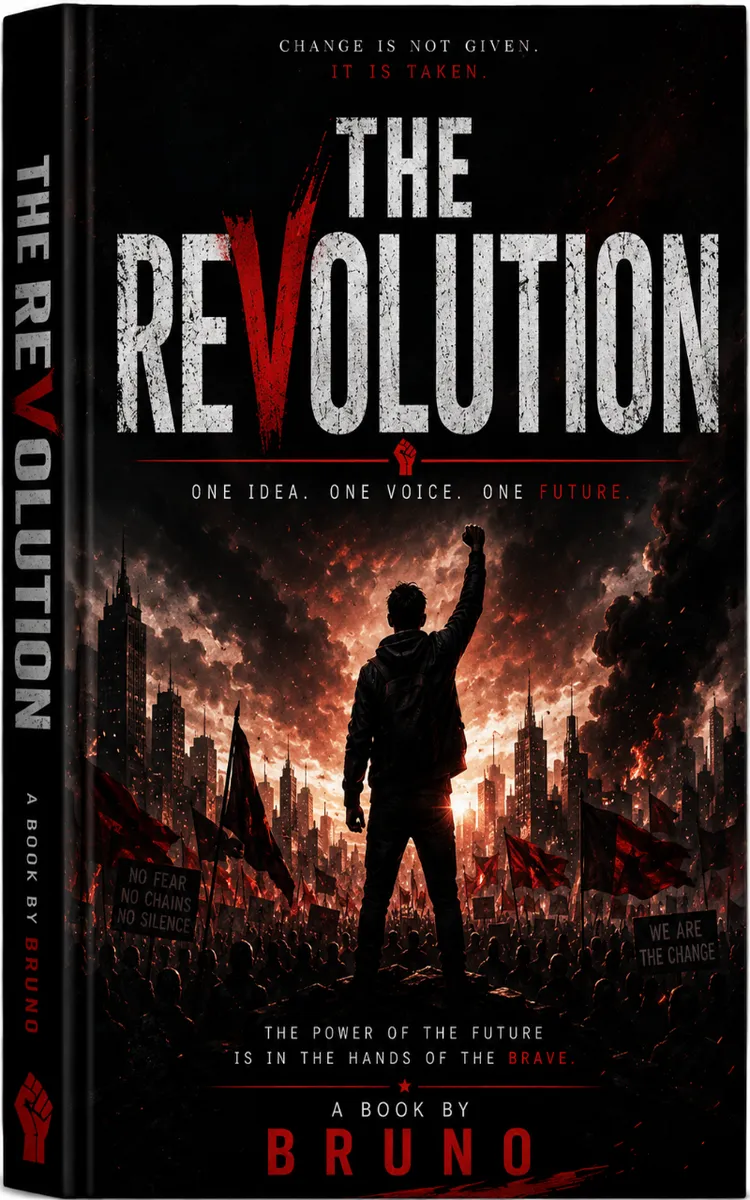
The Revolution
Created with Inkfluence AI
Exploration of revolutions and their causes, impacts, and outcomes
Table of Contents
- 1. The Spark That Starts Revolutions
- 2. Why Grievances Need a Story
- 3. The Nonviolent Leverage Equation
- 4. When Armies Choose Sides
- 5. The Day After: Revolution’s Real Test
Preview: The Spark That Starts Revolutions
A short excerpt from “The Spark That Starts Revolutions”. The full book contains 5 chapters and 7,987 words.
When One Moment Becomes Everyone’s Moment
A person drops a basket of fruit, refuses to move to the back of a bus, or posts a short video from a prison cell. The act may take seconds, yet years later it can be remembered as the beginning of a revolution. The paradox is that the event itself is often ordinary; what changes is the meaning thousands of people attach to it.
Private anger is common. Public action is rare. Between the two lies a process in which a small incident becomes a shared signal: evidence that others have seen the same injustice, felt the same humiliation, and are willing to stand together. The signal does not create every grievance. It makes scattered grievances visible to one another.
The Fuse-to-Flame Model helps explain this change. A long fuse consists of accumulated pressures - unfair laws, economic hardship, political exclusion, police violence, censorship, or the simple exhaustion of being ignored. The spark is the triggering event. The flame is collective action, fed by communication, trust, imitation, and the belief that participation is no longer solitary.
Why does one person’s moment of refusal sometimes become a crowd’s permission to act?
The Fuse Was Burning Before the Spark
Revolutions rarely begin with the event later used to name them. The French Revolution did not begin with the storming of the Bastille on July 14, 1789. That dramatic seizure of a Paris prison became its symbol, but the fuse had been burning through royal debt, food shortages, social inequality, political conflict, and anger at a system in which privilege was built into law.
The Bastille mattered because it arrived at a moment when authority was already losing its appearance of control. Paris was anxious about food prices and rumors of military action. The king had called the Estates-General, a representative body that had not met since 1614, and the Third Estate had declared itself the National Assembly. Political uncertainty had moved from courtrooms and pamphlets into streets and markets.
The prison itself held only a handful of inmates when the crowd arrived. Its importance was not its population but its architecture. The Bastille represented arbitrary royal power: a place where people could be detained by a sealed order rather than a public trial. When the crowd seized it, the act communicated something larger than the release of prisoners. The old authority could be entered, challenged, and dismantled.
A triggering event works best when it gives an existing grievance a visible shape. A tax dispute becomes a symbol of exploitation. A police beating becomes evidence of a whole system. A single arrest becomes proof that the law is being used selectively. The incident is small in scale but large in interpretive reach.
That is why the same event can produce silence in one society and upheaval in another. The spark does not carry a fixed amount of revolutionary power. Its force depends on the material waiting around it.
The Signal Travels
A private grievance becomes politically important when other people can recognize themselves in it. Communication is the bridge. In the eighteenth century, pamphlets, coffeehouses, taverns, letters, and printed caricatures allowed people who had never met to discuss the same abuses. In the twentieth century, newspapers, radio, photographs, and television expanded that bridge. Today, a phone camera and a social media platform can transmit an incident across a country before official institutions have settled on an explanation.
Speed matters, but recognition matters more. A message spreads when it answers a question people have already been asking: Is this what happens to people like us? Does anyone else see that this is wrong?
The Montgomery bus boycott illustrates the process. On December 1, 1955, Rosa Parks was arrested in Montgomery, Alabama, after refusing to surrender her seat to a white passenger under the city’s segregation rules. Parks was not the first Black person arrested for challenging bus segregation, and her act did not emerge from political inexperience. She was an experienced organizer and secretary of the local NAACP chapter. Her arrest became a signal partly because a network already existed to interpret it.
Black residents of Montgomery had endured routine humiliation on public buses: paying at the front, sometimes being forced to exit and reenter through the rear, and facing demands to surrender seats. Local women’s political groups, churches, lawyers, and civil rights organizations provided channels through which anger could be converted into coordinated refusal. The boycott began on December 5 and continued for more than a year, ending after the Supreme Court upheld a ruling that bus segregation was unconstitutional.
The spark was Parks’s arrest. The flame was sustained by carpools, church meetings, legal action, fundraising, and thousands of ordinary decisions not to board buses....
About this book
"The Revolution" is a curiosity book by MANZI NSHUTI Bruno with 5 chapters and approximately 7,987 words. Exploration of revolutions and their causes, impacts, and outcomes.
This book was created using Inkfluence AI, an AI-powered book generation platform that helps authors write, design, and publish complete books.
Frequently Asked Questions
What is "The Revolution" about?
Exploration of revolutions and their causes, impacts, and outcomes
How many chapters are in "The Revolution"?
The book contains 5 chapters and approximately 7,987 words. Topics covered include The Spark That Starts Revolutions, Why Grievances Need a Story, The Nonviolent Leverage Equation, When Armies Choose Sides, and more.
Who wrote "The Revolution"?
This book was written by MANZI NSHUTI Bruno and created using Inkfluence AI, an AI book generation platform that helps authors write, design, and publish books.
Write your own curiosity book with AI
Describe your idea and Inkfluence writes the whole thing. Free to start.
Start writingCreated with Inkfluence AI


