
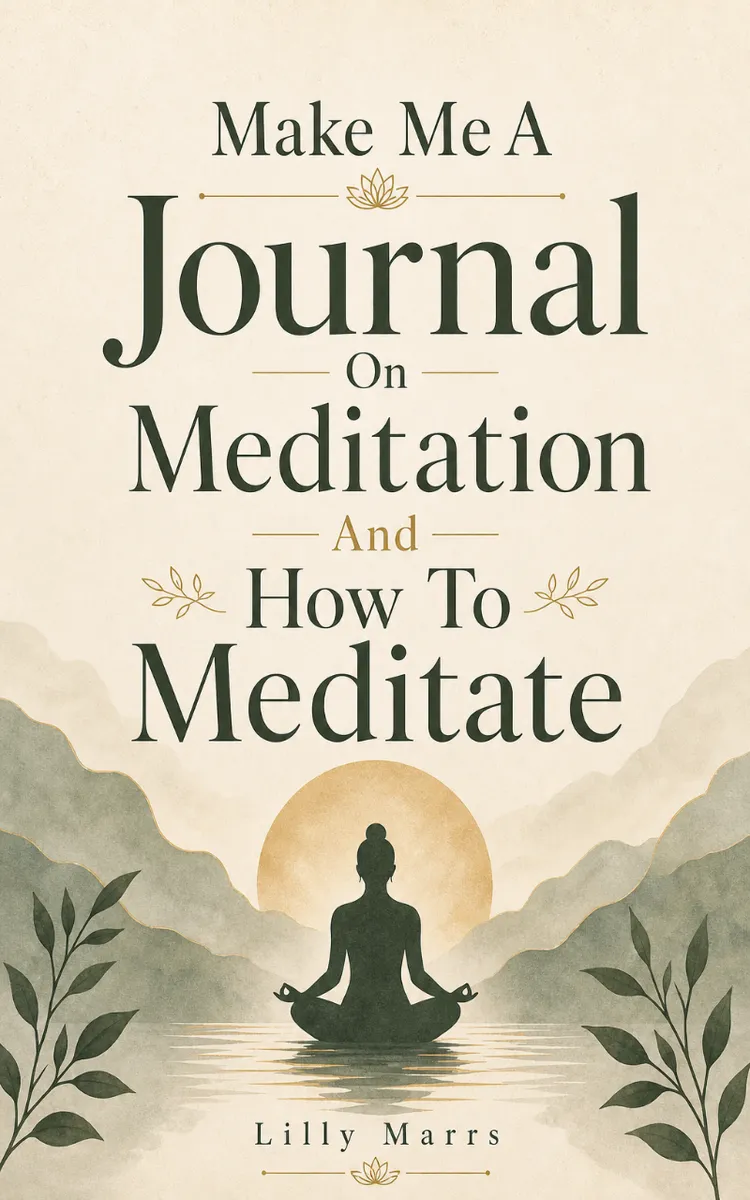
Make me a journal on meditation and how to meditate
Created with Inkfluence AI
Table of Contents
- 1. Why a meditation journal matters and what you’ll gain
Preview: Why a meditation journal matters and what you’ll gain
A short excerpt from “Why a meditation journal matters and what you’ll gain”. The full book contains 1 chapters and 909 words.
Why a meditation journal matters and what you’ll gainKeeping a meditation journal fixes a common problem: you practice, but you forget what worked, what felt different, and how long it took to notice change. A short, focused journal turns scattered sessions into a searchable record so you can repeat helpful techniques and stop repeating what doesn’t help. You’ll get clearer feedback than memory alone gives you, and that clarity speeds progress.
After reading this chapter, you’ll be able to start a simple, usable meditation journal that fits into five minutes a day. You’ll know what to track (time, method, sensations, distractions, outcome), why each item matters, and how to use one week of entries to change your next week of practice. You’ll leave with a ready-to-use template and a habit plan you can follow for 30 days.
Core technique: the 5-field journal entry and how to do itUse a single-page, five-field entry for every session. It keeps data consistent and forces you to notice cause and effect. Here’s the layout and why each field matters, with a quick example after the list.
Session length (minutes)
Why: Duration affects focus. Short, consistent sessions build habit and reveal attention limits.
Example: 12 minutes.
Method (label)
Why: Labeling the technique (breath focus, body scan, loving-kindness) links method to results.
Example: Breath focus using counted breaths.
Immediate sensations and distractions
Why: Noting sensations and interruptions (back pain, noisy street, phone buzz) shows environment and body influences.
Example: Tight shoulders, neighbor’s dog barked at minute 4.
Outcome (one sentence)
Why: A concise result (calmer, wired, clearer) captures session quality for later comparison.
Example: Calmer, could sustain 7-count breaths after minute 6.
Follow-up step
Why: A concrete next action turns reflection into improvement: repeat the successful detail or fix the problem.
Example: Next session sit on a cushion to reduce shoulder strain; start at 10 minutes.
Concrete example: You sit for 12 minutes, choose breath focus, note shoulder tightness and a dog barked twice, conclude “calmer, longer breaths,” and plan to use a cushion next time. That one-page entry gives you precise, testable information for the next session.
You’ve got this. Start with five fields and use the same labels for a week so you can compare apples to apples.
Real-world scenario: seven-day starter plan with detailed stepsDay 1: Set up. Choose a small notebook (A5), a pen, and a 10-minute timer on your phone. Sit on a chair or cushion. Write: Session length 10, Method: Breath focus, Sensations: neck tight, Distractions: phone alert at minute 3, Outcome: a bit calmer, Follow-up: silence phone next time. Expected outcome: a clear baseline and a habit started.
Day 2: Repeat with a tweak. Session length 10, Method: Breath focus with 4-count inhale, 6-count exhale, Sensations: less neck tension, Distractions: none, Outcome: more relaxed, Follow-up: keep timing, try 12 minutes in two days. Expected outcome: small improvement in relaxation and control.
Day 3: Increase duration. Session length 12, Method: Breath focus, Sensations: shoulders looser, Distractions: dog barked at minute 5, Outcome: sustained attention for 8 minutes, Follow-up: sit on cushion. Expected outcome: longer focus and clearer senses.
Day 4-7: Alternate tweaks (add body scan on day 4, loving-kindness on day 6), track and compare. By day 7, review entries and pick the two most effective tweaks to use next week.
Quick checklist:
Use an A5 notebook and single pen.
Record five fields every time: length, method, sensations/distractions, outcome, follow-up.
Start with 10 minutes, add 2 minutes every two sessions if focus stays at least 70% of time.
Review seven entries on day 7 and pick two repeatable changes.
If you follow this plan, you’ll finish the week with a clearer sense of what helps you focus and a simple habit you can maintain. You’ve got this - a small notebook now turns into reliable data for better practice.
Common mistakes and fixesSkipping the follow-up stepExplanation: You may jot sensations and outcomes but forget to write a next action. That stalls progress because you don’t test changes.
Do this: Always end entries with a single, specific next step (e.g., “silence phone,” “use cushion,” “count to six on exhale”).
Not this: Leaving the line blank or writing vague ideas like “try harder.”
Measuring only durationExplanation: Tracking only minutes gives a false sense of progress - longer sessions can be unfocused. You need method and outcome to know what changed.
Do this: Record method and one-sentence outcome every session so you link practice to effect.
Not this: Relying solely on “today I did 20 minutes” without noting how you felt or what you used.
Overcomplicating entriesExplanation: Adding too many fields or long reflections makes journaling feel like work and breaks the habit.
...
About this book
"Make me a journal on meditation and how to meditate" is a general book by Lilly Marrs with 1 chapters and approximately 909 words. It covers key insights and practical takeaways on the topic.
This book was created using Inkfluence AI, an AI-powered book generation platform that helps authors write, design, and publish complete books.
Frequently Asked Questions
What is "Make me a journal on meditation and how to meditate" about?
"Make me a journal on meditation and how to meditate" is a general book by Lilly Marrs covering key insights and practical takeaways on the topic.
How many chapters are in "Make me a journal on meditation and how to meditate"?
The book contains 1 chapters and approximately 909 words. Topics covered include Why a meditation journal matters and what you’ll gain.
Who wrote "Make me a journal on meditation and how to meditate"?
This book was written by Lilly Marrs and created using Inkfluence AI, an AI book generation platform that helps authors write, design, and publish books.
Write your own book with AI
Describe your idea and Inkfluence writes the whole thing. Free to start.
Start writingCreated with Inkfluence AI


