
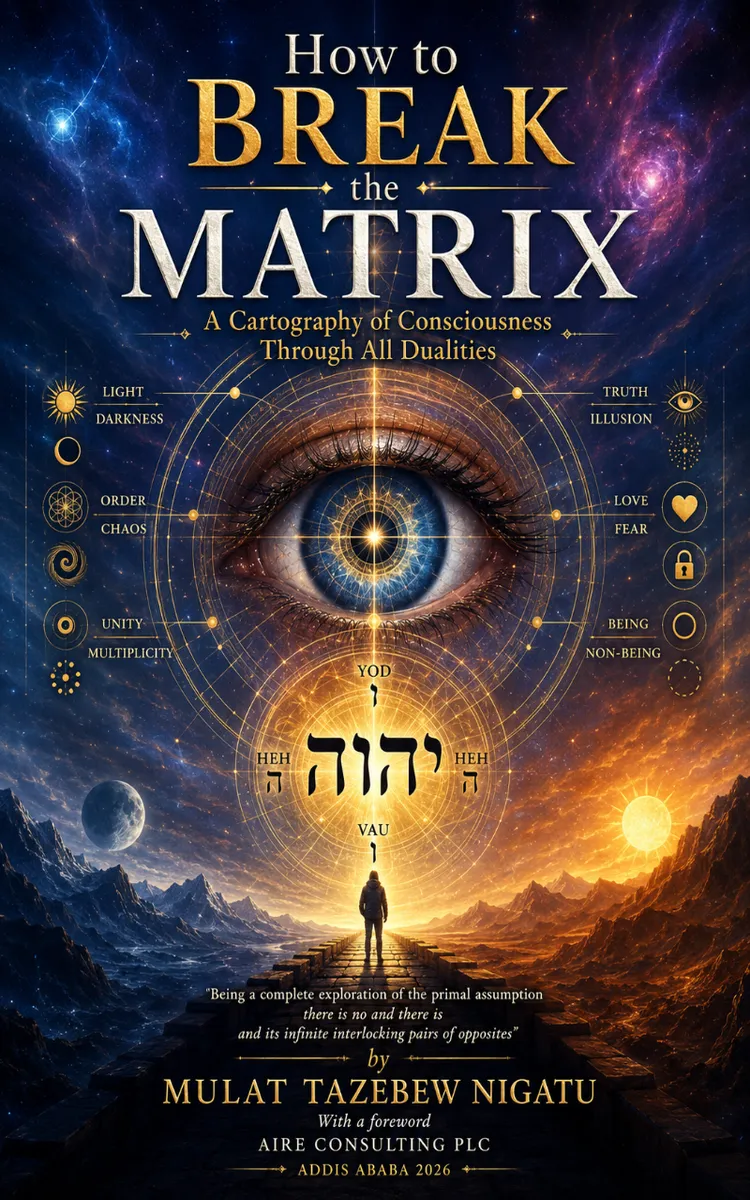
Read the first chapter
The whole of chapter one, free. About 10 min. Turn the pages with the arrows, your keyboard, or a swipe.
Chapter 1
Light Splits Itself When Asked
Light Splits Itself When Asked (and the question makes it so)
If you shine light at a detector, it can arrive as a single click - a discrete event, like a raindrop hitting a window. Yet when you let it travel and interfere with itself, it behaves like a spread-out wave, smearing across space as if it never agreed to be a point at all. The paradox is so sharp that it tempts you to pick a side: wave or particle. But the deeper strangeness is that the choice is not really the light’s choice - it’s the experiment’s question.
This chapter follows that question as it tightens around light. We’ll walk from the early days of optics, through the messy history of “either/or,” to the modern idea that measurement doesn’t just reveal what’s already decided. It helps manufacture the split - the first binary cut the mind learns to make: this rather than that, yes rather than no.
And somewhere inside that split lives a quieter implication: the fork may be older than the experiment. It may be how reality becomes readable at all.
What if the “either/or” is not a description of light, but the mind’s first tool for turning a seamless world into a pair of answers?
The Measurement Fork Model: how “wave” and “particle” are staged by the question
The Measurement Fork Model starts with a plain observation: experiments don’t merely watch light; they set up constraints. Those constraints determine what kind of outcome counts as meaningful. The “wave” story becomes vivid when the setup lets light’s phases matter - when paths can overlap and interfere. The “particle” story becomes vivid when the setup demands localized hits - when the apparatus is built to register a position, a time, a count.
The trouble is that we tend to treat wave and particle as two rival portraits of one hidden object. That picture is comfortable because it matches the way we talk about everyday things. A ball is either in your hand or not; a coin is either heads or tails. But light keeps refusing that comfort. It shows you wave-like structure in one arrangement and particle-like discreteness in another, without offering a single stable portrait that satisfies both views at once.
This is where history matters - not because we’re chasing trivia, but because the history shows how the either/or framing got installed. In the early 1800s, Thomas Young pushed the wave idea forward with the double-slit experiment, where light forms fringes - bands of brightness and darkness - consistent with interference. Later in the same century, James Clerk Maxwell unified electricity, magnetism, and light into electromagnetic waves, giving the wave story a clean mathematical home.
Then came the other half of the coin, the half that looks like it belongs to a different universe. Experiments on light interacting with matter - especially when detection is involved - often yield discrete outcomes. The most famous modern anchor is photon counting and related detector behavior: light can produce individual detection events. Even if the underlying field is treated as continuous in some theories, the outcomes you register are point-like and countable.
So what’s the fork? It’s not “light secretly switches hats.” It’s that the experimental question funnels the possibilities into a specific kind of answer. When the setup emphasizes interference, the wave description becomes the language that predicts what you’ll see. When the setup emphasizes localized detection, particle-like language becomes the language that predicts what you’ll see. In the Measurement Fork Model, the apparatus is not a neutral window. It’s a translator that makes one form of answer legible.
Leila - 19, a physics student with a habit of staying up too late - knows this feeling in her bones. She has a late-night telescope routine that looks ordinary from the outside: align, check focus, wait for the sky to settle. But her real practice is subtler. She learns to think like the instrument. If she changes filters, she isn’t just “adding information”; she changes what kinds of patterns can survive long enough to be registered. If she tweaks exposure settings, she isn’t merely “getting a brighter picture”; she’s altering the balance between signal and noise, between what can be resolved and what collapses into blur. The telescope doesn’t show her “truth” in the abstract. It shows her what that particular constraint set allows the sky to express.
That’s the Measurement Fork Model in everyday clothing: not a metaphysical claim that everything is fake, but a grounded claim that questions carve the space of answers.
The wave-particle strangeness isn’t a debate - it’s a compatibility problem
One of the most counterintuitive facts about this whole saga is that the wave and particle stories do not simply blend into a smoother third story. They collide when you try to demand both kinds of information at once. The classic home for this collision is the double-slit experiment with which-path information.
In the basic double-slit case, you send light toward two slits and observe interference on a screen. You get fringes. The wave story is doing well. But then you add an element that can tell you through which slit the light went. The moment you build an apparatus that can, in principle, tag the route, the interference pattern changes - fringes fade or disappear. The particle story gains dominance because the setup now treats “which slit” as the decisive variable.
This is not a matter of “the light got tired of being wave-like.” It’s a matter of what your measurement allows to be defined. If you ask for path information, the experiment’s conditions undermine the very phase relationships interference depends on. The wave structure is not merely hidden; it becomes operationally irrelevant to the answers the apparatus can deliver.
A single-sentence fact that’s hard to shake: interference requires coherence between the alternatives. If the setup makes the alternatives distinguishable in a way the apparatus can record, coherence is effectively broken for the screen pattern. That’s the bridge between the physics and the philosophy: the either/or doesn’t appear because light is indecisive. It appears because the experimental question builds a world where some relationships can’t both be simultaneously meaningful.
Historically, physicists wrestled with this by trying to rescue a single classical picture. They debated whether the wave was “real” or merely a tool, whether particles carried hidden guidance, whether the wave picture could be saved by some new mechanism. But the more precise the experiments became, the less the old comfort worked. The question “wave or particle?” began to look like the wrong question, because it treats the two descriptions as if they were mutually exclusive properties of a pre-existing object.
The Measurement Fork Model shifts the emphasis: wave and particle are not rival metaphysical labels competing for the same underlying essence. They are effective descriptions tied to different experimental constraints. That’s why the strangeness doesn’t wash away with better equipment. Better equipment just makes the incompatibility cleaner.
Leila notices this in her own way. When she watches faint structures in the eyepiece - say, the difference between a subtle ring and a smeared halo - she learns that the “shape” she sees is not just in the sky. It’s in the interplay between the sky’s emission, the telescope’s optics, the detector’s sensitivity, and the processing chain. She isn’t doing quantum experiments every night; she’s doing something more general: learning the difference between what exists in principle and what exists for her when the apparatus is turned a certain way.
The either/or framing isn’t just a scientific mistake. It’s a perceptual habit.
The counterintuitive finding: the question doesn’t just reveal - it helps manufacture the binary split
Here’s the surprise that still catches readers who think they already understand the story: in quantum experiments, the measurement setup doesn’t merely uncover a pre-decided attribute. It helps determine which attribute becomes the relevant one. The “either/or” is not only about what light does; it’s about what the experiment makes count.
This matters because it changes what “reality” means in the discussion. If the outcome is shaped by the measurement context, then reality isn’t a static inventory of properties waiting to be read off. Reality behaves more like a set of relations that become determinate when certain conditions are met. That doesn’t mean “nothing is real.” It means “the world isn’t obliged to match our everyday grammar.”
In the Measurement Fork Model, the fork is the translation step. The apparatus asks a structured question, and the answer comes back in one of two recognizable dialects: wave-like interference patterns or particle-like localized detections. The binary split is the first time the seamless becomes readable as is versus is-not.
There’s a philosophical sting here. The either/or question contains an assumption that must be tested: that the world is already divided into mutually exclusive categories, and we only fail to see the division clearly. But the quantum story suggests something else: the division can be partly manufactured by the act of asking for a specific kind of answer.
Leila, again, feels the sting in her late-night practice. She talks about “choosing a sensor” the way some people talk about choosing a language. When she switches from one filter to another, or changes the exposure strategy, her target isn’t “the same thing in a different skin.” It becomes a different kind of observable. Light from the same region of sky does not vanish; it reappears as different patterns. The split is not moral. It’s grammatical.
If you want to hear the deeper claim in plain words: the mind’s either/or habit might be more than a cognitive bias. It might be the condition under which measurement turns possibility into a reportable fact.
Addis Ababa nights: candles, darkness, and the first logic of visible meaning
To make this concrete, I go back to a scene that might sound too simple to be physics: long power outages in Addis Ababa, where night would settle thick and unlit, and then - neighbour by neighbour - candles would appear. Each window held a small, steady point of warmth and flame. The flame looked like a single thing, a tiny one against the dark.
But the dark mattered. Without it, the flame would not read as flame. The flame is an edge: burning and already-burnt, oxygen and fuel, bright and dark. Even in that ordinary observation, the binary is already being assembled. Visibility requires contrast, and contrast is a kind of split: what counts as bright depends on what counts as background.
Now consider how quickly the mind tries to turn that observation into a metaphysical claim. We see a point of light and assume it’s a thing. We see the surrounding darkness and assume it’s the absence of things. Then we ask a question - where does the light “really” come from? - and the answer we want pushes us back toward either/or thinking.
Leila would recognize the same temptation in a different setting: when a telescope shows a star as a point, she may forget that the point is a result of optics, atmosphere, and detector behavior. The point is not “the star’s essence.” It’s what her measurement can register. The candle flame is also not just “a point.” It’s a dynamic process with boundaries, and the boundary is what gives it form.
In the Measurement Fork Model, this is the human bridge. The first binary split - bright versus dark, object versus background - is not unique to quantum physics. It’s the oldest trick of perception. What quantum experiments do is pull the trick apart and show that the deeper split - wave-like structure versus particle-like localization - also depends on the question the apparatus asks.
So the candle isn’t a metaphor dressed up as a metaphor. It’s a reminder that visibility is already a negotiated outcome between process and boundary. When you add detectors and phase-sensitive setups, you’re negotiating in a more exacting dialect. The fork is still there, just sharpened.
And the most eerie part is that the candle’s simplicity doesn’t protect you from the logic. It only makes the logic easier to overlook.
What the either/or split tells us about how humans build reality from answers
The either/or question is not a villain. It’s a tool the mind uses to live in a world that can’t be processed all at once. It’s how we make decisions, how we navigate, how we coordinate with other people who need shared categories. Society runs on stable distinctions. Even language depends on them.
But quantum light shows what happens when the world refuses to stay still inside our categories. It doesn’t just confound physics; it confounds the comfort that categories are mirrors of pre-existing divisions. The Measurement Fork Model suggests that some divisions emerge at the moment of asking, not before it.
So the question isn’t “why can’t light make up its mind?” It’s “why do we assume the world must already be divided in the way our questions require?” That assumption is so natural we rarely notice it. Light, with its wave-particle strangeness, is a teacher that never raises its voice - only the frame changes, and the answer changes with it.
If reality can be coaxed into different but incompatible descriptions by different questions, what else have we taken as a property of the world - when it might be a property of our measuring language?
End of chapter one. 4 more chapters in the full book.
Swipe or use the arrows to turn the page
What's inside: 5 chapters
- 1. Light Splits Itself When Asked
- 2. The Orb Glitch That Isn’t Out There
- 3. Your Senses Are Binary Translators
- 4. The Ark Teaches Presence Comes From Gaps
- 5. Stop Chasing the Screen; Become It
About this book
"Chapter-Zero And One" is a curiosity book by Anonymous with 5 chapters and approximately 10,151 words. Philosophical exploration of light, perception, and quantum duality.
This book was created using Inkfluence AI, an AI-powered book generation platform that helps authors write, design, and publish complete books.
Frequently Asked Questions
What is "Chapter-Zero And One" about?
Philosophical exploration of light, perception, and quantum duality
How many chapters are in "Chapter-Zero And One"?
The book contains 5 chapters and approximately 10,151 words. Topics covered include Light Splits Itself When Asked, The Orb Glitch That Isn’t Out There, Your Senses Are Binary Translators, The Ark Teaches Presence Comes From Gaps, and more.
Who wrote "Chapter-Zero And One"?
This book was written by Anonymous and created using Inkfluence AI, an AI book generation platform that helps authors write, design, and publish books.
Write your own curiosity book with AI
Describe your idea and Inkfluence writes the whole thing. Free to start.
Start writingCreated with Inkfluence AI


