
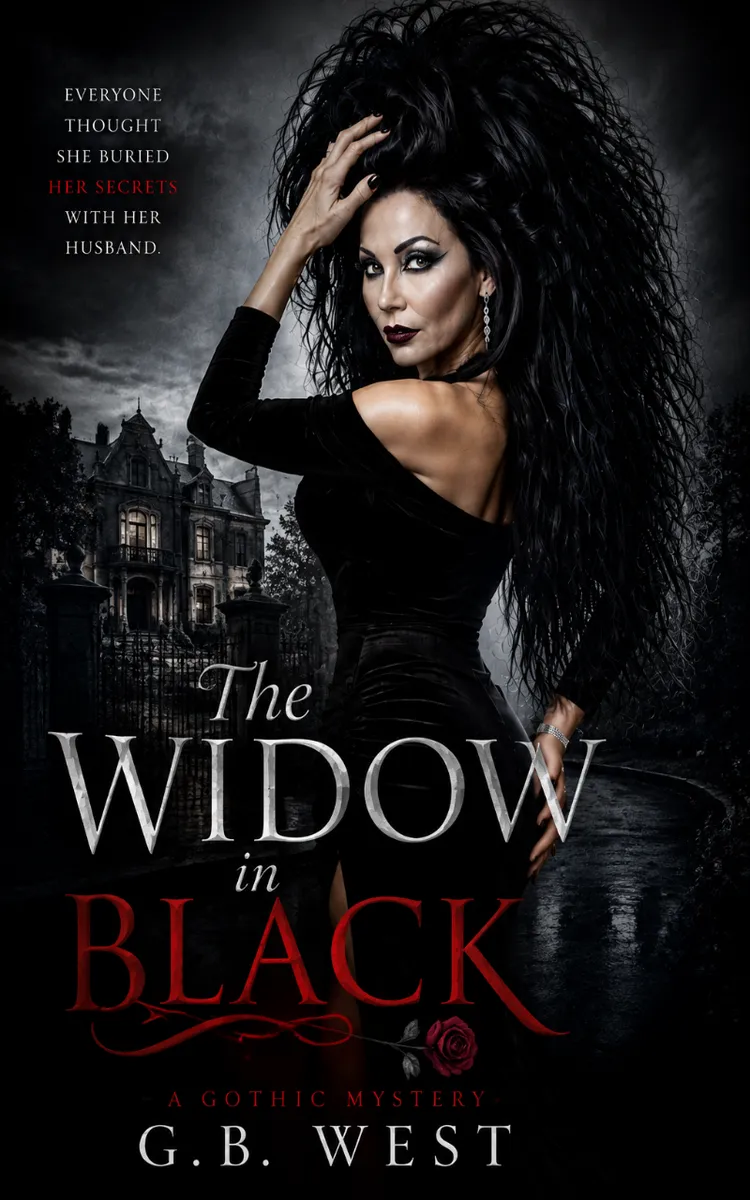
Read the first chapter
The whole of chapter one, free. About 7 min. Turn the pages with the arrows, your keyboard, or a swipe.
Chapter 1
The Envelope in Her Husband’s Hand
The iron gate was still swinging when Vivienne Blackwood stepped from the funeral car, its hinges complaining into the wet New Orleans dusk. Behind her, the cemetery bells gave one last hollow note, and then the street swallowed the sound beneath the hiss of tires on rain-dark pavement.
She did not look back.
Her black velvet gown dragged a faint line of cemetery mud across the marble threshold of the mansion. A single red rose remained pinned at her waist, its petals bruised from the coffin lid. She removed her gloves finger by finger and handed them to no one. The servants had been dismissed for the night. The house belonged to her now, in the way a locked room belonged to whoever had been shut inside it.
She wanted only to reach the receiving hall, pour herself something cold, and sit beneath the chandelier until the hours passed without asking anything of her.
The front doors closed behind her with a weighty boom.
Vivienne stopped.
The mansion answered with silence.
Not the ordinary silence of an empty house. This had shape. It pressed from the stairwell, waited beneath the gallery, settled in the velvet curtains and the carved mouths of the plaster cherubs. Somewhere beyond the receiving hall, a floorboard gave a small, deliberate creak.
Vivienne turned her head.
“Is someone there?”
Her voice traveled through the foyer and came back thinner.
Nothing moved.
She crossed to the console table, where a silver tray held the keys she had carried from the cemetery. Her hand paused above them. The front door was locked. She had watched the driver pull it shut after her. The side entrance had been bolted before she left for the funeral. Every window on the ground floor was secured by iron latches that required a key.
A faint scrape sounded from the receiving hall.
Vivienne took the brass letter opener from the console.
It was a ridiculous weapon, slim and ornamental, its handle shaped like a woman’s hand. She held it anyway. The blade caught the dim light beneath the chandelier as she moved through the archway.
The receiving hall opened before her in a wash of burgundy carpet and dark wood. Portraits watched from the paneled walls: Blackwoods with pale eyes, stiff collars, and the same expression of practiced disappointment. Her husband’s portrait hung above the fireplace, painted twelve years earlier, when his hair had been black and his smile still convinced people he possessed a conscience.
The French doors at the far end stood open.
Vivienne had closed them herself that morning.
A figure in a dark raincoat stood beyond the threshold, half concealed by the curtains. One gloved hand rested on the brass handle of the garden door. The other held a cream-colored envelope.
For one suspended second, neither of them moved.
Then the stranger turned.
“Wait.”
Vivienne lunged forward.
The figure slipped through the door. She reached it as the rain struck her face, cold and sharp. Beyond the terrace, the garden lay in black layers of magnolia, boxwood, and dripping Spanish moss. A path of pale stones curved toward the rear gate.
The stranger was already gone.
Vivienne stepped onto the terrace. Water soaked through the hem of her gown. She scanned the garden, searching for movement, a flash of fabric, the glint of a shoe. The rear gate stood open, swinging gently in the rain.
She could hear nothing but water ticking from the leaves.
“Damn you,” she said.
The words disappeared into the dark.
She returned to the hall and shut the French doors. The envelope lay on the carpet just inside them, as if the stranger had dropped it or placed it there for her to find. No stamp marked its cream surface. No seal held it closed.
Her name was written across the front.
Vivienne Blackwood.
The handwriting tightened something beneath her ribs.
She knew every angle of those letters. The long, elegant stroke of the V. The severe downward slash of the B. The final d, looped once and cut short.
Her husband’s hand.
Vivienne stared at the envelope until the chandelier blurred.
He had been dead for less than six hours.
She bent and picked it up.
The paper was damp along one edge, but the ink had not run. Beneath her fingers, something stiff shifted inside. Photographs, perhaps. Documents. A threat. Her husband had always preferred threats that could be folded neatly and carried in a breast pocket.
She crossed to the fireplace and set the envelope on the mantel. The rain tapped against the windows. Behind her, the mansion seemed to rearrange itself, settling into its nighttime posture.
Vivienne looked toward the French doors.
The stranger had entered her house.
Not approached it. Not left something on the steps. Entered it.
That meant the locks had failed, or someone had opened them.
She went back to the foyer and checked the front door first. The dead bolt was turned. She touched the brass, then examined the keyhole. No scratches. No broken metal. The side entrance was still bolted. At the base of the staircase, a smear of wet grit marked the marble, leading toward the receiving hall.
She followed it.
The trail ended beside the mantel.
Vivienne’s gaze lifted to her husband’s portrait.
His painted eyes seemed fixed on the envelope.
“Did you send this before you died?” she asked.
The portrait offered the same polished smile.
She took a crystal decanter from the drinks cabinet and poured whiskey into a tumbler. Her hand was steady. She drank, felt the burn pass down her throat, and poured another measure without looking away from the envelope.
She had not cried at the funeral. Not when the priest spoke of devotion. Not when the coffin disappeared beneath white flowers. Not when the mourners lowered their voices and called her brave.
Grief required intimacy. She had not been intimate with her husband in years.
Suspicion, however, was a familiar language.
Vivienne carried the envelope to the receiving table and placed it beneath the lamp. She found a pair of silver scissors in the drawer and cut along the top edge.
Five photographs slid onto the polished wood.
The first showed a young woman seated on a wrought-iron bench. She had dark hair, a narrow face, and a pale dress buttoned to the throat. Behind her rose the columns of a house Vivienne did not recognize. The photograph had been taken outdoors in summer; the woman’s expression was guarded, but not unhappy.
On the back, in her husband’s handwriting, were two words.
No name.
The second woman stood beside a riverboat, one hand resting on the rail. She was blonde, perhaps thirty, with a smile too bright for the camera. The third wore a red coat and stood before a hotel entrance. The fourth was older, with silver at her temples and a wedding ring on her left hand.
The fifth photograph showed a woman with black hair cut sharply at her jaw. She faced the camera as if someone had called her name just before the shutter fell.
Vivienne turned it over.
Six words had been written across the back.
YOU WERE NEVER MY ONLY WIFE.
The room narrowed around her.
Her husband had married her thirty-one years earlier in a private ceremony at St. Louis Cathedral. He had told her there had been no one before her who mattered. She had believed the statement because she had wanted to, and because the Blackwood name had opened doors that had remained closed to her all her life.
Now five strangers looked up from the table.
“What are you trying to tell me?” she whispered.
A knock sounded at the front door.
Vivienne’s hand closed around the whiskey glass.
Three knocks. Evenly spaced.
She left the photographs beneath the lamp and crossed the foyer. The marble felt cold through her stockings. At the door, she looked through the narrow pane of glass.
No one stood on the steps.
A second knock came, this one from inside the house.
Vivienne turned.
The receiving hall was empty.
The photographs lay in a neat row on the table. The envelope rested beside them. Nothing else had changed, yet a draft moved through the room, stirring the black fringe of the curtains.
She returned to the table.
The fifth photograph was no longer where she had left it.
It lay half beneath the first, its corner protruding at an angle.
Vivienne touched it.
The paper tore.
A fresh white rip opened along the upper corner, jagged and damp at the edges.
She withdrew her hand.
For a moment she heard only the rain. Then, from somewhere above the receiving hall, came the soft sound of a door closing.
Vivienne looked toward the staircase.
The whiskey glass trembled once in her hand, then steadied.
She gathered the photographs and slid them back into the envelope. The torn fifth corner caught against the paper. She folded the envelope shut and carried it to the fireplace, where a black iron box sat beneath the mantel. Her husband had kept deeds, contracts, and letters in it. After his death, the key had been found in the pocket of his funeral suit.
Vivienne unlocked the box.
Inside lay nothing but a velvet pouch and three old brass keys.
She placed the envelope beneath them and locked the lid.
Then she removed the key, crossed to the foyer, and tucked it into the hidden seam of her gown.
The house creaked again above her.
This time, Vivienne did not call out.
She lifted the letter opener and began climbing the stairs, leaving the receiving hall dark behind her. On the table below, the five women waited in silence, their faces preserved in paper, their names stolen before she had ever learned them.
End of chapter one. 7 more chapters in the full book.
Swipe or use the arrows to turn the page
What's inside: 8 chapters
- 1. The Envelope in Her Husband’s Hand
- 2. Black Velvet, No Tears, One Choice
- 3. The First Missing Woman’s Trail
- 4. Locked Study, Opened Secrets
- 5. Five Photographs, One Disappearing Frame
- 6. The Body Isn’t One of Them
- 7. You Were Never My Only Wife
- 8. The Rose That Closes the Case
About this book
"The Widow In Black" is a fiction book by Anonymous with 8 chapters and approximately 15,900 words. A widow investigates her husband's hidden wives and murders.
This book was created using Inkfluence AI, an AI-powered book generation platform that helps authors write, design, and publish complete books. It was made with the AI Novel Writer.
Frequently Asked Questions
What is "The Widow In Black" about?
A widow investigates her husband's hidden wives and murders
How many chapters are in "The Widow In Black"?
The book contains 8 chapters and approximately 15,900 words. Topics covered include The Envelope in Her Husband’s Hand, Black Velvet, No Tears, One Choice, The First Missing Woman’s Trail, Locked Study, Opened Secrets, and more.
Who wrote "The Widow In Black"?
This book was written by Anonymous and created using Inkfluence AI, an AI book generation platform that helps authors write, design, and publish books.
How can I create a similar fiction book?
You can create your own fiction book using Inkfluence AI. Describe your idea, choose your style, and the AI writes the full book for you. It's free to start.
Write your own fiction book with AI
Describe your idea and Inkfluence writes the whole thing. Free to start.
Start writingCreated with Inkfluence AI


