
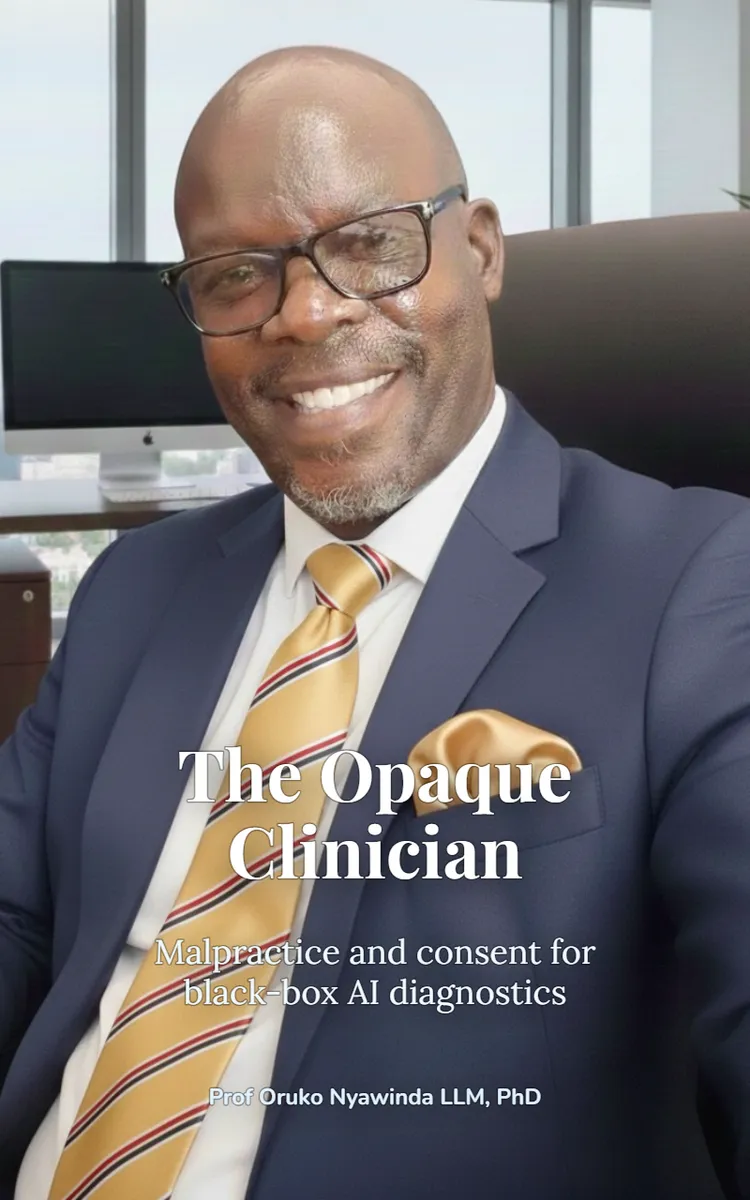
Read the first chapter
The whole of chapter one, free. About 9 min. Turn the pages with the arrows, your keyboard, or a swipe.
Chapter 1
The Epistemic Gap and Autonomy
The first time Amina Okoth saw a black-box diagnostic AI “light up” with a confident suggestion in the Nairobi ER, it felt like relief - until she tried to defend the decision in her own mind. The output came with no readable reasoning path: no traceable chain from symptom and test results to the conclusion, only a result card and a confidence score. When she later had to explain the basis of that choice to a patient and a supervisor, she realized the uncomfortable truth: she could repeat what the tool said, but she could not audit how the tool got there. That mismatch - between disclosure duties grounded in humanly explainable reasoning and the operational limits of black-box AI - is where the “Epistemic Gap” becomes a legal and clinical problem.
This chapter builds the bridge between the legal logic of Canterbury v. Spence (1972) and the practical reality of an Opaque Clinician: a clinician who cannot audit the specific diagnostic logic inside the Machine. The health outcome readers can expect from learning this is not “better certainty”; it is better decision hygiene. You will learn how to run a disclosure and validation process that respects patient autonomy even when you cannot see the internal steps that produced the AI’s suggestion.
The Epistemic Gap Map: Why Canterbury-Style Disclosure Breaks Under Black-Box AI
Amina’s workday shows the core failure mode. Canterbury-style disclosure assumes that a clinician can meaningfully communicate the material risks and the reasoning basis for a proposed course of action. With black-box AI, the clinician is asked to disclose a diagnostic recommendation that they cannot explain from the inside. The patient hears something that sounds like a medical judgment, but the clinician can only disclose the surface: inputs used by the tool (sometimes), the output shown (always), and the fact that the internal logic is not auditable.
What you can expect by applying the Epistemic Gap Map is a structured way to keep autonomy intact. The goal is to preserve a patient’s ability to make a self-determined choice based on what is knowable and material - without pretending you can open the Machine when you cannot. Key benefits are straightforward: fewer “hand-wavy” explanations that later look indefensible, clearer boundaries around what you can validate, and a consistent script for warnings that track what legally matters (material risk) rather than what feels reassuring.
Who this is for: clinicians, clinic managers, and health professionals who are being asked to use diagnostic AI outputs in consent discussions or treatment decisions, and who need a practical way to avoid malpractice exposure when they cannot audit the AI’s internal diagnostic logic. If you are a busy ER clinician or a small hospital lead, you’ll still get something usable: concrete time windows, documentation prompts, and a validation rhythm that fits into real workflow.
Practical takeaway to hold onto: if you cannot audit the diagnostic logic, you must shift disclosure from “the reasoning inside the Machine” to “the validation you performed and the risks introduced by opacity.”
The Opaque Clinician and the Mechanisms of the Epistemic Gap
The mechanism is simple to state and hard to live with: black-box AI produces an output using internal computations that are not human-auditable, not meaningfully inspectable, and often not even reconstructible from the clinician’s perspective. In plain language, the clinician cannot answer the audit question: “What exact diagnostic logic led from these facts to this conclusion?” That audit failure creates an Epistemic Gap - a gap between what the patient is entitled to understand for autonomy purposes and what the clinician can actually justify.
There are three common drivers of the gap:
1. Opacity of internal logic The Machine’s internal model structure and decision pathway are not accessible in a way that allows a clinician to explain the reasoning chain. Amina can tell you the output, but she can’t tell you why the internal weights and hidden layers made that choice.
2. Mismatch between disclosure categories and what the AI can support Canterbury-style disclosure focuses on material information: what risks exist, what alternatives exist, and why the clinician recommends a course. If the diagnostic basis is not explainable, the clinician cannot safely fold the Machine’s reasoning into the disclosure narrative without overclaiming.
3. Automation bias under time pressure Even when clinicians know better, the workflow rewards quick acceptance. The Machine’s suggestion can become a shortcut for thinking. If that shortcut later gets challenged, the clinician’s inability to audit the logic turns a “reasonable reliance” defense into a credibility problem.
Ask yourself a quick comprehension check: if a patient asks, “Why should I trust this?” can you answer with a validation story that you can actually stand behind? If the honest answer is “I can’t see the logic,” the disclosure structure must change.
Key medical vocabulary in this chapter: - Material risk: the kind of risk that would likely matter to a reasonable patient when deciding whether to proceed. - Autonomy: the patient’s right to make an informed choice based on material information, not just on clinician confidence. - Black-box AI: an AI system whose internal decision logic cannot be meaningfully audited by the clinician.
Concrete differentiator (Nairobi ER reality): Amina often has minutes, not hours. The Epistemic Gap Map is designed to work in that window: it turns “I can’t explain the model” into “I can document the validation and disclose the opacity-driven procedural risk.”
Practical takeaway to hold onto: the Epistemic Gap is not solved by reassurance; it is managed through validation you can defend and disclosure you can explain.
Action Protocol: Using the Epistemic Gap Map for Disclosure Without Auditing the Machine
The Epistemic Gap Map is a documentation and consent workflow. It does not require you to see inside the Machine. It does require you to show, step-by-step, what you could validate and what you disclosed because you could not.
The validation rhythm (timed to ER workflow)
Use this rhythm whenever the Machine output influences a recommendation that will be part of consent or treatment planning:
1. 0-5 minutes after the output appears: “Surface capture” Record the exact Machine output shown to you, including the timestamp, tool name/version if available, and the listed inputs (symptoms/tests) the interface claims to have used. If the interface does not list inputs clearly, note that limitation immediately.
2. 5-15 minutes: “Independent clinical anchoring” Re-check the case using standard clinical reasoning based on information you can access directly (history, exam findings, and available tests). Your goal is not to “beat the Machine,” but to decide whether the output fits the clinical picture and whether it conflicts with red flags you can verify.
3. 15-25 minutes (or before the consent moment): “Gap labeling and disclosure script” Label what you can and cannot audit, then disclose that limitation in a patient-facing way that stays tied to autonomy. You will explicitly say that the diagnostic logic inside the tool is not directly explainable by you, while you explain the validation you performed.
4. Ongoing (every 1-4 hours depending on severity): “Re-check triggers” If the patient’s condition changes, repeat the anchoring step and update documentation. For unstable patients, do this more often; for stable cases, less frequently.
Warning signs: when you should seek professional help (and escalate documentation)
If any of the following occurs, treat it as a “consent and safety escalation” trigger rather than a routine use of AI output:
• The Machine suggests a high-impact diagnosis that conflicts with vital sign abnormalities or clearly documented exam findings. - The patient’s course is not tracking with the recommendation within a short window (for ER contexts, think within 2-6 hours, depending on the clinical pathway). - The interface provides output without a usable list of inputs, or you cannot verify key inputs (for example, whether a test result was actually used). - A patient asks directly, “Can you show me how it decided?” and you cannot provide a meaningful explanation beyond “it’s not auditable.”
In those moments, involve senior clinical supervision, ethics/medico-legal support if available, and ensure the consent record reflects both the validation steps and the opacity disclosure.
A comparison table: what Canterbury expects vs what black-box AI forces you to do
| Disclosure element (patient-facing) | Canterbury-style assumption (humanly explainable basis) | Epistemic Gap Map adjustment for black-box AI | |---|---|---| | Reasoning basis | Clinician can explain why the recommendation follows from the facts | Clinician explains what was validated independently and what cannot be audited inside the Machine | | Material risk framing | Risks tied to the proposed course and its rationale | Add procedural risk disclosure: risk introduced by diagnostic opacity (what the patient should know because the logic is not explainable) | | Trust and reliance | Trust can be anchored in transparent clinical judgment | Trust is anchored in validation steps you can document, not in claims about internal model logic |
Practical takeaway to hold onto: the consent record should read like a defensible audit trail: “what the tool said,” “what I checked independently,” “what I could not audit,” and “what I told the patient because it matters.”
Common Errors That Create Liability When You Cannot Audit the Machine
Amina learned quickly that certain patterns - common in busy clinical practice - become high-risk when the Machine is involved. Below are the errors that repeatedly collapse disclosure into something courts may view as incomplete or misleading.
Assuming the confidence score substitutes for explainability Why it happens: A confidence number feels like evidence. Clinicians may treat it as a stand-in for reasoning, especially when the ER is crowded and time is tight. But confidence does not answer the audit question: it does not show the diagnostic logic that led to the recommendation.
What to do instead: Document the confidence score as part of “surface capture,” then anchor disclosure in your independent clinical anchoring. If the patient asks why the AI is right, your answer should rely on the clinical fit you verified (exam findings, accessible labs, and timing), and acknowledge that you cannot inspect the internal logic.
Practical takeaway: numbers can be included; they cannot replace validation.
Over-disclosing what you cannot audit Why it happens: Clinicians sometimes try to “sound like they understand the model” to reduce patient anxiety. This is especially tempting when the patient is scared and wants a straight answer. The problem is that you may end up claiming a reasoning chain you cannot actually verify.
What to do instead: Disclose opacity accurately and specifically: explain that the diagnostic logic inside the tool is not directly explainable by you. Then disclose what you can explain: the validation steps you performed and the clinical information you used.
Practical takeaway: honesty about limits is not an obstacle to consent; it is the foundation of informed choice.
Waiting to document until after the consent moment Why it happens: Documentation is often delayed due to workload. But when the patient later questions the decision, a delayed record can look like rationalization rather than contemporaneous validation - especially when the clinician cannot audit the Machine’s logic.
What to do instead: Use the Epistemic Gap Map timing: surface capture within 0-5 minutes, anchoring within 5-15 minutes, and gap labeling before consent. If you miss the window, document the reason for delay and still complete the validation record as soon as possible.
Practical takeaway: the audit trail must exist when the decision is being made, not when it is being defended.
Closing: Turning Opacity Into a Defensible Autonomy Practice
The uncomfortable lesson Amina carried forward is that black-box AI does not only change diagnostics - it changes what can be truthfully disclosed. Canterbury-style disclosure depends on meaningful clinician explanation; the black-box context creates an Epistemic Gap by removing the clinician’s ability to audit the specific diagnostic logic. Your job, legally and ethically, becomes narrower and more precise: validate what you can, label what you cannot, and disclose the opacity-driven procedural risk in a way the patient can use.
As the next layer of the book examines informed consent doctrines under AI opacity, this chapter’s core takeaway will keep you steady: autonomy is not preserved by optimism about the Machine; it is preserved by disciplined transparency about what you checked, what you could not check, and what that means for the patient’s choice.
End of chapter one. 4 more chapters in the full book.
Swipe or use the arrows to turn the page
What's inside: 5 chapters
- 1. The Epistemic Gap and Autonomy
- 2. Standard of Reasoned Justification
- 3. Dual-Layer Disclosure for Material Risk
- 4. Human-in-the-Loop Liability Split
- 5. MAIDA and Regulatory Safe Harbors
About this book
"The Opaque Clinician" is a health & wellness book by Prof Oruko Nyawinda LLM, PhD with 5 chapters and approximately 10,886 words. Legal and ethical frameworks for physician malpractice and informed consent with AI diagnostics.
This book was created using Inkfluence AI, an AI-powered book generation platform that helps authors write, design, and publish complete books. It was made with the AI Health Book Generator.
Frequently Asked Questions
What is "The Opaque Clinician" about?
Legal and ethical frameworks for physician malpractice and informed consent with AI diagnostics
How many chapters are in "The Opaque Clinician"?
The book contains 5 chapters and approximately 10,886 words. Topics covered include The Epistemic Gap and Autonomy, Standard of Reasoned Justification, Dual-Layer Disclosure for Material Risk, Human-in-the-Loop Liability Split, and more.
Who wrote "The Opaque Clinician"?
This book was written by Prof Oruko Nyawinda LLM, PhD and created using Inkfluence AI, an AI book generation platform that helps authors write, design, and publish books.
How can I create a similar health & wellness book?
You can create your own health & wellness book using Inkfluence AI. Describe your idea, choose your style, and the AI writes the full book for you. It's free to start.
Write your own health & wellness book with AI
Describe your idea and Inkfluence writes the whole thing. Free to start.
Start writingCreated with Inkfluence AI


