
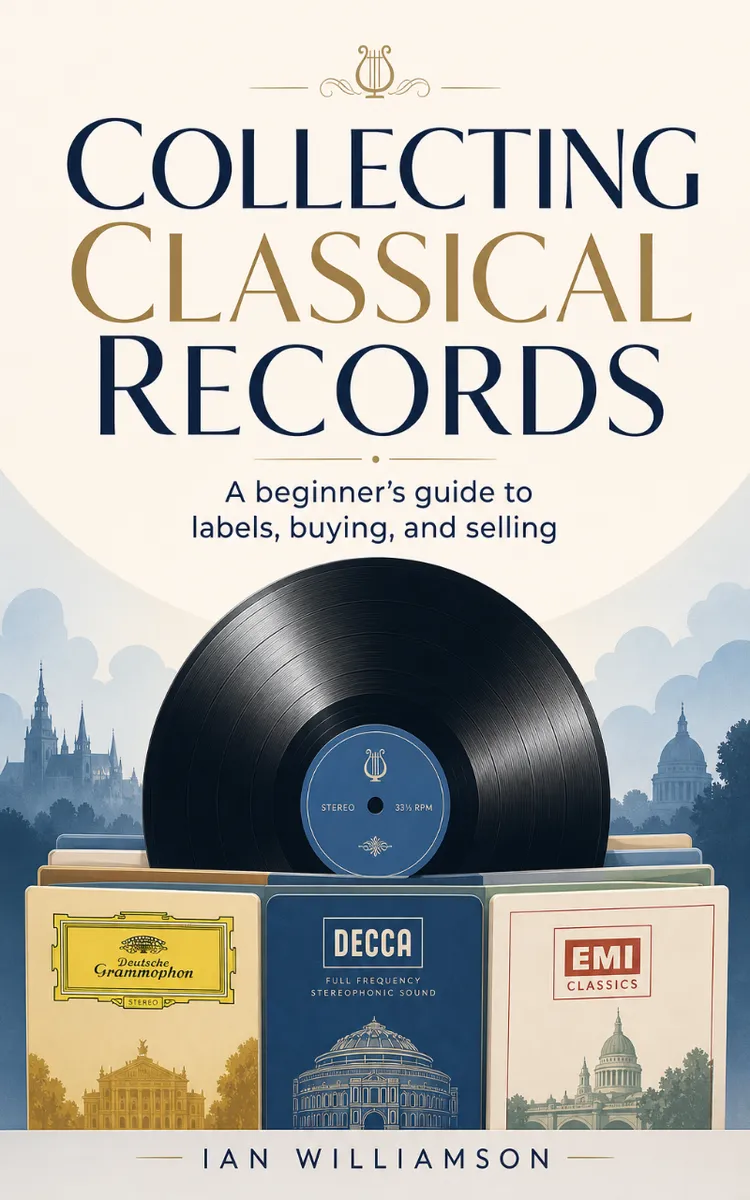
Read the first chapter
The whole of chapter one, free. About 9 min. Turn the pages with the arrows, your keyboard, or a swipe.
Chapter 1
What to Collect in Classical
Choose a Good record, Not Just a Famous Record
Which classical record would you still play even if it had no monetary value?
That question keeps a first collection focused. Classical catalogues contain thousands of symphonies, concertos, chamber works, choral pieces, and operas. A beginner who buys every attractive cover soon ends up with heavy shelves full of damaged, incomplete, or poorly chosen records. A beginner who chooses a clear starting group can learn the music, compare pressings, and spot better copies when they appear.
Your first aim should not be to own the rarest label. It should be to build a small set of important works in strong performances and playable condition. You will learn which recordings deserve priority, how first and later releases differ, and why labels such as Decca, HMV, Columbia, and Philips matter. You will also have a practical way to judge a record at a boot sale, charity shop, or online listing before you spend money.
The result should feel like a useful listening shelf: a few major symphonies, concertos, chamber works, and operas that teach you what good classical records sound like. Once that shelf makes sense, label variations and resale value become easier to understand.
Build Your Starter Repertoire Ladder
If you are collecting for your own pleasure then the Starter Repertoire Ladder gives you an order for buying. Start with works that offer clear musical variety and strong recording choices. Then move toward larger, more expensive, or more specialised sets.
• Begin with core symphonies. Choose Beethoven, Mozart, Brahms, Tchaikovsky, or Dvořák. A symphony gives you a full orchestral sound and helps you hear whether a record has surface noise, distortion, or weak dynamics. Start with a single clearly representative symphony, for example Beethoven’s Fifth, rather than attempting a composer’s entire catalogue.
• Add concertos. Look for a solo instrument with orchestra: violin, piano, or cello. Concertos make it easier to compare the soloist with the orchestra. Decca, HMV, and Columbia often produced excellent concerto recordings, so this category also introduces you to important label styles.
• Choose chamber music. Buy string quartets, piano trios, or sonatas when you want a quieter test of pressing quality. Chamber music exposes clicks, hiss, and inner-groove distortion because fewer instruments cover those faults.
• Move into opera and choral works. Opera sets often contain two or three records, a libretto, and a large cast. Buy them after you understand how to check completeness. A missing record or booklet can reduce both listening value and resale interest.
• Explore specialist recordings last. Early music, modern compositions, unusual conductors, and limited local issues can become rewarding areas, but they require more knowledge. Build your ears and catalogue skills first.
When you inspect a record, separate the work, the performance, and the pressing. The work tells you what music you are buying. The performance tells you who conducts or performs it. The pressing tells you which physical issue you hold. A later pressing can sound excellent, while a first release can suffer from scratches or groove wear. “First” does not automatically mean “best.”
Decca provides a useful example. Early Decca records often carry a wide-band label, commonly called ED1 by collectors. Later wide-band issues often appear as ED2, followed by ED3 and other variations. These labels can affect value because collectors want to identify the exact release, but you still need to check the record, sleeve, and catalogue number together. Two records with similar artwork may have different label details and different market prices.
The above image is an example of an "ED1" label, note that there is a groove or indentation towards the outer edge of the label - this is known as the "Wide Band Groove" or "WBG" - these are the most sought after first release versions and these labels are the ones to look out for
The above image is an example of an "ED2" label - these are largely second issues ( reissues ) and the key difference is the text in the "10 to 12" position has changed from "Original Recording by" to "Made in England by" - the "WBG" is still present.
The above image is an example of an "ED3" label - these are largely second issues ( reissues ) and the key difference is even though the text in the "10 to 12" position is still "Made in England by" - the "WBG" is has gone ( i.e. no groove )
HMV records also need careful identification. Collectors commonly describe early labels as White/Gold, followed by later Big Dog and Little Dog designs. “Dog” refers to the famous picture of the dog listening to the gramophone. These names help you search catalogues and listings, but do not rely on the nickname alone. Read the catalogue number, matrix information, label wording, and country of issue.
The above image shows the HMV "White / Gold " label variants which are first issue versions and the ones to keep an eye out for!
The above image shows the HMV "Big Dog" label variants which are the first reissue version of the release ( The dog is "Nipper" the original HMV dog)
The above image shows the HMV "Little Dog" label variants which are the later reissue version of the release (sometimes also known as "postage stamps" due to style of the image of Nipper the dog)
Columbia records appear in several designs, including Blue and Silver labels and later variations. The label colour can point you toward an era, but the complete label information gives you the safer identification. Columbia’s classical catalogue includes orchestral, concerto, chamber, and vocal recordings, so use the Starter Repertoire Ladder rather than buying only by label colour.
The above image shows the sought after first release "Blue / Silver" label variants from Columbia Records - ones to look out for!
Philips deserves a place on the beginner’s list because many Philips classical recordings offer clean, balanced sound and attractive performances. Look for symphonies, concertos, and chamber works, then check the catalogue number and country. A Dutch pressing, a United Kingdom pressing, and a later reissue may share cover artwork but differ in label and release details.
Use this simple buying rule: buy the music first, the performance second, and the pressing third. If the work fills a gap on your shelf and the record plays cleanly, a later issue may serve you better than an expensive first release. Ask yourself: “Will I play this, and can I explain exactly which release it is?” If you can answer both questions, you have made a sound beginner purchase.
Apply the Ladder at a Saturday Boot Sale
A realistic first buying trip might include £30 in cash, one hour, and several boxes of mixed records. The goal is not to leave with the most records. The goal is to return with three or four useful additions.
• Set a four-record target. Look for one symphony, one concerto, one chamber record, and one opera or choral set. Expect to inspect about 20 records to find four worth buying. This keeps the search practical and prevents impulse purchases.
• Start with the outer sleeve. Reject records with heavy damp staining, split seams, or crushed corners if the seller asks a premium price. A worn sleeve may still be acceptable for a cheap listening copy, but it should lower your offer.
• Read the spine and front cover. Write down the composer, work, conductor, performers, label, and catalogue number. For example, note “Beethoven Fifth Symphony, conductor Carlos Kleiber, Decca, SXL catalogue number,” rather than writing only “Beethoven.”
• Inspect both record surfaces under good light. Hold the disc by its edges and look for scratches that cross the grooves. A light hairline may play quietly; a deep scratch can cause repeated clicks or a skip. Ask the seller whether you may inspect the record before paying.
• Check the label against the release clues. On Decca, look for ED1, ED2, or ED3 features. On HMV, check White/Gold, Big Dog, or Little Dog designs. On Columbia, check for Blue and Silver and later label patterns. On Philips, compare the catalogue number and label layout with a trusted catalogue entry.
• Check completeness. For a two-record concerto set, confirm both discs remain in the sleeve. For opera, count every record and look for the libretto. A missing booklet may not affect listening, but it can matter when you later sell the set.
• Choose condition over excitement. Suppose you find an ED1 Decca symphony for £12 with a scratched playing surface and a clean ED2 copy for £8, buy the clean ED2 unless you specifically collect ED1 labels. Buy the clean ED2 unless your purpose specifically involves collecting the ED1 label. The expected outcome is better listening and less cleaning or repair.
• Record the purchase immediately. Use your phone to photograph the front cover, back cover, labels, and any matrix numbers. Later, search Discogs, an online music database, to identify the exact release. I use Discogs for my personal collection because its release pages help separate similar pressings, but I still compare the physical record with the listing.
A sensible result from this trip might be a clean Philips Beethoven symphony for £5, a Columbia concerto for £6, a chamber record for £3, and a complete HMV opera set for £10. You return with four different listening experiences for £24, plus enough information to catalogue them accurately. The value comes from choosing useful records, not from filling a crate.
Quick checklist
• Choose one work from each useful category before shopping.
• Record the catalogue number, not just the composer.
• Check both sides under strong light.
• Reject deep scratches, warping, and missing discs.
• Compare Decca ED1, ED2, and ED3 details carefully.
• Check HMV White/Gold, Big Dog, and Little Dog labels.
• Identify Columbia Blue and Silver and later variations.
• Confirm every disc and booklet in opera sets.
• Photograph the record before leaving the sale.
• Check the exact release on Discogs after buying.
Your practical takeaway: buy fewer records, but make each one teach you something about music, performance, sound, or label history.
Avoid the Most Expensive Beginner Errors
Buying a famous title without checking the performance
A famous work can have many recordings, and not every version suits your taste or your equipment. A Beethoven symphony with an admired conductor may still sound too sharp or too forceful for you. Read the performers before buying and, when possible, listen to a sample online.
Do this: choose one familiar work and compare two conductors or soloists.
Not this: pay a high price for a famous composer’s name alone.
A performance you enjoy will receive more play than a supposedly important copy that stays on the shelf.
Treating a first release as automatically superior
A Decca ED1, HMV White/Gold, or early Columbia label can attract collectors, but condition decides whether the record deserves your money. Groove wear, scratches, and noisy surfaces can ruin an otherwise desirable issue. A clean ED2 or later pressing may offer the better listening copy.
Do this: identify the label, then inspect the playing surface and ask what you want the record to do.
Not this: buy an expensive first release without checking whether it plays cleanly.
Use separate notes for “listening copy” and “collector copy.” The first should sound good. The second may matter because of its label, sleeve, matrix, or rarity.
Missing parts in opera and boxed sets
Opera sets create a common trap. The cover may look complete while one record, libretto, or insert has disappeared. A missing side can make the set unusable, and an incomplete set usually sells for less later.
Do this: count the records and check the booklet before paying. Write “complete” in your catalogue only after you confirm every part.
Not this: assume a thick box contains everything it originally held.
A strong beginner collection grows from deliberate choices: one work, one performance, one physical release, checked carefully. Start with the Starter Repertoire Ladder, learn how the major labels reveal their editions, and let each purchase sharpen your judgement for the next one.
End of chapter one. 8 more chapters in the full book.
Swipe or use the arrows to turn the page
What's inside: 9 chapters
- 1. What to Collect in Classical
- 2. Decca Labels: Ed1 Ed2 Ed3
- 3. HMV Labels: White Gold Big/Little Dog
- 4. Columbia Labels: Blue Silver Variants
- 5. Deutsche Grammophon Label Clues
- 6. Where to Buy: Boot Sales to Shops
- 7. How to Store Records Safely
- 8. Cataloguing on Discogs
- 9. Selling Records: eBay Facebook Discogs
About this book
"Collecting Classical Records" is a how-to guide book by Anonymous with 9 chapters and approximately 14,815 words. Stop guessing, start collecting. Learn how to identify classical record pressings by label, catalogue number, and matrix details, so you can buy the right copy, store it properly, and sell with confidence.
This book was created using Inkfluence AI, an AI-powered book generation platform that helps authors write, design, and publish complete books. It was made with the AI Ebook Generator.
Frequently Asked Questions
What is "Collecting Classical Records" about?
Stop guessing, start collecting. Learn how to identify classical record pressings by label, catalogue number, and matrix details, so you can buy the right copy, store it properly, and sell with confidence. Build a starter shelf that teaches you what good classical recordings sound like, then use a practical decoder method to avoid costly mistakes.
How many chapters are in "Collecting Classical Records"?
The book contains 9 chapters and approximately 14,815 words. Topics covered include What to Collect in Classical, Decca Labels: Ed1 Ed2 Ed3, HMV Labels: White Gold Big/Little Dog, Columbia Labels: Blue Silver Variants, and more.
Who wrote "Collecting Classical Records"?
This book was written by Anonymous and created using Inkfluence AI, an AI book generation platform that helps authors write, design, and publish books.
How can I create a similar how-to guide book?
You can create your own how-to guide book using Inkfluence AI. Describe your idea, choose your style, and the AI writes the full book for you. It's free to start.
Write your own how-to guide book with AI
Describe your idea and Inkfluence writes the whole thing. Free to start.
Start writingCreated with Inkfluence AI


