
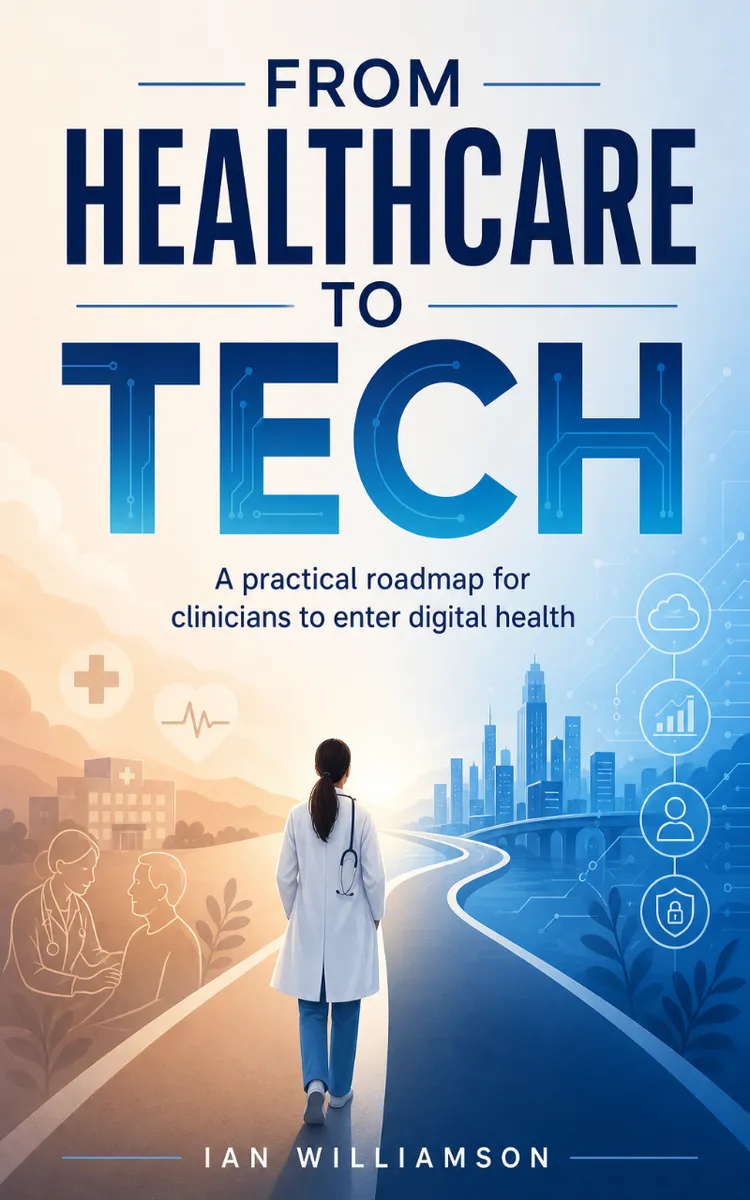
Read the first chapter
The whole of chapter one, free. About 8 min. Turn the pages with the arrows, your keyboard, or a swipe.
Chapter 1
Choosing Your Tech Exit Path
Start With the Work, Not the Job Title
Which part of healthcare work do you handle so well that you could explain it, observe it, or improve it for someone else? That answer often points more accurately to your best digital health role than your job title does.
A nurse who notices where patients become confused may fit user experience (UX) research. A clinical administrator who can trace a referral from order to appointment may fit product management. A respiratory therapist who trains teams, documents processes, and catches safety risks may fit implementation, clinical operations, or customer success. Each person brings healthcare expertise, but the strongest technology path depends on how that expertise shows up in daily work.
The Role Fit Compass helps you make that decision without starting over. You will sort your strengths into four practical areas - observation, workflow judgment, communication, and change management - then compare those strengths with the work performed in UX research, product management, and adjacent digital health roles. You will finish with one primary target, one backup path, and evidence you can use in applications.
Use the Role Fit Compass to Match Strengths to Work
The Role Fit Compass prevents a common mistake: choosing a role because its title sounds attractive rather than because its daily tasks match your existing abilities. Start by reviewing these four areas.
1. Observation: Identify how you gather information from patients, families, clinicians, or records. UX research depends on careful listening and behavior-based observation. If you can notice that a patient nods but still does not understand discharge instructions, you already practice a core research skill: detecting the difference between what people say and what they do.
2. Workflow judgment: Identify how you understand a process from beginning to end. Product managers decide which problems a digital product should solve and in what order. Your experience with electronic health record (EHR) workarounds, referral delays, medication reconciliation, or handoff gaps gives you useful product judgment because you have seen the cost of poor workflow design.
3. Communication: Identify how you explain complex information to different groups. Product managers, researchers, implementation specialists, and clinical educators all translate between technical teams and healthcare users. If you can explain a new documentation process to a busy clinician and a nervous patient, you can adapt that skill to product interviews and customer conversations.
4. Change management: Identify how you help people adopt a new process, tool, or policy. Implementation and clinical operations roles depend heavily on training, follow-up, issue tracking, and escalation. Product management also benefits from this experience because a well-designed feature still fails when users cannot fit it into their workday.
Now compare your strongest areas with the role’s actual work. UX researchers plan interviews, observe users, organize findings, and explain patterns to a product team. Product managers define problems, prioritize solutions, write requirements, review progress, and measure whether a change helps users. Adjacent paths include implementation specialist, clinical informatics analyst, customer success manager, clinical product specialist, and healthcare operations analyst.
Use this simple comparison before you apply:
| Your strongest evidence | Best first role to investigate | Why it fits | |---|---|---| | Patient interviews, observation, qualitative notes | UX research | You already collect and interpret human behavior | | EHR pain points, workflow mapping, prioritization | Product management | You understand problems that digital products must solve | | Training, rollout support, issue resolution | Implementation or customer success | You help users adopt tools and recover when workflows break | | Documentation standards, data review, safety checks | Clinical informatics or operations analysis | You connect clinical rules with reliable processes |
Do not treat this table as a permanent label. Treat it as a starting test. Ask yourself: “Which role would let me produce strong work within the first six months using skills I already practice?” That question matters because employers do not hire healthcare professionals for clinical identity alone. They hire them for evidence that they can perform the target role.
Create a one-page Role Fit Compass by writing three examples under each area. For instance, under workflow judgment, write: “Reduced referral follow-up delays by creating a shared tracking process.” Under communication, write: “Trained 18 staff members on a revised triage protocol.” Then translate each example into the language of the target role. The referral example can become: “Mapped a multi-step referral workflow, identified a handoff gap, and introduced a tracking process that improved follow-up reliability.” The training example can become: “Designed and delivered role-based training for 18 users during a process change.”
The goal is not to hide your clinical background. The goal is to show how it produces digital health results. By the end of this exercise, choose one primary role and one adjacent role. A nurse may select UX research as the primary target and implementation as the adjacent option. A medical administrator may select product management as the primary target and clinical operations analysis as the adjacent option. A focused target makes your resume, portfolio, and interview preparation more credible.
Apply the Compass to a Product Management Transition
Consider a clinical administrator who has spent four years coordinating specialty referrals. Her daily work includes reviewing incomplete orders, contacting clinics, tracking authorization delays, answering staff questions, and reporting recurring problems to leadership. She wants a remote-friendly digital health role but feels unsure whether product management or UX research fits better.
She can apply the Role Fit Compass in this order:
1. List five repeated problems from the last six months. She records incomplete referral information, unclear authorization status, duplicate patient calls, inconsistent scheduling notes, and missing follow-up ownership. These details create a product-relevant problem list instead of a general statement such as “I improved referrals.”
2. Separate observation from workflow judgment. She has gathered information from staff and patients, but her strongest evidence comes from tracing the referral process across departments. That gives her a stronger initial match for product management or clinical operations than for pure UX research.
3. Document one measurable change. She identifies a tracking sheet that assigned an owner and due date to each referral. Within eight weeks, the team reduced unresolved referrals from 42 to 17 at the weekly review. The number matters because it shows the result of her intervention, not merely her responsibility.
4. Turn the work into product language. She writes: “Mapped referral intake and authorization workflow, identified ownership gaps, and introduced status tracking that reduced unresolved cases from 42 to 17 over eight weeks.” This statement demonstrates problem discovery, workflow analysis, solution design, and measurement.
5. Test the target role through a small portfolio project. She creates a two-page product brief for a referral-status dashboard. The brief includes the user problem, affected users, three possible features, one feature she would postpone, and two measures of success: fewer duplicate calls and fewer referrals without an assigned owner. This project shows product judgment without claiming software development experience.
6. Compare the result with UX research requirements. She drafts five interview questions for referral coordinators, such as, “Walk me through what you do when an authorization status is unclear.” If she enjoys asking, listening, and organizing patterns more than choosing features and priorities, UX research may become her primary target. If she prefers deciding which workflow problem to solve first, product management remains the better fit.
7. Set a four-week validation plan. During week one, she reviews 10 digital health job descriptions and marks repeated requirements. During week two, she completes the product brief. During week three, she asks two former colleagues to review whether the proposed dashboard addresses a real workflow problem. During week four, she revises her resume and applies to five carefully matched roles. The expected outcome is not an immediate offer. It is clearer role fit, stronger evidence, and applications that speak to the employer’s needs.
Quick checklist
• Choose one primary role and one adjacent role. - Record three examples for observation, workflow judgment, communication, and change management. - Add numbers, time periods, users, or outcomes to each example. - Rewrite at least two clinical achievements in target-role language. - Build one small work sample: an interview guide, workflow map, product brief, or rollout plan. - Review 10 job descriptions and mark repeated skills. - Ask two healthcare colleagues whether your proposed digital solution addresses a real problem. - Track applications by role, evidence used, and response.
A practical test makes the decision clearer than extended self-assessment. If the product brief energizes you but the interview guide feels forced, prioritize product management. If the interviews reveal patterns you want to explore and the feature decisions feel premature, prioritize UX research. If training, rollout, and issue resolution feel most natural, investigate implementation or customer success.
Avoid Misreading Your Clinical Experience
Mistake: Treating clinical expertise as a complete qualification
Clinical credibility helps, but it does not replace role evidence. A hiring team may value your knowledge of medication workflows and still reject an application that never shows research synthesis, prioritization, documentation, or user adoption work.
Do this: Connect each clinical example to a target-role activity. Write, “Observed medication-reconciliation errors, grouped the causes, and recommended a workflow change.”
Not this: “Experienced nurse with strong clinical knowledge.”
The first statement shows work. The second only states identity.
Mistake: Applying to UX research and product management with the same message
These roles overlap, but employers assess different decisions. UX researchers need evidence that they can ask neutral questions, observe behavior, synthesize findings, and avoid jumping to solutions. Product managers need evidence that they can define a problem, weigh trade-offs, prioritize work, and measure results.
Do this: Create two versions of your evidence. For UX research, emphasize interviews, observation, thematic analysis, and usability findings. For product management, emphasize workflow problems, prioritization, requirements, and outcomes.
Not this: Send one resume that lists every clinical duty and hopes the reader will infer your fit.
A focused application makes your transition easier to understand.
Mistake: Choosing a role based on remote status alone
A remote job can still require intense meetings, detailed writing, independent decisions, and frequent coordination across time zones. Remote-friendly does not mean low-contact or low-structure.
Do this: Read the job description for its weekly work. Look for interviews, roadmap planning, ticket review, user training, data review, or implementation calls. Then compare those tasks with your Compass evidence.
Not this: Apply only because the listing says “remote.”
If your strongest evidence sits between roles, choose the adjacent path that gives you more direct exposure. An implementation role can build product knowledge. A clinical operations analyst role can build workflow and data experience. A customer success role can strengthen user research and adoption skills. The best next move is the one that converts your healthcare strengths into visible technology work.
Your Role Fit Compass should now point to a specific direction, not a vague wish to “move into tech.” Use that direction to shape every resume bullet, portfolio sample, and interview answer. Your clinical experience becomes valuable in digital health when you show exactly which problems you can see, which decisions you can improve, and which outcomes you can help a product or team achieve.
End of chapter one. 7 more chapters in the full book.
Swipe or use the arrows to turn the page
What's inside: 8 chapters
- 1. Choosing Your Tech Exit Path
- 2. Translating Bedside Skills to UX
- 3. Workflow Analysis for UX Research
- 4. Passing Health-Tech UX Research Interviews
- 5. Building a UX Research Portfolio Fast
- 6. Using EHR Frustrations for Product
- 7. Clinician-Turned-Product Manager Roadmap
- 8. Overcoming Domain Translation Gap Scripts
About this book
"From Healthcare To Tech" is a how-to guide book by Anonymous with 8 chapters and approximately 15,376 words. Career transition guide for healthcare professionals into health-tech roles.
This book was created using Inkfluence AI, an AI-powered book generation platform that helps authors write, design, and publish complete books. It was made with the AI Ebook Generator.
Frequently Asked Questions
What is "From Healthcare To Tech" about?
Career transition guide for healthcare professionals into health-tech roles
How many chapters are in "From Healthcare To Tech"?
The book contains 8 chapters and approximately 15,376 words. Topics covered include Choosing Your Tech Exit Path, Translating Bedside Skills to UX, Workflow Analysis for UX Research, Passing Health-Tech UX Research Interviews, and more.
Who wrote "From Healthcare To Tech"?
This book was written by Anonymous and created using Inkfluence AI, an AI book generation platform that helps authors write, design, and publish books.
How can I create a similar how-to guide book?
You can create your own how-to guide book using Inkfluence AI. Describe your idea, choose your style, and the AI writes the full book for you. It's free to start.
Write your own how-to guide book with AI
Describe your idea and Inkfluence writes the whole thing. Free to start.
Start writingCreated with Inkfluence AI


