

Read the first chapter
The whole of chapter one, free. About 10 min. Turn the pages with the arrows, your keyboard, or a swipe.
Chapter 1
“Everything Will Change” as a Signal
The Promise That Arrives First
When Nora, 34, became principal of a primary school, her first message to staff was almost expected: things were going to change. The school had recently struggled with staff turnover, uneven communication, and a timetable that seemed to belong to several different eras at once. A new principal, arriving with fresh authority, was naturally expected to bring a fresh direction.
The same announcement appears in many settings. A new coach promises a new culture. A new chief executive speaks of transformation. A newly elected government announces a break with the past. The wording varies, but the signal is familiar: what came before is no longer sufficient, and what comes next will be different.
This promise feels natural because leadership is often understood as a visible beginning. The person at the front changes, the language changes, and the organization looks for evidence that the old period has ended. Yet the announcement contains a quiet difficulty. A school, company, laboratory, or city is not made only of its current leader. It also contains routines, distinctions, warnings, workarounds, and memories accumulated by people who may no longer have any formal authority.
The first message therefore does more than announce change. It reveals what the new leader believes deserves to be left behind - and, perhaps without intending to, what the system may be in danger of forgetting.
When a new leader says everything will change, what is the system actually trying to protect?
The First-Message Drift Model
A new leader’s opening statement often begins with a useful observation: the organization has problems that require attention. The difficulty appears when that observation drifts into a broader story in which the past becomes one undifferentiated obstacle. This movement is the First-Message Drift Model. It describes how an announcement about changing particular conditions can gradually become a declaration against inherited knowledge itself.
The drift usually has three stages, though they do not arrive as a formal sequence. First comes contrast: the new period is set against the old one. Then comes simplification: the old period is described through a few visible failures, while its less visible successes remain unnamed. Finally comes substitution: new language, new meetings, new priorities, and new measurements are introduced before anyone has identified which older arrangements were carrying valuable knowledge.
Nora’s school offers a clear example. The timetable may have been inefficient, but it might also have encoded years of experience about which classes needed quiet transitions, which children became unsettled after lunch, and which teachers could reliably cover one another during emergencies. A staff meeting may have seemed too long, while also serving as the only place where small but important observations moved between classrooms. A new principal could reasonably change both. The question is whether the knowledge held inside those arrangements is recognized before the arrangements disappear.
This distinction matters because systems rarely store their learning in one place. It may be written in a policy, but it may also live in a habit, a sequence, a shared phrase, or the memory of why a seemingly awkward rule exists. The rule may look outdated to someone seeing it for the first time. To those who inherited the problem that produced it, it may be a compact record of an earlier lesson.
One surprising fact about organizations is that their most valuable knowledge is often least visible to newcomers. The smoother a routine becomes, the less likely people are to explain it.
A hospital handover, for example, can appear to be a simple exchange of information. In practice, its timing and order may reflect years of experience with what gets missed when staff are tired, interrupted, or working across departments. A software project’s code may contain comments that seem excessive until a later engineer encounters the exact failure they were written to prevent. In both cases, the visible procedure is only the surface. Beneath it lies a path of correction.
The First-Message Drift Model helps explain why declarations of renewal can produce unintended losses. The leader is not necessarily rejecting learning. More often, the leader is unable to distinguish between inherited burdens and inherited solutions. Both arrive together, carrying the same dust.
Why Starting Over Feels So Convincing
The attraction of a clean break has deep historical roots. Many institutions mark transitions with ceremonies, inaugural speeches, new uniforms, renamed departments, or redesigned buildings. Such symbols make time legible. They tell people that one period has ended and another has begun.
There is also a practical reason. A new leader has limited time and incomplete information. Visible change is easier to communicate than invisible continuity. Repainting a room, replacing a form, or reorganizing a team can be seen immediately. Preserving a useful distinction - knowing, for instance, why one decision must pass through two people rather than one - is harder to display. The new leader may be judged on movement before the system has had time to show whether the movement improved anything.
Organizations often reward this visible movement. A new coach changes training schedules. A chief executive introduces a new reporting structure. A principal replaces the staff bulletin with a digital platform. None of these decisions is automatically mistaken. The problem is that the replacement can be mistaken for the learning. The new tool is treated as progress even when the older tool was valuable because of the conversations it made possible.
The pattern appears beyond formal leadership. A family business passed from one generation to another may discard the handwritten records that explain seasonal purchasing, supplier reliability, or customer preferences because they look untidy beside modern software. A city may remove an old market, footpath, or public square in the name of efficiency, only to discover that the place had been performing social work no plan had measured. A research team may abandon a line of inquiry after a change in direction, forgetting that its failed experiments had narrowed the field for whoever came next.
A cathedral makes the contrast visible. Many great cathedrals were built across generations, with workers continuing foundations, walls, arches, and repairs begun by people whose names were unknown to them. No single builder could claim the whole structure. Continuity did not mean preserving every stone exactly as it was placed. It meant carrying forward enough of the design, measurement, and accumulated correction for later work to remain possible.
The same principle appears in a relay race. The speed of one runner matters, but so does the handover. A team that treats each runner as an isolated performance may produce impressive individual efforts and still lose the race through a poor exchange. The baton is not the whole inheritance. It is the object that makes the inherited path usable.
The Knowledge Hidden Inside an Institution
The most important inheritance of a mature system is rarely a person or a slogan. It is a set of working distinctions: this problem differs from that one; this warning matters earlier than it appears; this process is slow for a reason; this mistake has already been made.
Scientific research depends on such distinctions. A finding is not valuable only because it confirms a theory. A failed experiment can show which conditions do not produce the expected result, preventing later researchers from repeating the same route. The knowledge is not always dramatic. It may consist of a measurement that must be taken in a particular order, a sample that cannot be compared with another, or a question that appears simple but has repeatedly produced misleading answers.
Open-source software offers another form of continuity. Projects such as the Linux kernel have developed through contributions from many people over decades. The continuity is not personal; most contributors do not know one another. It is held in code, review practices, documentation, issue histories, and decisions about what not to change. A newcomer can alter the system, but the system also presents a record of previous judgments. The project’s maturity lies partly in its ability to make those judgments available without requiring every contributor to relive the past.
This is why preserving the past and preserving the architecture of learning are different tasks. Preserving the past can mean defending old forms simply because they are old. Preserving the architecture of learning means keeping the pathways through which experience remains available, even when forms, people, and tools change.
Nora might replace a paper attendance book with a digital system. That would alter the form. But if the paper book also carried informal notes about repeated absences, family circumstances, or patterns noticed by staff, the replacement would need somewhere for that knowledge to go. The continuity is not the paper. It is the school’s ability to notice, remember, and respond.
The Unexpected Cost of a Fresh Start
The counterintuitive finding is this: a system can become less innovative by changing too much too quickly. When every inherited arrangement is treated as suspect, people spend their energy learning the new structure rather than exploring what it might make possible.
This matters because innovation depends on a stable background. Researchers need reliable methods in order to investigate unusual questions. Engineers need dependable infrastructure before they can test new designs. Teachers need shared routines before they can adapt lessons to individual children. Without some continuity, each improvement must first rebuild the conditions that allow improvement to occur.
A fresh start can therefore create the appearance of freedom while reducing the system’s actual range of movement. The organization has more new language but fewer dependable reference points. Staff may comply with the new plan while withholding observations, because they have learned that yesterday’s knowledge will be discarded tomorrow. The result is not open development but a repeated loss of memory.
The surprise is not that change can fail. It is that excessive change can make change itself harder to understand. When too many elements move at once, no one can tell which alteration produced an improvement, which caused a problem, or which older practice had been quietly preventing one.
Nora and the School That Remembered
At Nora’s school, the first months after her appointment brought the usual pressure to demonstrate direction. She introduced a new planning format and reorganized staff meetings. These changes were visible, and some were useful. But conversations with teachers revealed that the school’s older routines contained a detailed record of its pupils’ needs.
One teacher explained why a particular year group always moved between classrooms through a longer corridor. The route took more time, but it avoided a narrow stairwell where younger children had repeatedly collided during busy transitions. Another described the reason for keeping a small reading group immediately after morning registration: several pupils arrived distracted, and the quiet start helped them settle before formal lessons began. Neither practice appeared in the school’s official improvement plan. Both represented accumulated learning.
The school did not need to preserve every old arrangement. The timetable could be revised, meetings shortened, and records improved. But the revisions became more reliable once the reasons behind existing practices were made visible. Change could then remove unnecessary weight without removing the school’s memory of how it had learned to carry it.
That is the quiet difference between replacing an institution and developing one. Replacement begins with the visible surface. Development asks what the surface has been holding.
What We Are Really Protecting
The promise that everything will change is often an attempt to restore confidence. It tells people that problems have been noticed and that the new leader will not be trapped by inherited habits. Yet the promise also creates a boundary between the present and the past, and boundaries can hide as much as they clarify.
Long-term systems do not survive because they resist every alteration. They survive because some knowledge remains recoverable while other parts are revised, discarded, or reinterpreted. Their continuity is architectural: a capacity to carry distinctions forward, to make mistakes legible, and to let later work begin from more than the memory of failure.
Human beings are drawn to beginnings because beginnings are easy to name. Development is harder to see; it is spread across handovers, records, habits, corrections, and choices that rarely receive credit. Perhaps the deepest sign of maturity is not how confidently a system announces a new era, but how much of its earned understanding remains available when the announcement is over.
What should truly be inherited in every long-term system: people, rules, institutions, or the accumulated ability to remember its own path, learn from it, and continue building without beginning from zero each time?
End of chapter one. 7 more chapters in the full book.
Swipe or use the arrows to turn the page


What's inside: 8 chapters
- 1. “Everything Will Change” as a Signal
- 2. When Starting Over Looks Like Progress
- 3. Inherit Pathways, Not People
- 4. Five Generations, One Growing Structure
- 5. Preserve Learning’s Architecture
- 6. The “What Must Survive” Inventory
- 7. Continuity Isn’t Political-It’s Structural
- 8. Maturity Means Remembering How to Continue
About this book
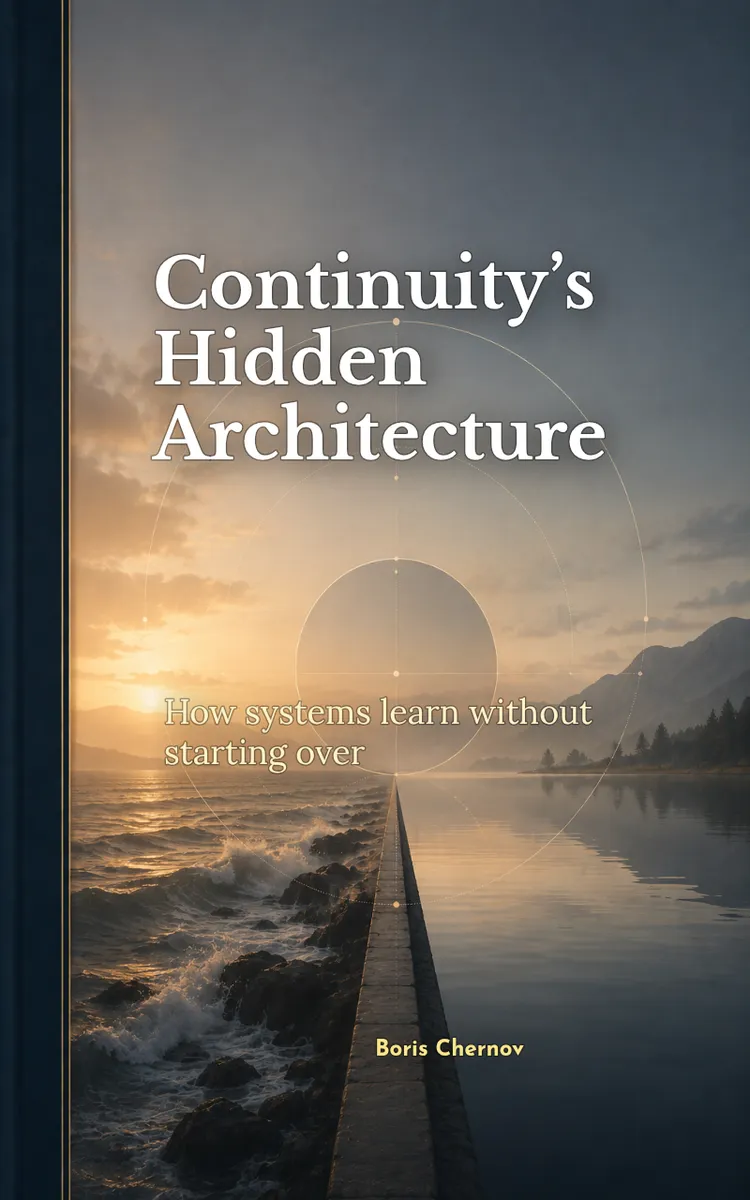
"Continuity’s Hidden Architecture" is a curiosity book by Boris Chernov with 8 chapters and approximately 13,957 words. Continuity in organizations and societies through accumulated learning pathways.
This book was created using Inkfluence AI, an AI-powered book generation platform that helps authors write, design, and publish complete books.
Frequently Asked Questions
What is "Continuity’s Hidden Architecture" about?
Continuity in organizations and societies through accumulated learning pathways
How many chapters are in "Continuity’s Hidden Architecture"?
The book contains 8 chapters and approximately 13,957 words. Topics covered include “Everything Will Change” as a Signal, When Starting Over Looks Like Progress, Inherit Pathways, Not People, Five Generations, One Growing Structure, and more.
Who wrote "Continuity’s Hidden Architecture"?
This book was written by Boris Chernov and created using Inkfluence AI, an AI book generation platform that helps authors write, design, and publish books.
Write your own curiosity book with AI
Describe your idea and Inkfluence writes the whole thing. Free to start.
Start writingCreated with Inkfluence AI


