
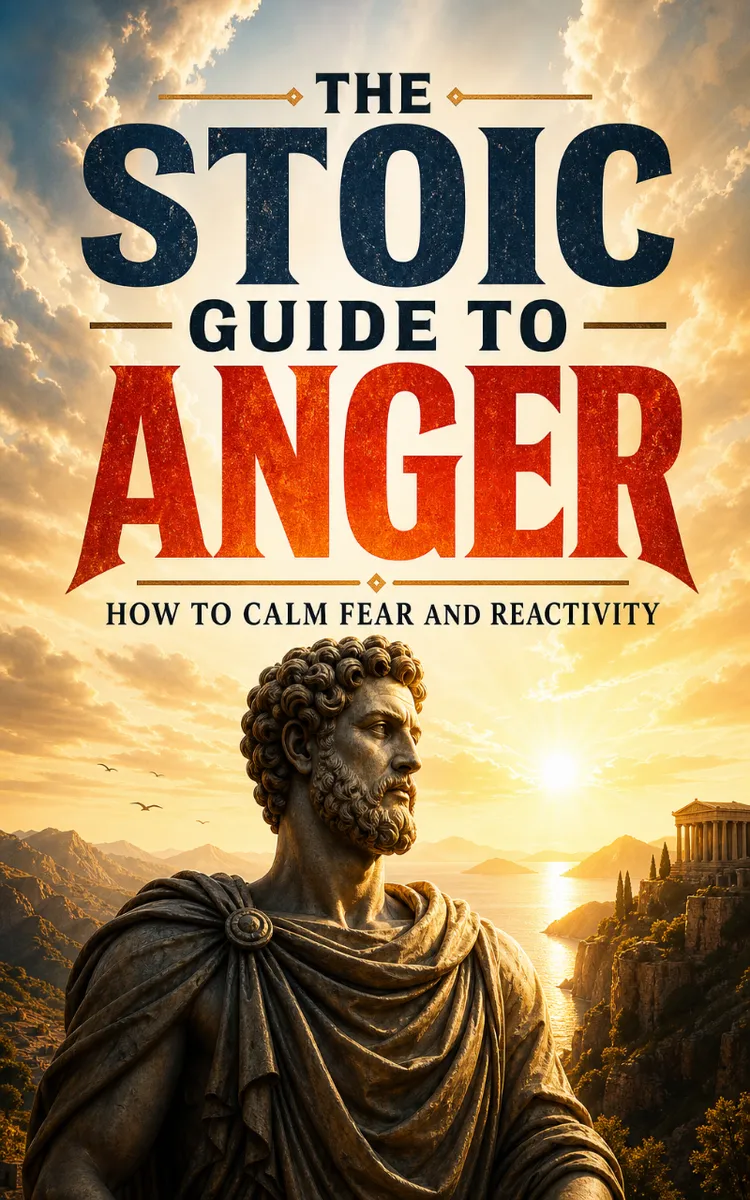
The Stoic Guide To Anger
Created with Inkfluence AI
Stoic-based strategies to manage anger and anxiety
Table of Contents
- 1. Anger as a Stress Alarm
- 2. The Stoic Control Split
- 3. Your Triggers Are Predictions
- 4. Stop Treating Thoughts as Orders
- 5. Build a Calm Identity
- 6. Reframe Frustration as Training
- 7. The Virtue-First Decision Rule
- 8. Name the Emotion Without Feeding It
- 9. Use the Stoic Pause Protocol
- 10. Breathing That Lowers the Alarm
- 11. Pre-Commit to Kind Boundaries
- 12. Speak With the Temperance Tone
- 13. The ‘What Would I Do?’ Rehearsal
- 14. Practice Negative Visualization for Calm
- 15. Turn Rumination Into Action Steps
- 16. The ‘If-Then’ Reactivity Plan
- 17. Repair After a Blow-Up Fast
- 18. Build Resilience With Daily Review
- 19. Handle Uncertainty Without Rage
- 20. Live on Purpose, Not Reactivity
Preview: Anger as a Stress Alarm
A short excerpt from “Anger as a Stress Alarm”. The full book contains 20 chapters and 29,534 words.
Picture This
Darius, 34, warehouse supervisor, knows the sound of “almost trouble.” It’s not an alarm bell. It’s the shift in people’s voices when the line gets behind-forklifts moving slower, radios crackling, someone saying, “We’re gonna have to redo that.” He’s carrying the whole floor in his head, and then-boom-one small mistake hits. A wrong label. A missed pick. A customer call that comes in hot.
His body reacts before his mind catches up. Heat rises. His chest tightens. Words show up like they’re on autopilot: How hard is it to just do it right? The feeling is anger, but the fuel underneath it is stress and anxiety-fear that everything is slipping, fear that he’ll be blamed, fear that he won’t be able to hold the line steady.
After it happens, he can’t even enjoy the moment being “over.” He replays it, edits it, adds new blame, and then the anger feels justified all over again-like it earned the right to stay.
If your anger is really an alarm, why are you treating it like the enemy?
The Mindset Shift
Old Belief: Anger is telling me who’s wrong, so I should argue back, correct harder, or punish the cause.
New Reality: Anger is a stress alarm. It’s telling me my system is overloaded-my job is to read the alarm, not worship the story.
That shift sounds simple, but it changes what you do in the first 10 seconds after the feeling hits. Old belief says: Find the person (or the situation) to blame. New reality says: Find the signal in my body and mind. Same anger. Different mission.
Here’s why it matters: anxiety doesn’t just make you worry-it makes your brain search for threat. When threat shows up, your mind throws a story on top: They didn’t care. They’re incompetent. I’m going to look bad. That story feels convincing because it’s built from relief-seeking instincts. If you blame something fast, you think you’ll regain control. But blaming usually doesn’t calm the alarm. It keeps the threat feeling alive, and then you’re arguing while your nervous system is still revving.
Let’s go back to Darius. When the wrong label happened, his anger didn’t just react to the label. It reacted to the “what this could mean” part-late shipments, complaints, his reputation, that sinking feeling of losing control. If he treated anger as the enemy, he’d go straight into correction mode with a sharp tone. People would tighten up. The line would slow more. Mistakes would multiply. And now the original fear would “prove itself.”
If he treats anger as a signal, he does something different: he still addresses the label, but he separates the alarm from the blame. He might pause long enough to breathe once, say something like, “We missed a step-let’s fix it and keep it from happening again,” and then move with calmer precision. The correction still happens. The reactivity doesn’t hijack the room.
The Mindset Shift isn’t about being nicer. It’s about being readable-to yourself first-so your actions match what actually needs to happen.
Going Deeper
Anger is often the loudest emotion in the room, but it’s not always the original one. In stress and anxiety, anger commonly shows up like a smoke alarm with a personal voice attached: it sounds urgent, it demands attention, and it tries to recruit you into a fight. The “Alarm-to-Insight Map” starts with this: anger is the alarm; the insight is what your system is trying to protect.
So what’s the alarm protecting? Usually something like stability, safety, fairness, or competence. Your mind senses risk-maybe you’ll be blamed, maybe you’ll fall behind, maybe the day will spiral. Anger becomes the energy that says, “Do something now.” The mistake is believing the story that anger hands you. The story is often a guess made under pressure. It’s not always wrong, but it’s rarely complete.
When you separate the feeling (alarm) from the story (blame), you create space. That space is where you can choose. Without it, your nervous system chooses for you.
Signs this pattern is running your life
1. You feel instantly sure about what someone “meant,” even when you don’t have all the facts. The anger arrives before the evidence.
2. You replay and polish the blame after the moment is over. You’re not just responding-you’re building a case.
3. Your correction turns into a tone problem. Even when you’re technically right, the delivery escalates things.
4. You get stuck in “fixing the people,” instead of fixing the process. The energy goes toward punishment, not prevention.
En résumé: Anger is the alarm; blame is the story your anxious brain writes while it’s trying to feel safe.
Now, how do you actually separate them in real life? You don’t start by “thinking positive.” You start by naming the two parts clearly:
- Alarm (feeling): “I’m flooded and activated.”
- Story (blame): “They’re careless / I’m going to fail / this means I’m not in control.”
Once you can label both, you can test the story gently....
About this book
"The Stoic Guide To Anger" is a self-help book by Socratic Mastery with 20 chapters and approximately 29,534 words. Stoic-based strategies to manage anger and anxiety.
This book was created using Inkfluence AI, an AI-powered book generation platform that helps authors write, design, and publish complete books. It was made with the AI Self-Help Book Writer.
Frequently Asked Questions
What is "The Stoic Guide To Anger" about?
Stoic-based strategies to manage anger and anxiety
How many chapters are in "The Stoic Guide To Anger"?
The book contains 20 chapters and approximately 29,534 words. Topics covered include Anger as a Stress Alarm, The Stoic Control Split, Your Triggers Are Predictions, Stop Treating Thoughts as Orders, and more.
Who wrote "The Stoic Guide To Anger"?
This book was written by Socratic Mastery and created using Inkfluence AI, an AI book generation platform that helps authors write, design, and publish books.
How can I create a similar self-help book?
You can create your own self-help book using Inkfluence AI. Describe your idea, choose your style, and the AI writes the full book for you. It's free to start.
Write your own self-help book with AI
Describe your idea and Inkfluence writes the whole thing. Free to start.
Start writingCreated with Inkfluence AI


