
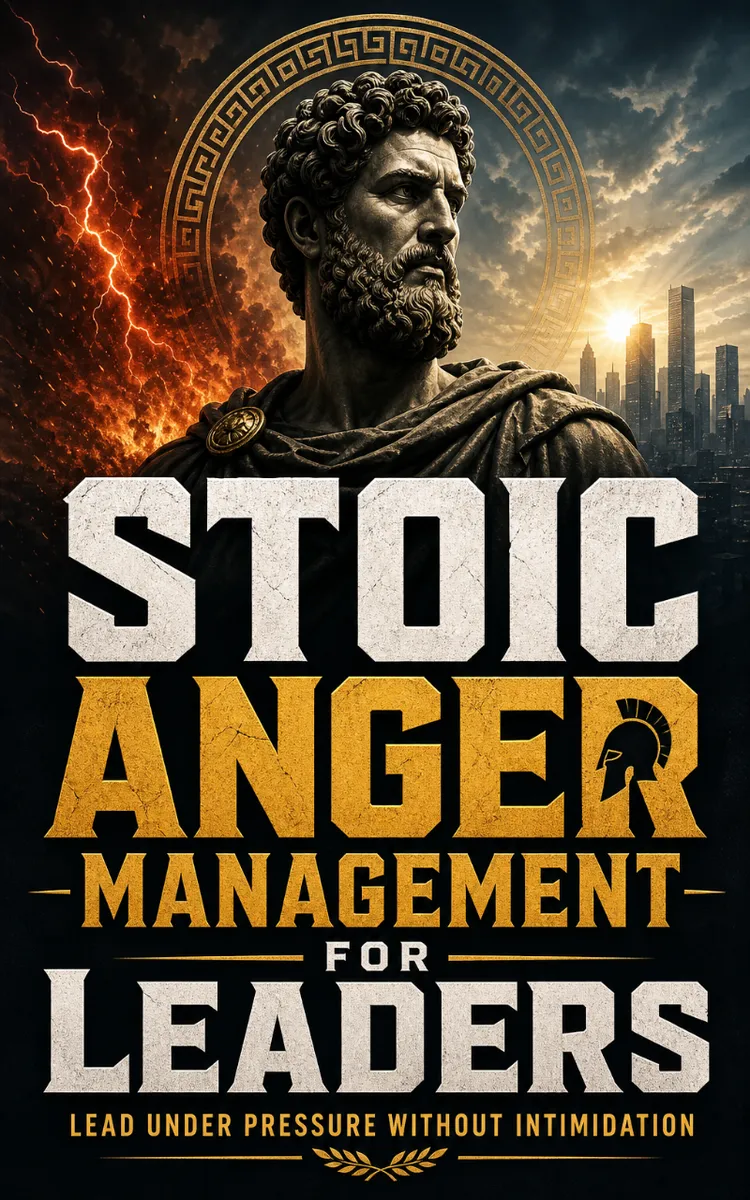
Stoic Anger Management For Leaders
Created with Inkfluence AI
Stoic-based anger management strategies for leaders under pressure
Table of Contents
- 1. Defining Leader Anger Triggers
- 2. Stoic View of Anger as Signal
- 3. The Control Circle for Leaders
- 4. Pause Before You Speak: The 3-Beat
- 5. Name the Emotion Without Feeding It
- 6. Separate Judgment from Event
- 7. Virtue-Based Intentions for Meetings
- 8. The Rational Response Script
- 9. Handling Disrespect Without Retaliation
- 10. Ego Injury and the Stoic Detach
- 11. Pre-Conflict Rehearsal for Calm
- 12. Breathing and Body Signals Under Stress
- 13. Interrupting Escalation in Real Time
- 14. Asking Better Questions When Angry
- 15. Accountability Without Humiliation
- 16. Repairing After a Reactive Moment
- 17. Weekly Stoic Review for Leaders
- 18. Journaling: The Negative Visualization Tool
- 19. Culture Systems That Prevent Intimidation
- 20. Sustaining Temperance Under Ongoing Pressure
Preview: Defining Leader Anger Triggers
A short excerpt from “Defining Leader Anger Triggers”. The full book contains 20 chapters and 34,674 words.
Have you ever noticed that your anger doesn’t start with “the problem”? It starts with a moment-often a sentence, a tone, a delay, a rule you think someone broke. The fastest way to lead calmly under pressure is to stop treating anger like a mood and start treating it like a signal with a pattern. Your Trigger Map Protocol does that.
Leaders don’t get angry because they’re “bad people.” They get angry because a specific trigger hits a specific belief in a specific moment, and your body and behavior take over. When you can name that trigger precisely, you gain a choice: you can respond with your leadership, not your reflex. In this chapter, you’ll learn what anger looks like in real leadership behavior, what it tends to cost you, and how to map your personal trigger patterns so you manage them before they manage you.
Why This Matters
In leadership, anger usually shows up as behavior before it shows up as words. You may raise your voice, cut people off, “correct” them in public, send a sharp message you regret later, or freeze and go silent. Those actions might feel justified in the moment, but they change how your team reads your intentions. Even when your facts are right, your delivery can make people shut down, guess, or defend themselves. That’s the hidden problem: anger doesn’t just express frustration-it changes the working relationship.
This matters because pressure creates more opportunities for triggers. A late supplier, a missed handoff, a customer complaint, a coworker who breaks a process-these events happen. Your job is not to eliminate events. Your job is to keep your reactions from turning ordinary friction into intimidation or ego battles. When you can clarify what anger means for you, you can spot it early and choose a different response.
After this chapter, you’ll be able to do three practical things: define anger in observable leadership behaviors, estimate the real cost of your anger patterns in your own work (not someone else’s), and build a basic Trigger Map Protocol for your likely triggers. You’ll end with a clearer sense of what sets you off-and what to do in the first moments, before you speak.
How It Works
Anger, in leadership, is not one emotion. It’s a cluster of fast signals: what your body does, what your mind decides, and what your behavior communicates. A useful definition for this book is: leader anger is the moment your response stops being helpful and starts becoming forceful, dismissive, or punitive. You can detect it by behavior, not by feelings alone.
Ask yourself a simple comprehension check: When I’m “angry,” what do I actually do? For many leaders, it looks like one or more of these: you shorten your answers, you talk over someone, you demand immediate compliance, you “stack” problems to prove a point, you make sarcastic comments, or you withhold clarity until the other person “learns.” None of that requires you to shout. The tone can be calm and still intimidating.
Now you’ll map the trigger pattern behind those behaviors. The Trigger Map Protocol works because it gives you a repeatable way to connect an event to your internal story and then to your outward reaction. Use it the next time you feel the heat rise.
1. Write the exact behavior you did (not the feeling).
Example: “I snapped and told Leila’s team, ‘This is unacceptable-do it right the first time.’” Keep it factual and specific. Expected outcome: you turn a vague state into something you can change.
2. Name the triggering event in one sentence.
Example: “A job ticket came in with missing measurements, and I found it after three hours.” Expected outcome: you separate “the situation” from “your interpretation.”
3. Capture the belief you jumped to (the story).
Example belief: “They don’t respect my time,” or “If they can’t follow process, we’ll keep losing.” Expected outcome: you locate the moment anger becomes personal.
4. Mark the first body signal you noticed.
Example: “My jaw tightened and I started talking faster within 30 seconds.” Expected outcome: you identify an early warning you can act on.
5. Predict the leadership cost if you repeat the pattern.
Example costs: people stop reporting issues early, you get more workarounds, mistakes repeat because nobody wants to “bring bad news.” Expected outcome: you stop treating anger as harmless self-expression.
Leila, 34, operations manager, tends to get “sharp” when her team shows a process break she already explained. In her case, the triggering event wasn’t “criticism” or “disrespect” as a vague feeling. It was a very specific moment: a checklist step was skipped, and she discovered it during a rush. Her first body signal was fast speech and a tighter jaw. Her belief jumped to: “They think they can get away with it.” Her outward behavior became a public correction with a tone that felt efficient-but landed like punishment....
About this book
"Stoic Anger Management For Leaders" is a how-to guide book by Socratic Mastery with 20 chapters and approximately 34,674 words. Stoic-based anger management strategies for leaders under pressure.
This book was created using Inkfluence AI, an AI-powered book generation platform that helps authors write, design, and publish complete books. It was made with the AI Ebook Generator.
Frequently Asked Questions
What is "Stoic Anger Management For Leaders" about?
Stoic-based anger management strategies for leaders under pressure
How many chapters are in "Stoic Anger Management For Leaders"?
The book contains 20 chapters and approximately 34,674 words. Topics covered include Defining Leader Anger Triggers, Stoic View of Anger as Signal, The Control Circle for Leaders, Pause Before You Speak: The 3-Beat, and more.
Who wrote "Stoic Anger Management For Leaders"?
This book was written by Socratic Mastery and created using Inkfluence AI, an AI book generation platform that helps authors write, design, and publish books.
How can I create a similar how-to guide book?
You can create your own how-to guide book using Inkfluence AI. Describe your idea, choose your style, and the AI writes the full book for you. It's free to start.
Write your own how-to guide book with AI
Describe your idea and Inkfluence writes the whole thing. Free to start.
Start writingCreated with Inkfluence AI


