

Read the first chapter
The whole of chapter one, free. About 8 min. Turn the pages with the arrows, your keyboard, or a swipe.
Chapter 1
The Tuesday the Sky Snapped
At 3:47 p.m. on Tuesday, Margaret Oduya’s dead phone displayed the wrong time.
It showed 3:46, then vanished into a black mirror.
“Perfect,” Margaret said. “The one device with a clock chooses retirement before I do.”
The Red Line rattled beneath Chicago, packed with damp coats, grocery bags, and people pretending not to notice one another. Margaret gripped the pole with one hand and her leather handbag with the other. Inside the bag sat a library book, two peppermints, and a letter she had not yet answered.
She wanted one thing before the day ended: reach her sister’s apartment in Bronzeville and collect the spare key.
That was all. No heroics. No surprises. No additional responsibilities.
The train screamed around a bend. Fluorescent lights flickered overhead. A child pressed both palms against the window, watching tunnels blur into black glass.
Then the darkness outside turned purple.
Not violet. Not neon. Purple with a sharp, screaming edge, as if the sky had been dragged across a live wire.
The train lurched.
Passengers slammed into one another. Margaret’s handbag flew open, scattering peppermints across the floor.
“What was that?” someone shouted.
The brakes shrieked. A metal panel popped loose above the doors. Dust rained down. Margaret caught the nearest seat before her knees gave way.
Another sound rolled through the tunnel.
It began as a wet groan. Then it climbed, twisted, and broke into laughter filtered through a garbage disposal.
The child at the window started crying.
Margaret looked up. Through the glass, beyond the tunnel wall that had somehow become transparent, something moved against the purple sky.
It had too many limbs and not enough face.
One arm - or what passed for one - dragged across the train’s roof. The metal buckled inward with a thunderous crunch.
“Everybody down!” the conductor yelled.
Margaret shoved the crying child beneath a seat. A woman beside her froze, one hand over her mouth.
“Move,” Margaret snapped. “Unless you’ve always wanted to become ceiling decoration.”
That got the woman moving.
The roof split.
Purple light poured through the opening, hot enough to sting Margaret’s cheeks. Wind exploded into the carriage. Papers, scarves, and one unfortunate wig shot upward.
The creature leaned over the train.
Its limbs unfolded in every direction, jointed like broken umbrellas. Where a face should have been, there was a pale, shifting hollow. The hollow widened.
The garbage-disposal laughter returned.
Margaret seized the emergency hammer.
She had spent forty-two years being told not to touch emergency equipment unless absolutely necessary. This qualified.
She smashed the glass.
The hammer struck once. The window cracked.
Again. The glass burst inward.
Cold air tore through the carriage. Margaret grabbed the metal frame and swung herself toward the opening.
“Ma’am!” the conductor yelled. “What are you doing?”
“Improving my options!”
She climbed onto the side platform as the train shuddered beneath her shoes. The creature’s nearest limb snapped down. Margaret ducked. It struck the roof, crushing three seats and sending sparks across the carriage.
The child’s mother screamed.
Margaret reached back through the broken window. “Give me the boy!”
The mother pushed him forward.
Margaret caught his coat and hauled him onto the platform. His sneakers scraped against the metal.
“Hold tight,” she said.
“To what?”
“Me. Obviously.”
A second limb curled around the rear carriage. The train groaned. Somewhere below, wheels left the track.
Margaret wrapped one arm around the boy and seized a ladder with the other. She climbed toward the surface while the city came apart above them.
Chicago had become a storm of impossible color.
The streets buckled around stopped cars. Windows flashed purple. Sirens rose from every direction, overlapping until they sounded like one enormous, panicked animal.
People poured from buildings. Some ran. Some filmed. One man stood in the middle of State Street, calmly holding a sandwich while reality tore open above him.
Margaret reached the pavement and shoved the boy toward a police officer.
“Get him somewhere enclosed,” she said.
The officer stared at the rift. “What is that?”
“An inconvenience,” Margaret said. “A very large one.”
The creature climbed through the opening.
Its limbs scraped against the edges of the world. Each movement bent the buildings around it. Glass burst from upper floors. Traffic lights swung on their cables, blinking red through the purple glare.
The officer grabbed Margaret’s sleeve. “You need to evacuate.”
“I need to get to Bronzeville.”
“Ma’am, the city is under attack.”
“I heard you the first time.”
A shockwave rolled down the street. Margaret hit the pavement hard. Her shoulder struck concrete. The leather bag landed beside her, open and empty except for the library book.
The letter was gone.
For one stunned second, she watched it tumble through the purple light.
Then a bus lifted off the street.
Margaret crawled behind a newspaper box as the bus spun overhead. It crashed through a storefront, showering the sidewalk with glass.
The officer crouched beside her. “We have to move now!”
Margaret looked toward the south. Smoke climbed between the buildings. The Red Line entrance had collapsed behind them.
Her sister’s key remained across town.
So did the letter.
Margaret pushed herself upright. Her shoulder burned. Her knees trembled, but they worked.
“Fine,” she said. “We move.”
• * *
Six hours later, beneath the Swiss Alps, the emergency bunker lost contact with Chicago for eleven seconds.
Eleven seconds became seventeen.
A wall of screens displayed cities across the globe. Chicago flickered in purple static. London showed a widening black fracture above the Thames. Tokyo’s image had frozen on a tower bending sideways. São Paulo appeared through smoke and rain.
The director of the International Crisis Council stood at the center table, pale beneath the bunker’s white lights.
“Confirm the sequence,” she said.
An analyst swallowed. “Chicago first. Seventeen forty-seven UTC. London followed by twenty-three minutes. Tokyo after that. São Paulo nine minutes later.”
“Military response?”
“Chicago airspace is unusable. Two aircraft lost control near the rift. Conventional munitions had no measurable effect.”
“London?”
“Same result.”
The director turned to the weapons coordinator. “What does ‘no measurable effect’ mean?”
“It means the missiles exploded,” he said. “The rift did not care.”
Nobody spoke.
Behind them, a steel door opened. General Elias Varga entered with a tablet under one arm. He had spent the last hour arguing with commanders on three continents. His tie hung loose. His expression suggested he had personally lost patience with gravity.
“Close the launch channels,” Varga said.
The weapons coordinator stared at him. “We can still deploy - ”
“Close them.”
“We have civilians trapped in the affected zones.”
“And your answer is to throw more metal at a hole that eats physics?”
“It is the answer we have.”
Varga slapped the tablet onto the table. Footage filled the nearest screen. A missile struck the edge of the Chicago rift and vanished. The explosion followed three seconds later, reversed, and folded into itself.
The room watched in silence.
The director’s voice dropped. “What are we looking at?”
“A problem outside the military model,” Varga said. “Outside the scientific model, too.”
An analyst brought up a red file. Its title appeared in stark letters.
PROJECT PHOENIX.
The director frowned. “That program was shelved.”
“It was delayed,” Varga said.
“It was unethical.”
“So is allowing four cities to become laboratories for whatever is coming through those openings.”
The screens flickered again. Chicago returned.
The image showed a street cratered by impact. Emergency crews moved through purple haze. A woman in a dark coat stood beside an overturned bus, shouting at a line of soldiers.
Even through the bunker’s speakers, her voice carried.
“You cannot seal a dimensional rupture with sandbags!”
A soldier answered, “Ma’am, please step behind the barrier.”
“I am behind the barrier. Your barrier is useless.”
The director leaned toward the screen. “Who is she?”
An analyst enlarged the image. Margaret Oduya’s face sharpened through the interference.
“Retired municipal systems auditor,” he said. “Sixty-eight. No military background.”
“Why is she in the restricted zone?”
“She says she was helping civilians.”
Varga watched Margaret point at the soldiers, then at the rift, then at a fallen emergency vehicle.
“Listen to her,” he said.
The director turned. “To what?”
“She’s not panicking.”
On the screen, a soldier tried to guide Margaret away. She pulled free and jabbed one finger toward the sky.
“Your machines cannot reach it,” she shouted. “Stop sending machines!”
Her fury cut through the bunker’s polished quiet.
The director looked at the Phoenix file again. “You think she can help?”
“I think she understands failure.”
“That is not a qualification.”
“It may be the only one we have.”
The director opened the file. Photographs appeared. Candidates. Assessments. Medical reports. Psychological flags.
At the bottom sat a line stamped in black:
A new kind of soldier.
She read it twice.
Then the bunker shook.
Dust sifted from the ceiling. Every screen went dark except Chicago.
The rift above the city widened.
For a moment, something pressed against its purple surface from the other side. Not a limb. Not a face. Something broader, heavier, and patient.
The lights returned.
A secure phone rang on the table.
The director answered. “Yes?”
A clipped voice spoke from Washington. Another joined from London. Then Tokyo. São Paulo followed, breathless and furious.
The old answers had failed. Nobody needed a report to explain that.
The director closed her eyes, then opened the Phoenix file.
“Bring me Oduya’s full record,” she said.
The analyst hesitated. “Her record?”
“Everything. Employment, medical history, complaints, disciplinary notes.”
Varga almost smiled. “There will be complaints.”
“There already are.”
He looked at Margaret’s frozen image. She stood beneath a broken street sign, coat torn, shoulder bruised, still arguing with the soldiers.
The director picked up the secure phone again.
“Find her,” she said. “Offer her a position.”
“What position?” the Washington voice asked.
The director watched the purple sky pulse above Chicago.
“Something with a uniform,” she said. “Something with access to the impossible.”
Across the ruined street, Margaret found the letter caught beneath a tire.
She pulled it free, wiped soot from the envelope, and read the government seal.
Her expression hardened.
“Oh, absolutely not,” she said.
The phone in her pocket rang, though its battery had died hours earlier.
End of chapter one. 5 more chapters in the full book.
Swipe or use the arrows to turn the page


What's inside: 6 chapters
- 1. The Tuesday the Sky Snapped
- 2. Recruitment at Hammer Headquarters
- 3. Old Dogs, New Powers
- 4. Words That Turn Into Weapons
- 5. Los Angeles: Improvisation, Not a Drill
- 6. A Letter, a Laugh, a Second Chance
About this book
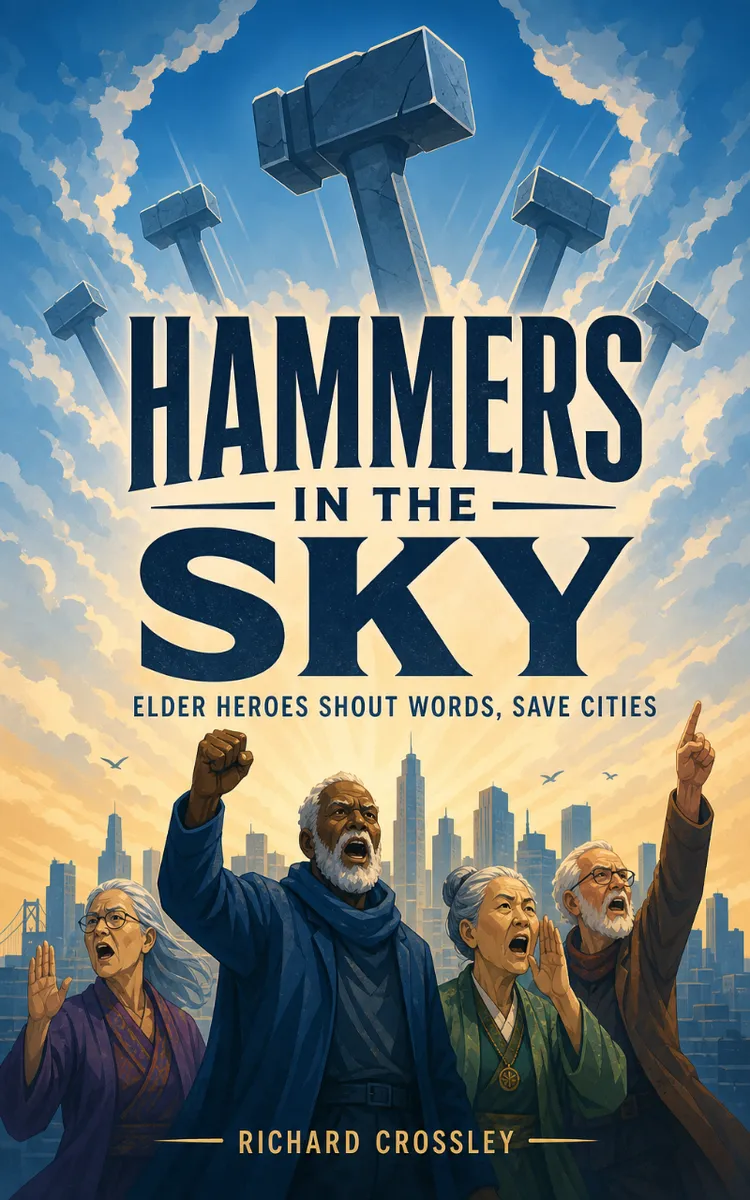
"Hammers in the Sky" is a fiction book by Richard Crossley with 6 chapters and approximately 9,420 words. When rifts tear open reality, a mismatched team of older recruits discovers that surviving the end of the world may require therapy, teamwork, and learning to weaponize dictionaries—literally..
This book was created using Inkfluence AI, an AI-powered book generation platform that helps authors write, design, and publish complete books. It was made with the AI Novel Writer.
Frequently Asked Questions
What is "Hammers in the Sky" about?
When rifts tear open reality, a mismatched team of older recruits discovers that surviving the end of the world may require therapy, teamwork, and learning to weaponize dictionaries—literally.
How many chapters are in "Hammers in the Sky"?
The book contains 6 chapters and approximately 9,420 words. Topics covered include The Tuesday the Sky Snapped, Recruitment at Hammer Headquarters, Old Dogs, New Powers, Words That Turn Into Weapons, and more.
Who wrote "Hammers in the Sky"?
This book was written by Richard Crossley and created using Inkfluence AI, an AI book generation platform that helps authors write, design, and publish books.
How can I create a similar fiction book?
You can create your own fiction book using Inkfluence AI. Describe your idea, choose your style, and the AI writes the full book for you. It's free to start.
Write your own fiction book with AI
Describe your idea and Inkfluence writes the whole thing. Free to start.
Start writingCreated with Inkfluence AI


