

Read the first chapter
The whole of chapter one, free. About 7 min. Turn the pages with the arrows, your keyboard, or a swipe.
Chapter 1
The Warning in the Sunshine
The parking meter at the Orlando Veterans Affairs clinic displayed 3:17 p.m. and charged Clyde McGraw for a day that had already ended.
He slapped the coin return. Nothing happened.
A horn blared behind him. A woman in a sun visor shouted about blocking traffic. Somewhere near the entrance, an automatic door opened, beeped twice, and refused to close.
Clyde checked the envelope in his hand. General Patricia Hartley’s seal showed through the paper.
He wanted one thing: get inside, deliver the envelope, and leave before another machine demanded a fee.
The meter swallowed his second quarter.
“Of course,” Clyde muttered.
The horn blared again.
He turned, raised both hands, and stepped aside. A golf cart rolled past with a flashing amber light. Its driver wore a badge, mirrored sunglasses, and the expression of a man who had lost an argument with a vending machine.
“Clinic parking is for patients,” the driver called.
“I’m a patient.”
“Then park like one.”
Clyde looked at the crooked white lines. Every space leaned toward the building. The nearest one contained a faded plastic flamingo.
He glanced at the envelope. The seal pulsed once beneath the paper.
That settled it.
Clyde left the meter to its tiny kingdom and marched toward the clinic.
Inside, the lobby television showed a weather report. The map glowed red across the peninsula. A cheerful meteorologist pointed at a band of storms shaped like a clenched fist.
“Heat index warnings remain active,” she said. “Residents should avoid unnecessary outdoor activity.”
The lobby’s air conditioner coughed.
Clyde reached the reception desk. A sign announced that the sign-in tablet was temporarily unavailable. Beneath it, another sign instructed visitors to use the tablet.
The receptionist looked up. “Appointment?”
“General Hartley sent me.”
“Do you have an appointment?”
“No.”
“Then you’ll need to sign in.”
“The tablet is down.”
“You’ll need to wait until it comes back.”
Clyde stared at her.
She stared back.
A phone rang behind her. Nobody answered it. The ringing continued until the caller gave up, then started again.
Clyde had managed three theme-park openings during hurricanes. He had evacuated a restaurant after a grease fire, rerouted twenty thousand guests around a burst water main, and once convinced a costumed dragon to stop fighting a trash compactor.
This lobby was worse.
The envelope warmed against his palm.
“Tell Hartley I’m here,” he said.
The receptionist sighed. “General Hartley is not listed.”
“She sent me a letter.”
“Then the letter should say where to go.”
“It says the clinic.”
“That’s not a department.”
A man in a wheelchair rolled up beside Clyde. “Try window four.”
“There are only three windows,” Clyde said.
“Exactly.”
The man pointed toward a hallway. A paper arrow taped to the wall directed visitors toward a locked door.
Clyde followed it.
The door opened before he touched it.
General Patricia Hartley stood beyond the threshold in a gray uniform, one hand gripping a cane. Her silver hair was cut close, and her left eyebrow carried a thin scar.
“You took your time,” she said.
“The parking meter held me hostage.”
“Good. It has begun.”
Clyde stepped inside. The door slammed behind him.
The room looked like a storage closet converted by someone with military authority. Folding chairs lined the walls. A portable fan rattled on a crate. Maps covered a corkboard, all of them marked with red circles across Florida.
Hartley pointed at the envelope. “Open it.”
Clyde broke the seal.
A single photograph slid out.
It showed a man in a white suit standing on a beach beneath a black umbrella. His face was narrow, pale, and delighted. Around him, tourists battled umbrellas, coolers, sunscreen bottles, and one enormous inflatable alligator.
On the back, someone had written a name.
Vexatious.
Clyde read it aloud.
Hartley’s jaw tightened. “Lord of Irritation. Prince of Petty Annoyances.”
“That sounds less threatening than it should.”
“He feeds on frustration.”
The fan coughed and stopped.
Clyde looked at it. “Naturally.”
Hartley tapped the map. “He has chosen Florida as his next battlefield.”
“Why here?”
“Because Florida is already primed for maximum irritation.”
A ceiling tile dropped into one of the empty chairs.
Clyde flinched. Hartley did not.
“Traffic circles,” she continued. “Insurance forms. Condo boards. Toll roads with three different payment systems. Every minor inconvenience becomes fuel.”
“You’re saying he eats complaints?”
“Not complaints. The moment before them. The little spark when a person decides the universe has singled them out.”
Clyde looked through the narrow window. The parking meter flashed ERROR.
“That spark seems plentiful.”
“It is. But Vexatious needs more than scattered irritation. He needs a concentration.”
Hartley removed a metal case from beneath the table. Its locks clicked open.
Inside rested six glass vials filled with blue liquid.
Clyde leaned closer. The serum shimmered as if tiny fish moved inside it.
“What is that?”
“A countermeasure.”
“Looks expensive.”
“It is.”
“Looks dangerous.”
“It is both.”
Hartley lifted one vial. “It only works on individuals over sixty-five.”
Clyde blinked. “That is oddly specific.”
“Florida has the highest concentration of eligible recruits.”
“Eligible for what?”
Hartley’s eyes sharpened. “For surviving Florida operations.”
The portable fan restarted with a shriek. Clyde stepped back.
Hartley closed the case. “We need someone who can organize people under pressure. Someone who understands crowds, breakdowns, weather, panic, and the emotional consequences of a malfunctioning restroom.”
Clyde folded the photograph. “You called the wrong man.”
“I called the retired operations manager who maintained Walt Disney World at ninety-nine point seven percent operational uptime.”
“That number was before smartphones.”
“Exactly. You’re experienced.”
“I managed attractions. I didn’t fight demons.”
“Vexatious is not asking for a sword.”
“What is he asking for?”
“Complaints.”
A loud crash sounded in the hallway.
Someone shouted, “The elevator is going down!”
Hartley rose. The cane struck the floor once.
Clyde moved toward the door. “What happens if the serum fails?”
“We lose the recruits.”
“And if it works?”
“They become resistant to irritation.”
Clyde paused. “That sounds impossible.”
Hartley opened the door. The hallway lights flickered. At the far end, a vending machine dispensed a bag of chips, then kept dispensing bags until the floor disappeared beneath them.
A nurse kicked the machine.
The machine laughed.
Clyde stared.
Hartley said, “It has already started.”
The nurse kicked it again. The vending machine laughed louder. A man waiting beside it began arguing with the ceiling. Another man joined him. Within seconds, three people shouted about the machine, the ceiling, and a chair that squeaked whenever anyone looked at it.
The sound crawled under Clyde’s skin.
He knew that sound.
Not the laughter. The rhythm.
A crowd tipping from inconvenience into disorder.
Clyde stepped into the hall. “Everyone stop.”
Nobody stopped.
The nurse kicked the machine again. The machine spat coins across the floor.
“Stop kicking it,” Clyde barked.
She rounded on him. “It stole my money!”
“It is giving you money.”
“It’s not the right money!”
A man pointed at Clyde. “Who made him supervisor?”
“No one,” Clyde said.
“Then he can’t tell us what to do.”
Clyde scanned the hallway. The vending machine rattled. The elevator doors opened and closed without an elevator behind them. The automatic lights dimmed each time someone complained.
There it was.
A system feeding on reactions.
Clyde grabbed a rolling laundry cart and shoved it beneath the vending machine’s coin slot. Coins clattered into the cart. He pulled the power cord.
The machine kept laughing.
“Fine,” Clyde said. “New plan.”
He climbed onto the cart.
Hartley watched him. “You have a plan?”
“I have a crowd.”
Clyde pointed toward the chips. “Free snacks. Take one bag each. Then move away from the machine.”
A woman in a robe narrowed her eyes. “Who paid for them?”
“No one.”
“Then they’re not free.”
Clyde reached into his pocket and tossed her a quarter. “Now they are.”
She caught it.
The room quieted by one degree.
Clyde pointed at the nearest man. “You. Hold the door open.”
“Why?”
“Because it keeps closing.”
“It’s supposed to close.”
“Not today.”
The man grabbed the door.
Clyde pointed at the nurse. “You. Count the coins.”
“I’m not counting those.”
“Then sort them by size.”
She hesitated, offended by the distinction.
“Let’s go,” Clyde said.
The nurse knelt.
The lights steadied.
The vending machine’s laughter thinned into a wheeze.
Clyde turned toward the crowd. “Nobody kicks anything. Nobody argues with architecture. If a machine misbehaves, we give it a job.”
The woman in the robe held up her chip bag. “What job does it have?”
“Distribution.”
The machine shuddered. One final bag dropped.
Then its display changed.
THANK YOU FOR YOUR PATIENCE.
The hallway went silent.
Hartley approached Clyde through the scattered chips. “You improvised.”
“I managed the problem.”
“You recruited them.”
“I prevented a riot.”
“Same skill.”
Clyde climbed down from the cart. His knees complained. He ignored them.
Hartley held out the metal case.
“Six vials,” she said. “Six recruits. I need a leader.”
Clyde looked at the blue serum. Beyond the hallway window, the Florida sun blazed over the parking lot. The meter flashed ERROR again, as if celebrating.
“Who are the other five?”
“People who have survived Florida long enough to become dangerous.”
“That’s not a qualification.”
“It’s the only one we have.”
A low tremor moved through the building.
The vending machine display flickered.
THANK YOU FOR YOUR PATIENCE changed to THANK YOU FOR YOUR ANGER.
The lights went red.
Somewhere outside, every car alarm in the parking lot began screaming at once.
Hartley closed her hand around Clyde’s wrist.
“Florida operations begin now.”
Clyde looked at the alarms, the chips, and the six blue vials.
Then he picked up the case.
“Fine,” he said. “But I’m fixing the parking system first.”
End of chapter one. 6 more chapters in the full book.
Swipe or use the arrows to turn the page


What's inside: 7 chapters
- 1. The Warning in the Sunshine
- 2. Cinnabon Bones and Liability Waivers
- 3. Awakenings, Accidents, and Orlando
- 4. Paper Cuts Versus Satisfaction
- 5. The Florida Man Conspiracy
- 6. Believing the Swamp Away
- 7. A Team That Saves Without Grim
About this book
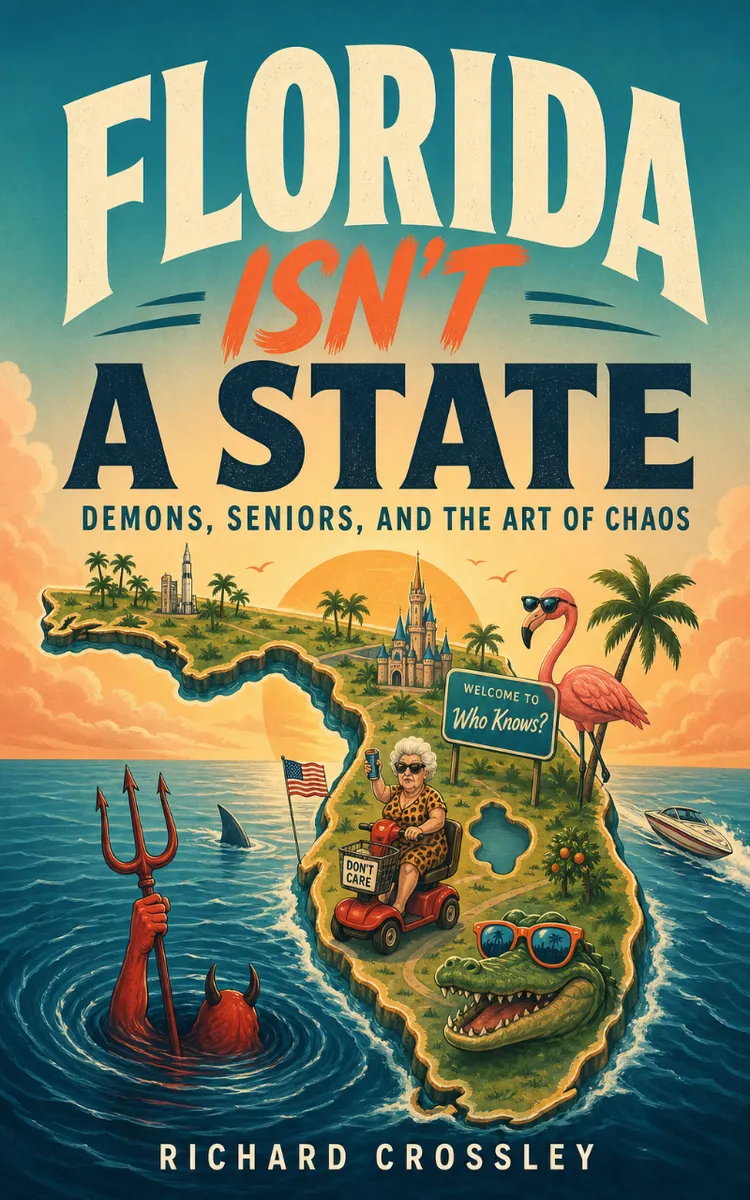
"Florida Isn’t a State" is a fiction book by Richard Crossley with 7 chapters and approximately 12,077 words. A retired operations manager and a mismatched team of Florida seniors discover that demons feed on petty annoyances—and that the only way to beat them is to turn frustration into satisfaction..
This book was created using Inkfluence AI, an AI-powered book generation platform that helps authors write, design, and publish complete books. It was made with the AI Novel Writer.
Frequently Asked Questions
What is "Florida Isn’t a State" about?
A retired operations manager and a mismatched team of Florida seniors discover that demons feed on petty annoyances—and that the only way to beat them is to turn frustration into satisfaction.
How many chapters are in "Florida Isn’t a State"?
The book contains 7 chapters and approximately 12,077 words. Topics covered include The Warning in the Sunshine, Cinnabon Bones and Liability Waivers, Awakenings, Accidents, and Orlando, Paper Cuts Versus Satisfaction, and more.
Who wrote "Florida Isn’t a State"?
This book was written by Richard Crossley and created using Inkfluence AI, an AI book generation platform that helps authors write, design, and publish books.
How can I create a similar fiction book?
You can create your own fiction book using Inkfluence AI. Describe your idea, choose your style, and the AI writes the full book for you. It's free to start.
Write your own fiction book with AI
Describe your idea and Inkfluence writes the whole thing. Free to start.
Start writingCreated with Inkfluence AI


