
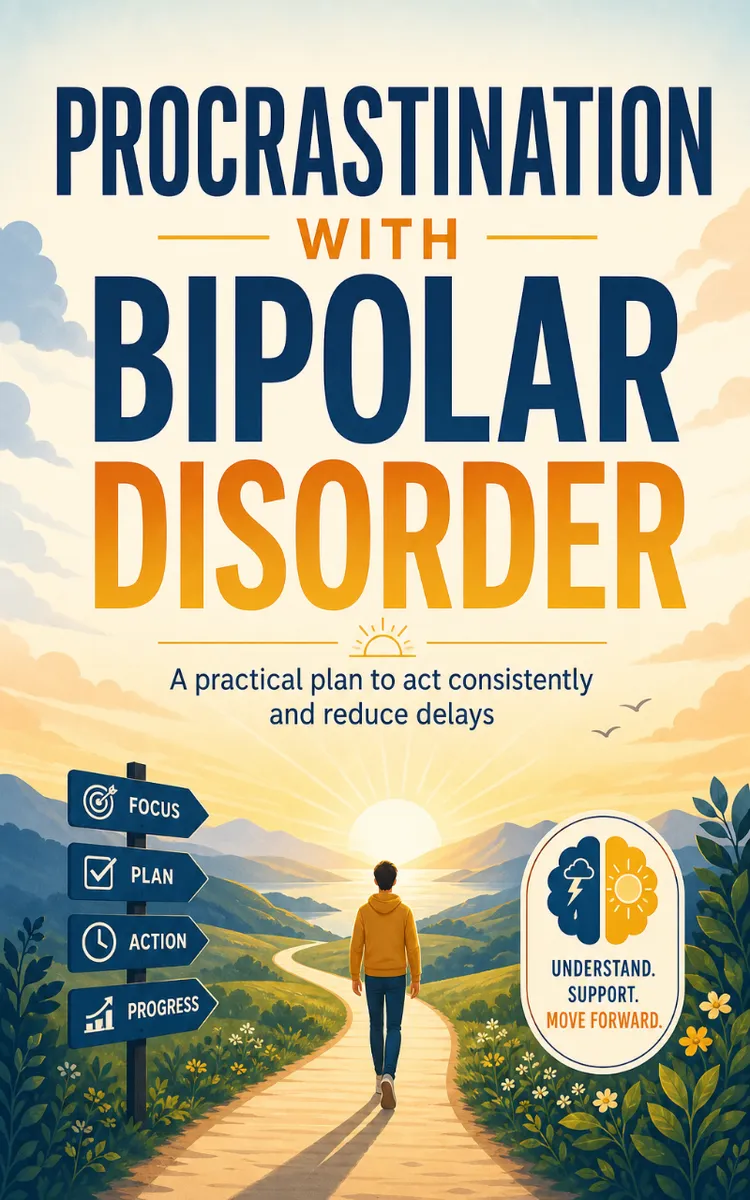
Procrastination With Bipolar Disorder
Created with Inkfluence AI
Strategies to overcome procrastination for people with bipolar disorder
Table of Contents
- 1. Rebuilding Your Bipolar Identity
- 2. Mapping Mood to Procrastination Triggers
- 3. Using the 2-Minute Start Rule
- 4. Breaking Perfectionism Without Losing Quality
- 5. Designing Mood-Smart Daily Routines
- 6. Creating a Task List That Actually Moves
- 7. Scheduling With the Time-Box Reset
- 8. Asking for Support Without Shame
- 9. Handling Setbacks With the Relapse-Proof Plan
- 10. Building Purpose-Driven Momentum Long-Term
Preview: Rebuilding Your Bipolar Identity
A short excerpt from “Rebuilding Your Bipolar Identity”. The full book contains 10 chapters and 15,146 words.
When “I’m Broken” Becomes the First Task
Tanya, 34, stood outside the nurse manager’s office with a report open on her phone and three overdue emails waiting. She’d handled a chaotic shift the night before. She’d answered questions, solved staffing problems, and kept her voice steady when everyone else was running hot. Now, with one quiet hour to finish paperwork, she couldn’t begin.
Her mind offered a familiar explanation: I’m broken. Other people can just do things. I always fall apart when my mood changes. The report stayed untouched. Shame grew louder. By evening, the unfinished work seemed like proof - not of a difficult mood or a hard starting point, but of a defective identity.
That story can make procrastination feel permanent. If “broken” is who you are, why try again? The Identity-First Reset starts somewhere kinder and more useful: separating your identity from what your mood is doing today.
The Question Beneath the Procrastination
What if the problem isn’t that you’re broken, but that you’ve been asking a changing mood to prove a permanent identity?
Bipolar disorder can affect your energy, focus, confidence, sleep, and sense of time. Those shifts are real. They can make a simple task feel enormous on one day and strangely easy on another. But a mood state is not a full description of you. It’s information about your current conditions.
Tanya used to treat every delayed task as a character verdict. During a low period, she’d look at the report and think, I’m unreliable. During an elevated period, she might start five improvements at once and assume her new energy would last forever. When it didn’t, the crash became more evidence against herself. Her identity changed with the mood.
The before-and-after wasn’t dramatic. She didn’t suddenly become perfectly consistent. Instead, she changed the sentence. Before: “I’m a broken nurse manager who can’t follow through.” After: “I’m a capable nurse manager in a low-energy state, and I need a smaller start.” That second sentence didn’t erase the report. It made opening the document possible.
A stable identity doesn’t mean pretending every day feels the same. It means choosing a description of yourself that remains true across mood shifts: I’m a person who can take one honest next step. I’m someone who adjusts without abandoning myself. That identity gives you somewhere to stand when motivation moves around.
How the Broken Story Creates Delay
The pattern often works like this:
1. When you notice a task during a low or unsettled mood, the task feels bigger than its actual size. The unread email becomes “everything I’ve failed to handle.”
2. You feel shame, fear, or distrust of yourself. Your body may tighten. Your attention may scatter. Starting now feels like stepping into proof that you’ll fail.
3. So you avoid the task or wait for a better mood. You check messages, reorganize supplies, scroll, nap, or make a detailed plan you don’t use.
4. Which leads to more unfinished work and stronger evidence for the broken identity. The next task arrives carrying yesterday’s shame, so starting becomes even harder.
The Identity-First Reset changes the chain:
1. When you notice a task during a mood shift, you name the condition without turning it into a verdict: “My energy is low, and this task needs a smaller entry point.”
2. You feel some self-respect alongside the discomfort. The task may still be unpleasant, but it no longer has to decide who you are.
3. So you choose an identity-based start. You open the report, write the heading, or set a five-minute timer because that’s what a person who supports their future self can do today.
4. Which creates evidence for a steadier identity. You learn, through action, “My mood can change, and I can still begin in an adjusted way.”
The goal isn’t to force yourself through every task. It’s to stop making your worth depend on perfect performance.
Your mood may shift, but your next honest step can still belong to you.
Check Your Identity Before You Check the Task
Use these prompts when you catch yourself delaying because “this is just who I am.” Rate each from 1 to 10, or answer yes or no. Don’t aim for impressive answers. Accurate answers are more useful.
1. How strongly do I believe, right now, that procrastination proves I’m broken?
A low score may mean you can see the task clearly. A high score suggests the identity story is adding pain and size to the task.
2. How often do I describe a mood state as a permanent trait?
For example: “I’m lazy,” instead of “My energy is low today.” A low score shows some separation between state and identity. A high score means your language may be turning temporary conditions into permanent labels.
3. Can I name one thing I’ve handled well while my mood was difficult?
Yes may show that your memory still includes evidence of capability....
About this book
"Procrastination With Bipolar Disorder" is a self-help book by Anonymous with 10 chapters and approximately 15,146 words. Strategies to overcome procrastination for people with bipolar disorder.
This book was created using Inkfluence AI, an AI-powered book generation platform that helps authors write, design, and publish complete books. It was made with the AI Self-Help Book Writer.
Frequently Asked Questions
What is "Procrastination With Bipolar Disorder" about?
Strategies to overcome procrastination for people with bipolar disorder
How many chapters are in "Procrastination With Bipolar Disorder"?
The book contains 10 chapters and approximately 15,146 words. Topics covered include Rebuilding Your Bipolar Identity, Mapping Mood to Procrastination Triggers, Using the 2-Minute Start Rule, Breaking Perfectionism Without Losing Quality, and more.
Who wrote "Procrastination With Bipolar Disorder"?
This book was written by Anonymous and created using Inkfluence AI, an AI book generation platform that helps authors write, design, and publish books.
How can I create a similar self-help book?
You can create your own self-help book using Inkfluence AI. Describe your idea, choose your style, and the AI writes the full book for you. It's free to start.
Write your own self-help book with AI
Describe your idea and Inkfluence writes the whole thing. Free to start.
Start writingCreated with Inkfluence AI


