
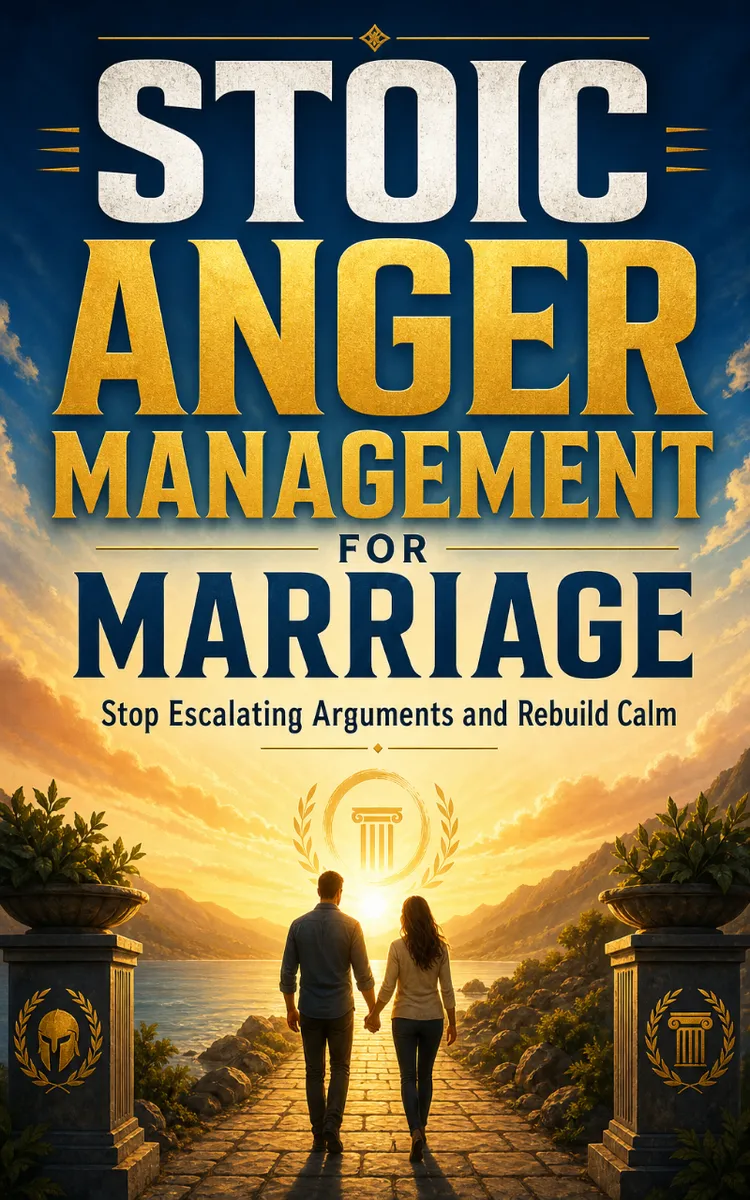
Stoic Anger Management For Marriage
Created with Inkfluence AI
Stoic-based strategies to manage anger in marriage
Table of Contents
- 1. Redefine Anger as Information
- 2. Stop Treating Thoughts as Truth
- 3. Choose Your Virtue in Conflict
- 4. The Calm-First Identity Statement
- 5. Boundaries Without Emotional Attacks
- 6. Name the Trigger Before It Spikes
- 7. The Two-Column Blame Detox
- 8. Practice Stoic Pre-Commitments
- 9. Use the Pause That Prevents Damage
- 10. Speak in Requests, Not Accusations
- 11. The ‘What I Meant’ Clarifier
- 12. Listen for Needs, Not Wins
- 13. Repair Faster With the Stoic Apology
- 14. Stop Escalation Using the Contempt Cut
- 15. Time-Outs That Build Trust
- 16. Turn Repetition Into Pattern Insight
- 17. Handle Disrespect Without Losing Dignity
- 18. Rebuild Calm With Daily Micro-Repairs
- 19. Practice Stoic Journaling After Arguments
- 20. Live the Long Game of Love
Preview: Redefine Anger as Information
A short excerpt from “Redefine Anger as Information”. The full book contains 20 chapters and 28,118 words.
Picture This
“Anger is a fire alarm, not an instruction manual.”
Lena, 34, a hospital nurse, knows this feeling in her bones. One minute she’s back at home, boots by the door, trying to switch off work mode. The next minute her partner says something-nothing dramatic on paper, just a sharp tone or a careless comment-and the heat comes fast. Her chest tightens. Her thoughts start firing: They don’t respect me. They’re doing it again. Before she even realizes it, she’s already preparing a rebuttal like she’s about to defend her patient care.
Then the argument kicks in. Not because the original comment was some life-or-death emergency, but because her anger starts acting like it’s in charge. It doesn’t just show up-it grabs the steering wheel. She hears herself say “I’m angry,” and in her mind that sentence becomes permission. Permission to interrupt. Permission to press harder. Permission to “make it clear” that she won’t be treated that way.
If anger is a signal, why do we keep treating it like a command?
The Mindset Shift
Old Belief: “I’m angry” means I should act-argue, correct, or punish the moment.
New Reality: “I’m noticing” means my anger is telling me something matters, and I still get to choose what to do next.
That one-word swap-noticing instead of being-sounds small, but it changes the whole relationship you have with the moment. When you say “I’m angry,” you fuse with it. Anger becomes your identity: This is who I am right now. Stoicism offers a different lens. Anger is not a master; it’s an alert. Something inside you is flagging a value-respect, safety, fairness, connection-and your job is to figure out what the signal is pointing to, not to obey the volume knob.
Here’s the concrete example Lena experiences. Her partner forgets to take out the trash. The behavior itself is ordinary. The emotional explosion isn’t about trash. In the heat of it, Lena feels dismissed-like her effort is invisible. When she’s stuck in the old belief, she goes straight to “You never…” and then it’s a whole courtroom scene. But when she practices the shift, she catches herself earlier: I’m noticing I feel dismissed. Suddenly the argument has a different shape. She can say, “I’m noticing I feel dismissed. I need us to handle chores in a way that feels fair.” Same situation, different outcome. Not perfect. Just less flammable.
And it’s not about being calm for the sake of being calm. It’s about stopping the automatic escalation. Anger’s job is to tell you something matters. Choice is your job-because you’re the one living with the consequences.
Going Deeper
Stoicism doesn’t deny anger. It questions what anger is for. Think of anger like your body’s alarm system: it’s trying to protect you. But when the alarm is treated like a supervisor, you end up sprinting toward conflict without checking whether the fire is even real. In marriage, the “fire” is often emotional-feeling unheard, feeling unsafe, feeling like you’re carrying more than your share. The signal is useful. The rush to act is what usually causes the damage.
The Signal-to-Choice Switch is the core move here: you take the energy that anger provides and redirect it from reaction to response. Not by forcing yourself to be “nice.” By recognizing the anger as information first. Then you decide what choice best serves your values and your relationship. That pause is your power.
In Lena’s world, she learns this because hospital life trains her to respond-not to explode. When an alarm goes off, she doesn’t just yell at the patient monitor. She checks what it’s saying, assesses the situation, and acts with intention. That same logic can show up at home, even if the stakes feel smaller.
Signs this pattern is running your life:
1. You use “I’m angry” like a fuse-once it’s true, you feel obligated to escalate.
2. Your anger picks a target (their character) before it checks a signal (your value). “They’re disrespectful” shows up before “I need respect.”
3. You can’t remember what you originally wanted, only what you want to win.
4. After the argument, you feel regret-but the regret doesn’t teach you to slow down next time, it just makes you feel worse about yourself.
Le verdict (En résumé): Anger is information; your job is to translate it into a choice, not a performance.
Reflection & Self-Assessment
1. When you say “I’m angry,” what are you actually trying to protect?
If you’re not sure, pick the closest word: respect, fairness, connection, safety, appreciation. Lena often discovers hers is respect-the feeling that her effort counts.
2. What did you “hear” in their words or tone that might be different from what they meant?
Try answering honestly: Did I assume intention? Did I catch a tone and treat it like a message? A real answer might be, “I heard criticism even though it was probably frustration.”
3....
About this book
"Stoic Anger Management For Marriage" is a self-help book by Socratic Mastery with 20 chapters and approximately 28,118 words. Stoic-based strategies to manage anger in marriage.
This book was created using Inkfluence AI, an AI-powered book generation platform that helps authors write, design, and publish complete books. It was made with the AI Self-Help Book Writer.
Frequently Asked Questions
What is "Stoic Anger Management For Marriage" about?
Stoic-based strategies to manage anger in marriage
How many chapters are in "Stoic Anger Management For Marriage"?
The book contains 20 chapters and approximately 28,118 words. Topics covered include Redefine Anger as Information, Stop Treating Thoughts as Truth, Choose Your Virtue in Conflict, The Calm-First Identity Statement, and more.
Who wrote "Stoic Anger Management For Marriage"?
This book was written by Socratic Mastery and created using Inkfluence AI, an AI book generation platform that helps authors write, design, and publish books.
How can I create a similar self-help book?
You can create your own self-help book using Inkfluence AI. Describe your idea, choose your style, and the AI writes the full book for you. It's free to start.
Write your own self-help book with AI
Describe your idea and Inkfluence writes the whole thing. Free to start.
Start writingCreated with Inkfluence AI


