
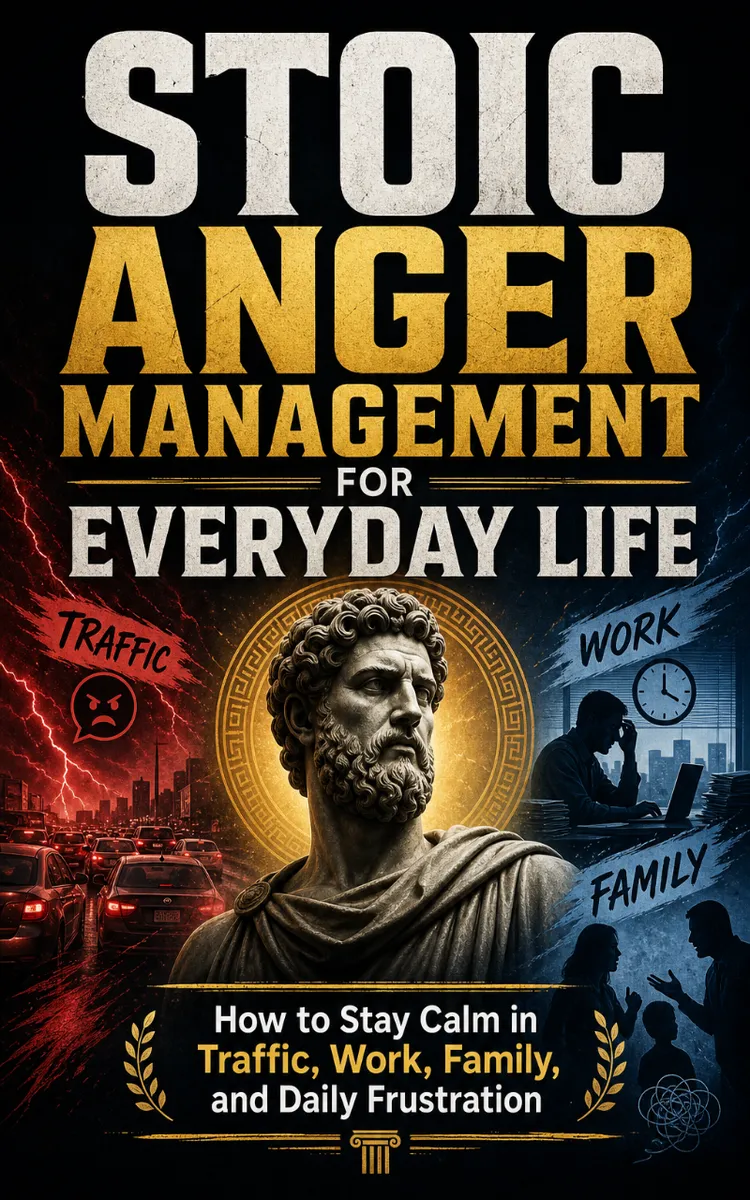
Stoic Anger Management For Everyday Life
Created with Inkfluence AI
Practical Stoic techniques to manage everyday anger
Table of Contents
- 1. Recognize Your Anger Triggers
- 2. Separate What You Control
- 3. Use the Pause-Then-Choose Reset
- 4. Practice Stoic Rehearsal for Hard Moments
- 5. Name the Feeling Without Feeding It
- 6. Adopt the Virtue-First Response
- 7. Turn Complaints Into Questions
- 8. Traffic Anger: The Roadway Detachment
- 9. Work Anger: The Meeting Boundary Script
- 10. Family Anger: The Kind-But-Clear Reply
- 11. Reframe ‘Injustice’ Into Opportunity
- 12. The Negative Visualization Practice
- 13. Control Your Inner Monologue
- 14. Set Micro-Goals for Calm Behavior
- 15. Use the Three-Second Breathing Anchor
- 16. Respond, Don’t React: The Delay Rule
- 17. Repair After a Blow-Up
- 18. Build an Anger-Proof Routine
- 19. Handle Passive-Aggressive Triggers
- 20. Your Stoic Anger Review Journal
Preview: Recognize Your Anger Triggers
A short excerpt from “Recognize Your Anger Triggers”. The full book contains 20 chapters and 32,428 words.
Have you ever felt anger hit you like a sudden brake tap-one second you’re fine, and the next you’re gripping the steering wheel so hard your knuckles hurt? For most people, anger doesn’t start as “a decision.” It starts as a chain: a specific situation, a fast thought, and a body cue that shows up first. If you catch that chain early, you stop anger from driving.
This chapter helps you spot your own triggers before you act on them. You’ll learn how to notice the exact moments that reliably spark anger in traffic, at work, and at home-and you’ll map those moments into a simple tool called the Trigger Radar Map. After this chapter, you’ll be able to look at a real problem (a wrong turn, a rude message, a repeated mistake) and quickly identify what set you off, what thought fired next, and what body signal showed up first.
The point isn’t to “be calm no matter what.” The point is to catch the trigger chain early enough that you can choose a response instead of reacting. If you can recognize your pattern, you can change it.
Why This Matters
Anger feels powerful, but it’s usually predictable. Your mind runs the same shortcuts under the same conditions: someone cuts you off, a coworker ignores your request, a family member repeats the same issue. Your body then backs up the thought with a physical push-tight chest, hot face, jaw clench, faster breathing. When you don’t notice those signals, anger takes over the steering wheel and you end up saying or doing things you didn’t plan.
This chapter solves a practical problem: most people try to manage anger after it already fully shows up. By then, your brain treats the situation like an emergency. You’ll think louder, talk sharper, and move faster-sometimes in ways that make the conflict worse. If you can catch the trigger earlier, you keep the conflict from spreading and you protect your relationships, your job, and your own peace.
After you learn your triggers, you also stop blaming yourself for “random” anger. You’ll see the pattern. Then you can build a Trigger Radar Map that helps you spot the next trigger in real time. A quick map also makes it easier to practice new responses, because you won’t guess-you’ll know what to watch for.
Takeaway to reflect on: Think of your last anger flare-up. What happened right before it-one specific moment?
How It Works
The core idea is simple: anger usually follows a repeatable sequence. Your job is to notice it in three parts-Situation, Thought, and Body cue-then record it so you can spot it faster next time. The Trigger Radar Map turns scattered frustration into clear signals you can train.
Darius (34), a rideshare driver, understands this the hard way. His anger didn’t show up when he “felt like it.” It showed up around specific moments: a passenger who doesn’t answer the pickup text, a long red light during a tight schedule, and another driver who blocks his lane. When he started tracking these, he stopped treating anger like a mystery and started treating it like a pattern he could detect.
Use this structure and capture your triggers exactly like this:
1. List your “Situation” trigger (what happened).
Write the concrete event, not the whole story. Example: “Passenger doesn’t respond for 2 minutes after pickup text” or “Car cuts into my lane without signaling.” This matters because anger often follows the event you can point to.
2. Write the “Thought” that fires immediately (the sentence your mind says).
Keep it short and true-to-life. Example: “They’re doing this on purpose,” or “I’m going to fall behind and get punished.” This matters because your thought turns the situation into threat in your brain.
3. Note the “Body cue” that shows up first (what your body does).
Use plain language: “jaw tightens,” “heat rises in face,” “hands grip steering wheel,” “chest feels tight,” “breathing speeds up.” This matters because your body cue often appears before you fully realize you’re angry.
4. Add the “Action urge” (what you want to do next).
Example: “lay on the horn,” “slam the door,” “send a sharp message,” “drive aggressively to make up time.” This matters because urges predict your next move-and you can interrupt the urge earlier.
To make the Trigger Radar Map usable, you’ll organize triggers into “zones” based on where they happen most: Traffic, Work, and Family. For each zone, you record 3-6 triggers you notice often. You’re not collecting everything-you’re collecting the repeat offenders. Darius focused on two traffic triggers and one work trigger first, because those were the ones that kept ruining his week.
Now ask yourself a quick comprehension check: When anger hits, can you name the exact situation and the exact first thought? If you can’t yet, that’s normal. Your map builds that skill with practice.
...
About this book
"Stoic Anger Management For Everyday Life" is a how-to guide book by Socratic Mastery with 20 chapters and approximately 32,428 words. Practical Stoic techniques to manage everyday anger.
This book was created using Inkfluence AI, an AI-powered book generation platform that helps authors write, design, and publish complete books. It was made with the AI Ebook Generator.
Frequently Asked Questions
What is "Stoic Anger Management For Everyday Life" about?
Practical Stoic techniques to manage everyday anger
How many chapters are in "Stoic Anger Management For Everyday Life"?
The book contains 20 chapters and approximately 32,428 words. Topics covered include Recognize Your Anger Triggers, Separate What You Control, Use the Pause-Then-Choose Reset, Practice Stoic Rehearsal for Hard Moments, and more.
Who wrote "Stoic Anger Management For Everyday Life"?
This book was written by Socratic Mastery and created using Inkfluence AI, an AI book generation platform that helps authors write, design, and publish books.
How can I create a similar how-to guide book?
You can create your own how-to guide book using Inkfluence AI. Describe your idea, choose your style, and the AI writes the full book for you. It's free to start.
Write your own how-to guide book with AI
Describe your idea and Inkfluence writes the whole thing. Free to start.
Start writingCreated with Inkfluence AI


