

Read the first chapter
The whole of chapter one, free. About 23 min. Turn the pages with the arrows, your keyboard, or a swipe.
Chapter 1
The Wet Box Delivers a Key
The television flickered blue across the living room walls as rain lashed the windows hard enough to make the glass tremble. October had turned the street outside into a black river, and every few seconds the porch light caught the icy streaks sliding down the pane.
Ding-dong.
Lyra jerked upright on the couch.
The chime faded into the house’s silence. Her dad was still at work. Mom’s old room upstairs remained dark, its door shut the way it had been for months. No footsteps crossed the hall. No pipes groaned. Only the refrigerator hummed in the kitchen while the rain battered the roof.
The doorbell rang again.
Lyra grabbed the nearest thing she could use as a weapon - a brass fireplace poker - and crossed the living room. The floorboards felt cold through her socks. She paused beside the front door, listening.
Nothing.
“Dad?” she called.
The storm swallowed her voice.
She set the poker against the wall, slid back the lock, and pulled the door open.
Wind drove a spray of icy rain across her face. The porch stood empty. Beyond it, the street shone beneath the lamps, but no car waited at the curb. No figure hurried away. No shadow moved between the dripping hedges.
Something sat on the welcome mat.
A cardboard box.
It had been left directly in the downpour. Water streamed from its corners, darkening the cardboard to the color of a bruise. One side had collapsed inward, and the tape sagged in pale, soggy strips.
Lyra leaned out farther, scanning the street.
“Hello?”
A curtain shifted in the house across the road. Then it fell still.
She stepped onto the porch and snatched up the box. Cold water soaked through her sleeve at once. The package was heavier than it looked, and something inside gave a faint, metallic knock against the bottom.
“Who sends a package like this?”
No answer came.
Lyra tucked the box beneath her arm and hurried inside. She kicked the door shut against the wind, locked it, then checked the dead bolt twice. Rainwater dotted the hallway floor. Her hoodie clung damply to her shoulders.
The package had no return address. The shipping label was wrinkled and half dissolved, but her name remained visible in blurred black ink.
Lyra Hart.
She carried it into the kitchen and set it beneath the yellow light over the counter. The house looked different there - too bright, too ordinary. A bowl of apples sat beside the sink. Her dad’s coffee mug rested upside down on a towel. The clock above the stove clicked from 10:47 to 10:48.
She reached for the box cutter, then stopped.
The cardboard shifted.
Lyra froze.
A second later, she realized it was only water dripping from the porch roof onto the box. Drip. Drip. Drip.
“Get a grip,” she muttered.
She sliced through the tape. The wet cardboard tore open with almost no resistance. Inside, beneath a layer of crumpled brown paper, lay a folded sheet and a small object wrapped in black cloth.
Lyra lifted the paper first.
The writing on it was elegant and narrow, the ink dark despite the moisture.
This key opens something that was meant to stay closed. Use it wisely.
She read it twice.
Then she unwrapped the object.
A silver key rested in her palm.
It was smaller than the keys on her dad’s ring, with a thin stem and a round head carved into curling patterns. The metal was cold enough to sting. Tiny swirls covered its surface, so fine they seemed less engraved than grown there.
Lyra turned it toward the light.
For an instant, one of the patterns looked like an eye.
She dropped it onto the counter.
The key struck the wood with a clear, bright click.
“Absolutely not.”
The television murmured from the living room. A burst of laughter rose from the program, cheerful and wrong in the empty house.
Lyra picked up the note again. There was no signature. No explanation. No clue who knew her name or why they had chosen tonight to leave something on her porch.
She carried the key to the front door.
It slid into the lock halfway, then stopped.
“Come on.”
She pushed harder. The key bent slightly between her fingers.
Lyra pulled it free and tried the dead bolt. Nothing. She tried the back door, the pantry, the small lock on the cabinet where her dad kept spare batteries. The key refused every one.
By eleven, the kitchen counter had become a map of failure. The jewelry box in her dad’s room sat open beside the old sewing basket. Three desk drawers had been emptied onto the floor. She had tried the lock on the attic hatch, the medicine cabinet, the shed, and the little diary tucked beneath her mattress.
Nothing.
The key fit nowhere.
Lyra stood in the bedroom hallway with the key pinched between two fingers. The hall stretched from the stairs to the dark doorway of her room. Rain tapped against the narrow window at the far end, and the glass trembled in its frame.
She looked toward Mom’s closed door.
For months, no one had touched it. The brass knob had dulled beneath a film of dust. Lyra had never tried to open it. She had no reason to now, except that the note had made every locked thing in the house feel suddenly important.
She walked to the door.
Her hand hovered over the knob.
“Don’t,” she whispered.
The word sounded like it came from behind her.
Lyra spun around.
The hallway was empty.
At the bottom of the stairs, darkness pooled beneath the banister. The kitchen light did not reach that far. For one wild second, she thought she saw someone standing there - a narrow shape with wet hair and one hand pressed against the wall.
Then the refrigerator clicked on, and the shape became a coat draped over a chair.
Lyra let out a breath she had not realized she was holding.
“Ridiculous.”
She turned back to Mom’s door. The key remained cold in her hand.
The lock was an ordinary brass cylinder.
Lyra inserted the key.
It went in smoothly.
Her pulse jumped.
She gripped the bow and twisted.
The lock did not move.
She tried again, forcing the key until the metal cut into her palm. The door stayed shut. Somewhere inside the room, something gave a soft knock.
Lyra stepped back.
The sound came again.
Knock.
Knock.
Her mouth went dry.
“Dad?” she called, though she knew he was not there.
The house answered with rain.
She yanked the key from the lock and hurried downstairs. In the kitchen, she snatched up the note and held it close to the lamp. Perhaps there was writing hidden beneath the first line. Perhaps the paper had been treated with something. She turned it over, held it above the steam from the kettle, and rubbed the edges between her fingers.
The message did not change.
This key opens something that was meant to stay closed. Use it wisely.
“Something,” Lyra said. “That’s helpful.”
Her phone buzzed on the counter.
She nearly dropped the note.
Dad: Still at work. Lock up before bed.
Lyra stared at the message. Her fingers hovered over the screen.
Did you send me a package?
The reply came almost at once.
What package?
She looked at the box.
Never mind.
A few dots appeared, vanished, then returned.
Everything okay?
Lyra glanced toward the hallway. The dark seemed deeper now, crowded with all the doors she had not noticed before.
Fine, she typed.
She did not send it.
Instead, she set the phone facedown and picked up the key.
Its surface had warmed slightly against her skin. The carved swirls seemed to shift when she moved it beneath the light, winding inward toward the center of the bow. Lyra rubbed at them with her thumb.
A sharp pain pricked her fingertip.
She flinched and dropped the key.
A bead of blood welled from her skin.
The key landed beside the note.
For a moment, the silver metal shone with a faint, wet gleam. Not red. Not exactly. A pale light flickered along one of the carved lines, then disappeared.
Lyra stared at it.
The kitchen clock clicked.
She picked up the key more carefully.
“Who are you?” she whispered.
Nothing answered.
By midnight, exhaustion had begun to blur the edges of the room. Lyra returned the jewelry box and closed the drawers, though she left the note on the kitchen counter. She carried the key upstairs, stopping twice to listen to the hallway.
Mom’s door remained shut.
At her bedroom entrance, Lyra looked back.
The hall was empty. The rain had softened to a steady hiss against the window. Her dad’s house - her house, while he was gone - seemed to settle around her with small wooden creaks.
She changed into an oversized hoodie and sweatpants, then sat on the edge of her bed. The key rested in her palm, its teeth pressing into her skin.
It had arrived with a warning.
It had opened nothing.
That should have made it harmless.
Lyra placed it on her nightstand and turned off the lamp.
Darkness filled the room, broken only by the thin gray glow from the window. She lay down, pulled the blanket to her chin, and closed her eyes.
A knock sounded in the hallway.
Lyra opened them.
Nothing moved beneath the door.
Another knock came, quieter this time.
She sat up. The key waited on the nightstand, dull and silent.
For several seconds, she considered waking her dad. Then she remembered the empty street, the ruined label, and the message written by someone who knew exactly what they were giving her.
This key opens something that was meant to stay closed.
Lyra reached for it.
The metal felt colder than before.
She slid the key beneath her pillow and lay back down, clutching the edge of the fabric. The mattress dipped slightly beneath her head, as if the key had weight far beyond its size.
She tried to tell herself the warning was meant for someone else.
But as sleep pulled at her, a thought rose from somewhere beneath the rain.
The note had not said what the key might open.
It had said what was meant to stay closed.
And somehow, Lyra knew the message was meant for her.
The television’s blue light kept time with the rain: a slow, icy metronome against the glass. Lyra’s fingers left wet crescents on the box as she carried it inside; the house smelled faintly of lemon cleaner and old paper. The note’s ink didn’t run despite the storm. This key opens something that was meant to stay closed. Use it wisely.
She wanted one clear thing in that moment: to know who had left it and why. That concrete ache - answers, or at least explanation - pushed her into action. She tried every lock in the house for an hour, moving through rooms like someone mapping a smaller, trusted world. Each refusal felt louder than the last: the front deadbolt that swallowed the key halfway, the attic hatch that resisted, the jewelry box that clicked empty. The key bent her patience but never yielded its secret.
Obstacles gathered like the weather outside. Rain made the porch slick underfoot; the house kept filling with small, unplaceable sounds - pipes, a settling beam, a knock that came from nowhere. Her phone messages looped concern into the quiet. Mom’s closed door, untouched and dust-muted for months, became a magnet for possibility and dread. When she finally slid the key into that brass lock, it met resistance she couldn’t force. The knock from inside answered her attempt as if whatever lay behind the door noticed her trespass.
Lyra’s decision came not as a plan but as surrender. If the key would not open any real lock, she would carry it into the only place that still made room for the impossible: sleep. She pressed the cool metal beneath her pillow and let exhaustion finally pull her under, half-expecting nothing and half-expecting everything.
When she woke, she was not in her bed.
The room had become a corridor - endless, folded into itself, lined with doors set in panes of dark glass that drank the weak light instead of reflecting it. The air tasted of iron and distant rain; her skin prickled as if from cold and wonder together. The silver key was heavier in her pocket than it had been on the nightstand, its swirls seeming to shift under her fingers. Somewhere beyond those glass doors, something breathed.
Lyra stood in the center of that impossible hall and did the only thing she could: she listened to the space around her like it might speak back. The corridor was vast, the doors innumerable, and a new rule had settled in her chest - this was no longer only about finding who left the package. The key had moved with her. Whatever it opened now lay somewhere past glass and shadow, and the cost of wanting to know had just doubled.
The glass swallowed sound like a mouth. When Lyra stepped forward the soles of her sneakers made no echo; the corridor seemed to absorb noise the way wet cloth takes dye. Each door sat in its own black frame, inset in glass so dark it held moving shadows that were not her reflection. A cold draft slid down the hall, tasting faintly of pennies and old books, and it raised the fine hairs along her forearms.
She slid a hand into her pocket. The silver key pressed against her palm, warm now where it had been cold; the swirls along its bow felt like ridges beneath skin, as if the metal had merged with the muscle of her own hand. When she flexed her fingers the pattern seemed to pivot, a tiny wheel turning toward some inner axle. It made her think of a heartbeat - mechanical, steady, impossible.
A lane of lamps hung above, spaced as if to measure distance by intervals of dimness. Their light was not light but a low silver mist: it didn’t cast shadows so much as thin them. Between two doors a smear of movement crossed the glass, not quite a person. Lyra stopped and watched until the smear dissolved and the glass went obediently black again. Her breath fogged in the air, small, visible puffs that vanished like moths against the panes.
“Hello?” she said, the word brittle in the hush. The sound skewed, arriving back to her from the glass like a message bounced off a cold window. No answer came, only the slow whisper of the corridor and something like the distant turning of a key in an unseen lock.
Her fingertips brushed one frame. The surface was colder than she expected and slick under her skin, as if a thin film of water lay across every pane. When she pressed her palm flat against it, the glass did not feel like glass at all: it had the texture of river-smoothed stone, and a faint vibration prickled up her arm, like the thrum of a tuning fork held to bone. Behind the pane, light shifted in a way her eyes couldn’t follow - a gray wind through a treeline, the flash of something white, the suggestion of an arm raised in farewell. The door itself bore no handle, only a keyhole the size of a thumbnail, and when Lyra held the silver key there the metal hummed against the coolness of the frame.
She stepped back. The corridor stretched on, an exhausted ribbon of doors folding away into a horizon that never quite arrived. Somewhere far off a sound repeated: a slow, rhythmic clack, like shoes on flagstone, moving closer, then pausing as if considering which door to tap next. Lyra’s heart picked up its pace and she felt the ache of adrenaline like a fresh bruise under bone.
She wanted answers - wanted the note’s author, wanted Mom’s closed rooms explained, wanted someone to tell her whether taking the key had been curiosity or crime. That wanting tightened into a physical ache that pushed her forward. She moved to the nearest door and set the key’s teeth against the small hole. The metal fit without resistance now, as though the lock had been waiting for warmth. A low chime sounded somewhere in the glass - a tone like a bell submerged - and the pane clouded, then cleared, revealing a narrow room lit by a single candle whose flame bent away from her as if shying.
A voice came from within: not words at first, but a rustle like pages riffled by a wary hand. Lyra swallowed and spoke that name she had given the place aloud: “Asteria.”
The utterance seemed to settle the air. The candle’s flame steadied and a figure leaned into view: a silhouette with long hair, hands folded at its waist, not stepping through the glass but existing just behind it. The pane trembled and for one breath Lyra saw a face - too faint to be certain - then the glass darkened and the image vanished as if someone had swept a curtain.
“Does it obey you?” asked a voice immediately to her left, close enough to make her spin. A shape stood in the shadow between lamps: taller than she expected, shoulders wrapped in something like a captain’s coat, the collar high and stiff. He had eyes that caught the dim and threw it back at her in slashes. Lyra’s mouth went dry.
“I don’t know,” she admitted. Her hand brushed the key. It thrummed like a small living thing.
The man - Celio, she realized with an odd start; his name slid into place like a missing tile - tilted his head. “Try,” he said flatly. “Not everything listens.”
Lyra hesitated. The want inside her pressed like a nickel under thumb: to pry, to know. She slid the key into the thumbnail keyhole again and turned, this time with intention, with the weight of every unanswered question behind the motion. The lock accepted her. A faint ache threaded up through her wrist and settled at her temple, a small bell of nausea and exhilaration.
Behind the glass the world shifted, not into the room shown before but into something else - an open courtyard at night, cobbles slick with rain that gleamed with a strange inner light. A single figure stood at its center, head bowed. At the edge of the scene something large and black leaned against a wall, its bulk restful and patient. Lyra felt as though she had intruded on a private memory.
“Do you see her?” the captain asked softly. His voice carried no surprise; it carried calculation. Lyra did not know whether he meant the figure in the courtyard or someone else altogether.
She wanted to say the note’s warning. Use it wisely. But the words felt threadbare in the vastness of Asteria. What did wise mean here - caution, or secrecy, or sacrifice?
Instead she asked the question that had lodged in her throat since her pillow: “Who left the key?”
Celio’s mouth flattened. “Questions make doors heavy,” he said. “Some doors exist so that asking opens them in spite of the lock.”
A distant scraping breathed through the hall - thin and metallic. The glass near the ceiling quivered. Lyra felt the air shift, colder now and edged with something like iron filings. The corridor itself seemed to tighten, the lamps blinking once as if watching her. Behind another pane a pair of hands smoothed a cloth over something that might be a face or might be a carving. The sound of the cloth across glass was intimate and threatening all at once.
Lyra’s fingers closed around the key, awareness sharpening into decision. If the key had chosen her for reason or accident, that choice had consequences. She could step back, slide the metal back beneath her pillow in some attempt to return to normalcy, to pretend the storm and the box and the hallway were one long, vivid dream. Or she could move forward and see what answered to her turning.
“Open,” she said at last, not sure whether she meant the door or herself.
The pane sighed and became a corridor within a corridor. The lights dimmed and a small door within the courtyard scene swung inward, revealing steps that sloped away into black. From below came the sound of distant voices arguing in a language Lyra didn’t know and the faint clatter of armor. The key in her pocket grew hot, and she felt the echo of its pulse tethered to the little ache behind her eye.
Celio’s shadow shifted. “Then we go,” he said.
Lyra stepped forward, the floor cold through her shoes, and the glass at her shoulder answered with a whisper like breath against skin. The corridor was no longer only an expanse of doors; it was a map of choices, each pane a promise or a peril. Snow or rust, welcome or warning. She could already feel the cost tightening like a strap across her ribs.
Behind her, somewhere far beyond the lamps, a figure moved with deliberate slowness. It did not hurry. It did not claw. It listened. Lyra turned, and in the reflection of the glass she caught a glimpse of her own face: pale, determined, and small against the scale of the hall.
She pushed the door open. The sound was a small, clean click that echoed far longer than it should have, and the corridor inhaled as if in answer.
The steps smelled of wet stone and old smoke. Lyra's sneakers hit each tread with a dull thud that seemed to swallow itself. Behind the small door the courtyard had shrunk into memory; up close the night felt colder, the rain-slick cobbles reflecting nothing but the dark. The single figure at the center had turned. For a heartbeat Lyra thought it was a woman - then the silhouette stepped forward and the lamplight caught its face; it was a boy, younger than she expected, hair plastered to his forehead as if he'd walked out of a different storm.
He looked at her with an incredulous, tired stare. “You shouldn't be here,” he said, voice small and edged with something like accusation.
Lyra tightened her grip on the key until the metal bit into her palm. The heat running along her veins was not all fear; there was the ridiculous, intoxicating clarity that came when the world pared down to two choices: move or not. “Neither should you,” she heard herself answer. The words came out steadier than she felt.
The boy's jaw worked. He took one step toward her, boots whispering on the cobbles. Close enough now, she could see the smallness of his hands, the way his fingers curled as if afraid to touch what they might disturb. Behind him the bulky shadow she’d glimpsed leaned forward like a waiting boulder. It made the courtyard feel crowded and private at once, like two people leaning in over a secret.
A scraping sound rose from the far edge of the square, thin as a thorn dragged over metal. Lyra's pulse tightened into a wire in her throat. The noise didn't belong to the courtyard scene; it came from somewhere deeper in Asteria's architecture, where gears clicked and thresholds remembered the weight of footsteps. Celio's presence at her shoulder was a cold anchor - he had not moved forward. He watched the boy with the careful stillness of someone measuring danger.
“Who left the key?” Lyra asked again, because asking was the only way she knew to steer the thin skeins of information around her like lamps.
The boy blinked, as if considering whether to trust her with such a thing. “Not who,” he said slowly. “Why.” His voice folded around the single syllable. “Some things open because someone wanted them to. Some open because something wanted to be seen.”
Between two rooftops a clock chimed - five slow, metallic notes that echoed through the courtyard and made the boy flinch. With each chime the edges of the scene shimmered, like heat above summer asphalt. Lyra felt that shimmer in her teeth, a vibration that spoke of pressure building somewhere beyond sense. The key in her pocket sent that same hum through her ribs, synchronized with the clock as if keyed to the world’s own pulses.
“Then why me?” she asked, more of a demand than a question. The want that had driven her all night folded inward, sharpened now into fear of what the answer might demand.
The boy's eyes slid past her, toward the place the scraping came from. He didn't answer. Instead, he lifted a hand and pointed - not at a person, but at the far wall of the courtyard where a narrow stair disappeared into a rain-dark mouth. “Down there,” he said. “They've been asking. The doors don't like being watched.”
Something in Lyra tightened at that. Doors that didn't like being watched - an idea that made the hair along her arms crest with cold. The corridor outside had felt like a map; now it threatened to be a trap with every panel identical until the wrong one decided to care about her.
A shadow detached itself from the bulk by the wall - a younger guard, smaller than the first but with eyes that glinted like wet coins. He moved without hurry, the clank of his armor soft and deliberate. When he called, his voice was careful, practiced. “Identification,” he said, as if reciting regulations.
Lyra's mouth went dry. The word landed like a gauntlet. In the house she'd been anonymous - just a kid who’d found a soggy package. Here, in Asteria, the rules were different and heavier. Identification meant being named, placed, assessed. It meant recognition that could chain her to something she did not understand.
Celio's hand brushed her elbow. “Don't hand over what you don't know,” he murmured. There was no softness in it; it was caution folded into command. Lyra felt simultaneously protected and exposed, as if his warning had created a spotlight on the small, dangerous decision she had to make.
Her palm found the key under her hoodie - no longer cold, no longer merely metal, it sat there like a pulse she could feel. The thought rose, sudden and selfish: bury it again under the pillow, let Asteria close up and become a nightmare she could forget by morning. The alternative beat at the same time: go down the stairs, follow the scraping and the voices, and risk whatever identification might mean.
The scraping grew louder, as if whatever made the noise had decided not to be patient. From below came a murmur of many voices, threaded with a language Lyra didn't recognize but felt in the places a child's lullaby lands - at the hollow of the throat, behind the ribs. The lanterns in the courtyard guttered; cold trickles of wind threaded the light and made the shadows twitch like restless animals.
Lyra swallowed. The decision wasn't heroic. It wasn't even clever. It was a single, foolish, unavoidable movement: she stepped toward the stair mouth. The cobbles bit into her soles, the courtyard exhaled, and the boy's expression shifted to something like relief or resignation.
“Names make rooms keep you,” he whispered as she passed. “Names make things listen.”
Lyra's hand closed on the key. It felt as if the metal were trying to crawl out of her fingers, eager to be used. She could feel the line of warmth it left tracing up her wrist, an ember moving toward the place behind her eye where questions flared into resolve.
Behind her, Celio's shadow fell across the courtyard like a promise. He didn't follow immediately; instead he let the space between them hold like a test. “If they ask,” he said, voice low and flat, “tell them you are passing through. Tell them nothing else.”
Lyra wanted to say she wasn't just passing through. She wanted to say the key had chosen her, that the note had insisted on her name without saying it, that the wet box on her porch had been a declaration. But the stair swallowed sound, and beyond it the voices braided tighter. The corridor's lamps blinked like watchful eyes.
She descended.
The air below tasted like copper and old paper and the metallic tang of rain. The scraping became a rattling, then rhythm: a step, a pause; a step, a pause - like someone learning the measures of the place. Lyra felt the corridor press in, the glass doors above receding into a ring of watching panes, each one black and patient. The key in her hand pulsed once, then twice, and when she passed the threshold the pulse seemed to answer to everything that had been waiting.
At the bottom, the guard stepped forward, the younger one's armor whispering. He held out a palm and smiled like someone delivering final instructions. “State your purpose,” he said. His smile did not touch his eyes. The words were small, precise, a hinge waiting to be turned.
Lyra met his gaze and felt the pressure of the corridor pressing the question into her sternum: who were you when you took a key that was not yours?
She could claim ignorance. She could tell him the truth. Or she could fall silent and let Asteria decide what a silence was worth.
Her thumb brushed the key's stem. It thrummed like a heartbeat in answer, and for a moment the decision felt like choosing which side of a knife to stand on.
“I came because it opened,” she said finally, voice low and steady. It was not a confession; it was a declaration shaped by the cold inevitability of the place. The guard's eyes flicked to Celio at the mouth of the stairs, then back to her, calculating.
“Names,” he said. “Give a name.”
The corridor waited with the patience of something that knew how to make time hungry. Lyra felt the key warm against her skin and understood then that some doors demanded not keys but claims. She could feel, under her ribs, the first small burn of something settling - the smell of being known.
“Lyra,” she said. The single syllable landed and echoed like a bell struck into stone.
Around them, something clicked, small and final, and the air tightened into a new rhythm - one that included her name.
End of chapter one. 4 more chapters in the full book.
Swipe or use the arrows to turn the page
What's inside: 5 chapters
- 1. The Wet Box Delivers a Key
- 2. Asteria Opens Through Her Chest
- 3. The Door Locks Itself, Not Her
- 4. Lyra Commands the Threshold, Then Falls
- 5. The Secret Keeper Hides in Her Choice
About this book
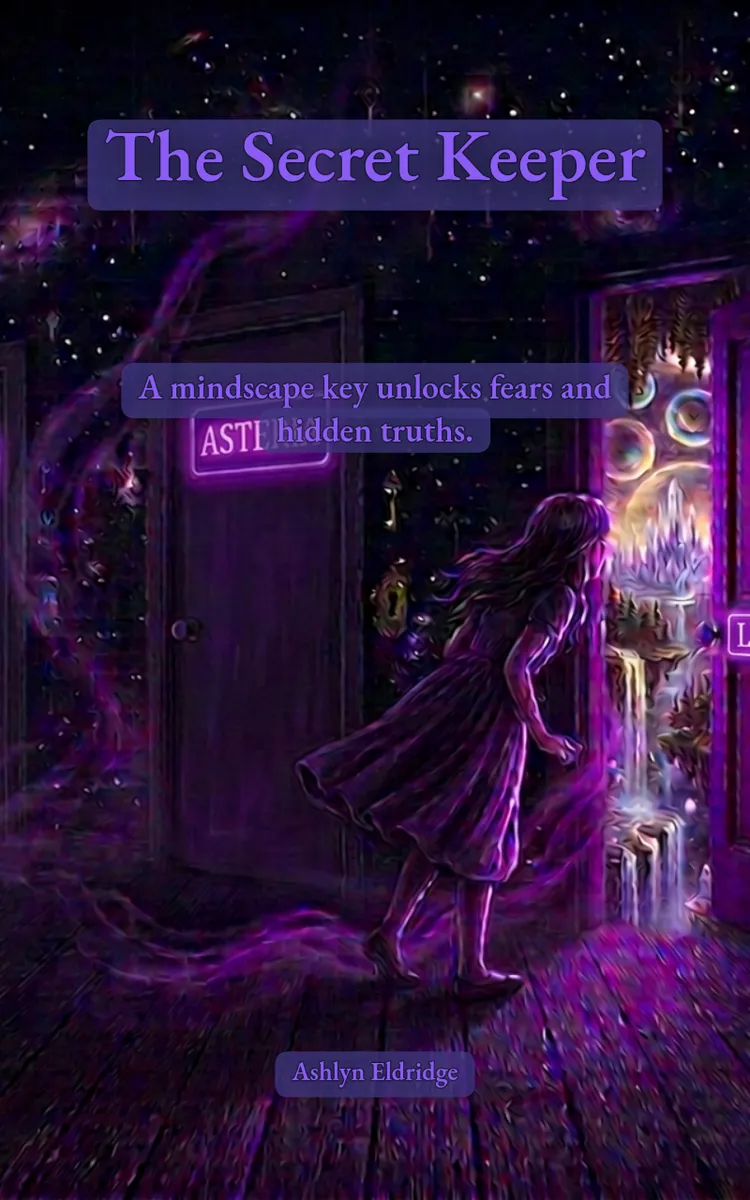
"The Secret Keeper" is a fiction book by Ashlyn Eldridge with 5 chapters and approximately 12,279 words. A teen discovers a key that opens a dream labyrinth..
This book was created using Inkfluence AI, an AI-powered book generation platform that helps authors write, design, and publish complete books. It was made with the AI Novel Writer.
Frequently Asked Questions
What is "The Secret Keeper" about?
A teen discovers a key that opens a dream labyrinth.
How many chapters are in "The Secret Keeper"?
The book contains 5 chapters and approximately 12,279 words. Topics covered include The Wet Box Delivers a Key, Asteria Opens Through Her Chest, The Door Locks Itself, Not Her, Lyra Commands the Threshold, Then Falls, and more.
Who wrote "The Secret Keeper"?
This book was written by Ashlyn Eldridge and created using Inkfluence AI, an AI book generation platform that helps authors write, design, and publish books.
How can I create a similar fiction book?
You can create your own fiction book using Inkfluence AI. Describe your idea, choose your style, and the AI writes the full book for you. It's free to start.
Write your own fiction book with AI
Describe your idea and Inkfluence writes the whole thing. Free to start.
Start writingCreated with Inkfluence AI


