
Read the first chapter
The whole of chapter one, free. About 10 min. Turn the pages with the arrows, your keyboard, or a swipe.
Chapter 1
The Body in St. Brigid’s Porch
The key to St. Brigid’s stuck halfway in the lock, its iron teeth rasping against something hard inside.
Clara Wren crouched on the church porch and worked it gently, careful not to snap the old brass bow. Dawn had only just reached the village rooftops. Beyond the yew hedge, a milk cart creaked along the lane, its wheels striking the ruts with a hollow clop. Somewhere behind the vicarage, a cock crowed late and angrily.
“Come on,” Clara murmured. “Not this morning.”
The key shifted. The door gave a little, then stopped.
She set down her ring of spare keys and peered at the narrow gap. A strip of dark cloth showed beneath the inner edge of the door.
Clara frowned.
She pushed again. The door moved an inch. Cold air pressed through the opening, carrying the dusty scent of stone and old wood. Her fingers tightened around the handle.
“Is someone in there?”
No answer.
She tried the key once more, then leaned her shoulder against the oak. The bolt scraped back with a deep metallic groan. The door swung inward.
A man lay across the porch floor.
For one second Clara saw only the shape of him: one arm flung towards the church threshold, boots turned awkwardly beneath him, a dark coat spread like a blanket over the flagstones. Then the morning light found his face.
He was a stranger.
His skin had the grey, waxy cast of candle grease. A thin line of blood ran from behind his right ear and disappeared into the collar of his shirt. One hand rested palm-up beside the step, the fingers curled as if they had tried to catch hold of the stone.
Clara did not scream. The sound rose in her throat and stopped there.
She stepped back, knocking her knee against the porch rail. The church key fell from her hand and struck the flags.
For a moment the only noise was the milk cart fading down the lane.
Then the church bell above her gave a small, accidental tremor. Its rope, hanging inside the porch, had been caught beneath the dead man’s shoulder.
Clara stared at him.
She had come to unlock St. Brigid’s before the first visitors arrived. Mrs Pritchard would bring flowers at half past eight. Two tourists from the station were expected later, according to the note pinned to the vestry door. Clara had meant to open the nave, light the lamps, and make certain the leaking roof had not stained the hymn boards again.
Instead, she stood with one foot on the threshold and a dead man at her feet.
The first thought that came was absurdly practical: no one must step on him.
The second was worse.
Someone had put him here.
Clara snatched up the key and backed away from the porch. The church doors remained open behind her, revealing the dim nave, the rows of pews, and the pale saints painted on the east wall. She reached for the door and pulled it shut, but the man’s coat had caught beneath it.
The fabric dragged over his shoulder.
Clara froze.
“Sorry,” she whispered, though he could not hear her.
She opened the door just enough to free the coat, then closed it again. The latch clicked. The stranger was now outside, visible through the narrow glass panel, while the church stood locked behind her.
That would have to do.
She hurried down the porch steps. The flagstones were slick with dew, and her shoes slipped. At the gate she turned towards the lane, searching for anyone at all.
A figure appeared beyond the hedge, carrying a wicker basket.
“Mrs Pritchard!” Clara called.
The woman stopped. “What is it?”
“Don’t come inside the churchyard. Stay there.”
Mrs Pritchard lowered the basket. “Are you ill?”
“There’s a man on the porch.”
“Who is he?”
“I don’t know.”
“Is he hurt?”
Clara looked back at the church. The stranger’s face showed through the glass, tilted towards the pale sky.
“He’s dead.”
Mrs Pritchard crossed herself. The basket slipped from her hand, and apples rolled across the lane.
Within minutes, the quiet began to fracture.
Mrs Pritchard shouted for her husband. The milkman reversed his cart so sharply that one of the cans toppled and clanged against the road. A boy from the baker’s appeared at the gate, then vanished, only to return with three more boys behind him. Someone called for the vicar. Someone else said the man had been murdered before Clara had even touched the door.
“No one comes through the gate,” Clara said.
Her voice sounded too thin, but she repeated it louder. “Keep back. All of you.”
“Clara, what happened?” called Mr Pritchard.
“I found him.”
“Did you touch the body?”
“No.”
“Are you certain?”
She turned on him. “I know what I touched.”
The old man raised both hands. “I only asked.”
“And I’m telling you no one goes near him.”
The boys pressed against the iron railings, whispering. Mrs Pritchard stood with her shawl drawn tight around her shoulders, staring at the porch. Her gaze fixed on the stranger’s boots.
“Those aren’t village boots,” she said.
“What does that mean?” Clara asked.
“It means I’ve never seen them.”
“He may have come from the station,” said the milkman. “There’s a night train.”
“No night train stops here,” someone replied.
“It passes close enough.”
“Then why walk to St. Brigid’s?”
The questions began to overlap.
Who was he? Had Clara seen him before? Was he carrying money? Had he been robbed? Was there a knife? Had the church been broken into? Had the vicar offended someone?
Clara stepped through the gate and pulled it shut. The latch was weak, but she looped the chain through it twice.
“Go home,” she said. “All of you.”
No one moved.
The village had spent years complaining that nothing happened in St. Brigid’s, in Wrenford, in any place within walking distance of the green. Now the body had drawn them as surely as a brass band. Faces appeared at windows. A woman in a dressing gown hurried across the churchyard with a baby on her hip. The baker’s boy climbed onto the low wall for a better view.
Clara felt the church behind her, locked and silent. The porch had become a trap: one narrow entrance, one low wall, one body between the villagers and the truth.
She pushed through the crowd towards the vicarage.
“Where are you going?” Mrs Pritchard demanded.
“To telephone the police.”
“There’s no need to bring the police into this,” said Mr Pritchard.
Clara stopped. “There is a dead man on the church porch.”
“Constable Bell will come.”
“Then someone must fetch him.”
“He’ll hear soon enough.”
Clara looked back at the gate. The baker’s boy had dropped from the wall and was now inside the churchyard.
“Get out,” she said.
The boy stared at her.
“Now.”
He bolted. Clara followed him through the gate and caught the chain before anyone else could enter. The metal cut into her palm.
“Mrs Pritchard,” she said, keeping her eyes on the crowd, “take the children away. Mr Pritchard, stand by the gate. If anyone tries to enter, stop them.”
“You’re giving orders now?” said the milkman.
“Yes.”
That silenced him.
Clara returned to the porch alone. She did not go near the body. From the step, she could see details she had missed before: mud dried along the stranger’s left trouser cuff, a small tear in his coat pocket, and a pale mark around his wrist where a watch might have been.
No hat. No wallet. No papers.
The church door behind her remained locked. She checked it twice, though she knew it had not moved.
A sound came from the lane: the brisk approach of a bicycle.
Constable Bell rode into view, his uniform coat unbuttoned and his helmet tilted back. He dismounted beside the gate, breathing hard but not hurriedly. He was a broad, pink-faced man with a moustache that seemed permanently damp.
“What’s all this?” he called.
“Constable,” Clara said, “there’s a dead man on the porch.”
Bell glanced past her. “Dead?”
“Yes.”
“Who found him?”
“I did.”
“Anyone else touch him?”
“No.”
He looked at the villagers. “You lot keep back.”
The instruction had less effect than Clara’s. People shifted, but none left.
Bell walked towards the porch. Clara moved in front of him.
“You mustn’t step up there.”
His eyebrows rose. “Mustn’t I?”
“I kept everyone away. You’ll ruin the - ”
“Ruin what?”
“The evidence.”
A few villagers murmured behind the gate.
Bell gave a short laugh. “Evidence?”
“He has blood behind his ear. He may have been killed.”
“Or he fell.”
“People don’t usually fall onto a church porch with their pockets turned out.”
Bell looked at the stranger again. He climbed the first step.
“Constable - ”
“Mrs Wren, I’ve seen men dead before.”
“Not this one.”
The constable’s expression hardened. “And how many murders have you seen?”
Clara had no answer that would help her.
Bell crouched beside the body. He did not touch it at first. He leaned close, then placed two fingers against the stranger’s neck. After a moment, he sat back on his heels.
“Cold,” he said.
“I told you.”
“Cold doesn’t mean murdered.”
“Look at his head.”
“I am looking.”
Bell reached into the coat and searched the pockets. Clara heard the rustle of cloth, the scrape of a button, and the soft exhalations of the crowd behind her.
“Nothing,” he said. “No identification.”
“His watch is missing.”
Bell glanced at the pale mark on the wrist. “Plenty of men don’t wear watches.”
“There’s a tear in his pocket.”
“Plenty of coats have tears.”
“His boots are muddy.”
“It’s January.”
Clara took one step closer, then stopped herself at the edge of the porch. “He was placed here.”
Bell stood. “That’s your opinion.”
“It’s what I saw.”
“What you saw was a body when you opened the door.”
“And the door was locked.”
Bell looked towards the church. “Locked from the inside?”
“The key was sticking. I had to force it.”
“Then perhaps he came in before you and died there.”
“He’s on the porch.”
“People die in inconvenient places.”
A tremor of laughter moved through the crowd and died quickly.
Clara felt heat rise beneath her collar. “You need to call the county police.”
Bell’s face changed then, not with concern but irritation. “I am the police.”
“You’re the village constable.”
“And this is a village death. Until I know otherwise, I’ll handle it.”
The words settled over the porch like dust.
Behind Bell, Mrs Pritchard began to cry quietly. Mr Pritchard told her not to make a spectacle. The baker’s boy whispered that the dead man had been stabbed. Someone said he had seen a motorcar near the church before dawn. Another voice insisted it had been a black van.
“Stop,” Clara said.
No one listened.
She looked at the telephone box across the green. Its red paint was peeling, but the line worked. She had tested it last week when the vestry lamp failed.
Bell turned back to the body. “I’ll send for the doctor.”
“And the county police.”
“If the doctor thinks it necessary.”
Clara watched him bend over the stranger again. His broad shoe rested inches from the blood-darkened stone.
She made her decision.
Without another word, she went through the gate. Mr Pritchard called after her, but she kept walking. The village green opened before her, bright with frost and scattered footprints. At the telephone box, she pulled the door shut and lifted the receiver.
The line crackled.
“Operator,” said a distant voice.
Clara pressed the receiver to her ear. Through the glass, she could see St. Brigid’s porch and the gathering crowd. Constable Bell stood beside the body, one hand on his hip, already looking as though the matter bored him.
“I need the police,” Clara said. “There has been a death at St. Brigid’s Church in Wrenford.”
The operator asked questions. Clara answered each one, giving the village name, the church address, the constable’s name, and the fact that the dead man remained unidentified.
When she replaced the receiver, her hand was shaking.
Across the green, Bell had turned towards her.
He lifted one arm and beckoned.
Clara stepped out of the telephone box.
The constable waited until she reached the gate. “County officers will come,” he said. “But you’ll tell them the same thing I’ve told you. No proof of murder.”
Clara looked past him at the stranger’s still face.
“I’ll tell them what I found.”
Bell frowned. “And what did you find?”
She glanced down at the porch stones. Near the dead man’s hand, almost hidden beneath the hem of his coat, lay a single black button.
Clara had not seen it when she opened the door.
She raised her eyes to the constable.
“A man no one knows,” she said. “And a church door that was locked before he got there.”
Bell’s mouth tightened. “Don’t make a mystery out of a dead stranger, Mrs Wren.”
But behind him, the church bell began to ring.
No one was holding the rope.
End of chapter one. 4 more chapters in the full book.
Swipe or use the arrows to turn the page
What's inside: 5 chapters
- 1. The Body in St. Brigid’s Porch
- 2. Clara’s Secret Interview with Elsie
- 3. The Mill Ledger That Doesn’t Match
- 4. The Constable’s Arrest and the Missing Key
- 5. Clara Names the Killer by Motive
About this book
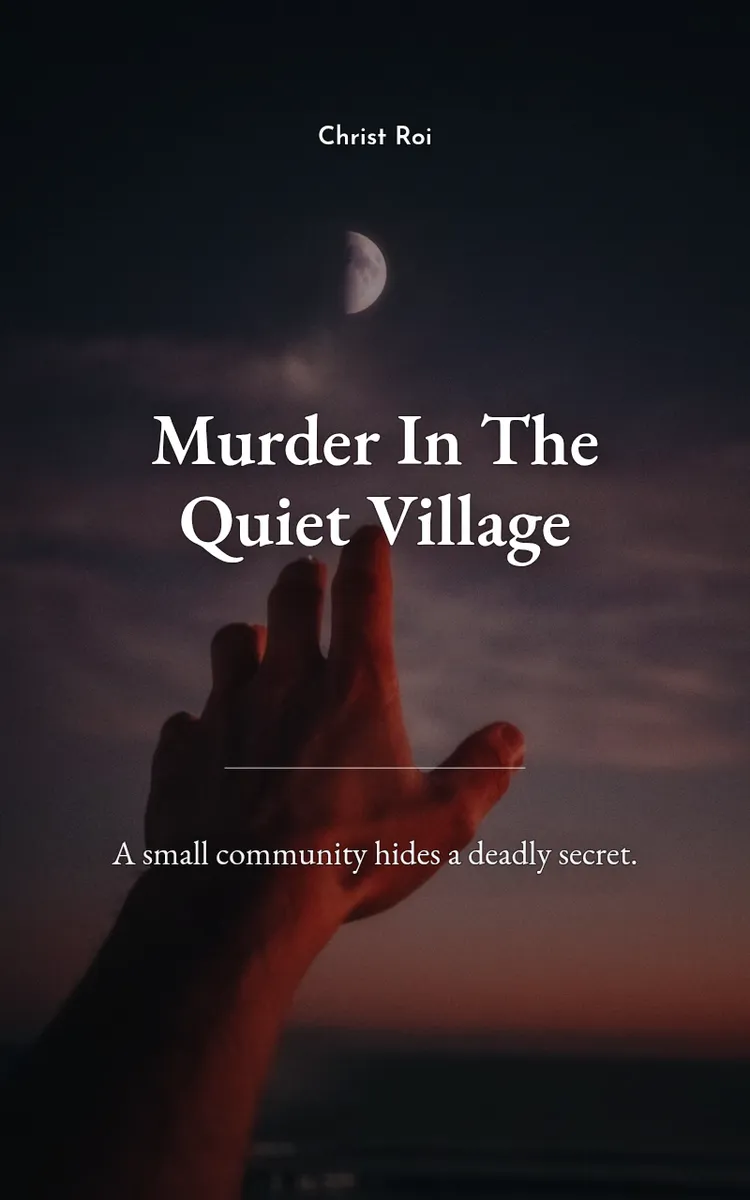
"Murder In The Quiet Village" is a fiction book by Christ Roi with 5 chapters and approximately 10,938 words. A murder mystery set in a quiet English village.
This book was created using Inkfluence AI, an AI-powered book generation platform that helps authors write, design, and publish complete books. It was made with the AI Novel Writer.
Frequently Asked Questions
What is "Murder In The Quiet Village" about?
A murder mystery set in a quiet English village
How many chapters are in "Murder In The Quiet Village"?
The book contains 5 chapters and approximately 10,938 words. Topics covered include The Body in St. Brigid’s Porch, Clara’s Secret Interview with Elsie, The Mill Ledger That Doesn’t Match, The Constable’s Arrest and the Missing Key, and more.
Who wrote "Murder In The Quiet Village"?
This book was written by Christ Roi and created using Inkfluence AI, an AI book generation platform that helps authors write, design, and publish books.
How can I create a similar fiction book?
You can create your own fiction book using Inkfluence AI. Describe your idea, choose your style, and the AI writes the full book for you. It's free to start.
Write your own fiction book with AI
Describe your idea and Inkfluence writes the whole thing. Free to start.
Start writingCreated with Inkfluence AI


