
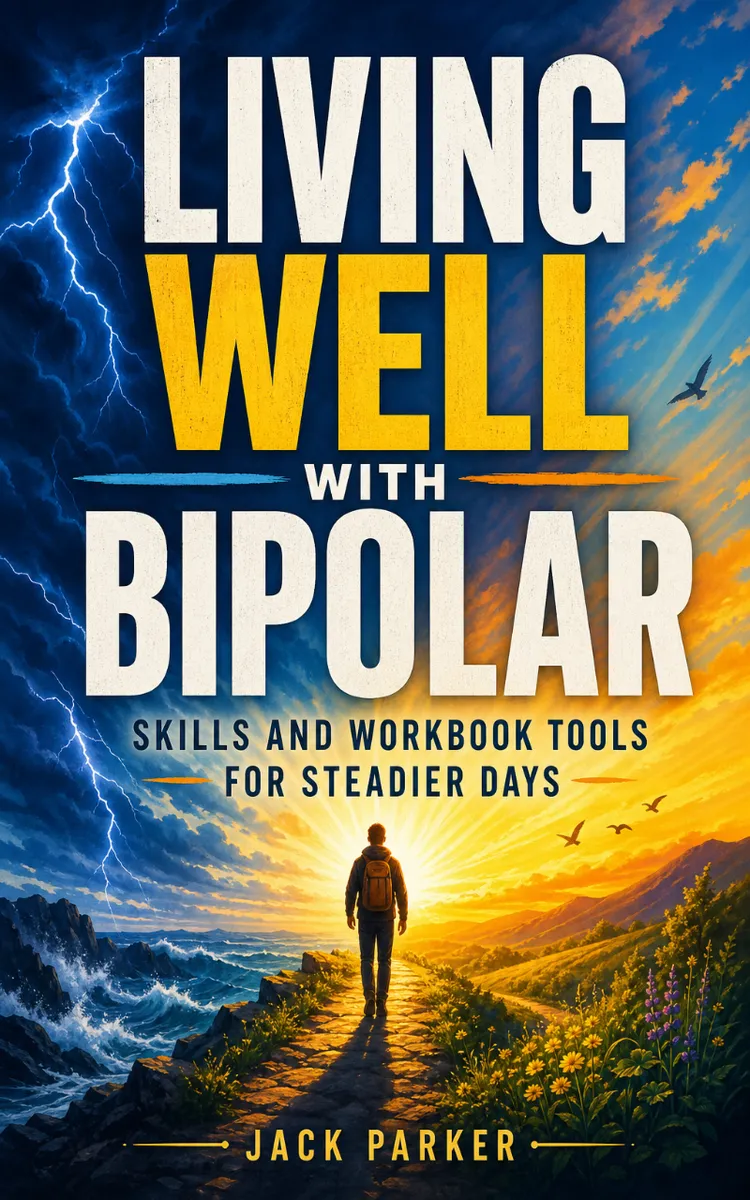
Living Well With Bipolar
Created with Inkfluence AI
Bipolar disorder education, coping skills, and workbook exercises
Table of Contents
- 1. What Bipolar Really Is
- 2. Bipolar Types and Episode Patterns
- 3. Myths That Keep You Stuck
- 4. Recognizing Early Warning Signs
- 5. Understanding Triggers Without Blame
- 6. The Mood Cycle You Can Track
- 7. Medication as a Stabilizing Ally
- 8. Sleep Rules for Mood Stability
- 9. Build a Daily Routine That Fits
- 10. Nutrition and Energy for Balanced Days
- 11. Exercise Without Triggering Overdrive
- 12. Stress Management That Actually Works
- 13. Coping With Racing Thoughts
- 14. Grounding When Emotions Surge
- 15. Challenging Catastrophic Thinking
- 16. Managing Irritability and Anger
- 17. Setting Boundaries Without Guilt
- 18. Communicating Your Needs Clearly
- 19. Building a Bipolar Support Team
- 20. Designing Your Early Action Plan
- 21. Preventing Impulsive Decisions
- 22. What Helps You Feel Happy
- 23. Your Personal Happiness Routine
- 24. Workbook: Your Stability Plan
- 25. Workbook: Your Next 30 Days
Preview: What Bipolar Really Is
A short excerpt from “What Bipolar Really Is”. The full book contains 25 chapters and 37,430 words.
When a Mood Shift Becomes More Than a Bad Week
A mood episode isn’t defined by one dramatic day. It’s a noticeable change in mood, energy, sleep, thinking, and behavior that lasts long enough - and becomes strong enough - to affect how you function. That’s why bipolar disorder can be confusing, even to the person living with it.
Tanya, 34, works as an emergency-room nurse. After three exhausting night shifts, she might feel irritable, wired, and emotional. That could be ordinary stress. But during one episode, she slept three hours a night for nearly a week and still felt full of energy. She talked faster, started several expensive projects, and became certain she could handle everything without help. Later, her mood dropped. Getting dressed felt impossible, and she couldn’t understand why her confidence had turned into shame.
The hard question isn’t, “Am I allowed to feel this way?” You are. The useful question is, “Is this a temporary reaction, or is my whole system shifting?”
The goal isn’t to distrust every feeling. It’s to learn which changes deserve attention.
From “I’m Just Moody” to Seeing the Pattern
Old Belief: Bipolar disorder means having ordinary mood swings, being dramatic, or changing your mind often.
New Reality: Bipolar disorder involves distinct mood episodes - depression, mania, or hypomania - that bring a sustained change in mood and energy, along with changes in sleep, thinking, speech, activity, or judgment.
This shift matters because everyday emotions usually make sense in context and move with the situation. You may feel irritated after an argument, sad after a loss, or excited about good news. Those feelings can be intense, but they often ease as the situation changes, rest returns, or you work through what happened.
A mood episode can feel different. The change may seem bigger than the event that started it, or it may appear without an obvious cause. Your sleep may change sharply. Your thoughts may speed up or slow down. Your behavior may stop matching your usual values or plans.
For Tanya, a difficult shift at work could leave her cranky for a day. That’s not automatically mania. During a possible manic episode, though, she noticed a cluster: very little sleep, unusually fast speech, racing plans, risky spending, and a growing belief that normal limits didn’t apply to her. The cluster gave her more useful information than any single symptom.
Depression is also more than having a rough day. It can include lasting sadness or emptiness, loss of interest, deep fatigue, changes in sleep or appetite, slowed thinking, hopelessness, guilt, or trouble doing basic tasks. Mania usually involves a highly elevated, expansive, or irritable mood and increased energy, along with symptoms such as reduced need for sleep, rapid thoughts, increased activity, inflated confidence, impulsive decisions, or risky behavior. Hypomania has similar features but is less severe than mania and doesn’t cause the same level of impairment or loss of contact with reality. A clinician is the right person to sort out the diagnosis.
The Bipolar Map Model helps you look at the whole pattern instead of arguing with yourself about one feeling. It tracks four connected areas: mood, energy, body rhythms, and behavior. When several areas shift together and stay shifted, you may be looking at an episode rather than an ordinary emotional wave.
Reading the Bipolar Map
Your mood is the emotional weather: low, steady, bright, tense, or unusually irritable. Energy is how activated or slowed your body and mind feel. Body rhythms include sleep, appetite, and daily timing. Behavior shows what you’re doing differently - spending, talking, working, withdrawing, starting projects, or taking risks.
No single map reading proves an episode. A bad night of sleep after an ER shift doesn’t equal mania. Feeling sad after a breakup doesn’t equal depression. The pattern becomes more meaningful when changes gather together, last, and interfere with your life.
Signs this pattern is running your life:
1. Your sleep changes sharply. You sleep far less without feeling tired, or you sleep much more and still feel drained.
2. Your pace changes. Your speech, thoughts, movement, or plans speed up - or everything feels painfully slowed.
3. Your judgment changes. You spend, drive, argue, work, or make commitments in ways that don’t fit your usual self.
4. Your functioning changes. Work, relationships, self-care, or safety become harder to manage.
Tanya once called a five-day stretch of little sleep “being productive.” Looking at her Bipolar Map showed something else: her energy had risen, her sleep had dropped, her speech had sped up, and her spending had changed. The map didn’t shame her. It gave her an early warning.
A mood episode is a sustained whole-person shift, not a single strong emotion.
...
About this book
"Living Well With Bipolar" is a self-help book by Jack Parker with 25 chapters and approximately 37,430 words. Bipolar disorder education, coping skills, and workbook exercises.
This book was created using Inkfluence AI, an AI-powered book generation platform that helps authors write, design, and publish complete books. It was made with the AI Self-Help Book Writer.
Frequently Asked Questions
What is "Living Well With Bipolar" about?
Bipolar disorder education, coping skills, and workbook exercises
How many chapters are in "Living Well With Bipolar"?
The book contains 25 chapters and approximately 37,430 words. Topics covered include What Bipolar Really Is, Bipolar Types and Episode Patterns, Myths That Keep You Stuck, Recognizing Early Warning Signs, and more.
Who wrote "Living Well With Bipolar"?
This book was written by Jack Parker and created using Inkfluence AI, an AI book generation platform that helps authors write, design, and publish books.
How can I create a similar self-help book?
You can create your own self-help book using Inkfluence AI. Describe your idea, choose your style, and the AI writes the full book for you. It's free to start.
Write your own self-help book with AI
Describe your idea and Inkfluence writes the whole thing. Free to start.
Start writingCreated with Inkfluence AI


